Mormons in Israel

For those of you who do not read the Los Angeles Times this article will be of interest.  I do not trust Mitt Romney because he has been a serial flip-flopper.  There is hardly a position he took as governor of Massachusetts that he has not changed. If you can believe him, Romney says he would never criticize Israel and would be a steadfast ally to the Jewish state. You could call it politics but there does not appear to be any issue that is core to his beliefs.  Still this article may give you pause to at least listen to his campaign.

Mormons in Israel

By Rafael Medoff

Mitt Romney’s trail to the Holy Land was blazed by a Utah missionary a century ago.

Mitt Romney at the Western (Wailing) Wall in JerusalemMITT ROMNEY’S visit to Israel will gener­ate much specula­tion on the role Jew­ish voters will play in the U.S. presidential election. His visit may also spark discussion about Mormon-Jewish relations in the wake of the recent controversy over a Mormon temple that con­ducted posthumous baptism cere­monies for some Holocaust vic­tims.

But another Mormon’s visit to Jerusalem, 99 years ago, deserves some of the spotlight too. Because that little-known visit ultimately had a decisive impact on Jewish history and America’s response to the Holocaust.

In 1913, 29-year-old Elbert Thomas and his wife, Edna, wrapped up their five-year stint in charge of a Mormon mission in J a­pan and prepared to return to their native utah. They decided to pay a short visit to Turkish-occupied Palestine on the way home.

The Holy Land figures promi­nently in Mormon theological tracts. Thomas was keenly aware of Mormon prophecies about an in- . gathering of the Jewish exiles and the rebirth of the Jewish home­land.

“We sat one evening on the Mount of Olives and overlooked Je­rusalem,” he later recalled. “We read the poetry and the prophecy, the forebodings and the prayers, with hearts that reached up to God.” Under “stars the likes of which you see nowhere else in the world but on our own American desert, out where I grew up,” Thomas read the lengthy “Prayer of Dedication on the Mount of Ol­ives” by Orson Hyde, an early Mor­mon leader and fervent Christian Zionist.

“Consecrate this land … for the gathering together of Judah’s scat­tered remnants … for the building up of Jerusalem again after it has been trodden down by the Gentiles so long,” Hyde had written in 1841. “Restore the kingdom unto Israel, raise up Jerusalem as its capital…. Let that nation or people who shall take an active part in behalf of Abraham’s children, and in the raising of Jerusalem, find favor in Thy sight. Let not their enemies prevail against them … but let the glory oflsrael overshadow them.”

The moment, the mood and the words moved Thomas to feel a deep spiritual connection to the Jewish people and to commit him­self to becoming one of those who would “take an active part in behalf of Abraham’s children.” And three decades later, he was presented with an opportunity to do so.

In the 1940s, as a U.S. senator from utah, Thomas became deeply concerned about the plight of the Jews in Nazi Europe. He joined the Emergency Committee to Save the Jewish People of Europe, a lobby­ing group led by Jewish activist Pe­ter Bergson. Thomas signed on to its full-page newspaper ads criti­cizing the Allies for abandoning European Jewry. He also co­chaired Bergson’s 1943 conference on the rescue of Jews, which chal­lenged the Roosevelt administra­tion’s claim that nothing could be done to help the Jews except win­ning the war. Although a loyal Democrat and New Dealer, the Utah senator boldly broke ranks with President Franklin D. Roose­velt over the refugee issue.

Thomas played a key role in ad­vancing a Bergson-initiated con­gressional resolution calling for creation of a government agency to rescue Jews from the Nazis. Sen. Tom Connally CD-Texas), chair­man of the Senate Foreign Rela­tions Committee, initially blocked consideration of the resolution. But when Connally took ill one day, Thomas, as acting chair, quickly in­troduced the measure. It passed unanimously.

Meanwhile, senior aides to Treasury Secretary Henry Mor­genthau Jr. had discovered that State Department officials had
been obstructing opportunities to rescue Jewish refugees. Morgen­thau realized, as he told his staff, that the time had come to say to the president, “You have either got to move very fast, or the Congress of the United States will do it for you.” Armed with a devastating re­port prepared by his staff, and with congressional pressure mounting, Morgenthau went to FDR in Janu­aryI944.

Roosevelt could read the writ­ing on the wall. With just days to go before the full Senate would act on the resolution, Roosevelt pre­empted Thomas and the other congressional advocates of rescue by imilaterally creating the agency they were demanding: the War Refugee Board.

Although understaffed and underfunded, the board played a major role in saving more than 200,000 Jews during the final 15 months of the war. Among other things, the board’s agents per­suaded a young Swede, Raoul Wal­lenberg, to go to German-occupied Budapest in 1944. There, with the board’s financial backing, he undertook his now-famous rescue mission. Thomas’ action in the Senate was an indispensable part of the chain of events that led to Wallenberg’s mission.

The Swedish government, to­gether with Holocaust institutions and Jewish communities around the world, recently launched a yearlong series of events com­memorating this summer’s 100th anniversary of Wallenberg’s birth. One hopes these celebrations will include appropriate mention ofthe role played by Americans such as Thomas in making Wallenberg’s work possible.

And as Romney retraces some of Thomas’ steps in Jerusalem, he will have special reason to feel proud of the role played by a fellow Mormon in helping to save Jewish lives.

RAFAEL MEDOFF is director of the David S. Wyman Institute for Holocaust Studies and the coauthor with Sonja Schoepf Wentling of the new book “Herbert Hoover and the Jews: The Origins of the ‘Jewish Vote’ and Bipartisan Support for Israel.”
Policeman of the World – Let China Do It

This cogent commentary in Newsweek June 25, 2012 was written by Niall Ferguson. He is their regular conservative contributor. Here is an abridged version of his column.

It’s not America’s job to intervene in Syria.

THE ARAB SPRING  has plunged Syria into a bloody civil war. Now, with allegations flying that the Russians are supplying helicopters to the odious regime of Bashar al Assad in Syria, a familiar debate is underway. Should we intervene?

There can be no morally credible argument against intervention-by someone.

But why should it be the United States that once again attempt to play the part of global cop?

Since the early 1970s, the Middle East has absorbed a disproportionate share of American resources. Particularly since 9/11, it has consumed the time of presidents like no other region of the world. Yet it is far from clear that this state of affairs should continue, for three good reasons.

 First, advances in fracking tech­nology and discoveries of bountiful natural gas reserves mean that North America’s dependence on Middle Eastern oil will diminish rapidly in the next two decades.

Second, a new military intervention makes very little sense at a time when theU.S.defense budget is being slashed.

Finally, what is the point of humanitarian interven­tion in a region where no good deed goes unpunished?

So if not us, then who? Or perhaps that should be: if not us, then Hu? That, after all, is the name of the current Chinese president.

 In terms of geopolitics,China today is the world’s supreme free rider.China’s oil consumption has doubled in the past 10 years, while America’s has actually declined.

Moreover, China’s dependence on Middle Eastern oil is set to increase. The International Energy Authority estimates that by 2015 foreign imports will account for between 60 and 70 percent of its total consumption.

Yet China contributes almost noth­ing to stability in the oil-producing heartland of the Arabian deserts and barely anything to the free movement of goods through the world’s strategic sea lanes.

 Finally, the world is ready for the Chinese to partici­pate more fully in international security. According to another Pew survey of 14 nations around the world, 42 percent of people now think China is the world’s lead­ing economic power, compared with 36 percent who think it’s still the United States.

 Under President Obama, U.S.grand strategy has been at best incoherent, at worst nonexistent. I can think of no better complement to the president’s recent “pivot” to the Asia-Pacific region than to invite China to play a greater role in the Middle East-one that is commen­surate with its newfound wealth and growing military capability. NW

A New Frontier for Americans

Business Week June 11-17, 2012 offered a new consideration for everyone searching for employment.  Have you ever considered employment outside the United States?

Americans are most likely to look for work in their home country.  Even though you hear about many people traveling overseas, the number of Americans working elsewhere is relatively small.  Consider the fact that many people in other nations immigrate to the United States.  I know my father considered moving from Canada to England to obtain work in 1939 (near the end of the Great Depression).

Today the USA has a large population of Filipinos who still consider their home the Philippines.  Many Latin Americans still feel loyalty to their home country even though they have been in the United   States for years.  I base these statements on empirical evidence.  It’s the Filipino care givers and the Hispanics who fly their home country flags.

So where does Business Week suggest Americans move to obtain those jobs?

Brazil:

Why: Last year, Brazil became the world’s sixth largest economy. And according to a 2011 study by Manpower Group, 64 percent of employers there find vacancies hard to fill. Plus it may soon ease visa requirements.

Jobs: bankers, executives, hedge fund managers, lawyers, and engineers.

India:

Why: Outsourcing has led to a burgeoning tech industry, which has in turn created pockets of econom­ic opportunity. The number of Americans moving is still small, so be first among your friends!

Jobs: tech, mostly. But there are also positions at English ­language newspapers and schools.

Australia

Why: The Chinese demand for ore spurred a mining boom in Australia.  Because of its isolation, the coun­try has an inflexible supply of workers, which means that out­siders are needed. The cost has been rising, but still beats theU.S.

Jobs: mining.

Canada

Why: With a healthy economy, no language bar­rier, lower corporate tax rates, and free health care, Canada is drawing more Americans than before (though still far fewer than during the draft-dodging heyday of the 1970s).

Jobs: whatever you’re currently doing.

Russia

Why: Exxon Mobil’s newly expanded access to the country’s off shore Arctic.

Jobs: oil.

You could think of these places as more of the pioneering spirit that induced so many Americans to travel to our own western frontier in the 1800s.

Echoes of 1967: Israel is preparing to act

An important commentary by Charles Krauthammer .  If he is correct, Netanyahu has sent a message to Obama.

David Bancroft

IN May 1967, in brazen violation of previous truce agreements, Egypt ordered U.N. peacekeepers out of the Sinai, marched 120,000 troops to the Israeli border, blockaded Eilat (Israel’s southern outlet to the world’s oceans), abruptly signed a military pact With Jordan and, together with Syria, pledged war for the final destruction of Israel.

May 1967 was Israel’s most fearful, desperate month. The country was surrounded and alone. Previous great-power guarantees proved worthless. A plan to test the blockade with a Western flotilla failed for lack of participants. Time was running out. Forced to protect against invasion by mass mobilization – and with a military consisting overwhelmingly of civilian reservists – life ground to a halt. The country was dying.

On June 5, Israel launched a pre-emptive strike on the Egyptian air force, then proceeded to lightning victories· on three fronts. The Six-Day War is legend, but less remembered is that on June 1, the nationalist opposition (Menachem Begin’s Likud precursor) was for the first time ever brought into the government, creating an emergency national-unity coalition.

Everyone understood why. You do not undertake a supremely risky pre-emptive war without the full participation of a broad coalition representing a national consensus.

Forty-five years later, in the middle of the night ·of May 7-8, 2012, Prime Minister Benjamin Netanyahu shocked his country by bringing the main opposition party, Kadima, into a national unity government. Shockking because just hours earlier, the Knesset was expediting a bill to call early elections in September.

Why did the high-flying Netanyahu call off elections he was sure to win(

Because for Israelis today, it is May 1967. “The dread is not quite as acute: The mood is not despair, just foreboding. Time is running out, but not quite as fast. War is not four days away, but it looms. Israelis today face the greatest threat to their existence – ‘apocalyptic .mullahs publicly pledged to Israel’s annihilation acquiring nuclear weapons – since May 1967. The world is again telling Israelis to do nothing as it looks for a way out. But if such a way is not found – as in 1967 – Israelis know they will once again have to defend themselves, by themselves.

Such a fateful decision demands a national consensus. By creating the largest coalition in nearly three decades, Netanyahu is establishing the political premise for a pre-emptive strike, should it come to that. The new government commands an astonishing 94 Knesset seats out of 120, described by one Israeli columnist as a “hundred tons of solid concrete.”

So much for the recent media hype about some great domestic resistance to Netanyahu’s hard line on Iran. Two notable retired intelligence figures were widely covered here for coming out against him. Little noted was that one had been passed over by Netanyahu to be the head of Mossad, while the other had been fired by Netanyahu as Mossad chief (hence the job opening). For centrist Kadima·(it pulled Israel out of Gaza) to join a Likud-led coalition whose defense minister is a former Labor prime minister (who once offered half of Jerusalem to Yasser Arafat) is the’ very definition of national unity – and refutes the popular “Israel is divided” meme, “Everyone is saying the same thing,” explained one Knesset member, “though there may be a difference of tone.”

To be sure, Netanyahu and Kadima’s Shaul Mofaz offered more prosaic reasons for their merger: national service laws, a new election law and negotiations with the Palestinians. But Netanyahu, the first Likud prime minister to recognize Palestinian statehood, did hot need Kadima for him to enter peace talks .. For two years he’s been waiting for Mahmoud Abbas to show up at the table. Abbas hasn’t. And won’t. Nothing will change on that front.

What does change is Israel’s position vis-a-vis Iran. The wall-to-wall coalition demonstrates Israel’s political readiness to attack, if necessary. (Its military readiness is not in doubt.)

Those counseling Israeli submission, resignation or just endless patience can no longer dismiss Israel’s tough stance as the work of irredeemable right-wingers. Not with a government now representing 78 percent of the country.

Netanyahu forfeited September elections that would have given him four more years in power. He chose instead to form a: national coalition that guarantees 18 months of stability – 18 months during which, if the world does not act to stop Iran, Israel will.

And it will not be the work of one man, one party or one ideological faction. As in 1967, it will be the work of a nation.

Charles Krauthammer is a columnist for the Washington Post. Readers may contact him via email atletters@!charleskrauthammer.com.

Israel’s Nuclear Deception – A Perfect Hoax

Remember the Trojan Horse and the inflatable tanks on the shores of England at the end of WWII. Israel’s nuclear war heads are in the same anthology.

Do a Google search and you will find that there is the perception that Israel has nuclear weapons. France did provide cooperation for some kind of nuclear development in the 1950s. There is a secret facility in a location called Dimona but United States officials have never actually seen what is located there. Apparently no one outside Israel has seen the inner workings of the site. One Googled site speculates “Israel could have thus produced enough plutonium for at least 100 nuclear weapons, but probably not significantly more than 200 weapons.”

However, the next time you read an article quoting an Israeli official or listen to an interview you will notice that they never claim to have any nuclear weapons. I just saw an interview by Erin Burnett of Benjamin Netanyahu and he avoided responding to her inquiries about Israel’s nuclear capabilities. In the April 2, 2012 issue of Time magazine “10 Questions” column the author asks President Simon Peres Remind me, does Israel have nuclear weapons? ‘Look, Israel doesn’t intend to introduce nuclear weapons, but if people are afraid that we have them, why not? It’s a deterrent. I want to tell you a small story. Amr Moussa was the Foreign Minister of Egypt. One day he came to me and said, ‘Simon, we are such good friends. Take me to Dimona. Let me see what’s going on.’ I said, ‘Amr, are you crazy? I shall take you, and you’ll see there’s nothing there. You’ll stop being frightened, and then I should be out of my job.’ ”

Obviously Israel has perpetuated the perfect hoax. Most Jews even believe it!

Canada is Not Part of the U.S.A.

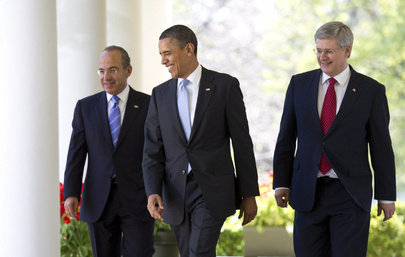
Mexican Pres. Calderon, Obama, Canadian P.M. Harper at the White House          Mexican Pres. Calderon, Obama, Canadian P.M. Harper at the White House

Reported in the Toronto Star, “Ottawa has no choice but to aggressively pursue other export markets to safeguard Canada’s economy in case Keystone is rejected, PM says in Washington.”

Let’s be honest. The Keystone oil was not destined for consumption in the United States. The benefit to the USA is that there will be construction jobs for laying the pipeline, maintenance jobs for keeping the oil flowing without any leaks, and refinery jobs on the Gulf of Mexico.

The additional major benefit is that if there was an oil embargo the United States would have access to the supply.

Canada has the benefit of many natural resources. The Canadian government’s first interest is in the well being of its own people. As it should. Exporting their resources has enabled that country to thrive. For some reason Americans think that Canada owes its total existence to them and should respond to American wishes and desires at Canadian peril. Despite that belief, Canada is not part of the U.S.A.

A Festival of Lies

OP-ED COLUMNIST in the New York Times
A Festival of Lies
By THOMAS L. FRIEDMAN
Published: March 24, 2012

THE historian Victor Davis Hanson recently wrote a brutally clear-eyed piece in The National Review, looking back at America’s different approaches to Iraq, Iran, Libya, Syria, Egypt, Pakistan and Afghanistan and how, sadly, none of them could be said to have worked yet.

“Let us review the various American policy options for the Middle East over the last few decades,” Hanson wrote. “Military assistance or punitive intervention without follow-up mostly failed. The verdict on far more costly nation-building is still out. Trying to help popular insurgents topple unpopular dictators does not guarantee anything better. Propping up dictators with military aid is both odious and counterproductive. Keeping clear of maniacal regimes leads to either nuclear acquisition or genocide — or 16 acres of rubble in Manhattan. What have we learned? Tribalism, oil, and Islamic fundamentalism are a bad mix that leaves Americans sick and tired of the Middle East — both when they get in it and when they try to stay out of it.”

And that is why it’s time to rethink everything we’re doing out there. What the Middle East needs most from America today are modern schools and hard truths, and we haven’t found a way to offer either. Because Hanson is right: What ails the Middle East today truly is a toxic mix of tribalism, Shiite-Sunni sectarianism, fundamentalism and oil — oil that constantly tempts us to intervene or to prop up dictators.
This cocktail erodes all the requirements of a forward-looking society — which are institutions that deliver decent government, consensual politics that provide for rotations in power, women’s rights and an ethic of pluralism that protects minorities and allows for modern education. The United Nations Arab Human Development Report published in 2002 by some brave Arab social scientists also said something similar: What ails the Arab world is a deficit of freedom, a deficit of modern education and a deficit of women’s empowerment.

So helping to overcome those deficits should be what U.S. policy is about, yet we seem unable to sustain that. Look at Egypt: More than half of its women and a quarter of its men can’t read. The young Egyptians who drove the revolution are desperate for the educational tools and freedom to succeed in the modern world. Our response should have been to shift our aid money from military equipment to building science-and-technology high schools and community colleges across Egypt. 

Yet, instead, a year later, we’re in the crazy situation of paying $5 million in bail to an Egyptian junta to get U.S. democracy workers out of jail there, while likely certifying that this junta is liberalizing and merits another $1.3 billion in arms aid. We’re going to give $1.3 billion more in guns to a country whose only predators are illiteracy and poverty.

In Afghanistan, I laugh out loud whenever I hear Obama administration officials explaining that we just need to train more Afghan soldiers to fight and then we can leave. Is there anything funnier? Afghan men need to be trained to fight? They defeated the British and the Soviets!

The problem is that we turned a blind eye as President Hamid Karzai stole the election and operated a corrupt regime. Then President Obama declared that our policy was to surge U.S. troops to clear out the Taliban so “good” Afghan government could come in and take our place. There is no such government. Our problem is not that Afghans don’t know the way to fight. It is that not enough have the will to fight for the government they have. How many would fight for Karzai if we didn’t pay them?

And so it goes. In Pakistan, we pay the Pakistani Army to be two-faced, otherwise it would be only one-faced and totally against us. In Bahrain, we looked the other way while ruling Sunni hard-liners crushed a Shiite-led movement for more power-sharing, and we silently watch our ally Israel build more settlements in the West Bank that we know are a disaster for its Jewish democracy.

But we don’t tell Pakistan the truth because it has nukes. We don’t tell the Saudis the truth because we’re addicted to their oil. We don’t tell Bahrain the truth because we need its naval base. We don’t tell Egypt the truth because we’re afraid it will walk from Camp David. We don’t tell Israel the truth because it has votes. And we don’t tell Karzai the truth because Obama is afraid John McCain will call him a wimp.

Sorry, but nothing good can be built on a soil so rich with lies on our side and so rich with sectarianism, tribalism and oil-fueled fundamentalism on their side. Don’t get me wrong. I believe change is possible and am ready to invest in it. But it has got to start with them wanting it. I’ll support anyone in that region who truly shares our values — and the agenda of the Arab Human Development Report — and is ready to fight for them. But I am fed up with supporting people just because they look less awful than the other guys and eventually turn out to be just as bad.

Where people don’t share our values, we should insulate ourselves by reducing our dependence on oil. But we must stop wanting good government more than they do, looking the other way at bad behavior, telling ourselves that next year will be different, sticking with a bad war for fear of being called wimps and selling more tanks to people who can’t read.

A version of this op-ed appeared in print on March 25, 2012, on page SR13 of the New York edition with the headline: A Festival of Lies.

Obama vs. Israel: Priority No.1? Stop Israel

Although Charles Krauthammer is an excellent commentator I rarely agree with his opinion. This time he does make me think.

Is this an uh-oh moment for Israel?

By Charles Krauthammer, published in a local paper today

IT’S Lucy and the football, Iran-style. After ostensibly tough talk about preventing Iran from going nuclear, the Obama administration acquiesced to yet another round of talks with the mullahs.

This, 14 months after the last group-of-six negotiations collapsed in Istanbul because of blatant Iranian stalling and unseriousness. Nonetheless, the new negotiations will be both without precondition and preceded by yet more talks to decide such trivialities as venue.

These negotiations don’t just gain time for a nuclear program about whose military intent the IAEA is issuing alarming warnings. They make it extremely difficult for Israel to do anything about it (while it still can), lest Israel be universalfy condemned for having aborted a diplomatic solution.

If the administration were serious about achievement rather than appearance, it would have warned that this was the last chance for Iran to come clean and would have demanded a short timeline. After all, President Obama insisted on deadlines for the Iraq withdrawal, the Afghan surge and Israeli-Palestinian negotiations .. Why leave these crucial talks open-ended when the nuclear clock is ticking?

This re-engagement comes immediately after Obama’s campaign-year posturing about Iran’s nukes. Last Sunday in front of AlPAC, he warned that “Iran’s leaders should have no doubt about the resolve of the United States.” This just two days after he’d said (to the Atlantic) of possible U.S. military action, “I don’t bluff.” Yet on Tuesday he returns to the very engagement policy that he admits had previously failed.

Won’t sanctions make a difference this time, however? Sanctions are indeed hurting Iran economically. But when Obama’s own director of national intelligence was asked by the Senate intelligence committee whether sanctions had any effect on the course of Iran’s nuclear program, the answer was simple: No. None whatsoever.

Obama garnered much AlPAC applause by saying that his is not a containment policy but a prevention policy. But what has he prevented? Keeping a coalition of six together is not success. Holding talks is not success. Imposing sanctions is not success.

Success is halting and reversing the program. Yet Iran is tripling its uranium output, moving enrichment facilities deep under a mountain near Qom and impeding IAEA inspections of weaponization facilities.

So what is Obama’s real objective? “We’re trying to make the decision to attack as hard as possible for Israel,” an administration official told the Washington Post in the most revealing White House admission since “leading from behind.”

Revealing and shocking. The world’s greatest exporter of terror (according to the State Department), the systematic killer of Americans in Iraq and Afghanistan, the self-declared enemy that invented “Death to America Day” is approaching nuclear capability – and the focus of U.S. policy is to prevent a democratic ally threatened with annihilation from pre-empting the threat?

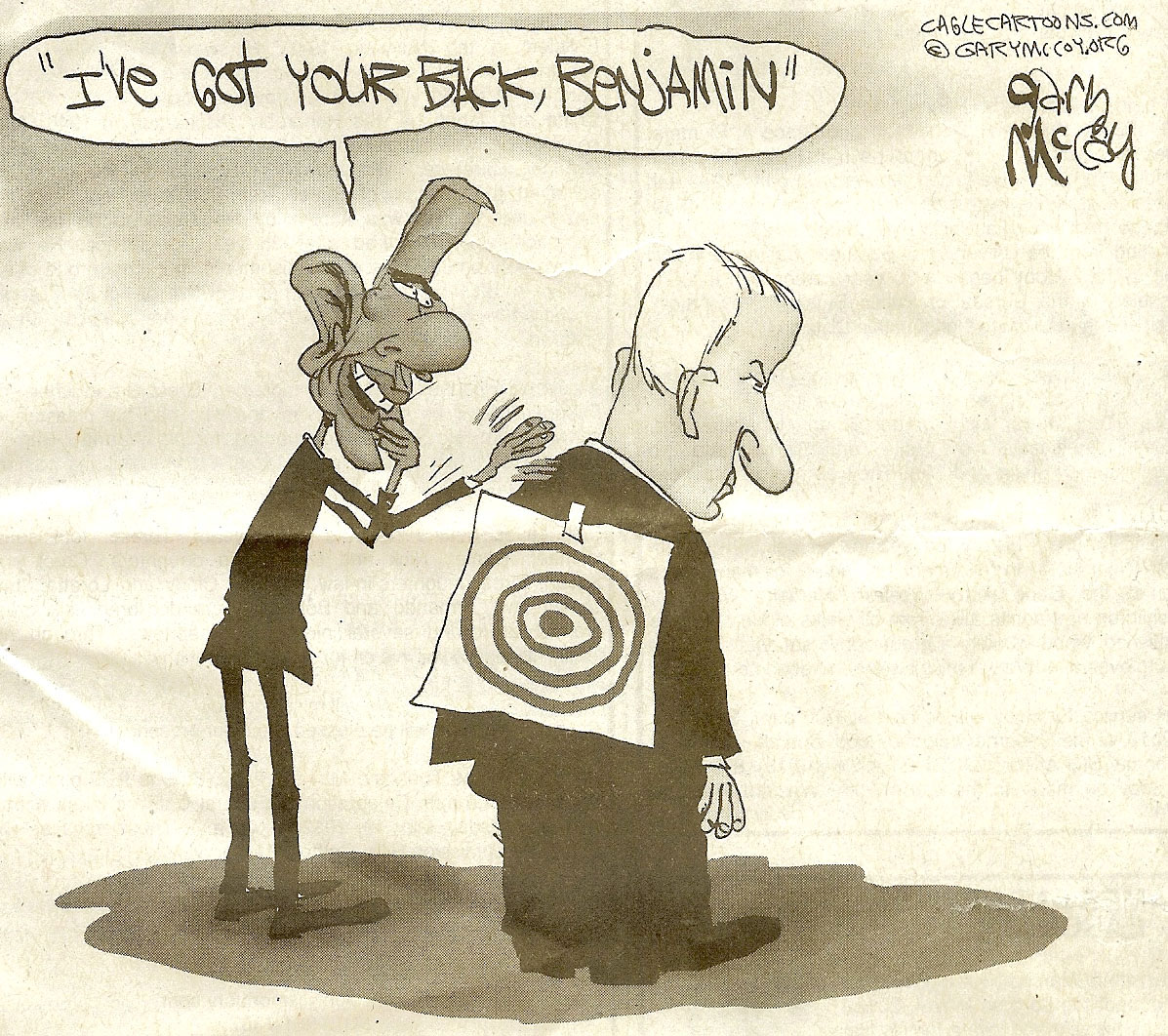
Indeed it is. The new open-ended negotiations with Iran fit well with this strategy of tying Israel down. As does Obama’s “I have Israel’s back” reassurance, designed to persuade Israel and its supporters to pull back and outsource to Obama what for Israel are life-and-death decisions.

Yet 48 hours later, Obama tells a news conference that this phrase is just a historical reference to supporting such allies as Britain and Japan – contradicting the intended impression he’d given AlP AC that he was offering special protection to an ally under threat of physical annihilation.

To AlPAC he declares that “no Israeli government can tolerate a nuclear weapon in the hands of a regime that denies the Holocaust, threatens to wipe Israel off the map, and sponsors terrorist groups committed to Israel’s destruction” and affirms “Israel’s sovereign right to make its own decisions … to meet its security needs.”

And then he pursues policies – open-ended negotiations, deceptive promises of tough U.S. backing for Israel, boasts about the efficacy of sanctions, grave warnings about “war talk” – meant, as his own official admitted, to stop Israel from exercising precisely that sovereign right to self-protection.

Yet beyond these obvious contradictions and walk-backs lies a transcendent logic: As with the Keystone pipeline postponement, as with the debt-ceiling extension, as with the Afghan withdrawal schedule, Obama wants to get past Nov. 6 without any untoward action that might threaten his re-election.

For Israel, however, the stakes are somewhat higher: the very existence of a vibrant nation and its 6 million Jews. The asymmetry is stark. A fair-minded observer might judge that Israel’s desire to not go gently into the darkness carries higher moral urgency than the political future of one man, even if he is president of the United States.

Russian Navy Captures Somali Pirates

You don’t want to mess around with these guys!

How about that – The Russians captured the Pirates, tied them up, put them on their boats, then set them all on fire – puff no more Pirates!

NO POLITICAL CORRECTNESS BS HERE!

This video shows Russian Navy commandos on a Somalian pirate ship shortly after the pirates had captured a Russian oil tanker.  The  Euro Union navy that patrols these waters would not interfere because they feared there could be casualties.

All explanations are in Russian with a single exception of when a wounded pirate says something in English and the Russian soldier says “This is not a fishing boat”.  All conversations between the commandos are in Russian.  If you don’t understand Russian, the pictures speak for themselves.

The soldiers freed their compatriots and the tanker.  The Russian Navy Commandos moved the pirates back to their own (pirate) ship, searched the pirate ship for weapons and explosives and then they left the ship and exploded it with all remaining pirates hand-cuffed to it.

The commandos sank the pirate ship along with the pirates and without any court proceedings, lawyers etc.  That is, they used the anti-piracy laws of the 18th and 19th centuries where the captain of the rescuing ship has the right to decide what to do with the pirates.  Usually, they were hung.

I would think from now on, Russian ships will not be targets for Somali pirates.

Click on this link…http://www.true-turtle.livejournal.com/85315.html