Donald Trump’s Disgraceful Summit Press Conference

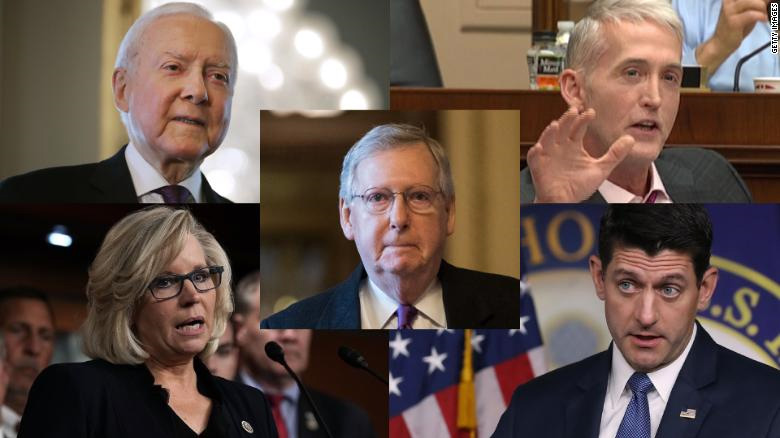
I can understand Democrats criticising Donald Trump but these are some of the comments made by Republicans after the Trump Putin press conference in Helsinki Finland.  I have selected just a few of the reported comments made by Republican members of congress.

I would say his words of praise of Vladimir Putin and Russia are treasonous.  Congressional Republicans will have to decide whether Donald Trump should be impeached.  I would support that decision. 

Sen. John McCain, an Arizona Republican who has consistently criticized the President, said Trump’s comments were “one of the most disgraceful performances by an American president in memory.”


Senate Foreign Relations Chairman Bob Corker said the President “made us look like a pushover” and that Putin was probably eating caviar on the plane home.


Senator Ben Sasse, a Republican from Nebraska, “This is bizarre and flat-out wrong. The United States is not to blame. America wants a good relationship with the Russian people but Vladimir Putin and his thugs are responsible for Soviet-style aggression. When the President plays these moral equivalence games, he gives Putin a propaganda win he desperately needs.”


Rep. Trey Gowdy, a South Carolina Republican, “I am confident former CIA Director and current Secretary of State Mike Pompeo, DNI Dan Coats, Ambassador Nikki Haley, FBI Director Chris Wray, Attorney General Jeff Sessions and others will be able to communicate to the President it is possible to conclude Russia interfered with our election in 2016 without delegitimizing his electoral success.”


Arizona Sen. Jeff Flake, a Republican who has been constant critic, called the President’s performance “shameful.” “I never thought I would see the day when our American President would stand on the stage with the Russian President and place blame on the United States for Russian aggression. This is shameful,” tweeted Flake, who is not running for re-election.


John Brennan, Former CIA Director (2013-17) Tweet, “Donald Trump’s press conference performance in Helsinki rises to & exceeds the threshold of “high crimes & misdemeanors.” It was nothing short of treasonous. Not only were Trump’s comments imbecilic, he is wholly in the pocket of Putin. Republican Patriots: Where are you???”

Kim Jong Un Wins

In his speech on September 30, 1938, Neville Chamberlain famously declared “My good friends, for the second time in our history, a British Prime Minister has returned from Germany bringing peace with honor. I believe it is peace for our time…” The “peace for our time” was a reference to Benjamin Disraeli’s address after returning from the Congress of Berlin in 1878.

Winston Churchill in the British parliament said “Chamberlain had the choice between war and shame. Now he has chosen shame – he’ll get war later.”

The United Kingdom, along with most of its Dominions and Crown colonies declared war on Nazi Germany in September 1939.

Sadly, Donald Trump has not read and is not a fan of any history.

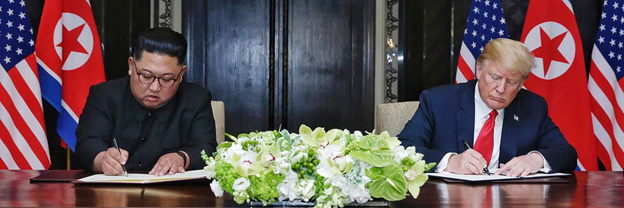
Thus Trump signs a document that says we agree to talk.  It is better than war.  Prior agreements with North Korea have not resulted in any change by North Korea in its effort to threaten the world.  Under the current leader Kim Jong Un the threat of a nuclear war has become even greater.  There is nothing in this agreement that that takes the world one step closer to denuclearization. Just today Trump has announced that the United States will discontinue joint military exercises in South Korea.  The exercises have been a sore point for North Korea for decades.  They obtained that concession without giving one thing in return. Where was the tough talk of Secretary State Mike Pompeo?

Donald Trump is the 21st century version of Neville Chamberlin.


Joint Statement of President Donald J. Trump of the United States of America and Chairman Kim Jong Un of the Democratic People’s Republic of Korea at the Singapore Summit

President Donald J. Trump of the United States of America and Chairman Kim Jong Un of the Democratic People’s Republic of Korea (DPRK) held a first, historic summit in Singapore on June 12, 2018.

President Trump and Chairman Kim Jong Un conducted a comprehensive, in-depth and sincere exchange of opinions on the issues related to the establishment of new US-DPRK relations and the building of a lasting and robust peace regime on the Korean Peninsula. President Trump committed to provide security guarantees to the DPRK, and Chairman Kim Jong Un reaffirmed his firm and unwavering commitment to complete denuclearization of the Korean Peninsula.

Convinced that the establishment of new US-DPRK relations will contribute to the peace and prosperity of the Korean Peninsula and of the world, and recognizing that mutual confidence building can promote the denuclearization of the Korean Peninsula, President Trump and Chairman Kim Jong Un state the following:

1.    The United States and the DPRK commit to establish new US-DPRK relations in accordance with the desire of the peoples of the two countries for peace and prosperity.

2.    The United States and DPRK will join their efforts to build a lasting and stable peace regime on the Korean Peninsula.

3.    Reaffirming the April 27, 2018 Panmunjom Declaration, the DPRK commits to work toward complete denuclearization of the Korean Peninsula

4.    The United States and the DPRK commit to recovering POW/MIA remains, including the immediate repatriation of those already identified.

North Korea Nuclear Timeline

The cancellation of disarmament negotiation with North Korea should not come as a surprise to anyone.  Like the Peanuts cartoon where Lucy pulls the ball away just as Charlie Brown is running to kick it so has North Korea pulled away from completing an agreement to end its nuclear/ballistic missile program.   North Korea has pulled away from every agreement.

Here is a an abbreviated list of the previous failed efforts as reported on a CNN web site.  

1985
North Korea signs the Nuclear Non-Proliferation Treaty (NPT).

1994
North Korea and the United States sign an agreement. North Korea pledges to freeze and eventually dismantle its old, graphite-moderated nuclear reactors in exchange for international aid to build two new light-water nuclear reactors.

2002
October – The Bush Administration reveals that North Korea has admitted operating a secret nuclear weapons program in violation of the 1994 agreement.

2003
January 10 – North Korea withdraws from the NPT.

2005
North Korea tentatively agrees to give up its entire nuclear program, including weapons. In exchange, the United States, China, Japan, Russia and South Korea say they will provide energy assistance to North Korea, as well as promote economic cooperation.  

2007
February 13 – North Korea agrees to close its main nuclear reactor in exchange for an aid package worth $400 million.

2008
December – Six-party talks are held in Beijing. The talks break down over North Korea’s refusal to allow international inspectors unfettered access to suspected nuclear sites.

Donald Trump did the right thing in cancelling a Singapore summit.

Anti-Semitism is alive and well in Germany

Wars won do not end hatred!

Just because WWII ended, hatred of Jews didn’t end.  Kristallnacht, literally, , literally, “Night of Crystal,” is often referred to as the “Night of Broken Glass.” The name refers to the wave of violent anti-Jewish pogroms which took place on November 9 and 10, 1938 in Germany. That was well before the Holocaust. The wave of violence took place throughout Germany as they annexed Austria and areas of the Sudetenland in Czechoslovakia.

This past week a nationwide controversy erupted in Germany over a taboo-breaking rap duo that won one of the country’s most important music industry awards for a best selling album and song that included lyrics that made references to the Holocaust and Nazi concentration camp prisoners. Then just three days later German police said that they had launched an investigation after two men wearing Jewish skullcaps were attacked and insulted in Berlin. It was an incident that comes amid concern that anti-Semitism could be on the rise in Germany.

What is really curious is the growing Jewish population in Germany.

When Germany was reunited in 1990, there were 28,000 Jews in the country. Since then, the number has more trebled to 107,000, largely due to an influx from Eastern Europe, after Germany passed the “Quota Law”. Enforced until 2004, this gave those from the former Soviet Union who could prove they were Jewish, or had a Jewish parent, the right to settle. Germany now has now the third largest Jewish population in Western Europe after Britain and France.  The New York Times reported on September 27, 2017 that Israelis are also moving to Germany.

Jews must be suffering some kind of amnesia.

Syria – A Moral Dilemma

Aleppo
Aleppo, Syria

That this discussion is falling on Holocaust Remembrance Day should at least give everyone a pause and a thought about Syria today.

This is a test for President Donald Trump!

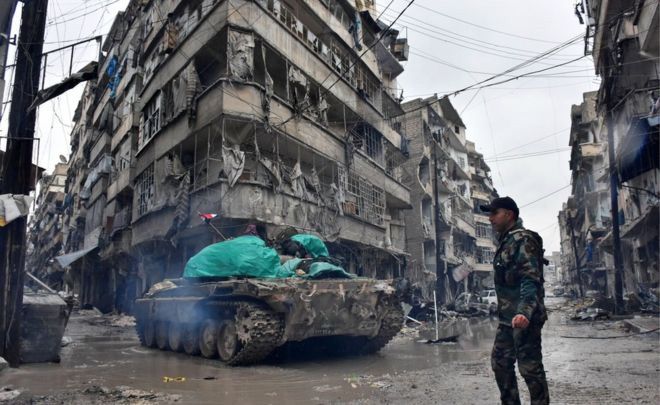
Try searching for a strategic value of Syria to the United States on the internet and you will come up empty handed.  That may be the reason the Donald Trump said just eight days ago that America would be leaving very soon.  Our only reason that I can find for being there is to protect the hundreds of thousands of civilians who have been the victims of the continuous bombardment of their cities and towns by Bashar al-Assad’s air force.

A pin prick bombardment by America of Syrian army bases by the United States will not change Assad’s attack on his own people.

If the United States is actually concerned with the well-being of the Syrian people it is obvious that America would have to send a much larger army than the 2,000 or so troops currently there.  This brings up the question of America’s willingness to protect people everywhere from genocide.  Make no mistake Assad’s attacks are a form of genocide.

America’s history in protecting victims of genocide should be obvious.  Most recently the Rohingya Muslims of Myanmar (Burma) is the best example of pretending nothing was happening.  Rwanda is another example.  Historically America refused asylum for Jews attempting to escape the Holocaust during WII.

President Bill Clinton intervention in Bosnia is an example of America standing up to genocide.

No one seems to know or understand the mind of Donald Trump.  If he were to stop the killing of people in Syria he would go down in history as a man who really does care about people.     

Pacific Rim Tran-Pacific Partnership Agreement is not Dead!

Talks on the Pacific Rim trade pact (TPP) have stalled. And some international media are blaming Canada: Justin Trudeau did not show up to meet other leaders.

Regardless of who is to blame, it does appear that a TPP agreement might still be completed. It will be the United States that will be the loser because the other nations will have a valuable free trade zone while the United States will be denied access to the many business opportunities that free trade provides.

The following article appeared in the Toronto Star newspaper.

DANANG, VIETNAM—Trade ministers from 11 Pacific Rim countries said they reached an agreement Saturday to proceed with the free-trade Trans-Pacific Partnership deal that President Donald Trump abandoned it. However, an immediate formal endorsement by the countries’ leaders meeting in Vietnam appeared unlikely.

A statement issued in the early hours Saturday said an accord was reached on “core elements” of the 11-member pact. The compromise was delayed by last-minute disagreements that prevented the TPP leaders from meeting to endorse a plan on Friday.

“Ministers are pleased to announce that they have agreed on the core elements of the Comprehensive and Progressive Agreement for Trans-Pacific Partnership,” the 11 nations said in a statement.

Japan’s delegate to the talks, Economy Minister Toshimitsu Motegi, told reporters that disagreements that cropped up Friday had been resolved in five hours of talks that stretched late into the night.

“We have confirmed there was no mistake about us having reached a basic agreement,” Motegi said.

Despite enthusiasm for sticking with the plan following the U.S. withdrawal under Trump in January, criticism over various issues persists. Detractors of the TPP say it favours corporate interests over labour and other rights.

Aspects of the trade pact have raised hackles also over a requirement that companies be allowed to sue governments for lack of enforcement of related laws.

The proposed basic agreement reached in Danang said that the ministers maintained “the high standards, overall balance and integrity of the TPP while ensuring the commercial and other interests of all participants and preserving our inherent right to regulate, including the flexibility of the parties to set legislative and regulatory priorities.”

The TPP member countries are trying to find a way forward without the U.S., the biggest economy and, before Trump took office, one of its most assertive supporters. Trump has said he prefers country-to-country deals and is seeking to renegotiate several major trade agreements to, as he says, “put America first.”

Trump reiterated his markedly different stance on trade before the 21-member APEC summit convened late Friday with a gala banquet.
The U.S. president told an APEC business conference that “we are not going to let the United States be taken advantage of anymore.” He lambasted the World Trade Organization and other trade forums as unfair to the United States and reiterated his preference for bilateral trade deals, saying “I am always going to put America first.”

Trump said he would not enter into large trade agreements, alluding to U.S. involvement in the North American Free Trade Agreement and the TPP.

In contrast, Chinese President Xi Jinping told the same group that nations need to stay committed to economic openness or risk being left behind.

The Chinese president drew loud applause when he urged support for the “multilateral trading regime” and progress toward a free-trade zone in the Asia-Pacific. China is not part of the TPP.

APEC operates by consensus and customarily issues nonbinding statements. TPP commitments would eventually be ratified and enforced by its members.

But even talks this week on a declaration to cap the APEC summit had to be extended for an extra half day as ministers haggled over wording. It’s unclear what the exact sticking points were, but officials have alluded to differences over the unequal impact more open trade has had on workers and concerns over automation in manufacturing that could leave many millions in a wide array of industries with no work to do.

As a developing country with a fast-growing export sector, this year’s host country, Vietnam, has a strong interest in open trade and access for its exports to consumers in the West. The summit is an occasion for its leaders to showcase the progress its economy has made thanks largely to foreign investment and trade. Danang, Vietnam’s third largest city, is in the midst of a construction boom as dozens of resorts and smaller hotels pop up along its scenic coastline.

APEC’s members are Australia, Brunei, Canada, Chile, China, Hong Kong, Indonesia, Japan, South Korea, Malaysia, Mexico, New Zealand, Papua New Guinea, Peru, Philippines, Russia, Singapore, Taiwan, Thailand, the U.S. and Vietnam.

Saber Rattling Will Not Deter Kim Jong-un

Saber rattling will not deter Kim Jong-un in his obsession to obtain an ICBM that can strike the United States.

First, the United States and South Korea conducted joint missile exercises off the east coast of the South Korean peninsula. Then, on July 8, American B-1 bombers flew over the Korean Peninsula, where they were joined by South Korean and American fighter jets. Now it is reported that the THAAD missile defense system will be tested.

All of this is saber rattling. The United States is unlikely to start a war with North Korea. The loss of life, likely hundreds of thousands of people, would be too high.

There are many things the United States can do to force North Korea to take the action it wants including telling China that exports to the U.S. will be limited unless there is clear evidence that North Korea has begun dismantling its nuclear and missile technology.  If I were president of the United States I would give China 60 days to produce verifiable results. 

Businesses in the United States will suffer if we limit imports from China but this is national security taking priority over American business interests. What President Trump needs to do is obvious but does he have the courage to take the needed action?

Obfuscate

To obscure, muddy, cloud, and conceal.  Those were the objectives of two guests on ‘This Week with George  Stephanopoulos.”  US National Security Advisor H. R. McMaster and Newsmax Media CEO Christopher Ruddy who is now as an ABC News contributor.

I have put in bold what I think are some of the most interesting parts of this interview program.

RUDDY: So many stories, fake news stories, are becoming fact here. Where in the Russia investigation has there ever been an allegation that the president had done anything wrong with the Russians? Where is there any evidence?

Or in other words the New York Times and The Washington Post are creating fake news.

The real thing to read is the transcript of  Stephanopoulos talking to McMaster today, May 21, 2017 his Sunday morning talk show.

STEPHANOPOULOS: General McMaster, thanks for joining us today. I want to get to the trip, but first some questions about that meeting you all had with the Russian foreign minister. “New York Times”, as you know, reporting that here’s what the president said in the meeting. “I just fired the head of the FBI. He was crazy, a real nut job. I faced great pressure because of Russia. That’s take off.”

Is that what the president said?

H.R. MCMASTER, NATIONAL SECURITY ADVISER: Well I don’t remember exactly what the president said. And the notes that there apparently have I do not think are a direct transcript. But the gist of the conversation was that the president feels as if he is hamstrung in his ability to work with Russia to find areas of cooperation because this has been obviously so much in the news. And that was the intention of that portion of that conversation.

STEPHANOPOULOS: Did you know he was going to report that to the Russians? And what did you think when you heard it?

MCMASTER: Report what, George?

STEPHANOPOULOS: The — what you he said about James Comey. That he fired him and why.

MCMASTER: Well, the firing had been in the news. But I didn’t know in advance that the president was going to raise it, but as I mentioned he raised it in the context of explaining that that he has been — feels as if he’s been unable to find areas of cooperation with Russia, even as he confronts them in key areas where they’re being disruptive, like Syria for example, and the subversive activities across Europe. Their support for the — not only the Assad regime but for Iran and its activities across the Middle East.

STEPHANOPOULOS: Did you understand how this might look though to an average American right no? You have the President of the United States telling the Russian foreign minister, in their first meeting, that that the pressure is off because he’s fired the FBI director investigating Russian interference in the campaign. Does that seem appropriate to you?

MCMASTER: As you know, it’s very difficult to take a few lines, to take a paragraph out of what are — what appear to be notes of that meeting. And to be able to see the full context of the conversation.

As I mentioned last week, the really purpose of the conversation was to confront Russia on areas, as I mentioned, like Ukraine and Syria, their support for Assad and their support for the Iranians.

We’re trying to find areas of cooperation in the area of counterterrorism and the campaign against ISIS.

And so that was the intent of that conversation was to say what I’d like to do is move beyond all of the Russia news so that we can find areas of cooperation.

STEPHANOPOULOS: So, did the president confront them on their interference in our election? This was their first meeting?

MCMASTER: Well, there already was too much that’s been leaked from those meetings. And one of the things that I’m most concerned about is the confidence, the confidentiality of those kind of meetings, as you know, are extremely important. And so, I am really concerned about these kind of leaks, because it undermines everybody’s trust in that kind of an environment where you can have frank, candid, and often times unconventional conversations to try to protect American interests and secure the American people.

STEPHANOPOULOS: I understand your concern about leaks, but I could an see the — the feeling of perhaps someone likely on your staff or in your community who leaked this thinking they had a duty to leak it because you have this apparent contradiction.

The president disparaging the person who was investigating the Russians, but not confronting the Russians who interfered in our election.

MCMASTER: Well, as you know, the initial leak that came out was a leak about concerns about revealing intelligence source and methods, information that’s not even part of the president’s briefing. And so in a concern about divulging intelligence, they leaked actually not just the information from the meeting, but also indicated the sources and methods to a newspaper? I mean, it doesn’t make sense, George.

STEPHANOPOULOS: I take your point on that, although there’s also the question of whether or not it was right for the president to give that information to the Russians. But I just asked a direct question. Did the president confront the Russians on their interference in our election?

MCMASTER: Well, I’m not going to divulge more of that meeting. Those meetings, as you know, are supposed to be privileged. They’re supposed to be confidential. They’re supposed to allow the president and other leaders to have frank exchanges.

STEPHANOPOULOS: Well, let me ask just one final question, then, on that meeting. Sean Spicer has spoken out, the president’s press secretary. He said by grandstanding and politicizing the investigation into Russian’s actions, James Comey created unnecessary pressure on our ability to engage and negotiate with Russia.

You’re the president’s national security adviser, do you agree that the former FBI’s director grandstanding and politicizing, those are Sean Spicer’s words, hurt our ability to deal with Russia?

MCMASTER: I think what’s been hurting our ability to deal with Russia more than any other factor, has been Russia’s behavior. But since President Trump has taken action in Syria, we think that there may be opportunities to find areas of cooperation in places like Ukraine, places like Syria in particular.

STEPHANOPOULOS: After your first press conference on that meeting, your friend and former colleague, retired Colonel John Neagle told NPR that you’re in an impossible situation, because the president expects you to defend the indefensible. What’s your reaction to that?

MCMASTER: I don’t think I’m in an impossible situation. I think what the president expects and what is my duty to do as national security adviser and as an officer in our army is to give my best advice, to give my best, candid advice. Nobody elected me to make policy. What my job is, is to give the president options, to integrate the efforts across all of our agencies and departments. And then once the president makes decisions, to help him execute those decisions to protect and advance the interests of the American people.

So, I find no difficulty at all serving our nation and serving the president in my current capacity.

STEPHANOPOULOS: But if the president did put you in that position as you wrote about with President Johnson and Vietnam, would you resign? Would you push back?

MCMASTER: Well, you know there was middle ground there during the Vietnam period. What occurred in that period is many of the president’s senior advisers, civilian, and military, didn’t give their best advice, because they concluded that what would be appropriate for them to do given what Johnson expected, President Johnson expected, was to tell him the advice he wanted to hear. I don’t think the president expects that from me, and certainly I don’t think I’d be fulfilling my duties and responsibilities unless I gave him not just my candid advice, that’s really not my job either — is to integrate and coordinate across the departments and agencies to give him the best advice from across our government and with our key multinational partners.

STEPHANOPOULOS: But it sounds like one of the difficulties of this meeting –and I do want to get on to the trip — is that when the president disparaged James Comey, when he gave that information to the Russians who had interfered in our campaign, when he apparently did not confront the Russians over this, he didn’t even ask your advice.

MCMASTER: Well, George, what I’d like to talk about is where I am right now, in Saudi Arabia. I mean I think I answered the questions concerning the media and I’d like to move on while we still have time.

STEPHANOPOULOS: We definitely will have time. So, you — did the president ask your advice about this before he talked about James Comey?

MCMASTER: The president always asks for advice before these sorts of sessions, but the subject of the FBI investigation to my recollection didn’t come up. But really, that conversation, although I don’t want to talk about any more of the specifics from within it, covered a broad range of subjects, most of which had to do with areas in which we think Russia’s behavior’s been unacceptable and is increasing risk to international security, is supporting those who are helping to create a humanitarian crisis in Syria and across the region. That would be the Assad regime and Iran. But then also look for areas where we can cooperate and begin to move toward a resolution of conflicts in Ukraine, in Syria, and then to be able to cooperate more effectively in our counter terrorism campaigns.

STEPHANOPOULOS: Let’s talk broadly about the goal of this trip. The president said you had a very good start. What exactly do you want to accomplish?

MCMASTER: Well, really three main things. The first is to advance the security of the American people. And to recognize that to do that, America needs allies and partners to deal with the very complex problems that we are dealing with. And of course in this region, those are two main and interconnected problems, the problem of transnational terrorist organizations, some of which now, like ISIS, control territory and populations and resources. But then how that problem is connected more broadly to the problem of Islamist extremism and the brainwashing of youths with really an irreligious ideology that is meant to foment hatred and justify violence against innocents.

And the second problem of Iran and Iran’s actions across the region, which we believe are aimed at keeping the Arab world perpetually weak and mired in a very destructive civil war. And you see that in Syria, obviously, a great human cost, but you see it in Yemen as well. You see it to a certain extent in Iraq.

And so security, cooperation, counterterrorism, but also counter-extremism is a big part of it.

STEPHANOPOULOS: As you know, the Saudis…

MCMASTER: The second part of it…

STEPHANOPOULOS: Go ahead

MCMASTER: The second part of it is economic cooperation, being able to get better access to markets, develop trade relationships, to create American jobs. There are a lot of important signings that happen in that connection.

And the third is to foster — this is just for this leg of the trip — better defense cooperation in the region and to encourage additional burden-sharing, responsibility-sharing with allies and partners so Americans don’t foot the full bill for security in this region and globally as well.

STEPHANOPOULOS: The Saudis have been in the past consistent backers of extremists around the world, around the region and around the world. Are you convinced that they’re truly ready to change?

MCMASTER: Well, we’re going to ask them to convince us. And so there’s some very good first steps being taken with the establishment of the center for combating global extremism, or terrorist extremism. We’ll have to see what the results are.

But I think the willingness to talk about it is somewhat different than it has been in the past. And as you know ,the record is poor going back to the ’60s and ’70s and beyond. And even today. And so what we need is we need to convene leaders across all religions, and that is a big theme of this trip, is to promote tolerance and cooperation across our religions to identify these terrorists for who they are — the enemies of all civilized people, irreligious criminals who use a perverted interpretation of religion to advance their criminal and political agendas.

And that’s the tone and tenor of the conversations that occurred today, which I think that is encouraging. Now I think there have to be concrete steps taken. Funding has to be cut off to these madrassas and mosques that are fomenting hatred and intolerance. Funding has to be cut off to terrorist organizations through effective threat finance measures, and that’s a big part of the initiative as well.

And so we’ll see. I mean, I think the expectation is that there — results — that we deliver results together. That’s what we’ve said that we expect of each other, and that will be a big part of the conversation tomorrow when the group of leaders expands dramatically to include not only the Gulf Cooperation Council but also about 50 nations of predominately Muslim and Islamic populations.

STEPHANOPOULOS: General McMaster, thanks for your time this morning.

MCMASTER: Thank you, George.

(END VIDEOTAPE)
Never Again!

Those words “Never Again!” have been repeated again and again.  We will not permit another Holocaust.  Despite the words from world leaders it just keeps happening again and again.

Today is Holocaust Remembrance Day, in Hebrew it is called Yom Hashoah. Six million Jews were killed by Hitler and his followers. So to answer the question: WILL OUR WORLD EVER LEARN FROM PAST MISTAKES? Apparently the answer is NO!

Evidence of that is happening today in Syria. Evidence since WW2 is easy to find and goes back to the WW1 and other times.

The Armenian Holocaust remembrance day is also April 24. At least 664,000 and possibly as many as 1.2 million died during the genocide conducted by the Ottoman Empire.

From April to mid-July 1994, members of the Hutu majority in Rwanda murdered some 500,000 to 800,000 people, mostly of the Tutsi minority, with horrifying brutality and speed.

In 1992, the government of Bosnia-Herzegovina declared its independence from Yugoslavia, and Bosnian Serb leaders targeted both Bosniak (Bosnian Muslim) and Croatian civilians for atrocious crimes resulting in the deaths of some 100,000 people by 1995.

The Cambodian Killing Fields are a number of sites in Cambodia where collectively more than a million people were killed and buried by the Khmer Rouge regime, during its rule of the country from 1975 to 1979.

Donald Trump’s use of missiles to attack an air force base was the right thing to do from a humanitarian point of view. It just was not enough.

U.S. Missile Attack on Syria – The Real Meaning

I have not watched any commentaries on television or read any in newspapers.  This is my personal opinion.

Donald Trump was put to the test.  Depending on your point of view he either passed or failed.

From the perspective of “Will the new president take military action in difficult circumstances?” the answer is YES.  From the perspective of “Will the new president avoid war at all costs?” the answer is NO.

I believe Trump’s order to fire missiles at the air base where chemical weapons were sent to kill a civilian population was the correct decision.  He sent a message to Syrian dictator Assad that the United States, while not participating in the war, is still a world leader that is concerned with all humanity.

The second message was perhaps even more important.  It sent a message to North Korea and China that a nuclear armed North Korea, that is trying to build the ability to fire ICBMs at the United States, will not go unanswered.

Finally, the third message is that the United States will not cower to others in the world who believe that that this country is a paper tiger.