Trump Presidency Accomplishments on Day 56

America’s president has accomplished something I doubt any other president has ever done in one day. A distinct dislike by two of our most important allies and a threat of war.

First he accused Great Britain, America’s most valuable ally, of participating in the wire tapping of the Trump Tower in New York City. He suggested that former president Barack Obama convinced Britain’s spy agency to monitor Mr. Trump during last year’s election campaign. Livid British officials adamantly denied the allegation and secured promises from senior White House officials never to repeat it. But a defiant Mr. Trump refused to back down, making clear that the White House had nothing to retract or apologize for because his spokesman had simply repeated an assertion made by a Fox News commentator. Fox itself later disavowed the report.

Second, Mr. Trump in his first face to face meeting with German Chancellor Angela Merkel, not only refused to shake hand with her, accused Germany of manipulating the Euro in a way that gave Germany an unfair trade advantage against the United States. She sat, obviously in an awkward situation, as Trump defended his wire tapping accusations.

Third, while Trump was busy in Washington, D.C. his Secretary of State Rex W. Tillerson was in Seoul, South Korea threatening a pre-emptive military strike against North Korea. He said that “The policy of strategic patience has ended.”


No doubt that Donald Trump has stirred things up in Washington. How has these actions put America in a better place?

Why there is No Peace between Israelis and Palestinians

This posting is motivated by the United Nations Security Council condemnation of Israel’s decision to build new housing in Israel occupied West Bank.

The story is old but people reading this blog need to understand how Israelis and Palestinians have come to this sorry place in history.  This is not a complete history of all the wars fought between Arabs and Israel. Nor is there any reference to Hamas and Hezbollah in this discussion, who are both sworn enemies of Israel.

  • When the state of Israel was created by an action of the United Nations in 1948 the Arab population in that area refused to recognize the creation of a Jewish state. Immediately after Israel declared itself a state the surrounding nations attacked.  Arabs lost that war.
  • In 1967 the Arab nations surrounding Israel gathered armies on the borders of Israel in preparation to invade. Those countries were Syria, Jordan, and Egypt.  The Israelis actually started the war before the Arab countries attacked.  Israel won that war driving the Syrians out of the immediately adjoining area, pushing the Jordanians to the east of the Jordan River and taking all of the Sinai Peninsula from Egypt and occupying all the land of Egypt to the Suez Canal.  In the process Israel also occupied parts of southern Lebanon.
  • Israel reached an agreement with Egypt to withdraw from all of the land they had won in the 1967 War in exchange for Egyptian recognition of the State of Israel. The EgyptIsrael Peace Treaty was signed in Washington, D.C., United States on 26 March 1979, following the 1978 Camp David Accords.
  • The Jordan-Israel Peace Treaty was signed on October 26, 1994, at the southern border crossing of Wadi ‘Araba. The treaty guaranteed Jordan the restoration of its occupied land (approximately 380 square kilometers), as well as an equitable share of water from the Yarmouk and Jordan rivers. Moreover, the treaty defined Jordan’s western borders clearly and conclusively for the first time.
  • Israel remains in control of what was part of Jordan, the area west of the Jordan River, and Gaza, a small strip of land along the Mediterranean Sea that had previously been controlled by Egypt, and the Golan Heights that were previously part of Syria.
  • Israel withdrew its settlements in Gaza in 2005. That amounted to about 8,500 people being relocated in the hopes of bringing some peace to that area. Repeated missile attacks from Gaza into Israel’s pre-1967 territory has resulted in repeated bombing of the area by the Israeli Defense forces.  The most recent bombing occurred in 2014.
  • Efforts to create a two state solution between Israel and the occupied Arab territories have been unsuccessful primarily because the leadership of the Palestinians refuse to recognize Israel’s right to exist.
  • Israelis take the position that the spoils of war is they get to decide what happens in the areas they occupy. Thus building Jewish communities in areas that are primarily Palestinians is a fair consequence of the wars they have won.  The rest of the world through the United Nations disagrees.
  • Neither Israelis nor Palestinians trust their opponents to honor their words.

Hatred makes a peace agreement an unlikely outcome in the next few years.  New leadership for both Israel and the Palestinians is the only hope for a settlement and permanent peace.

Happy New Year

David Bancroft

Not a Member of a Political Party

I am not registered as a member of any political party. Given my interest in politics it may seem an unlikely scenario. Let me tell you my reasoning.

The Republican Party historically in the 20th century was the party supporting business. They fought for lower taxes and less regulation. Who can be opposed to those objectives? Then the conservative religious groups evolved inside the G.O.P. Instead of being the business party they became the party of Evangelical Christians and other orthodox religious groups that put their religious beliefs ahead of business and the rights of non-believers. Today, thanks to Donald Trump, the G.O.P. has become the party concerned with helping the working classes of the country and the party of the extreme right wing (alt-right/neo-Nazi) hate groups. This is not a pretty picture.

Sadly the Democratic Party is no longer the party of the working class and middle class America. Extreme left wing socialists have become the driving force within the party. Senator Bernie Sanders has become a leader of this socialist perspective. America does have some socialist services but not to the level that the left wing aspires to bring to America. Social Security, Medicare, Medicaid, and welfare for the needy are all socialist programs but I do not support government ownership of businesses that should be operated privately (car manufacturing companies, aircraft manufacturers, etc.).

Third parties have had an inconsequential impact on American politics.

I am left with selecting candidates that have said or done something that catches my attention. I voted for both Democrats and Republicans in November. Some races were left unmarked for any candidate.

Donald Trump appears to be a thin skinned man who takes every slight as a major insult to him. How will he conduct himself as president? His behavior as a candidate has not changed since he won the election. The only thing that might stop him from starting a nuclear war might be the decisions of a wiser military.

How did America get itself into such a predicament?

Arabic/Islamic States ACTUALLY BITE THE HAND THAT FEEDS THEM !

This information was verified by snopes.com.  The Snopes staff says it is difficult to verify everything but for the most part this information is correct.

How they vote in the United Nations:        

Below are the actual voting records of various

Arabic/Islamic States which are recorded in both the US State Department and United Nations records:

Kuwait votes against the United States  67% of the time.

Qatar votes against the United States  67% of the time.

Morocco votes against the United States  70% of the time.

United Arab Emirates votes against the United States  70% of the time.

Jordan  votes against the United States  71% of the time.

Tunisia  votes against the United States  71% of the time.

Saudi Arabia votes against the United States  73% of the time.

Yemen votes against the United States  74% of the time.

Algeria  votes against the United States  74% of the time.

Oman votes against the United States  74% of the time.

Sudan votes against the United States  75% of the time.

Pakistan  votes against the United States  75% of the time.

Libya votes against the United States  76% of the time.

Egypt votes against the United States  79% of the time.

Lebanon votes against the United States  80 % of the time.

India votes against the United States  81% of the time.

Syria  votes against the United States  84% of the time.

Mauritania  votes against the United States  87% of the time. U S Foreign Aid to those who hate us:

Egypt, for example, after voting 79% of the time against the United States, still receives $2,000,000,000 (that is $2 Billion) annually in US Foreign Aid.

Jordan votes 71% against the United States and receives $192,814,000 annually in US Foreign Aid.

Pakistan votes 75% against the United States receives $6,721,000,000annually in US Foreign Aid.

India votes 81% against the United States receives $143,699,000annually in US Foreign Aid.

THEY ACTUALLY BITE THE HAND THAT FEEDS THEM !.


Perhaps it’s time to get out of the UN and give the tax savings back to the American workers who are having to skimp and sacrifice to pay the taxes. 

Loose Lips Sink Ships

Loose lips sink ships is an American English idiom meaning “beware of unguarded talk”.

Quite arguably one of the most famous and effective propaganda posters, “Loose Lips Might Sink Ships” links sharing war secrets with the loss of American life and attacks on the Navy. This slogan, created by the War Advertising Council, quite literally meant that citizens should avoid talking about ship movements, destinations and deployments because that information could easily be intercepted by the enemy at a grave cost. This propaganda poster is a prime example of how a simple, clear and memorable slogan can convey the severity of an issue and influence public behavior.

In an interview Donald Trump did with conservative radio host Hugh Hewitt on Thursday morning, in which Hewitt attempted multiple times to get Trump to say he was being metaphorical or hyperbolic, Trump repeatedly refused — and insisted he really meant Obama was a founder of ISIS.

Hewitt prodded Trump, suggesting the GOP nominee meant that Obama “created the vacuum, he lost the peace,” and was not to be taken literally. But Trump objected.

“No, I meant he’s the founder of ISIS. I do. He was the most valuable player. I give him the most valuable player award. I give her, too, by the way, Hillary Clinton,” Trump said.

Hewitt tried again, saying: “But he’s not sympathetic to them. He hates them. He’s trying to kill them.”

“I don’t care,” Trump replied. “He was the founder. His, the way he got out of Iraq was that that was the founding of ISIS, okay?”

Today, Friday, Trump attempted to walk back tweeting “”Ratings challenged @CNN reports so seriously that I call President Obama (and Clinton) “the founder” of ISIS, & MVP. THEY DON’T GET SARCASM?”

Did Hewitt take Trump’s words as sarcasm? I don’t think so. Hewitt is a very serious guy. He made every effort to obtain a clarification from Trump.

As president would he be threatening sanctions, tariff imposition, or war and then say “Oh, I was joking” or “That was sarcasm. I really didn’t mean what I said.”

You want this man as commander-in-chief of the United States?

Donald Trump: What sacrifices have you made?

Khizr Khan, whose son Army Capt. Humayun Khan died in Baghdad in 2004, delivered one of the most powerful speeches of the Democratic National Convention. With his wife Ghazala at his side, Khan repeatedly blasted Trump’s immigration proposals — specifically those aimed at barring Muslims — and said the billionaire businessman has “sacrificed nothing and no one.”


Trump to Khizr Khan: ‘I’ve made a lot of sacrifices.’

Donald Trump, in an ABC interview, said in response, “I’ve created thousands and thousands of jobs, tens of thousands of jobs, built great structures. I’ve had tremendous success. I think I’ve done a lot.”

Other than the 9-11 hijackers the only immigrant terrorists were the couple in San Bernardino California.  All the others were born in the United States.  So how would Mr. Trump monitor their behavior?  Trump is going down the path of the Nazi concentration camps and America’s Japanese internment camps.  Is that the path a majority of Americans want?

If that is the choice of the United States, I will not be a party to that action!

Are boycotts against Israel anti-Semitism or free speech?

Free speech in America means saying what you want to say no matter who is offended.  That translates to the KKK and other extremist groups having the right to hold rallies in public places.  That results in demonstrations in big cities by groups wanting to express their demands or frustrations.

Thus the above question posted on KPCC, the large audience NPR, FM station, in Los Angeles.  following is their explanation of a proposed law in the California legislature.  Although the intent might be pleasing to some people, the proposed law strikes me as unconstitutional.  At the end of the article on KPCC’s web site there were comments both for and against the law.


A California state bill that would punish companies participating in the boycott, divestment, and sanction (BDS) movement against Israel recently passed the California state Senate Judiciary Committee.

The controversial movement calls on individuals and companies to boycott Israel until it ends occupying “all Arab lands.” Rather than punish boycotts directly, AB 2844 targets “violations of existing anti-discrimination laws that take place under the pretext of a boycott or other ‘policy’ aimed at ‘any sovereign nation or people recognized by the government of the United States, including, but not limited to, the nation and people of Israel,’” according to a Los Angeles Times editorial. It also requires those seeking state government contracts to certify that they haven’t engaged in discrimination through such a policy.

There is disagreement about the strength of the current bill, as language directly referencing BDS has been removed in favor of more general assertions that reference the existing Unruh Civil Rights Act and California Fair Employment and Housing Act.

This has not mitigated the controversy surrounding the legislation.

Proponents of the bill seek to portray the BDS movement as anti-Semitic. Dillon Hosier, senior political adviser for the nonprofit advocacy organization Israeli-American Nexus, said that it has created an insidious anti-Jewish environment across California.

“Californians are being targeted who have zero connection to the government of Israel,” Hosier said. “What BDS has become is not ‘boycott, divestment and sanctions,’ [but rather] ‘bigotry, discrimination and anti-Semitism.’”

Opponents of the legislation argue the bill violates the First Amendment.

Estee Chandler is a founding member of the Los Angeles Chapter of Jewish Voice for Peace, an organization that seeks to end Israel’s presence in the Gaza Strip, the West Bank and East Jerusalem. She finds the California legislature’s actions against BDS  “deeply troubling,” saying she sees what the Legislature is doing as punishing political speech.

“From the start, AB 2844 was introduced to single out, stigmatize and suppress the political speech of Californians who criticized … Israeli and U.S. policies,” Chandler said. “Denying state business to an otherwise qualified contractor based solely on their views about Israel and their participation in a legal boycott … goes beyond government exercising its speech, and it impedes on our constitutional rights.”

AB 2844 passed an initial vote in the Assembly, and last week it passed through the Senate Judiciary Committee. Next, it heads to a vote in the Appropriations Committee in early August.

Assembly Bill 2844

Could We be about to Inaugurate the last President of the United States?

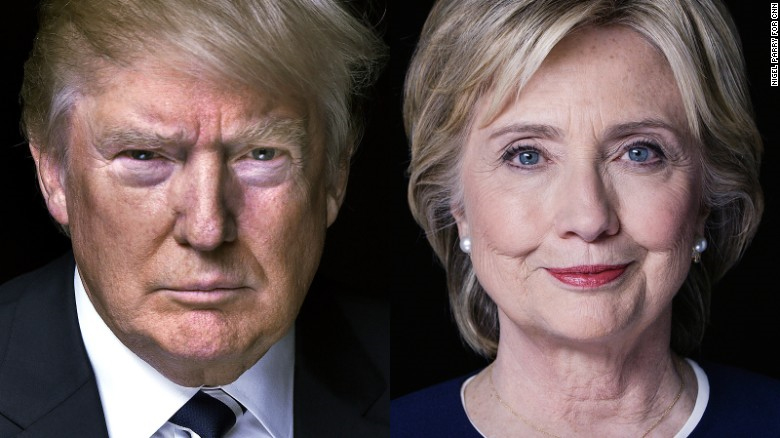
Trump versus ClintonNeither Donald Trump nor Hillary Clinton should be the two leading candidates for president of the United States. I find it appalling that both the Democrats and Republicans would select these seriously flawed people to lead the world’s most powerful nation.

Donald Trump has never held any elected office anywhere. His knowledge of the operations of the federal government is based upon what he has read or seen on television. His ideas about getting along with the rest of the world are a series of contradictions. In one breath he says that NATO is obsolete and in the next breath he talks about NATO forces being used to fight ISIS. Somehow he believes that a 35% to 45% tariff would bring jobs back to America. He says he wants to lower the national debt but he also wants to spend whatever it takes to enlarge our military, improve our educational system, and rebuild our infrastructure. All of these things, he says, will be done while lowering our income tax.

Hillary Clinton wanted to over throw Gadhafi in Libya (and we did) and now that country lacks a functioning central government. Her explanation about Benghazi is shrouded in a mist that cannot make that issue go away. She talks about being proud of her part in the Iran nuclear agreement and her solution to the Ukraine invasion by Russia. And Finally there is her use of a private email server that caused FBI Director James Comey to come very close to calling for her to be charged with a crime. Comey said, “Although we did not find clear evidence that Secretary Clinton or her colleagues intended to violate laws governing the handling of classified information, there is evidence that they were extremely careless in their handling of very sensitive, highly classified information.” In the end, Comey, a deputy attorney general under President George W. Bush, said Clinton’s careless conduct fell short of a crime because there was no evidence of “clearly intentional and willful mishandling” of classified information and no sign of “disloyalty” or an effort to “obstruct justice.”

Am I supposed to be reassured by either of these two candidates that they can carry out the duties of president without taking the nation into a financial collapse or a war?

I am not confident that either Trump or Clinton will be a capable leader. Rather I fear that the winner of the November election could mean we will be inaugurating the last president of the United States.

Trump Killing NAFTA Could Mean Big Unintended Consequences for the U.S.

Donald Trump intends to renegotiate NAFTA.  In a speech given today he laid out a seven-point plan to change U.S. ‘failed trade policies’, including withdrawing from the Trans-Pacific Partnership (TPP) and renegotiating NAFTA.

Following is an article that appeared on Bloomberg.com on October 1, 2015.  This article points out the benefits of NAFTA.

by Eric Martin

Ending the deal would hurt American manufacturers. For consumers, backing out might mean price increases on everything from cars to fruits and vegetables.

Donald Trump has pledged to renegotiate or terminate the North American Free Trade Agreement, saying that it’s been a disaster for the U.S.

And the billionaire front-runner for the Republican nomination isn’t the first presidential candidate to bash the deal: Since its inception (Ross Perot warned of a “giant sucking sound” pulling jobs to Mexico), Nafta has been a popular punching bag for politicians. Despite the idea’s popularity, pulling out of Nafta could have all sorts of unintended consequences for U.S. businesses and the economy.


1. America’s biggest export market would be jeopardized

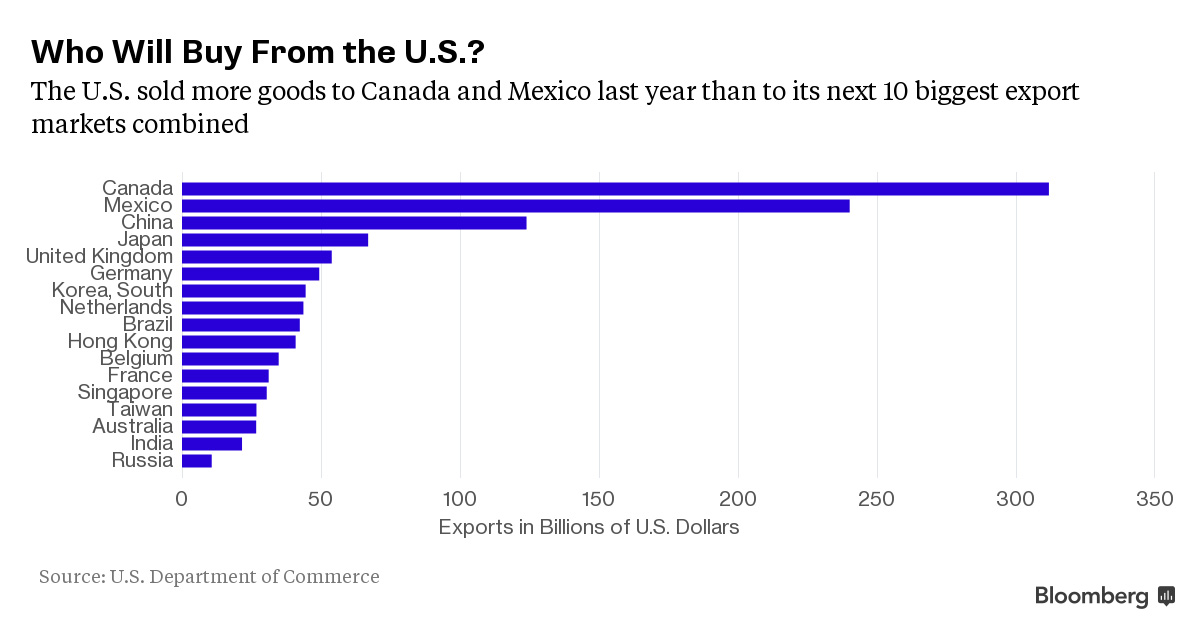
U.S. goods exports to Canada and Mexico have quadrupled since Nafta took effect in 1994, rising to about $550 billion last year. That’s more than sales to China, Japan, the U.K., Germany, South Korea, Brazil, India, Russia and Hong Kong combined.
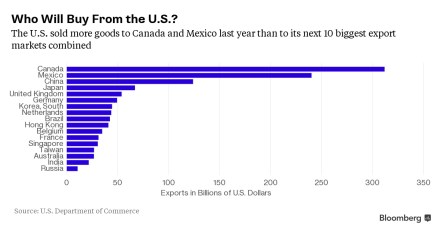
  Exports in Billlions of Dollars While critics have decried Nafta and other free-trade agreements for opening U.S. markets to foreign products, the deal actually lowered tariffs in Canada and Mexico even more than in the U.S. The American government applied an average tariff of just 4.3 percent to imports from Mexico and 5.1 percent to those from Canada before Nafta, while Canada had a 9.7 percent tax on imports from the U.S. and Mexico’s tax was 12.4 percent, according to a study last year led by Gary Hufbauer, an analyst at the Peterson Institute for International Economics.

A return to the tariffs pre-Nafta would mean “our exporters have more to lose in the immediate shock” than Canada and Mexico, Hufbauer said in an interview.


2. Jobs already gone wouldn’t return

As with any trade agreement, jobs were both created and destroyed after Nafta took effect as the workforce in each nation was realigned based on comparative advantage. In their search for lower costs for production chains, U.S. companies have moved jobs abroad—some to countries that have free trade with the U.S. and others to nations that don’t.

“If we didn’t have Nafta, would things like clothing and automobiles that are produced in Mexico be produced in the United States? No,” said David Gantz, who teaches trade law at the University of Arizona. “They’d be produced in China or somewhere that the labor costs are a lot lower. One needs to look at what the alternatives would be.”


3. The American economy overall would lose

Thanks to Nafta, U.S. consumers have enjoyed the benefits of cheaper imports from goods manufactured in Mexico. Scrapping the trade agreement might force Americans to stomach higher costs, from flat-screen TVs to Nissans to guacamole: Mexico is the world’s top producer of avocados.

Hufbauer estimates that Nafta trade growth makes the U.S. $127 billion richer each year, not only because of the boost to American exporters but also because of these benefits to U.S. consumers. That’s about $400 per person.

“It’s not always visible to people because much of the benefit is at the checkout counter,” Hufbauer said.


4. American drivers could pay more for gasoline

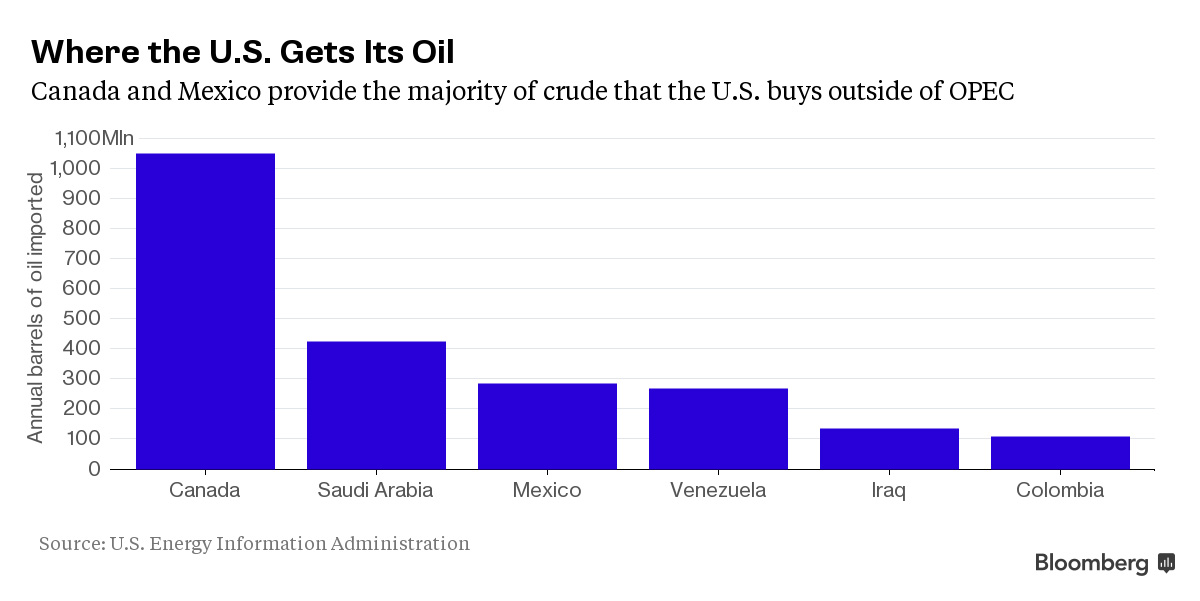
Canada and Mexico accounted for about half of U.S. oil imports in 2014, more than all the nations in OPEC combined and 84 percent of the oil the U.S. bought from outside the cartel.
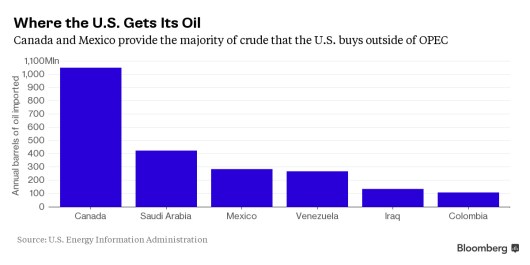
Where the U.S

While a supply glut has driven oil prices to near a six-year low, there’s no guarantee things will stay that way.  Ending Nafta could make the U.S. more reliant on imports from Saudi Arabia, Venezuela and other OPEC members when global demand rebounds down the road.

Nafta gives the U.S. preferential access to oil, limiting the scenarios in which Canada can restrict energy exports to the U.S. If the U.S. didn’t import oil from its Nafta partners, it could do so at higher cost from other countries, some of which aren’t as friendly to the U.S. as Mexico or Canada.