Obfuscate

To obscure, muddy, cloud, and conceal.  Those were the objectives of two guests on ‘This Week with George  Stephanopoulos.”  US National Security Advisor H. R. McMaster and Newsmax Media CEO Christopher Ruddy who is now as an ABC News contributor.

I have put in bold what I think are some of the most interesting parts of this interview program.

RUDDY: So many stories, fake news stories, are becoming fact here. Where in the Russia investigation has there ever been an allegation that the president had done anything wrong with the Russians? Where is there any evidence?

Or in other words the New York Times and The Washington Post are creating fake news.

The real thing to read is the transcript of  Stephanopoulos talking to McMaster today, May 21, 2017 his Sunday morning talk show.

STEPHANOPOULOS: General McMaster, thanks for joining us today. I want to get to the trip, but first some questions about that meeting you all had with the Russian foreign minister. “New York Times”, as you know, reporting that here’s what the president said in the meeting. “I just fired the head of the FBI. He was crazy, a real nut job. I faced great pressure because of Russia. That’s take off.”

Is that what the president said?

H.R. MCMASTER, NATIONAL SECURITY ADVISER: Well I don’t remember exactly what the president said. And the notes that there apparently have I do not think are a direct transcript. But the gist of the conversation was that the president feels as if he is hamstrung in his ability to work with Russia to find areas of cooperation because this has been obviously so much in the news. And that was the intention of that portion of that conversation.

STEPHANOPOULOS: Did you know he was going to report that to the Russians? And what did you think when you heard it?

MCMASTER: Report what, George?

STEPHANOPOULOS: The — what you he said about James Comey. That he fired him and why.

MCMASTER: Well, the firing had been in the news. But I didn’t know in advance that the president was going to raise it, but as I mentioned he raised it in the context of explaining that that he has been — feels as if he’s been unable to find areas of cooperation with Russia, even as he confronts them in key areas where they’re being disruptive, like Syria for example, and the subversive activities across Europe. Their support for the — not only the Assad regime but for Iran and its activities across the Middle East.

STEPHANOPOULOS: Did you understand how this might look though to an average American right no? You have the President of the United States telling the Russian foreign minister, in their first meeting, that that the pressure is off because he’s fired the FBI director investigating Russian interference in the campaign. Does that seem appropriate to you?

MCMASTER: As you know, it’s very difficult to take a few lines, to take a paragraph out of what are — what appear to be notes of that meeting. And to be able to see the full context of the conversation.

As I mentioned last week, the really purpose of the conversation was to confront Russia on areas, as I mentioned, like Ukraine and Syria, their support for Assad and their support for the Iranians.

We’re trying to find areas of cooperation in the area of counterterrorism and the campaign against ISIS.

And so that was the intent of that conversation was to say what I’d like to do is move beyond all of the Russia news so that we can find areas of cooperation.

STEPHANOPOULOS: So, did the president confront them on their interference in our election? This was their first meeting?

MCMASTER: Well, there already was too much that’s been leaked from those meetings. And one of the things that I’m most concerned about is the confidence, the confidentiality of those kind of meetings, as you know, are extremely important. And so, I am really concerned about these kind of leaks, because it undermines everybody’s trust in that kind of an environment where you can have frank, candid, and often times unconventional conversations to try to protect American interests and secure the American people.

STEPHANOPOULOS: I understand your concern about leaks, but I could an see the — the feeling of perhaps someone likely on your staff or in your community who leaked this thinking they had a duty to leak it because you have this apparent contradiction.

The president disparaging the person who was investigating the Russians, but not confronting the Russians who interfered in our election.

MCMASTER: Well, as you know, the initial leak that came out was a leak about concerns about revealing intelligence source and methods, information that’s not even part of the president’s briefing. And so in a concern about divulging intelligence, they leaked actually not just the information from the meeting, but also indicated the sources and methods to a newspaper? I mean, it doesn’t make sense, George.

STEPHANOPOULOS: I take your point on that, although there’s also the question of whether or not it was right for the president to give that information to the Russians. But I just asked a direct question. Did the president confront the Russians on their interference in our election?

MCMASTER: Well, I’m not going to divulge more of that meeting. Those meetings, as you know, are supposed to be privileged. They’re supposed to be confidential. They’re supposed to allow the president and other leaders to have frank exchanges.

STEPHANOPOULOS: Well, let me ask just one final question, then, on that meeting. Sean Spicer has spoken out, the president’s press secretary. He said by grandstanding and politicizing the investigation into Russian’s actions, James Comey created unnecessary pressure on our ability to engage and negotiate with Russia.

You’re the president’s national security adviser, do you agree that the former FBI’s director grandstanding and politicizing, those are Sean Spicer’s words, hurt our ability to deal with Russia?

MCMASTER: I think what’s been hurting our ability to deal with Russia more than any other factor, has been Russia’s behavior. But since President Trump has taken action in Syria, we think that there may be opportunities to find areas of cooperation in places like Ukraine, places like Syria in particular.

STEPHANOPOULOS: After your first press conference on that meeting, your friend and former colleague, retired Colonel John Neagle told NPR that you’re in an impossible situation, because the president expects you to defend the indefensible. What’s your reaction to that?

MCMASTER: I don’t think I’m in an impossible situation. I think what the president expects and what is my duty to do as national security adviser and as an officer in our army is to give my best advice, to give my best, candid advice. Nobody elected me to make policy. What my job is, is to give the president options, to integrate the efforts across all of our agencies and departments. And then once the president makes decisions, to help him execute those decisions to protect and advance the interests of the American people.

So, I find no difficulty at all serving our nation and serving the president in my current capacity.

STEPHANOPOULOS: But if the president did put you in that position as you wrote about with President Johnson and Vietnam, would you resign? Would you push back?

MCMASTER: Well, you know there was middle ground there during the Vietnam period. What occurred in that period is many of the president’s senior advisers, civilian, and military, didn’t give their best advice, because they concluded that what would be appropriate for them to do given what Johnson expected, President Johnson expected, was to tell him the advice he wanted to hear. I don’t think the president expects that from me, and certainly I don’t think I’d be fulfilling my duties and responsibilities unless I gave him not just my candid advice, that’s really not my job either — is to integrate and coordinate across the departments and agencies to give him the best advice from across our government and with our key multinational partners.

STEPHANOPOULOS: But it sounds like one of the difficulties of this meeting –and I do want to get on to the trip — is that when the president disparaged James Comey, when he gave that information to the Russians who had interfered in our campaign, when he apparently did not confront the Russians over this, he didn’t even ask your advice.

MCMASTER: Well, George, what I’d like to talk about is where I am right now, in Saudi Arabia. I mean I think I answered the questions concerning the media and I’d like to move on while we still have time.

STEPHANOPOULOS: We definitely will have time. So, you — did the president ask your advice about this before he talked about James Comey?

MCMASTER: The president always asks for advice before these sorts of sessions, but the subject of the FBI investigation to my recollection didn’t come up. But really, that conversation, although I don’t want to talk about any more of the specifics from within it, covered a broad range of subjects, most of which had to do with areas in which we think Russia’s behavior’s been unacceptable and is increasing risk to international security, is supporting those who are helping to create a humanitarian crisis in Syria and across the region. That would be the Assad regime and Iran. But then also look for areas where we can cooperate and begin to move toward a resolution of conflicts in Ukraine, in Syria, and then to be able to cooperate more effectively in our counter terrorism campaigns.

STEPHANOPOULOS: Let’s talk broadly about the goal of this trip. The president said you had a very good start. What exactly do you want to accomplish?

MCMASTER: Well, really three main things. The first is to advance the security of the American people. And to recognize that to do that, America needs allies and partners to deal with the very complex problems that we are dealing with. And of course in this region, those are two main and interconnected problems, the problem of transnational terrorist organizations, some of which now, like ISIS, control territory and populations and resources. But then how that problem is connected more broadly to the problem of Islamist extremism and the brainwashing of youths with really an irreligious ideology that is meant to foment hatred and justify violence against innocents.

And the second problem of Iran and Iran’s actions across the region, which we believe are aimed at keeping the Arab world perpetually weak and mired in a very destructive civil war. And you see that in Syria, obviously, a great human cost, but you see it in Yemen as well. You see it to a certain extent in Iraq.

And so security, cooperation, counterterrorism, but also counter-extremism is a big part of it.

STEPHANOPOULOS: As you know, the Saudis…

MCMASTER: The second part of it…

STEPHANOPOULOS: Go ahead

MCMASTER: The second part of it is economic cooperation, being able to get better access to markets, develop trade relationships, to create American jobs. There are a lot of important signings that happen in that connection.

And the third is to foster — this is just for this leg of the trip — better defense cooperation in the region and to encourage additional burden-sharing, responsibility-sharing with allies and partners so Americans don’t foot the full bill for security in this region and globally as well.

STEPHANOPOULOS: The Saudis have been in the past consistent backers of extremists around the world, around the region and around the world. Are you convinced that they’re truly ready to change?

MCMASTER: Well, we’re going to ask them to convince us. And so there’s some very good first steps being taken with the establishment of the center for combating global extremism, or terrorist extremism. We’ll have to see what the results are.

But I think the willingness to talk about it is somewhat different than it has been in the past. And as you know ,the record is poor going back to the ’60s and ’70s and beyond. And even today. And so what we need is we need to convene leaders across all religions, and that is a big theme of this trip, is to promote tolerance and cooperation across our religions to identify these terrorists for who they are — the enemies of all civilized people, irreligious criminals who use a perverted interpretation of religion to advance their criminal and political agendas.

And that’s the tone and tenor of the conversations that occurred today, which I think that is encouraging. Now I think there have to be concrete steps taken. Funding has to be cut off to these madrassas and mosques that are fomenting hatred and intolerance. Funding has to be cut off to terrorist organizations through effective threat finance measures, and that’s a big part of the initiative as well.

And so we’ll see. I mean, I think the expectation is that there — results — that we deliver results together. That’s what we’ve said that we expect of each other, and that will be a big part of the conversation tomorrow when the group of leaders expands dramatically to include not only the Gulf Cooperation Council but also about 50 nations of predominately Muslim and Islamic populations.

STEPHANOPOULOS: General McMaster, thanks for your time this morning.

MCMASTER: Thank you, George.

(END VIDEOTAPE)
25 Years after the April 1992 Los Angeles Riots

The riots were a consequence of the Rodney King police beating and a frustration of Blacks in South Central Los Angeles over their lack of opportunities for decent education, decent jobs, and decent housing.

We were living in the West San Fernando Valley when the riot occurred.  Neither I nor my neighbors were impacted by what happened.

I was shocked by the verdict as many others were shocked.

Los Angeles Mayor Tom Bradley went on television with an inflammatory condemnation of the verdict: “I was stunned. I was shocked. | was outraged when I heard that verdict,” he exclaimed with vehemence. “No, our eyes did not deceive us. We saw what we saw. What we saw was a crime. No, we will not tolerate the savage beating of our citizens by a few renegade cops …. The jury’s verdict will never outlive the images of the savage beating seared forever into our minds and our souls.”

I saw that comment made by Tom Bradley and immediately said that his statement was an invitation to Blacks to riot.  Of course the following day he denied that his words inspired the rioters.  The words “No, we will not tolerate the savage beating of our citizens” sent the message that it is OK to riot.

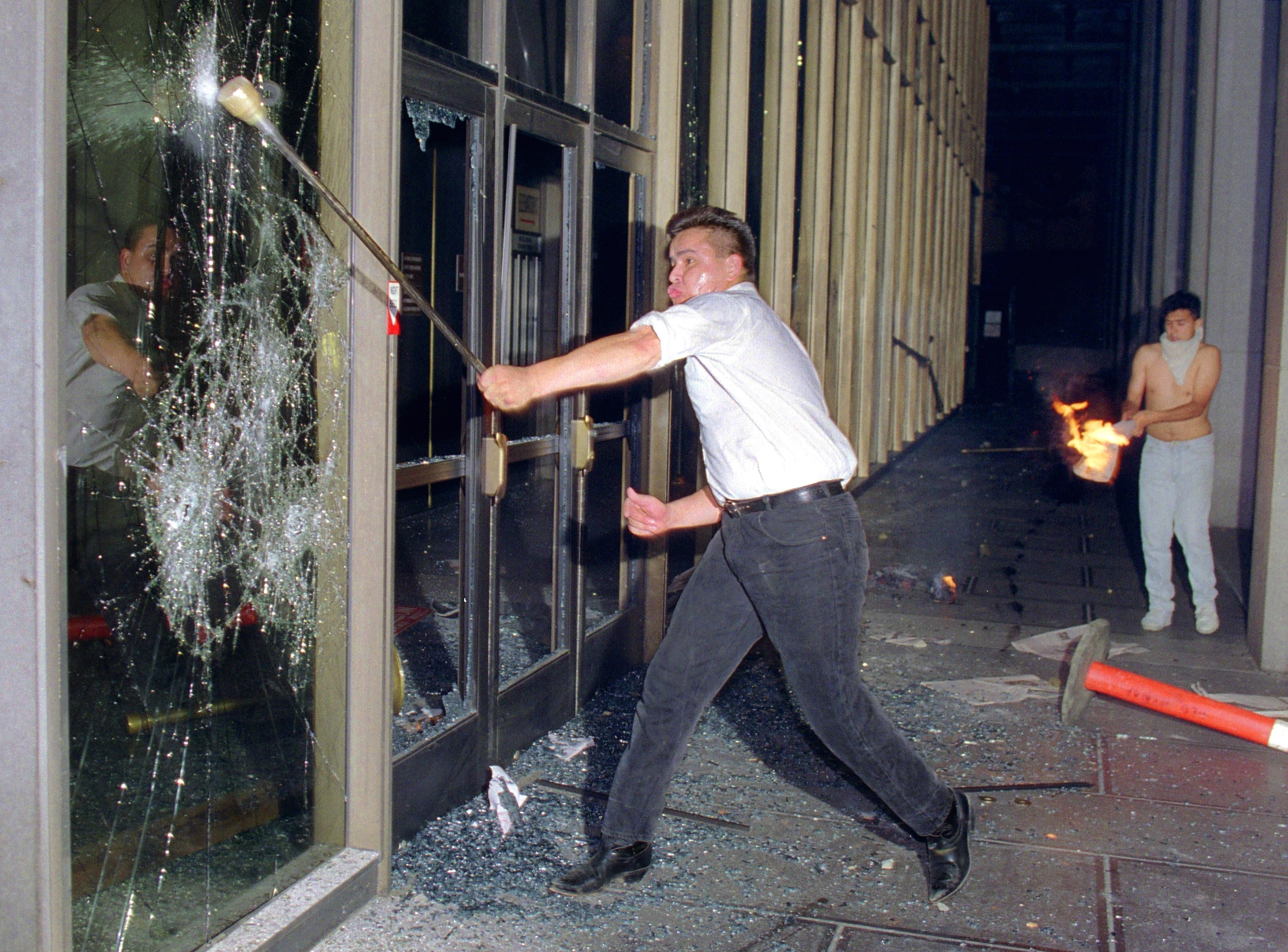
LOS ANGELES, CA – APRIL 29: A rioter breaks a glass door of the Criminal Courts building, downtown Los Angeles, 29 April 1992, after a jury acquitted four police officers accused of beating a black youth, Rodney King, in 1991. Riots broke out throughout Los Angeles hours after the verdict was announced. (Photo credit should read HAL GARB/AFP/Getty Images)

Today’s Black Lives Matter movement is an outgrowth of the continuing mistreatment of Black Americans.

The Trump 100 Day Legislative Disaster

Mexico is not paying for the wall. The Trump travel ban has twice been blocked by the courts. Trump has failed to mobilize a Republican monopoly on power in Washington and his big legislative goal — repealing Obamacare — crashed.

Not one single major piece of legislation has been passed by congress and signed into law.

Most of what Trump has accomplished has been through executive order.

Donald Trump’s Contract with the American Voter was his 100 day action plan.  The plan was announced on October 26, 2016.

How did he do?

Six measures to clean up the corruption and special interest collusion in Washington, DC:

★ FIRST, propose a constitutional amendment to impose term limits on all members of Congress.  NOT DONE.

★ SECOND, a hiring freeze on all federal employees to reduce the federal workforce through attrition (exempting military, public safety, and public health). THE FEDERAL HIRING FREEZE WAS IMPOSED IN JANUARY.  IT WAS LIFTED ON APRIL 14.

★ THIRD, a requirement that for every new federal regulation, two existing regulations must be eliminated. DONE.

★ FOURTH, a five-year ban on White House and Congressional officials becoming lobbyists after they leave government service. DONE.

★ FIFTH, a lifetime ban on White House officials lobbying on behalf of a foreign government. DONE.

★ SIXTH, a complete ban on foreign lobbyists raising money for American elections. DONE.


Seven actions to protect American workers:

★ FIRST, I will announce my intention to renegotiate NAFTA or withdraw from the deal under Article 2205. DONE. HE WILL RENEGOTIATE.

★ SECOND, I will announce our withdrawal from the Trans-Pacific Partnership. DONE.  

★ THIRD, I will direct the Secretary of the Treasury to label China a currency manipulator. NOT DONE. REVERSED OPINION.

★ FOURTH, I will direct the Secretary of Commerce and U.S. Trade Representative to identify all foreign trading abuses that unfairly impact American workers and direct them to use every tool under American and international law to end those abuses immediately. NOT DONE.

★ FIFTH, I will lift the restrictions on the production of $50 trillion dollars’ worth of job-producing American energy reserves, including shale, oil, natural gas and clean coal. DONE.

★ SIXTH, lift the Obama-Clinton roadblocks and allow vital energy infrastructure projects, like the Keystone Pipeline, to move forward. DONE.

★ SEVENTH, cancel billions in payments to U.N. climate change programs and use the money to fix America’s water and environmental infrastructure. DONE. EXCEPT NO WATER AND INFRASTRUCTURE PROJECTS HAVE BEEN BUDGETED.


Five actions to restore security and the constitutional rule of law:

★ FIRST, cancel every unconstitutional executive action, memorandum and order issued by President Obama. NOT DONE.

★ SECOND, begin the process of selecting a replacement for Justice Scalia from one of the 20 judges on my list, who will uphold and defend the U.S. Constitution. DONE. MAJOR ACCOMPLISHMENT.

★ THIRD, cancel all federal funding to sanctuary cities. NOT DONE.

★ FOURTH, begin removing the more than two million criminal illegal immigrants from the country and cancel visas to foreign countries that won’t take them back. DONE.

★ FIFTH, suspend immigration from terror-prone regions where vetting cannot safely occur. All vetting of people coming into our country will be considered “extreme vetting.” NOT DONE.

No Mr. Trump you are not all powerful. This is a democratic republic.

   The failure of Trumpcare was good news for some.  Doctors didn’t like it.  Nurses didn’t like it.  The AARP was one of the biggest critics.

If nothing else Mr. Trump has learned that being president of the United States is nothing like owning your own company.  You cannot make demands of the people and expect they will follow your orders merely because you are president.  As the owner of your own company you can give directions to your employees and know they will be carried out.

So promising to repeal and replace Obamacare was a winning promise on the campaign trail.  As president Trump has learned that making promises is easy but fulfilling them takes another set of capabilities.  Donald Trump has not yet learned that he is confronted with a set of circumstances that are entirely different than those he faced as the head of his company.

It’s not just his health care proposal that did not pass the House of Representatives that has been a challenge.  He has seen his immigration executive orders stopped by the courts, faced questions about his proposal to defund domestic programs in order to raise defense spending, and learned that foreign affairs are far more complicated than he imagined.

It seems that when things don’t go his way he finds someone else to blame.  The Democrats are to blame for the health care defeat. “So called judges” are to blame for the hold on his immigration ban.  There are leakers who are to blame for information going to the press who only deal in fake news.

As Charles Krauthammer pointed out in his latest column the country’s checks and balances really do work.  This is a feature of government that Donald Trump either does not understand or hopes will go away.  It won’t go away.

Mr. Krauthammer listed these checks on the usurping of power.

1.     The courts.

2.     The states.

3.     Congress.

4.    The media.

Trump Presidency Accomplishments on Day 56

America’s president has accomplished something I doubt any other president has ever done in one day. A distinct dislike by two of our most important allies and a threat of war.

First he accused Great Britain, America’s most valuable ally, of participating in the wire tapping of the Trump Tower in New York City. He suggested that former president Barack Obama convinced Britain’s spy agency to monitor Mr. Trump during last year’s election campaign. Livid British officials adamantly denied the allegation and secured promises from senior White House officials never to repeat it. But a defiant Mr. Trump refused to back down, making clear that the White House had nothing to retract or apologize for because his spokesman had simply repeated an assertion made by a Fox News commentator. Fox itself later disavowed the report.

Second, Mr. Trump in his first face to face meeting with German Chancellor Angela Merkel, not only refused to shake hand with her, accused Germany of manipulating the Euro in a way that gave Germany an unfair trade advantage against the United States. She sat, obviously in an awkward situation, as Trump defended his wire tapping accusations.

Third, while Trump was busy in Washington, D.C. his Secretary of State Rex W. Tillerson was in Seoul, South Korea threatening a pre-emptive military strike against North Korea. He said that “The policy of strategic patience has ended.”


No doubt that Donald Trump has stirred things up in Washington. How has these actions put America in a better place?

The Conflicted Presidency

The following editorial appeared in today’s Los Angeles Times.  While I do not usually re-print their editorials, this one is particularly important.   This commentary points out that Donald Trump does not care what you think or what you believe.

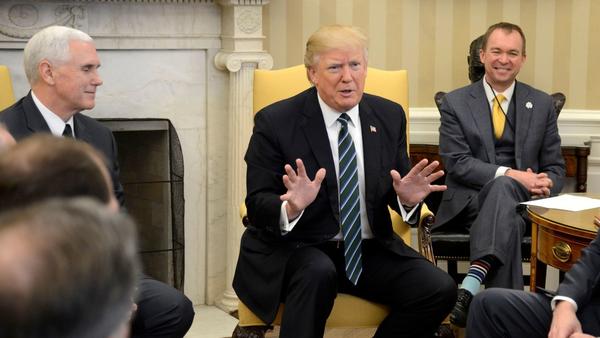
Donald Trump in the East Room discussing health


Financial conflicts abound when the orbits of the highest office and the family business overlap.

Donald Trump ran for office as a candidate so deeply enmeshed in his family business that just about any remedy short of selling the Trump Organization would lead to conflicts of interest for his presidency. Two months later, that’s exactly what we’ve got: conflicts galore.

Trump made a big pre-inaugural show of separating himself from active participation in the Trump Organization by turning control over to his children. Yet he retains a financial stake, so any profits that accrue to the business accrue to him too. And since Trump has broken with four decades of tradition by refusing to make his tax returns public (an outrage that he still should rectify), the nation doesn’t even know where all his conflicts might be. And as Trump has repeatedly noted, the president is exempt from the federal conflict-of-interest laws that his appointees must follow.

The problems exist at two levels. First is the clear potential for self-dealing. But benefits also could fall to President Trump through unbidden acts by others, such as foreign governments granting advantages to his overseas properties hoping to win favor with the administration. In fact, China recently approved three dozen Trump-related trademarks in what some experts say was an expedited process. And with Trump as the U.S. government’s chief executive, his private business holdings will routinely put underlings in fraught situations. If they roll back regulation, was it because it needed to be changed or because it might help the boss?

So where are Trump’s conflicts? Pretty much everywhere. Since the inauguration, Trump has spent four weekends at Mar-A-Lago, his private Palm Beach resort that on Jan. 1- three weeks before Trump’s inauguration – doubled its initiation fee to 9200,000. Trump’s backers argued that it was overdue- the fee had been halved in the aftermath of the Bernie Madoff scandal, which hit Palm Beach hard. Yet the timing is, at the least suspect, as though the resort was capitalizing on the desire of the well-heeled to hobnob with the new president.

And when Trump is in Florida, he plays golf at one of two nearby Trump courses, among the 17 owned or controlled by Trump Golf, five in foreign countries. Son Eric Trump, who oversees the golf portfolio, said recently that “the stars have all aligned … I think our brand is the hottest it has ever been.” What aligned those stars? Trump’s election, which added value to the brand.

And among the first regulations Trump’s Environmental Protection Agency targeted for repeal is known as the Waters of the United States rule. That rule put costly restrictions on runoff from, you guessed it, golf courses.

The Trump Organization also lists 14 hotels, six overseas and eight in the U.S., including the new Trump International in the renovated and government-owned Old Post Office building a few blocks from the White House. The lease for that building bars elected officials from receiving benefits from it, and although it appears Trump is now in violation, it is up to his government employees to enforce or re-negotiate. Foreign diplomats have thrown business to the hotel because the president’s name is on it, revenues that ethics experts say violate the emoluments clause in the U.S. Constitution barring the president from receiving money from foreign governments. And last week the owners of a nearby wine bar sued, complaining that competitors operating in the hotel had an unfair advantage because the president’s name is on the building.

The list goes on. Trump says he is under audit by the Internal Revenue Service, which now works for him, raising questions about its independence. Trump will be appointing a majority of the National Labor Relations Board, which lists 47 active cases involving Trump businesses. Trump’s been renting space to the Secret Service in his Trump Tower to provide security for his wife and son, who remain in New York City.

Trump will not resolve these conflicts on his own – he’s shown that he intends to bull ahead, the interests of the nation be damned. Among those who could force the issue are congressional Republican leaders – but they seem content to let it simmer. That is unacceptable. The system of checks and balances requires action, not quiet acquiescence, and Congress should be ensuring that the executive does not violate the Constitution.

The End of Free Speech in America

Does anyone understand the first amendment to the constitution of the United States? Does anyone understand the intent?

Congress shall make no law respecting an establishment of religion, or prohibiting the free exercise thereof; or abridging the freedom of speech, or of the press; or the right of the people peaceably to assemble, and to petition the Government for a redress of grievances.

A Vietnamese woman came to this country when she was five years old. She was part of the “boat people” who escaped Vietnam when the United States abandoned its efforts to stop the spread of communism. That was at the end of the Vietnam War that ended in defeat for the United States.

That woman is now Senator Janet Nguyen, R-Garden Grove, California. She is the first Vietnamese American in the country elected to a state senate seat. She dared to criticize late state Sen. Tom Hayden’s, D-Santa Monica, support of the communists in Vietnam. California State Senate President Pro Tem Kevin de Leon, D-Los Angeles had Senator Nguyen physically dragged off the Senate floor for pointing out that Tom Hayden was in fact a traitor to the United States.


Fires burned in the cradle of free speech, University California Berkeley. Furious at a lecture organized on campus, demonstrators wearing ninja-like outfits smashed windows, threw rocks at the police and stormed a building. The speech? The university called it off. The university was under siege for canceling a speech by the incendiary right-wing writer Milo Yiannopoulos and words like intolerance, long used by the left, were being used by critics to condemn the protests on February 3 that ultimately prevented Mr. Yiannopoulos from speaking.


In April 2014 Ayaan Hirsi Ali was invited to Brandeis University’s commencement festivities and then she was uninvited.  So, what’s all that about? Well, Hirsi Ali is a figure of some controversy, don’t you know! She has been a strong voice against such barbaric practices as female genital mutilation, and the more totalitarian aspects of Islamic sharia law that oppress women, such as so-called “honor killings.” Personally speaking, I am glad she has done such things. However, she is not of the mind that Islam is a legitimate religion that has been, in some instances, tragically co-opted in some benighted corners of the world by nihilistic death-cults. She does not believe it is possible for a moderate or Westernized form of Islam to exist. She has said so: “There is no moderate Islam.” And so, she has called for the complete destruction of Islam existentially.


In September 2011 jurors on found 10 of the “Irvine 11” Muslim students guilty on charges that stemmed from the disruption of a speech by the Israeli ambassador, Michael Oren, to the United States when he visited UC Irvine in February of 2010.


What do all of these incidents have in common?  The denial of freedom of speech.  How did we get here?  We have come to a time when we insist not to hear any opinions that do not coincide with our own.  We want an echo chamber that returns all of our thoughts and all of our ideas.  We have come to believe that no other thoughts and no other ideas are worth considering.  We are so sure that our ideas are the right ideas that we want to deny anyone from hearing other ideas.

Where do we go from here?

Donald Trump manipulates the Media and Congress

Donald Trump know exactly what he is doing when he claims there has been wiretapping of Trump Tower.

I have not read or heard any of the any commentator’s explanation for the latest tweets that Barack Obama was instrumental in the phone wiretap at the Trump Tower in New York. After all it was Trump in his address to congress who said “The time for small thinking is over. The time for trivial fights is behind us.”

Did he forget the speech or was that the words of his speech writer?

My theory is quick and easy to understand. Use the media to redirect the focus of the American people. In doing that his administration will not be the center of attention. Trump, I suspect, believes the public focus on wire tapping or other Alt-facts will enable him to carry out his agenda without a great deal of media focus.  In other words, get the media and the congress to focus on fake news.

As of today he has succeeded. The Sunday morning TV talk shows have been talking about wire tapping. In coming days Trump will say other things to distract the media and the congress.

This Huffington Post report supports my contention that we are now focused on the Alt-news. Sen. Lindsey Graham (R-S.C.) said Saturday that if former President Barack Obama actually wiretapped Donald Trump’s phones, either legally or illegally, it would be the biggest scandal since Watergate.

Speaking at a town hall in Clemson, South Carolina, Graham addressed Trump’s baseless claims that Obama eavesdropped on him prior to the 2016 election. Trump claimed Obama’s actions were as scandalous as “Nixon/Watergate” in one of several tweets on Saturday morning.

“I don’t know if it’s true or not, but if it is true, illegally, it would be the biggest political scandal since Watergate,” Graham said, referring to a scenario in which the Obama administration tapped Trump’s phones without a warrant. The crowd, which was evidently packed with anti-Trump residents, booed at this suggestion.

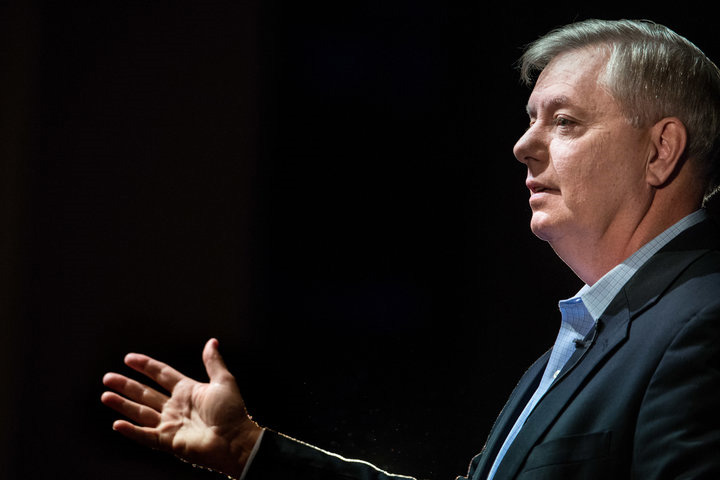
senator-lindsey-graham

Sen. Lindsey Graham addressed Trump’s baseless claim Saturday that former president Barack Obama had wire tapped Trump Tower phones.

33 false things Donald Trump has said as president so far

donald-trump-2-3-17


U.S. President Donald Trump has a history of saying false things, big and small. Canada’s Toronto Star newspaper’s Washington Bureau reporter Daniel Dale has been tracking them all.

This is Mr. Dale’s current running tally of the bald-faced lies, exaggerations and deceptions the president of the United States of America has said, so far.

33. Feb. 3, 2017 — Twitter
The claim: “Thank you to Prime Minister of Australia for telling the truth about our very civil conversation that FAKE NEWS media lied about.”
In fact: The media did not lie about their phone call, which was not civil. A senior Trump official acknowledged to the Washington Post that it had been “hostile and charged,” and prominent news outlets in both countries reported that Trump had berated Malcolm Turnbull. Turnbull denied that Trump had “hung up” on him, but he did not deny that the call had ended abruptly after 25 minutes, as the Post reported. “Was it cut short?” an Australian radio host pressed Turnbull. “The call ended courteously. That’s all I want to say about that,” Turnbull responded.

32. Feb. 2, 2017 — White House meeting with Harley-Davidson
The claim: “I love Australia as a country, but we had a problem where for whatever reason, President Obama said that they were going to take probably well over 1,000 illegal immigrants who were in prisons, and they were going to bring them and take them into this country. And I just said, ‘Why?’…1,250. It could be 2,000, it could be more than that.”
In fact: The people in question are refugees, not illegal immigrants, who are living in island detention centres off of Australia. As Australia’s prime minister repeatedly told Trump, and as Trump’s own press secretary concurred, the agreement covers 1,250 people, not 2,000.

31. Feb 2, 2017 — Twitter
The repeated claim: “Do you believe it? The Obama Administration agreed to take thousands of illegal immigrants from Australia.”
In fact: The people in question are refugees, not illegal immigrants; the agreement covers 1,250 people, not “thousands.”

30. Feb. 2, 2017 — Twitter
The claim: “Iran was on its last legs and ready to collapse until the U.S. came along and gave it a lifeline in the form of the Iran Deal: $150 billion.”
In fact: Iran was nowhere near collapse before it signed the 2015 nuclear deal with the U.S. and five other major countries. Iran did not get $150 billion in the deal. Rather, a smaller amount of Iranian assets were unfrozen. The Treasury Department told Congress in 2015 that total Iranian assets were estimated at $100 billion to $125 billion; it put the “usable liquid assets” at around $50 billion. John Kerry, then the secretary of state, said Iran would get about $55 billion.

29. Jan. 30, 2017 —Remarks at the White House
The claim: “But we cut approximately $600 million off the F-35 fighter, and that only amounts to 90 planes out of close to 3,000 planes. And when you think about $600 million, it was announced by Marillyn (Hewson), who’s very talented, the head of Lockheed Martin. I got involved in that about a month ago. A lot was put out, and when they say a lot, a lot meant about 90 planes. They were having a lot of difficulty. There was no movement and I was able to get $600 million approximately off those planes.”
In fact: Whether or not Trump secured additional discounts from Lockheed, he is wrong that there had been “no movement” until he got involved: the company had been moving to cut the price well before Trump was elected, multiple aviation and defence experts say. Just a week after Trump’s election, the head of the F-35 program announced a reduction of 6 to 7 per cent — in the $600 million to $700 million range.
“Trump’s claimed $600 million cut is right in the ballpark of what the price reduction was going to be all along,” wrote Popular Mechanics. “Bottom line: Trump appears to be taking credit for years of work by the Pentagon and Lockheed,” Aviation Week reported, per the Washington Post.

28. Jan. 30, 2017 — Twitter
The claim: “Only 109 people out of 325,000 were detained and held for questioning. Big problems at airports were caused by Delta computer outage, protesters and the tears of Senator Schumer.”
In fact: This is false and misleading in multiple ways. The Delta computer outage happened a full day and a half after the chaos over Trump’s ban on all new refugees and on travel by nationals from seven mostly Muslim countries. The peaceful protesters at airports did not cause “big problems.” Nor, of course, did Schumer’s emotional speech.
In reality, the poorly explained order caused confusion around the word, resulting in hassles at airports and beyond for tens of thousands of people — far more than were detained upon entry. And while it is not clear if Trump was correct that “only” 109 people had been detained at the time, Homeland Security officials said a day later that 721 people had been denied boarding.

27. Jan. 29, 2017 — Facebook statement on travel ban affecting seven predominantly Muslim countries
The claim: “My policy is similar to what President Obama did in 2011 when he banned visas for refugees from Iraq for six months.”
In fact: Trump is wrong that Obama “banned” Iraqi refugees. After two Iraqi refugees were arrested on terrorism charges, Obama increased scrutiny of new refugee applicants, slowing down the process significantly, but did not ban Iraqis entirely or ban all new refugees. Iraqi refugees were admitted to the U.S. in every month of 2011, government figures show, and 9,388 were admitted in total in 2011.

26. Jan. 28, 2017 — Twitter
The claim: “Thr (sic) coverage about me in the @nytimes and the @washingtonpost gas (sic) been so false and angry that the times actually apologized to its dwindling subscribers and readers.”
In fact: This claim is false in two ways. First, the Times’ subscriber base is growing, not dwindling: the company says it added more than 300,000 subscribers in the fourth quarter of 2016. Second, the Times never apologized for its Trump coverage; Trump was referring to a post-election letter, a kind of sales pitch, in which Times leaders thanked readers and said they planned to “rededicate ourselves to the fundamental mission of Times journalism.”

25. Jan. 27, 2017 — Interview with Christian Broadcasting Network’s David Brody
The claim: “Do you know if you were a Christian in Syria it was impossible, very very, at least very very tough to get into the United States? If you were a Muslim you could come in, but if you were a Christian, it was almost impossible.”
In fact: There is no basis for the claim that U.S. authorities are treating Christian applicants from Syria worse than they treated Muslims. While a very small percentage of the Syrian refugees accepted by the U.S. in 2016 were Christian — 0.5 per cent, according to FactCheck.org — Christians make up a similarly tiny percentage of the Syrian refugees in nearby countries: 1.5 per cent in Lebanon, 0.2 per cent in Jordan.

24. Jan. 27, 2017 — Interview with Christian Broadcasting Network’s David Brody
The claim: “The Cuban-Americans — I got 84 per cent of that vote, and they voted in big numbers.”
In fact: Trump got nowhere near that percentage of the Cuban-American vote. Writes NBC: “According to exit polls, Trump won 54 per cent of the Cuban American vote in Florida, where two-thirds of people of Cuban descent live. Latino Decisions’ election eve poll showed he got about 48 per cent of the Cuban American vote nationally and 52 per cent in Florida.”

23. Jan. 27, 2017 — Press conference with United Kingdom Prime Minister Theresa May
The claim: “I happened to be in Scotland at Turnberry cutting a ribbon when Brexit happened and we had a vast amount of press there. And I said Brexit — this was the day before, you probably remember, I said Brexit is going to happen and I was scorned in the press for making that prediction. I was scorned.”
In fact: Trump was not in Scotland the day before the Brexit vote. He was there the day after. When he was asked about Brexit the day before the vote, he told Fox Business, “I don’t think anybody should listen to me because I haven’t really focused on it very much.” He did not venture a prediction that day.

22. Jan. 26, 2017 —Interview with Fox News’s Sean Hannity
The claim (on companies creating jobs): “Here’s another thing with the media. ‘Oh, they would’ve done it anyway. They weren’t going to do it.’ You see, Jack Ma. He had no intention of doing it until I got elected. And he went down and he said, ‘I’m only going to do this because of Donald Trump.’ And nobody put that in the papers, which is OK.”
In fact: It is not exactly clear whether Ma made his proposal to “create one million” U.S. jobs as a direct result of Trump’s election, but Trump’s claim about media bias is false regardless: upon coming down the elevator at Trump Tower, Ma, the executive chairman of Chinese e-commerce company Alibaba, did not actually tell reporters that he had made the proposal “because of Donald Trump.” He said nothing of that sort at all.

21. Jan. 26, 2017 — Interview with Fox News’s Sean Hannity
The claim: “And a wall protects. All you have to do is ask Israel. They were having a total disaster coming across and they had a wall. It’s 99.9 per cent stoppage.”
In fact: Exact numbers do not exist, but Israel’s barrier with the West Bank stops far fewer than “99.9 per cent” of people who seek to cross. The New York Times reported at length last year on “a thriving smuggling industry that allows untold numbers of people to pass over, under, through or around what Israelis call the security barrier.” A police spokesman said “hundreds” of illegal crossers were detained every week.

20. Jan. 26, 2017 — Interview with Fox News’s Sean Hannity
The claim (on refugees): “We’ve taken in tens of thousands of people. We know nothing about them. They can say they vet them. They didn’t vet them. They have no papers. How can you vet somebody when you don’t know anything about them and you have no papers?”
In fact: Refugees to the U.S. are rigorously vetted. The process includes multiple kinds of background and security checks and at least two interviews with U.S. representatives. Regardless of their paperwork situation, and regardless of one’s opinion on how good the vetting is, the U.S. knows far more than “nothing” about the refugees it approves.

19. Jan. 26, 2017 —Speech to Republican legislators at retreat in Philadelphia
The claim: “Here in Philadelphia, the murder rate has been steady — I mean, just terribly increasing.”
In fact: The number of Philadelphia homicides in 2016, 277, was actually down from the 280 in 2015. While both years represented an increase from 2013 (246 homicides) and 2014 (248 homicides), the overall trend has been downward: Philadelphia had 391 homicides in 2007 and 331 in 2008. The number of homicides as of Jan. 31, 30, was higher than the 19 at the same time in 2016 but about the same as the 27 in 2015. Regardless, the murder rate is never calculated on a month of data.

18. Jan. 25 — Interview with ABC’s David Muir
The claim (about Chicago): “So, look, when President Obama was there two weeks ago making a speech, very nice speech. Two people were shot and killed during his speech. You can’t have that.”
In fact: There were not only no homicides during Obama’s speech but no shootings at all, the Chicago Tribune reported based on police data.

17. Jan. 25, 2017 — Interview with ABC’s David Muir
The claim: “Look, Barack Obama — if you look back, eight years ago when he first ran — he was running for office in Chicago … and he was laughing at the system because he knew all of those votes were going to him … he was smiling and laughing about the vote in Chicago.”
In fact: This is a gross mischaracterization of Obama’s remarks and behaviour during the 2008 campaign. He did not laugh or smile about the voting system in Chicago, and he did not suggest in any way that he was going to be receiving fraudulent votes. He acknowledged that his party had sometimes “monkeyed” with Chicago elections “in the past.”

16. Jan. 25, 2017 — Interview with ABC’s David Muir
The claim: Regarding voting fraud: “You look at Philadelphia, you look at what’s going on in Philadelphia.”
In fact: There is no evidence of a significant voter fraud problem in Philadelphia.

15.Jan. 25, 2017 — Interview with ABC’s David Muir
The claim: Regarding voting fraud: “Chicago, look what’s going on in Chicago. It’s only gotten worse.”
In fact: There is no evidence of a significant voter fraud problem in Chicago, and there is no evidence that its voting system has become increasingly plagued by fraud.

14.Jan. 25, 2017 — Interview with ABC’s David Muir
The claim: Regarding his false claim of “millions” of possible illegal voters: “Those were Hillary votes. And if you look at it they all voted for Hillary. They all voted for Hillary. They didn’t vote for me. I don’t believe I got one. OK, these are people that voted for Hillary Clinton.”
In fact: These large numbers of illegal voters did not “all” vote for Clinton because they do not exist. Even if they did, it would be impossible for Trump to know that not a single one voted for him, since the ballot is secret. This claim is simply absurd.

13.Jan. 25, 2017 — Interview with ABC’s David Muir
The claim: “Now you’re telling me Pew report has all of a sudden changed.”
In fact: Trump was trying to use a 2012 Pew report as supposed evidence of widespread voter fraud. Muir told him he was wrong — not because the report changed but because it never showed what Trump falsely claims it showed. “The Pew study I directed doesn’t address voter fraud at all,” report leader David Becker told the Washington Post this weekend. Rather, the study addresses non-fraud voter registration issues, such as people remaining on one state’s rolls after they move to another.

12.Jan. 25, 2017 — Interview with ABC’s David Muir
The claim: Muir: “I called the author of the Pew report last night. And he told me that they found no evidence of voter fraud.” Trump: “Really? Then why did he write the report?” Muir: “He said no evidence of voter fraud.” Trump: “Excuse me, then why did he write the report? According to Pew report, then he’s — then he’s grovelling again.”
In fact: Grovelling means “to draw back or crouch down in fearful submission.” Becker is doing the opposite: publicly explaining his work, and explaining why the president is wrong.

11. Jan. 25, 2017 — Interview with ABC’s David Muir
The claim: Regarding Healthcare.gov: “Remember the $5 billion website?”
In fact: Healthcare.gov did not cost $5 billion. The Obama administration offered a figure of less than $1 billion, while an analysis by Bloomberg found that it cost just over $2 billion.

10.Jan. 25, 2017 — Interview with ABC’s David Muir
The claim: With regard to his speech to the Central Intelligence Agency earlier in the week: “They showed the people applauding and screaming and they were all CIA. There was — somebody was asking (press secretary) Sean (Spicer) – ‘Well, were they Trump people that were put’ — we don’t have Trump people. They were CIA people.”
In fact: Most of the audience was indeed made up of CIA personnel, but Trump is wrong that there were no “Trump people.” Spicer told the press that “maybe 10” people in attendance were part of Trump’s entourage; CBS News reported that an official familiar with the event said Spicer was inaccurate, as Trump and his allies brought about 40 people.

9.Jan. 25, 2017 — Interview with ABC’s David Muir
The claim: “I think you’re demeaning by talking the way you’re talking. I think you’re demeaning. And that’s why I think a lot of people turned on you and turned on a lot of other people. And that’s why you have a 17 per cent approval rating, which is pretty bad.”
In fact: Saying “you” here, Trump wrongly conveys the impression that Muir himself has 17 per cent approval. In fact, there is no polling on Muir. Trump appears to have actually been referring to a 2016 poll about Americans’ views on the media. In that poll, the media’s approval rating was 19 per cent.

8. Jan. 25, 2017 — Interview with ABC’s David Muir
The claim: “No, no, you have to understand, I had a tremendous victory, one of the great victories ever. In terms of counties I think the most ever, or just about the most ever.”
In fact: Trump’s victory was not close to one of the biggest of all time. He lost the popular vote, and his Electoral College margin ranks 46th out of 58 elections. Trump did far better in terms of counties, winning more than any candidate since Ronald Reagan, but he was well short of setting the record or even “just about” tying it: Richard Nixon won more than 2,950 counties in 1972, far exceeding Trump’s 2,623.

7.Jan. 25, 2017 — Interview with ABC’s David Muir
The claim: “In terms of a total audience including television and everything else that you have we had supposedly the biggest crowd in history. The audience watching the show. And I think you would even agree to that. They say I had the biggest crowd in the history of inaugural speeches.”
In fact: “They” can mean anyone, but no expert is declaring that Trump had the biggest inauguration crowd in history. Obama’s 2009 inauguration drew far more people in person and far more television viewers. Trump’s claim relies on the people who watched the inauguration on online streams. It is possible that these people gave him a record, but it is impossible to know for sure.

6. Jan. 23, 2017 — Private meeting with Congressional leaders
The claim: Trump told Congressional leaders that “he lost the popular vote to Hillary Clinton in last November’s election because between three million and five million ‘illegals’ cast ballots, multiple sources told Fox News.”
In fact: This claim, also reported by numerous other major media outlets, simply has no basis in reality. Trump’s own lawyers said in a legal filing that “all available evidence suggests that the 2016 general election was not tainted by fraud.” The National Association of Secretaries of State — the state officials who run elections — said they “are not aware of any evidence that supports the voter fraud claims made by President Trump.”

5. Jan. 21, 2017 — Speech at Central Intelligence Agency headquarters
The claim: “So a reporter for Time magazine — and I have been on their cover, like, 14 or 15 times. I think we have the all-time record in the history of Time Magazine. Like, if Tom Brady is on the cover, it’s one time, because he won the Super Bowl or something, right? I’ve been on for 15 times this year. I don’t think that’s a record, Mike, that can ever be broken. Do you agree with that?”
In fact: Trump’s numbers are well off. He has been on the cover 11 times, Time told Politico, which is not even close to a record: Richard Nixon was on 55 covers. Even if we generously give Trump a pass here — he said he was on covers “like” 14 or 15 times, and he wasn’t sure if he had a record — he his claim about this year is flat wrong. Trump was on eight covers in 2016 and another one on the 2017 week he was speaking here — so either eight or nine total, depending on how you count, not 15.

4. Jan. 21, 2017 — Speech at Central Intelligence Agency headquarters
The repeated claim: “It was almost raining, the rain should have scared em away, but God looked down and He said, we’re not going to let it rain on your speech. In fact, when I first started, I said oh no. First line, I got hit by a couple of drops, and I said this is too bad … but the truth is that, it stopped immediately, it was amazing, and then it became really sunny.”
In fact: Neither of these claims is true. The rain did not stop immediately, and the sky then remained cloudy.

3. Jan. 21, 2017 — Speech at Central Intelligence Agency headquarters
The repeated claim: “Honestly, it looked like a million and a half people. Whatever it was it was, but it went all the way back to the Washington Monument.” Later: “…all the way back to the Washington Monument, was packed.”
In fact: The crowd, which may not have even been half a million people strong, did not come close to reaching the Washington Monument.

2. Jan. 20, 2017 — Post-inauguration Salute To Our Armed Services Ball
The claim: “Even the media said the crowd was massive … that was all the way back down to the Washington Monument.”
In fact: The major media reported that the crowd was much smaller than Barack Obama’s two inauguration crowds, though in line with the inaugurations of other Republicans. The crowd did not come close to reaching the Washington Monument.

1. Jan. 20, 2017 — Post-inauguration Liberty Ball
The claim: “I looked at the rain, which just never came. We finished the speech, went inside, it poured … it’s like God was looking down on us.”
In fact: The rain began right at the beginning of Trump’s speech. During the inauguration itself, Rev. Franklin Graham told Trump, “Mr. President, in the bible, rain is a sign of God’s blessing. And it started to rain, Mr. President, when you came to the platform.”

History Repeats Itself – 900 Jewish Refugees Died


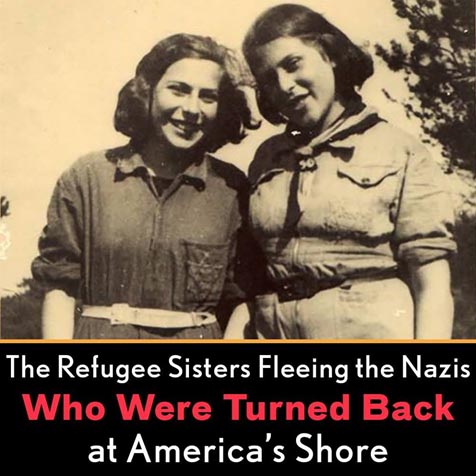
sisters-that-tried-to-flee-the-nazis

On May 13, 1939, a cruise liner, the MS St. Louis, carrying over 900 Jewish refugees desperate to escape the Nazis set off from Hamburg, Germany. Among their numbers were the two teenage girls pictured here, Sibyll and Ruthild Grünthal, who were traveling with their parents, Margarete and Walter. The St. Louis’ original destination was Havana, Cuba where the passengers hoped to seek refuge. But, anti-Semitic protests and editorials were cropping up all over the country and, by the time the ship arrived two weeks later, only a handful of passengers were allowed to disembark; the rest of the asylum seekers were told to take their pleas to the American government. This effort too would be in vain when the ship was blocked from docking at the port of Miami, their pleas for refuge going unanswered from all levels of the government. The ship’s captain, Gustav Schröder, even considered running the ship aground to allow the refugees to escape but U.S. Coast Guard vessels shadowed it to prevent it from approaching the shore. After also being denied refuge in Canada, the ship was eventually forced to return to Europe and many of the refugees it carried later died in the Holocaust, including both Sibyll and Ruthild, who were murdered at Auschwitz and Theresienstadt respectively.

In the United States at the time, the fear of the “other” was being used to stoke Americans’ paranoia and build support for repressive measures justified in the name of “national security.” At the time, government officials argued that refugees posed a security threat, with stories appearing in the media about German spies sneaking in among the refugees. Historians now believe that the concern about refugee spies or their threats to national security were blown far out of proportion but the damage at the time was done. The US shut the door on refugees in need like the ones on the St. Louis, and within two years, the anti-foreigner hysteria would even turn inward as over 100,000 Japanese-Americans were rounded up and sent to live for years in desert detention camps.

The voyage of the St. Louis and the shame such actions cast on American history have new potency today in light of the Administration’s permanent ban on Syrian refugees — of whom, in the United States, 75% are women and children under 14. As University of Michigan law professor James Hathaway observes, the St. Louis is just one example of “what happened when people slam doors shut on refugees.” Syria, he continues, is “probably the easiest example in the world today of people being massacred by a political tyrant. That we would not read the tea leaves of history and understand that the people fleeing are the enemies of our enemy is beyond comprehension to me.” The irrationality of banning refugees for security reasons given the extreme vetting they already undergo was even pointed out by the conservative think tank the Cato Institute which asserted: “[T]errorists who are intent on attacking U.S. soil have myriad other options for doing so that are all cheaper, easier, and more likely to succeed than sneaking in through the heavily guarded refugee gate. The low level of current risk does not justify the government slamming that gate shut.”

Enacting such a ban on last Friday’s Holocaust Remembrance Day has been viewed by many as shamefully symbolic. As Jewish educator Russel Neiss, who launched an education project focused on the St. Louis last week, told the Atlantic: “People always say that if you forget history then you will be doomed to repeat it. This is one of those moments where history gives us an opportunity to think about where we are now. When folks say ‘never again’ or ‘we remember,’ it is important for us to actually do so.” And, he reflects, “There’s something just about remembering the humanity of people that is getting lost in this debate. And when we talk about the importance of refugees being welcomed, we’re not talking about people who are coming here because they want to come here on vacation. We’re talking about people who are coming here because they’re fleeing for their lives. And if we escape that, if we ignore that, if we can’t remember that, then I don’t know what our humanity is really all about.”

Several civil rights groups are already taking legal action against the Administration’s illegal ban. To support these organizations’ legal fight with your donations and advocacy, visit the ACLU Nationwide (https://www.aclu.org/) and the National Immigration Law Center (https://www.nilc.org/). To learn more about how to take a stand as an individual, visit the Indivisible Guide (https://www.indivisibleguide.com/).