California’s governor, Jerry Brown, has followed at least 11 other states approving a law that will issue driving privileges to illegal aliens. The theory is that those people will now be able to legally drive and that means passing a driving test and obtaining auto insurance. Everyone will be safer. What could be wrong with that? If those aliens did all that the streets and highways would be safer.
The Los Angeles Times says “An estimated 1.4 million immigrants are expected to apply for the special permits, to be available in late 2014 or early 2015.”
The flaw in this plan is that I, as an illegal alien, fear being apprehended and deported and will not willingly give my real address to anyone except my closest friends and relatives. Thus I am not willing to divulge my address to the Department of Motor Vehicles. I would rather drive my car carefully but illegally.
The G.O.P., America’s conservative pro-business political party, has decided it wants to stop the president’s health care program at any cost. Thus throwing 800,000 government employees of out of work is not too high a price to pay, in their view, if their goal is reached.
Here is a list of some of the departments and programs that will be affected.
Internal Revenue Service call centers will close
90 percent of Environmental Protection Agency
National parks and museums will be shuttered
Equal Employment Opportunity Commission
Export-Import Bank of the United States
Federal Communications Commission
Federal Trade Commission
National Science Foundation
National Labor Relations Board
US Postal Service Inspector General
USDA – Rural Development
Civilian military workers (Department of Defense) – 400,000 people or ½ of staff
The U.S. debt ceiling will be reached on October 17. If the Republicans tie that limit to funding of the government I predict an impact on stock markets around the world.
While the United States will survive this self-inflicted wound, the country will be significantly diminished in the eyes of the world.
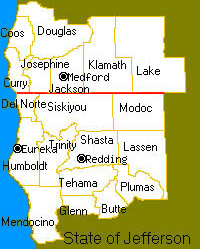
…a little rebellion now and then is a good thing, … Thomas Jefferson
Those who make peaceful revolution impossible will make violent revolution inevitable. John F. Kennedy
The above two quotes appear on the Jefferson State web page.
The fault in this scheme is that every area that finds itself in the minority has the right to succeed. This was settled in the Civil War. States have no right to secede. Areas of individual states should function with the same expectation.
Article IV, Section. 3 – U.S. Constitution New States may be admitted by the Congress into this Union; but no new State shall be formed or erected within the Jurisdiction of any other State; nor any State be formed by the Junction of two or more States, or Parts of States, without the Consent of the Legislatures of the States concerned as well as of the Congress.
Upstate New York has thrives despite its cultural differences with NYC and that surrounding suburban spread.
So while parts of Northern California and Southern Oregon want to form a new state so do parts of Idaho and Montana want the same thing. Just this past week rural northern Colorado reached the same conclusion. The only state cut from another state is West Virginia and that was the result of the Civil War.
Democracy works when we accept the idea of majority rule. It does not work when we split apart. Wait a minute. Tell that to the Congress.
The 223rd and final C-17 cargo plane was delivered to the Air Force last week. The plane was manufactured at Boeing (the old Douglas Aircraft facility) in Long Beach, California. That’s the last airplane manufacturing facility in Southern California. The plant will be closed by 2015 and will result in the loss of 3,000 jobs.
Here is the problem. While Boeing cited sequestration, the Pentagon has made it clear for several years that it didn’t require more C-17s. However, lawmakers pushed through more orders to preserve jobs.
As reported in Businessweek, October 29, 2009, “Every year since 2006, the Pentagon has said that it has enough C-17s. And every year, Congress overrules the military and authorizes funds for additional planes. In October the Senate approved $2.5 billion in the 2010 budget for 10 more C-17s, which would bring the fleet to 215.”
The United States has created high paying jobs by ordering complex technology and other aerospace/biotech products from American companies. To a great extent the military-industrial complex has been the driver of jobs.
We give $1.3 billion of aid to Egypt in the form of military hardware. We even gave Russia $126 million in aid in 2010.
Top Recipients of U.S. Military Aid, FY2010
Country
$ U.S. millions
Afghanistan
6,800.3
Israel
2,799.5
Egypt
1,301.9
Iraq
1,006.0
Pakistan
913.9
Jordan
303.8
Somalia
204.0
Colombia
185.8
Russia
126.8
Sudan
104.9
Mexico
96.0
Poland
55.6
Is this the only way we can provide our citizens with good jobs?
Our willingness to allow everyone to have a gun is part of what makes the United States an exceptional country. Freedom of press, freedom of religion, democracy is in all of the countries listed below and many more.
Despite the latest killing in Washington D.C., Americans view their right to bear arms as a vital part of their freedom. Thus even the killing in Newtown, Connecticut of 20 small children and their teachers is the price we pay for that freedom.
I disagree with this philosophy but it is the will of the majority.
According to GunPolicy.org, run by Philip Alpers, a firearms analyst at The University of Sydney, the United States is unusual with what Alpers described as the “two pillars” of gun control: licensing gun owners and registering weapons.
“You are basically the only country in the developed world that doesn’t license gun owners across the board and you are almost alone in not registering guns across the board,” Alpers said. “It’s very difficult to compare [the U.S.] with others, because you simply don’t have those things.” New Zealand and Canada are the other developed countries that don’t register guns across the board, Alpers said. The two countries register handguns and military-style semi-automatics, but not rifles and shotguns.
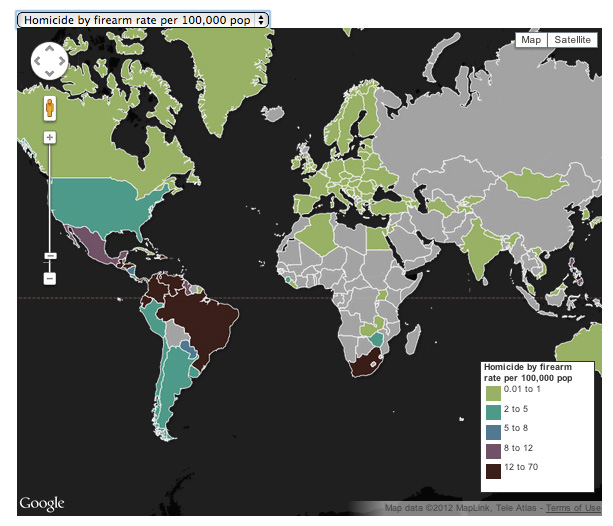
Adjusting for population, the U.S. death rate by firearms — which includes homicides, suicide and accidents — was 10.2 per 100,000 people in 2009, according to the Coalition for Gun Control. The closest developed country was Finland, with a firearms death rate of 4.47 per 100,000 people in 2008, less than half that of the U.S. rate. In Canada, the rate was 2.5 per 100,000 people in 2009. In the United Kingdom, the 2011 rate was 0.25 per 100,000 people.
A map showing homicides rates form an article in the Washington Post December 14,2012.
Here’s how several other prosperous nations deal with the issue: The United Kingdom In 2011, the U.K. had 0.07 gun homicides for every 100,000 people; the U.S., by contrast, had 3 gun homicides for every 100,000. In 2009 there were 138 gun deaths in the U.K, where there are 6.7 firearms for every 100 people. One reason contributing to this is the U.K.’s strict gun laws. According to an English rifle and gun club legal center, any person possessing a firearm in the U.K. must posses a Shotgun Certificate or a Firearm Certificate.
Machine guns, pepper spray, semi-automatic, and pump-action rifles, and any firearm that has a barrel less than 30 centimeters in length are prohibited.
The only firearms that can be owned legally are shotguns, black powder weapons, manually-loaded cartridge pistols and manually-loaded center-fire rifles, all termed “Section 1” firearms.
To gain a firearm certificate, applicants must be over age 14, and must demonstrate they have satisfactory security and “good reason” to own a rifle. Applicants must declare all criminal convictions and name two references to support the application. Applications must be renewed every five years.
The requirements are largely the same for a shotgun certificate, although the applicant doesn’t need two references, only one counter-signatory — and there is no minimum age.
Anyone convicted of a criminal offense can’t even handle a gun for five years. If the sentence involved more than three years in prison, there is a lifetime ban. Canada
The U.S.’s neighbor to the north also has outstandingly low gun casualty statistics. In 2009, there were 0.5 deaths per 100,000 from gun homicide — only 173 people. Still, the ownership is comparatively high — there are 23.8 firearms per 100 people in the country. There is no legal right to possess arms in Canada. It takes sixty days to buy a gun there, and there is mandatory licensing for gun owners. Gun owners pursuing a license must have third-party references, take a safety training course and pass a background check with a focus on mental, criminal and addiction histories.
Licensing agents are required to advise an applicant’s spouse or next-of-kin prior to granting a license, and licenses are denied to applicants with any past history of domestic violence. Buyers in private sales of weapons must pass official background checks.
Canadian civilians aren’t allowed to possess automatic weapons, handguns with a barrel shorter than 10.5 cm or any modified handgun, rifle or shotgun. Most semi-automatic assault weapons are also banned. As a result of exemptions, several kinds of assault weapons are still legal in Canada, although this has been the source of some controversy. Japan
Japan’s gun policies are notoriously strict. Civilians cannot possess handguns, automatic assault weapons, semi-automatic assault weapons, military rifles, or machine guns. Japanese civilians aren’t even allowed to own swords. Without a license, a Japanese citizen isn’t even permitted to touch a firearm. Failure to follow this law can result in up to 10 years in prison.
What is legal are hunting rifles and shotguns, but those can only be obtained after an exhaustive application process. An aspiring gun-toucher must first take an all-day class and pass both written and practical exams. Then, applicants are required to go to the hospital for a mental health test, and provide police with a medical certificate attesting their mental health and drug-free status.
The police then investigate the applicants ;background, relatives and group affiliations. Involvement in some political or activist organizations is grounds for categorical denial of license application.
Only after all that can a Japanese citizen buy a gun. Even then, gun-owners are required to store the gun in a locker, store ammunition in a separate locked safe, and provide for the police a map of the location of the locker,
Gun owners must then submit to annual inspections of the rifle or shotguns and retake the shooting range class and written exam every three years. Australia
Australia had 30 gun homicides in 2010, which amounted to 0.13 gun deaths for each 100,000 people. Australians hold 3-3.5 million guns, a rate of 15 guns for every 100 people.
Australia is a rare nation that has had a significant shift toward additional gun control in recent years. Following a 1996 shooting spree that left 35 Australians dead at the Port Arthur tourist location in Tasmania, the government launched a major overhaul of gun laws.
In the decade before Port Arthur, Australia saw 11 mass shootings; since then, there has not been a single mass shooting and the gun murder rate has continued its steady decline.
Here’s what they did: Pro-gun Conservative John Howard pushed through an ambitious gun control program. The laws banned all automatic and semi-automatic weapons and instituted strict licensing rules involving background checks and waiting periods for purchases.
The conservative government also instituted a buyback program, where people were paid for turning in newly illegal automatic and semi-automatic rifles; 650,000 weapons were voluntarily handed in and destroyed at a cost of roughly $359.6 million.
The president’s speech dealing with Syria clearly defined our moral outrage and our leadership in enforcing internationally accepted norms. Unfortunately America’s history dealing with Muslim countries has been a failure.
Iraq, Afghanistan, Libya, and Egypt are all realities. Despite America’s efforts to help those nations transition to democracies, all have been a failure.
Even if this proposed attack on Syria will be significant, it is unlikely to change Bashar al-Assad’s behavior.
If the president really does believe that the United States has a moral responsibility to deal a significant blow against Syria, he could have acted without congressional approval. Other presidents have acted in the past without that approval.
He still can act today without that approval. He won’t. Why? He does not have the backbone.
A Review of an Aug 28, 2013 post. Look at all the money those war material manufacturers will be making. Is this Obama’s job stimulus program? Green is for m-o-n-e-y.
It was no surprise that the stock market dropped yesterday. A 1.59% drop in one day on the S&P 500. After all the threat of the United States at war in Syria could have an additional impact on our country. Most likely it will impact every country as the cost of oil and other commodities increases.
Then today the stock markets in the United States have risen by .3%. How can that be? Why would the stock market rise when the threat of war is still so prominent?
MSN Money seems to have the answer. “Sales for the world’s 100 largest arms producers amounted to $411 billion in 2010, according to the Stockholm International Peace Research Institute. That was up 1% from the year before, a modest rise that was held in check by the drawdown of foreign forces in Iraq.”
The top ten listed below.
United Technologies
Arms sales in 2010 $11.4 billion
L-3 Communication
Arms sales in 2010 $13.1 billion
Finmeccanica
Arms sales in 2010 $14.4 billion
EADS
Arms sales in 2010 $16.4 billion
Raytheon
Arms sales in 2010 $23 billion.
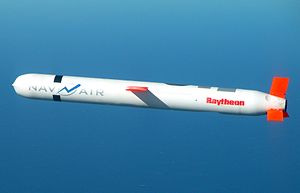
Raytheon’s web site says, “The combat-proven Tomahawk is the world’s most capable cruise missile and is ideally suited for critical long-range, precision-strike missions against high-value with minimal collateral damage.”
Arms sales as percent of total revenue: 91%.
Total Number of Employees: 72,400.
General Dynamics
Arms sales in 2010 $23.9 billion
Northrop Grumman
Arms sales in 2010 $28.2 billion
Boeing
Arms sales in 2010 $31.4 billion
BAE Systems
Arms sales in 2010 $32.9 billion
Lockheed Martin
Arms sales in 2010 $35.7 billion
Among Lockheed’s major products are the Trident missile and the F-16 and F-22 fighter jets.
It is not just President Obama that is facing a dilemma about what actions to take in Syria. Almost every leading congressman and senator has mixed feelings over what actions to take.
The reason is that a win by the Assad regime or the rebels result in equally troubling consequences.
As a benevolent dictator Assad has kept a lid on sectarian hatred that has enabled Syrian minorities to live in relative peace. Assad has not been continuously at war with Israel but at the same time has provided the sanctuary to the leader of Hamas. He has permitted the transfer of weapons across his country from Iran to Hezbollah in Lebanon. In an Arab war or war with the United States, he would be allied with Iran.
The rebels are dominated by Muslim extremists (Muslim Brotherhood supported by Iran and al-Qaeda that are supported by contributions from around the world). They appear to be in agreement that Israel must be obliterated and continuing attacks on Western Europe and America by any means.
Today’s Los Angeles Times has a front page article, More harm than good in strikes?, about the success of air attacks on nations that have defied American will or wishes. The resulting consequences of those attacks have been mediocre at best. The article’s words are “The type of campaign expected in Syria has a poor track record.” Sited are the two major bomb and cruise missile episodes against Osama bin Laden and Saddam Hussein’s Iraqi government and the 1986 bombing of Muammar Gaddafi’s Lybia. While all the attack weapons hit their targets, those events had achieved little. Even the invasion and removal of Saddam Hussein from Iraq is in dispute (there are almost daily reports of bombings in that country).
Barack Obama’s mistake was drawing a “red line.” Americans are tired of war. We do not have the man power or the persuasive skills to change the behavior of any society. Just yesterday I read of Buddhists setting fire to the homes of Muslims in Myanmar (Burma). Should America march into that country? Of course our military-industrial complex will say, Yes.
As sad as the gassing of innocent people is to most of us, there is little we can do to stop the carnage unless we send troops into Syria. Then a few years later we will withdraw and the carnage will resume.

 Coast Contact