December 7, 1941 Changed the United States Forever

December 7, 1941

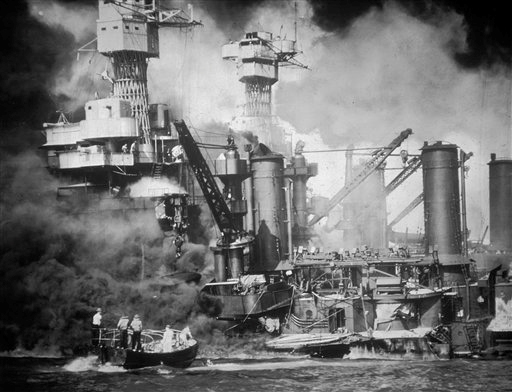
In this Dec. 7, 1941 photo provided by the U.S. Navy, sailors on a small boat rescue a USS West Virginia crew member from the water after the Japanese attack on Pearl Harbor, Hawaii. (AP Photo – U.S. Navy)

—————————————————————————————————

Yes, every year there are commemorations of the bombing of Pearl Harbor in Hawaii. We honor those who are still alive from that historic day. Ceremonies occur in many parts of the United States.

The real impact was not just America’s entry into WWII. The bombing of Pearl Harbor changed America’s attitude about the rest of the world and its place in the world. The United States surrendered its non-intervention policy (isolationism) that had survived since its inception to a position of leadership in world affairs that exists to this day.

President George Washington, in his farewell address, advised the nation to have “little political connection as possible.” This recommendation was followed up in 1823 with the Monroe Doctrine and reaffirmed in the Polk Doctrine, announced on 2 December 1845.  http://www.answers.com/topic/nonintervention-policy#ixzz2ER92HSBw

 William Seward, Secretary of State under President Lincoln wrote a letter to one William Dayton in 1863 defining The American Doctrine of Non-intervention in which I quote, “Our policy of non-intervention, straight, absolute, and peculiar as it may seem to other nations, has thus become a traditional one, which could not be abandoned without the most urgent occasion, amounting to a manifest necessity.”

 Even after WWI the United States returned to its non-intervention policy when it refused to join the League of Nations (an organization similar to the United Nations).

Since WWII there has been the Korean War, Vietnam War, America’s total support for Israel, America’s intervention in Lebanon (241 marines killed), Kuwait (first Gulf War), Iraq War, Afghanistan.

The U.S. has 737 bases around the world, of which 295 are considered “major military bases,” and has military personnel in 153 countries. Since the middle of the twentieth century the American State has intervened hundreds of times in the affairs of other countries, overthrowing elected leaders and invading sovereign countries. http://tfboyle.hubpages.com/hub/Non-Intervention-A-Foreign-Policy-for-the-American-Citizen

Here we go again! Today the United States is considering involvement in Syria because there is an indication that their government may be planning to use sarin gas. “What you should know about sarin gas, the chemical weapon believed to be in the Syrian regime’s possession.” This is part of an article in the Global Post.

 Is it Manifest Destiny or are we Americans just too sympathetic to not aid and abet our fellow man?

Gloat

Why are Democratic pundits gloating over the election results?  Barack Obama did not win by an overwhelming majority.

The final results from the presidential election are impressive when looking at the Electoral College (332 to 206) but not so impressive when looking at the popular vote (65,258,278 or 50.9% to 60,658,920 or 47.3%).  Thus .9% gave the president a win.  Hardly a landslide.

Despite that narrow victory Democratic pundits are gleefully hashing out the mistakes made by Mitt Romney and his campaign election team as if they were utterly incompetent.

Wikipedia lists these landslide victories among the popular vote.  These were wins worth gloating over.

So while I disagreed with Mitt Romney’s opinions on women’s rights (from pay to abortion and contraception), his lack of concern for 47% of the population, his solution to illegal immigration (self deport), and his confrontational views in foreign policy; almost half of all Americans gave him their vote.

Mr. President stop gloating.  You do not have a mandate.

35 Days to Fiscal Cliff Hell

Some of this posting is based upon an article titled, “Fiscal Cliff Could Cost America 277K Jobs in January” posted on this website.

While addressing the House Financial Services Committee in February of this year, Federal Reserve Chairman Ben Bernanke coined the term “fiscal cliff,” describing, “a massive fiscal cliff of large spending cuts and tax increases” scheduled to occur on January 1, 2013.

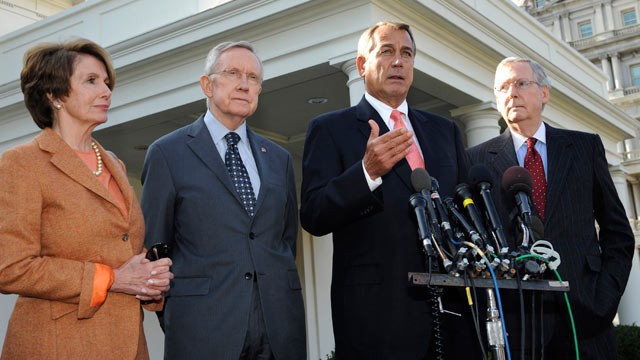
Just a few days ago President Barack Obama, House Speaker John Boehner, and Senate Majority Leader Harry Reid and minority leaders were all talking as if an agreement to avoid the fiscal cliff was a realistic possibility.

Today’s news reports are that little progress has been made.

Should Congress fail to act, allowing the tax cuts to expire and budget cuts to take effect, the results could be drastic, increasing the annual federal tax burden on the average family of four by about $2,200, according to the Congressional Budget Office.

The major components of the fiscal cliff are the expiration of the Bush Tax Cuts, federal unemployment benefits, and social security payroll tax cuts, on top of automatically triggered spending cuts associated with the Budget Control Act of 2011.

Cuts associated with the Budget Control Act could result in the loss of 277,000 federal jobs, according to a report from the George Mason  University Center for Regional Analysis. The report assesses the impact the Budget Control Act would have on all agencies subject to cutbacks including Agriculture, Commerce, Education, EPA, Energy, Health and Human Services, Homeland Security, Housing and Urban Development, State, NASA, Transportation and Interior. While the cuts would only reduce federal spending from 22.9% of GDP to 22.4% of GDP, according to the CBO, they would cause significant job losses for federal health inspectors, Federal Aviation Administration workers, and FBI agents.

The president does not appear to be willing to write a piece of proposed legislation to avert going over the fiscal cliff.  This was my complaint about his management style throughout his first term.  It was no Barack Obama who wrote the Affordable Care Act.  It was members of the Democratic Party leadership in the houses of Congress.

If the sequestration occurs both political parties deserve blame.  The president should not be campaigning as he did during much of his first term.  He should be negotiating with congress.  His failure to bring this self inflicted event to a satisfactory conclusion will dog his next four year term.

Abraham Lincoln and the Never Ending Civil War

Perhaps the title of this post should be “Is this the and of the United States?”

The American Civil War, also called War Between the States , fratricidal four-year war (1861–65) between the federal government of the United States and 11 Southern states that asserted their right to secede from the Union. The war ended 147 years ago.

After all of these years since the end of the Civil War the South is still re-fighting every battle and every event connected with the confederacy. Steven Spielberg’s new movie simply titled Lincoln says we have not gotten over the war or the events that led up to the war.

The new Steven Spielberg movie is based upon the book Team of Rivals by Doris Kearns Goodwin. It’s an enthralling book. Even someone who is not particularly interested in reading history books will find this biography a compelling read.

The troubling part of this story is that citizens of all 50 states have submitted petitions to secede from the United States and that happened just this year. Seven southern state petitions have collected significant number of signatures. The leading is Texas with over 101,000. Major numbers of petition signers are residence of Texas, Louisiana, Tennessee, Alabama, North Carolina, Georgia, and Florida.

Happily Anti-Secession Petitions are Gaining Clicks, Too! The thought is that those wanting to secede should be stripped of their citizenship and deported. I would agree with that thought. Perhaps Mexico will take them.

One More Reason There is a Federal Government

Those in the path of Hurricane Sandy should be grateful that Mitt Romney was not elected president.  Last year Mr. Romney pledged that if elected he would shrink the deficit by axing FEMA and handing the responsibility of disasters over to the states and local governments.

During a CNN debate at the height of the GOP primary, Mitt Romney was asked, in the context of the Joplin disaster and FEMA’s cash crunch, whether the agency should be shuttered so that states can individually take over responsibility for disaster response.

“Absolutely,” he said. “Every time you have an occasion to take something from the federal government and send it back to the states, that’s the right direction. And if you can go even further, and send it back to the private sector, that’s even better. Instead of thinking, in the federal budget, what we should cut, we should ask the opposite question, what should we keep?”

“Including disaster relief, though?” debate moderator John King asked Romney.

“We cannot — we cannot afford to do those things without jeopardizing the future for our kids,” Romney replied. “It is simply immoral, in my view, for us to continue to rack up larger and larger debts and pass them on to our kids, knowing full well that we’ll all be dead and gone before it’s paid off. It makes no sense at all.”

The Los Angeles Times is reporting today that New Jersey Governor Chris Christie is planning to ask the federal government to pay 90% of the associated costs.  Those costs are estimated to be in the billions of dollars.  They are already at $20 billion.  New York officials have indicated they will seek more than $30 billion in federal aid.

It is unlikely that any state could handle the costs of devastating climatic or geological occurrence.  Think Hurricane Sandy, Hurricane Katrina, and the Northridge Earthquake.

If we are the United States we come together to help those in need.  This is just one of the many reasons Americans re-elected Barack Obama.

Soap Opera Government

What a wonderful way to distract the public from the issues that really matter.  Most likely a series of worthless congressional hearings followed by more new regulations.

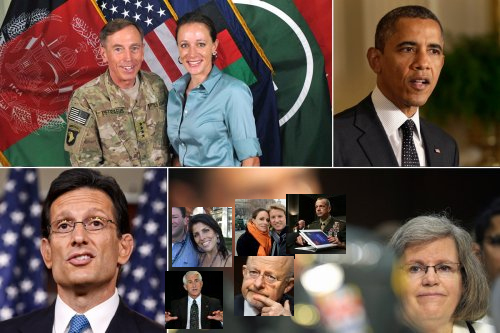
 If ever there was a real soap opera it’s the events now surrounding David Petraeus.  Now involved is General John Allen, Congressman Eric Cantor, Paula Broadwell, Jill Kelly, unnamed FBI agent, Holly Petraeus, Director of National Intelligence James Clapper and President Barack Obama.

The sequence of events as reported by blaze.com.  This really could be made into a soap opera.

Spring 2012:

  • FBI starts investigation, intercepting Petraeus’ emails and      reviewing older emails going back to his time in Afghanistan, where he was commander of U.S. Forces from      July 2010 to July 2011 (Newsmax, Nov. 9).

Week of October 21:

Oct. 26:

  •  Broadwell delivers speech at University of Denver, discussing      details about how Petraeus handled the attack on the U.S. consulate in      Benghazi and revealing possibly classified information about alleged      Libyan militia members being held prisoner at that consulate and that      situation may have been a potential catalyst for the attack (Fox News, Nov. 12).
  • Glenn Beck predicts that David      Petraeus would take the blame on Libya: “Who have they tried to sell down the river      every step of the way? The intelligence,” Glenn said. “You watch. Petraeus      is going to be the fall guy. They’re going to have him step down. They’re      going to point all fingers to him.” (TheBlaze TV, Oct. 26)

Week of October 28:

  • Federal investigators interview Petraeus. Prosecutors conclude      afterward they likely will not bring criminal charges. (Reuters, Nov. 11)

Oct. 31:

  •  House Majority Leader Eric Cantor’s office contacts FBI to inform them about information from an FBI whistle blower who told Cantor (R-Va.)      in late October that Petraeus had been involved in an extramarital affair      and was potentially putting national security at risk (New York Times, Nov. 10, 2012).

Nov. 6 (Election Day):

  • At about 5 p.m.: the FBI notifies Director of National Intelligence James Clapper,      who oversees the CIA and other intelligence agencies, about      Petraeus. Clapper speaks to Petraeus that evening and again Wednesday and      advises him to step down (Reuters, Nov. 11).

Nov. 7:

  • Clapper informs White House National Security Council official that      Petraeus may resign and President Barack Obama should be informed. The president      is told about it later that day (Reuters, Nov. 11).

Nov. 8:

  • At 11 a.m. A Petraeus meeting with foreign dignitaries scheduled for 2:30 p.m. is canceled and his visitors are informed he      has to go to the White House to meet with Obama. Petraeus meets with Obama  at the White House and offers his resignation, explaining the circumstances behind it. Obama did not immediately accept the resignation      (Reuters, Nov. 11).

Nov. 9:

  • In a statement to CIA    employees Friday, Petraeus said he submitted his resignation to President    Barack Obama on Thursday and Obama accepted it Friday afternoon (CIA).
  • Fox News reported the affair was with his biographer and      was discovered during the course of an FBI investigation on an “unrelated      and much broader case.” According to Fox, journalist and biographer Paula      Broadwell’s name came up during the investigation, which led to uncovering      the affair (Fox News, Nov. 9).
  • Fox News analyst Ralph Peters, a retired Army lieutenant colonel,      speculates that Obama administration knew of the affair and waited for the      right moment to “play the card” (Fox News, Nov. 9)

Nov. 11:

  •  A senior U.S. military official says Broadwell sent harassing      emails to a woman who was the State Department’s liaison to the military’s      Joint Special Operations Command. The official, who asked to remain      anonymous, says 37-year-old Jill Kelley in Tampa, Fla., received the emails from Petraeus biographer      Paula Broadwell that triggered an FBI investigation. (TheBlaze/AP).

Nov. 13:

  • To be continued.  Tune into to your local newspaper, favorite web site, or television station for the latest episode.

Japan’s Technology is Impacting the World

Bloomberg Businessweek sells advertising that looks like its columns.  Companies and countries use this methodology to promote their business friendly atmosphere.  The sections are clearly marked as “advertising section.”  In one edition the United Arab Emirates bought pages that promoted the business opportunities in those nations.  The information was presented in a format that leads readers to believe the articles were being presented by the magazine.  The font sizes and the presentations give the appearance that they are indeed being presented by the magazine publisher.

In the October 22, 2012 edition there was a 13 page presentation that was sponsored by Japanese companies.  It is impressive and informative.  It makes me realize how far other counties have developed compared to the United   States.  The article is long but is worth your time.  I was especially impressed by the fact that a Japanese company is updating the British railway system.  Another has developed quick set up homes for people who have been displaced by natural disasters (think the homes damaged by Hurricane Sandy).

Following is very abridged version of the article with significant statements in bold text.

A new market for Japanese rail technology is the U.K., the original home of railways. Hitachi Ltd. has formed a consortium with a British company to supply a total of nearly 600 high-speed rail carriages, and the supporting maintenance infrastructure, starting delivery in 2017. The Hitachi Super Express trains will be manu­factured in a newly built factory in the north of England. The total value of the project. including the maintenance and repair centers to be constructed throughout the U.K., is estimated at between ¥400-¥500 billion ($5.1-$6.3 billion).

These new trains will replace the U.K.’s aging Intercity fleet on the East Coast Main Lines and the Great Western Main Lines. The lightweight construction of the trains (between 15 and 40 percent weight reduction per seat) lowers energy consumption of the bi­mode units, and this light weight also helps reduce the travel time for the growing number of passengers on the routes where these trains will be operated.

High-speed shelters

Following the Great East Japan Earthquake, over 340,000 people were displaced, with most taking refuge in emergency shelters, such as school gymnasiums, until more permanent housing could be arrangec for them. The lack of privacy for extended periods (blankets or tempo­rary cardboard partitions were often the only divisions between family groups) caused severe additional emotional stress to many survivors.

Photo was scanned from Businessweek

Accordingly, a need was perceived for lightweight flexible structures that can be quickly transported and erected to provide such spaces. Enter the QS72 from Daiichikensetsu Ltd., with “QS” standing for “Quick Space” and “72” representing the number of hours within which such components can be deployed to provide floors, walls and roofs for meeting rooms, emergency clinics, toilets and other areas, in the time when disaster survivors are at their most vulnerable psychologically.

Constructed of polypropylene, the system requires only a few people and no tools to assemble. Using a lightweight construction method providing thermal insulation, the units can be linked together in a variety of ways to serve various needs of a displaced community. The basic construction recalls the principles of origami in the way the different parts fold and unfold to create the spaces. A single unit can temporarily accommodate a small family until more permanent accommodations can be arranged and constructed. Following this, the unit can be combined with others and reused as a community space, for example, or a store or medical center. Indeed, following the March 2011 quake, 100 units were donated to the Japanese Red Cross, and used as general purpose structures in lshinomaki, supplementing the existing hospital facilities.

Keeping in touch during disasters

A key issue following a disaster is the effective dissemination of information. Making use of one of the best IT infrastructures in the world, the Japanese government has developed Disaster Guide­lines and Action Plan for IT, with a twopronged emphasis on the preservation of life and the well-being of the survivors.

First, the safety of inhabitants of the affected area, and the status of emergency services, is confirmed. Following this immediate response, the system changes to provide information to survivors about vital infrastructure elements (utilities, communications and transportation). The rapid growth of smartphone use in Japan al­lows for rapid and easy sharing of information. Already, earthquake early-warning systems are incorporated into the cellular network, and internet sites designed for smartphones are planned that will allow parents to check on the safety of their children at school, as well as to use the newly developed J-anpi system to check on others’ safety and reassure friends and family of their own.

Lessons learned from the March 11 disaster that have been incorporated into the plan include the use of alternative channels (websites, email and social network services) beyond the usual emergency number. These channels can also disseminate information, using cloud services to ensure continuity of service, and supplement radio and TV broad­casts. The Prime Minister’s Office also operates a Twitter account, allowing the government to “push” up-to-the-minute information to millions of smartphone users.

In the event of future disasters, Japan hopes to save lives, and to improve the lives of survivors through such implementations of technology, and to share these techniques and technologies with other nations. – H.A.
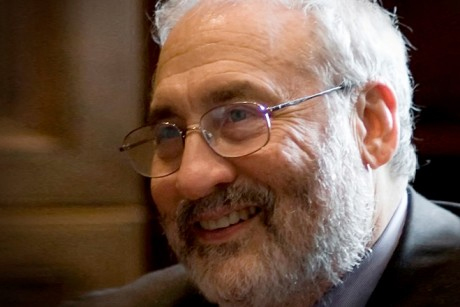
Joseph Stiglitz: “Romney’s plan is based on magic”

Joseph Stiglitz has a decent résumé. He won the Nobel Prize in economics and served as chairman of Bill Clinton’s Council of Economic Advisers before being named chief economist of the World Bank.

Since the election of Barack Obama, Stiglitz has also been something of a thorn in the side of the current administration, consistently critiquing the White House for falling short.

Stiglitz gave an interview to salon.com on his appraisal of the Romney economic plan. Here is a summary of that interview.  It’s somewhat long but worth your time.

What’s at stake in this election for the U.S. economy?

Quite a lot. First, there’s what we call the macro-economy. The budget cuts that Romney/Ryan propose will certainly slow growth. If the European downturn continues that could tip us into a recession. The cuts certainly won’t provide the kind of stimulus that Obama’s jobs bill, for instance, pushes. Romney’s plan is based on magic: Just because he gets elected, the economy is supposed to take off. There is no evidence that anything like that would happen. Quite the contrary — I think the opposite would happen. The business community would see the cutbacks coming and that would itself cause a slowdown in the economy.

You’ve made the negative case for how the economy will suffer if Romney is elected. Is there a positive case to be made for Obama? You’ve been one of the people on the left most critical of Obama’s efforts on the economy. Why should progressives vote for him now?

I think the main reason, quite honestly, to vote for him is that if he loses there could be a major step backward in every aspect. Not the least important of which is the importance of the Supreme Court, which would affect inequality of political power, as with the Citizens United case. The Court will also rule on basic human rights, gender rights, discrimination, things I think progressives should care a lot about.

But in terms of the economy, while I’ve been critical, there still has been progress in an awful lot of areas. Less progress than there should have been, less progress than was promised, but progress all the same.

Where do you see that progress?

Healthcare. Access to healthcare for everybody is an important step.

I was about to ask, what have been your biggest disappointments?

Housing policy has been a big disappointment. But compared to Bush, who didn’t do anything, and the Republicans, who haven’t proposed anything — Romney has been totally silent on the issue — at least Obama did something. So I am disappointed …

Looking ahead, are there things Obama could do that would represent a real step forward, rather than just consolidate what has already been achieved, or simply prevent going backward?

There aren’t many magic bullets, but let me talk about a couple things. Obviously, more progressive taxation — getting rid of the distortionary provisions in corporate welfare, special treatment of capital gains, carried interest — would make our economy more efficient and less unequal.

One of the biggest areas of progressive disappointment with respect to Obama has to do with banking policy. Do you see any chance of improvement there?

We face a choice between someone who is viewed as being too close to the financial industry and somebody who is in the financial industry. Of the two I’d rather have someone who is close but not init. So to me, there’s just not much choice.

Social Security Now Called ‘Federal Benefit Payment’

Have you noticed, your Social Security check is now referred to as a “Federal Benefit Payment”? It’s not accurate!

Not only did we all contribute to Social Security but our employers did too. It totaled 15% of our income before taxes.

If you averaged $30K per year over your working life, that’s close to $180,000 invested in Social Security.

If you calculate the future value of your monthly investment in social security ($375/month, including both your and your employer’s contributions) at a meager 1% interest rate compounded monthly, after 40 years of  working you’d have more than $1.3+ million dollars saved. This is your personal investment.

Upon retirement, if you took out only 3% per year, you’d receive $39,318 per year, or $3,277 per month.

That’s almost three times more than today’s average Social Security benefit of $1,230 per month, according to the Social Security Administration (Google it – it’s a fact). And your retirement fund would last more than 33 years (until you’re 98 if you retire at age 65)!

I can only imagine how much better most average-income people could live in retirement if our government had just invested our money in low-risk interest-earning accounts. Instead, the folks in Washington pulled off a bigger Ponzi scheme than Bernie Madoff ever did.

They took our money and used it elsewhere. They “forgot” that it was OUR money they were taking.

They didn’t have a referendum to ask us if we wanted to lend the money to them.

And they didn’t pay interest on the debt they assumed. And recently, they’ve told us that the money won’t support us for very much longer.

But is it our fault they misused our investments? And now, to add insult to injury, they’re calling it a “benefit,” as if we never worked to earn every penny of it.

Just because they “borrowed” the money, doesn’t mean that our investments were a charity!

Let’s take a stand.

We have earned our right to Social Security and Medicare. Demand that our legislators bring some sense into our government – Find a way to keep Social Security and Medicare going, for the sake of that 92% of our population who need it.

Then call it what it is: Our Earned Retirement Income. 99% of people won’t forward this.

Will you?

No Real change in the Unemployment Rate

Try Crunching these numbers!

President Obama received some good news last night.  The unemployment rate has dropped to 7.8%.  As Chris Mathews and others have said repeatedly, no president has been re-elected when the rate was over 8% since FDR.  Market Watch has questioned whether the books have been cooked.  I prefer to believe the data is accurate.  After all, the government could have provided false data over the past year and apparently did not.  How could the unemployment rate decline?  More people stopped looking for jobs than those obtaining new jobs.

The problem is the focus of the data.  The BLS trumpets the unemployment rate rather than the number of unemployed.  It’s only after extensive reading did I learn about another piece of data that tells the real story.  Table A-15 (Alternative measures of labor underutilization) of the BLS monthly report on Line U-6 provides a more accurate reflection of the true unemployment situation.  That line provides “Total unemployed, plus all persons marginally attached to the labor force, plus total employed part time for economic reasons, as a percent of the civilian labor force plus all persons marginally attached to the labor force.”

That number is 14.7% for this past month.  At its peak in December 2010 the percentage had reached 16.6%.

The president is silent on his plans and Mitt Romney has said he will create 12 million jobs in four years.  There are no details on the plans.  No wonder!  No one employs more help without demand.  Lower taxes are wonderful for the pocket book but will that make a difference in hiring?

I don’t think so!