A $1,000 Pill in the United States Costs $4.29 in India

As reported in BusinessWeek magazine (January 11-17, 2016 edition) the treatment for Hepatitis C in the United States by Gilead Science’s Sovaldi costs $1,000 a pill or $84,000 for the entire treatment. However in India the same medication is being manufactured by an Indian company as a generic with another name but is the same medication. The cost is $4.29 per pill.

Some medicines are sold in Canada for one-third (1/3) the price that Americans pay for the identical product. Aciphex and Dexilant are among that group.

Senator Bernie Sanders has spoken repeatedly about our broken health care system that does not provide health care for everyone. Medicare is not permitted to negotiate with pharmaceutical companies but must pay the rates those companies set.

Why hasn’t our congress addressed these issues? The simple answer is that pharmaceutical companies have the lobbyists who influence our representatives and provide the funding for re-election.

No matter who is elected president in November 2016 it is a good bet that this situation will not be changed in any significant way as long as we keep sending the same congress representatives and senators back to Washington.

Poetic Justice

A grand jury in Houston was asked to investigate Planned Parenthood Gulf Coast, a branch of one of the country’s most important healthcare providers for women, the grand jury found no wrongdoing on the part of the group, whose staffers were secretly videotaped talking about the cost of procuring fetal tissue for research. Instead, the grand jury handed down indictments against two of the antiabortion zealots involved in the “sting.”

If that’s not poetic justice, nothing is.

I understand there are many in the country who oppose abortions and want to find every avenue to stop them.

David Daleiden, the antiabortion zealot who created the Center for Medical Progress as a front for his deceptive efforts, has been indicted on a felony charge of tampering with a government record. (The reason for that charge is unclear, but Planned Parenthood has alleged that Daleiden and his associates used fake government identifications and used aliases.)

Once again it is men who are trying to tell women how they should handle an unwanted pregnancy. I am certain that there are women who oppose abortions too but it seems to be men who are in the forefront of the antiabortion fight. Carly Fiorina has been in the forefront of the fight. She claimed to have seen a video of a fully formed fetus kept alive to harvest the brain. Chris Wallace debunked that claim on his Sunday morning show.

So there is hope for the people of Texas.

Can We Trust Government Officials to Keep Us Safe?

Invariably when a government agency head or elected official makes a mistake he says, “I take full responsibility.”  What he doesn’t do is resign or pay a fine and most certainly does not go to jail.  So what does “taking responsibility” mean?  It really means I apologize for my errors and hope not to be caught again.  

The problems started after the push of a button, a toast with Flint River water and a budget forecast of saving $5 million that had to be tempting for a city in the midst of a financial emergency.

Despite the complaints that the water appeared dirty and had a peculiar odor and taste Flint, Michigan continued pumping water from the river.

The consequence is lead poisoned water that can result in brain damage to children and possible early death. The financial cost to replace the ruined piping is estimated at $75 million.

Porter Ranch residents suffering from headaches, nausea and other symptoms from a natural gas leak that has displaced thousands are assigning blame to a damaged well in the Santa Susana Mountains north of Los Angeles. Some government agencies are questioning the claims that although some people have experienced some problems there will be no long term effects.

This reminds me of the high school built on an abandoned oil field in Los Angeles. The abandonment of that project took major community involvement. Or the Virginia communities that were impacted by the Dan River spill of coal ash in February 2014.

Is there any evidence that government and business officials can be trusted to provide honest information about health issues?

The answer is an emphatic NO.

End of Life Act is NOT Assisted Suicide

We all watched with horror on 9-11 when so many people threw themselves out of the windows of the World Trade Center. They were people of all faiths and no faith. They were people of many national origins and ethnicities. And even though most faiths and traditions disapprove of suicide none of those who jumped were denied burial rites by any of their faiths.


All who wished, or whose families wished, received appropriate sacraments and were buried in sanctified ground. But how could this be with the strong prohibition against suicide? Simple. We all understand that human beings cannot be expected to stay in a burning room. It is primal–one of the two inborn fears that humans have.


We fear fire, and we fear falling. It’s ironic and tragic that those were the choices for many on 9-11. As far as we know all who had a choice chose falling and bringing a certain and quick end to their suffering.


Governor Brown just signed a controversial bill called “The End of Life Option Act” that is unfortunately and misleadingly referred to as the “Right-to-Die Bill” or “Assisted Suicide Bill.”


Remember the 9-11 jumpers were not suicides; they were escapees. They were escaping the anticipated pain of being burned alive. We understood. We all understood.


How is it we have such difficulties in understanding that some people today are living with real pain, right now pain and not anticipated pain? How can we not have the same understanding and compassion for those suffering from intractable, chronic and acute agony?


For some their very bodies are burning rooms in which they should not be required to stay. There are conditions that even our strongest painkillers can barely touch. There is pain so severe that the cost of knocking out is to be so narcotized as to have no quality of life.


The great question–and it doesn’t have an easy or glib answer–is when medical treatment prolongs living and when it prolongs dying? Most of us don’t want our lives cut short or our deaths prolonged. And it is not a fine line between the two but a big fat blurry line. This makes it a hard call; and it should be.


We certainly don’t want people to choose death for a transient condition or from treatable depression. We need some standards and processes. But we also need to understand that bills like California’s are not about the “right to die,” but the Right to Stop Dying. It’s not about ending living but ending dying.


Our wonderful modern medicine has worked miracles at keeping us alive, at fixing once untreatable conditions and curing once incurable diseases. But it has also made it sometimes too hard to die. It has fought diseases and conditions on the battlefield of the patient’s body. It is alright to hate the disease or condition, but we must also remember to love the patient.


Suicide is the wrong word to be associated with this issue. Suicide is about taking one’s own life or acting against one’s own interests. Sometimes, however, our interests are not to be in a burning room, and leaving the room is taking not a life, as in throwing it away, but taking control of one’s fate and asserting a rational, if painful, choice.


Ironically the fear of loss of control over our own life and death can lead to a premature exit. Most of us don’t want to be powerless over our fate and at the mercy of even the benignly motivated ministrations of others. I have seen people save pills and begin to prepare an exit because they feared losing their power and dignity. However, often when assured of the love and support, and yes, help of loved ones, they were, with a lovingly supported escape plan in place, able to go on living.


©2015 Jonathan Dobrer
www.Dobrer.com

“Right to Die” is Now Legal in California

Since 1997, four states in the US have recognized the right to die with dignity. Oregon, Washington, Vermont, and California in 1997, 2009, 2013, and 2015, respectively, have laws that provide a protocol for the practice of physician assisted suicide.

Switzerland, The Netherlands, Belgium, Luxembourg, Province of Québec, Canada have legalized voluntary euthanasia. On February 6, 2015 the supreme court of Canada officially declared that denying the right to assisted suicide is unconstitutional.

Jack Kevorkian is best known for publicly championing a terminal patient’s right to die via physician-assisted suicide; he claimed to have assisted at least 130 patients to that end. He was often portrayed in the media as “Dr. Death“; however, many consider him a hero as he helped set the platform for reform. He famously said, “Dying is not a crime.”

Should the state pass laws that decide if it’s legal to commit suicide? I believe it should be your choice no matter what the reason.

The California law seems reasonable to me.  Here is how its is explained in a Los Angeles Times article.

Modeled after a landmark law in Oregon, California’s law would allow terminally ill Californians to end their lives with drugs prescribed by physicians.

The legislation includes safeguards against abuse, supporters say. It would require two physicians to confirm a patient’s prognosis of six months or less to live, as well as the patient’s mental competence to make healthcare decisions.

The patient would have to make two oral requests to a physician for help in dying, at least 15 days apart, with witnesses to the requests. The medication would have to be self-administered. In addition, the bill would create felony penalties for coercing a patient into making a request or for forging a request.

The Right to Spread Disease

Measles is a highly contagious viral disease. It is widespread in many parts of the world, including Europe, Africa, and Asia. Measles begins with a fever that lasts for a couple of days, followed by a cough, runny nose, conjunctivitis (pink eye), and a rash. The rash typically appears first on the face, along the hairline, and behind the ears and then affects the rest of the body. Infected people are usually contagious from about 4 days before their rash starts to 4 days afterwards. Children routinely get their first dose of the MMR (measles, mumps, rubella) vaccine at 12 months old or later. The second dose of MMR is usually administered before the child begins kindergarten but may be given one month or more after the first dose. For anyone planning to travel internationally, the California Department of Public Health (CDPH) strongly encourages all Californians to make sure they are protected against measles and other dangerous diseases before they go abroad.

In December 2014, a large outbreak of measles started in California when at least 40 people who visited or worked at Disneyland theme park in Orange County contracted measles; the outbreak also spread to at least half a dozen other states. On April 17, 2015, the outbreak was declared over, since at least two 21-day incubation periods (42 days) have elapsed from the end of the infectious period of the last known outbreak-related measles case.

Pneumonia is one of several serious common complications of measles and the most common cause of death from the virus, said William Schaffner, a professor at Vanderbilt University School of Medicine in Nashville. Measles kills one or two children out of every 1,000 infected, according to the CDC.  At least one person was reported dead from this disease in July 2015.

At the end of June 2015 California passed a law requiring all children be vaccinated before they will be admitted to public schools. Three days after Gov. Jerry Brown signed one of the nation’s strictest mandatory vaccination bills, several hundred opponents rallied in Santa Monica on Friday and vowed to repeal it.  Opponents of California’s tough new vaccine law filed petitions this past Monday seeking to put a referendum on the issue on the November 2016 ballot, but it may be a month before elections officials determine whether the ballot measure qualifies.

People have called California’s governor a fascist and other names for signing the law. The mystery is why would you not want to protect your children?

Will the Anthem-Cigna deal cost you money?

The question posed by the Los Angeles Times is ludicrous. Dave Jones, California’s insurance commissioner, said he doubts there will be any significant benefits to customers from this latest merger.

This is a no brainer. With reduced competition Anthem will be able to raise their rates and possibly reduce coverage for many with hard to treat illnesses.

In a society where profits are the driving force we all know that this merger will be approved and everyone will pay more for coverage. Even those not enrolled with Anthem or Cigna will see their rates increase.

Imagine the cost of the food you eat if there was only one source. You must buy your food from that one source or grow it yourself. That one giant food store chain sets the prices and the profits rise to the delight of the stock holders.

We need more people like Senator Bernie Sanders. When will this situation change? Not until the majority of the population voices their opposition.

Another Effort to Reduce Competition

Over the past 35 years since Ronald Reagan became president we have seen a decline in competition in the United States. His words “Government is the problem” was a signal to those who could accumulate more wealth and control of businesses at the expense of America’s general welfare. Reagan’s philosophy was government should not interfere with business.  Thus we now have just four banking companies that control most finance. There is a handful of pharmacy chains, and a handful of supermarket chains spread across the nation that set the price you will pay for eggs, meat, and everything other food product.

List of largest banks in the United States

Rank Bank name   Headquarters
1 JPMorgan Chase            New York City, NY
2 Bank of America            Charlotte, North Carolina
3 Citigroup           New York City, NY
4 Wells Fargo            San Francisco, California

Chances are you do your banking at one of the branches of these companies.

List of largest drug store chains in the United States

  1. Walgreens
  2. CVS
  3. Rite Aid
  4. Walmart

Chances are you are buying some part of your drug supplies from one of these companies. Go into any of them and you will find their prices to be almost the same.

Now imagine what the cost of health care will be when the number of insurance providers is reduced. Did you know that Blue Cross and Blue Shield are both owned by Anthem? This is not a new fact.

Yesterday Centene said it will spend $6.3 billion to buy fellow insurer Health Net. Today Hartford, Conn.-based Aetna will spend about $35 billion to buy rival Humana. Now Health insurance giant Anthem presses for Cigna takeover at $54 billion.

Of course these companies argue that their consolidation will lower costs. For Who?

Will the federal government stop these consolidations? Who are the major contributors to presidential campaigns? Who provides the money to help your congressional representative and senator? Small donations are accepted but the big donors aren’t supporting those elected officials without receiving something in return.

Now Hear This

This article was scanned from Bloomberg BusinessWeek.  As I have a significant birth defect hearing loss in one ear this article is consequential to me.

Bloomberg Businessweek March 1 – March 15, 2015

NowHearThis

Advances in circuitry and Bluetooth have made hearing-aid alternatives cheaper and more powerful

But “a lot of people will continue to pay for traditional hearing aids”

One night in June 2010, New York composer Richard Einhorn went to bed in a motel feeling stuffy and woke up almost completely deaf. At the time, Einhorn, who wrote the oratorio Voices of Light, had limited ways to deal with his nightmare condition, known as sudden sensorineural hearing loss. He visited an audiologist and bought a hearing aid for $3,000. (His insurance plan, like most, didn’t cover it.) Unhappy with the expense and the limits of the earpiece’s technology, which struggled to adapt to different noise levels, Einhorn began searching for alternative gadgets that could restore more of his hearing for less money.

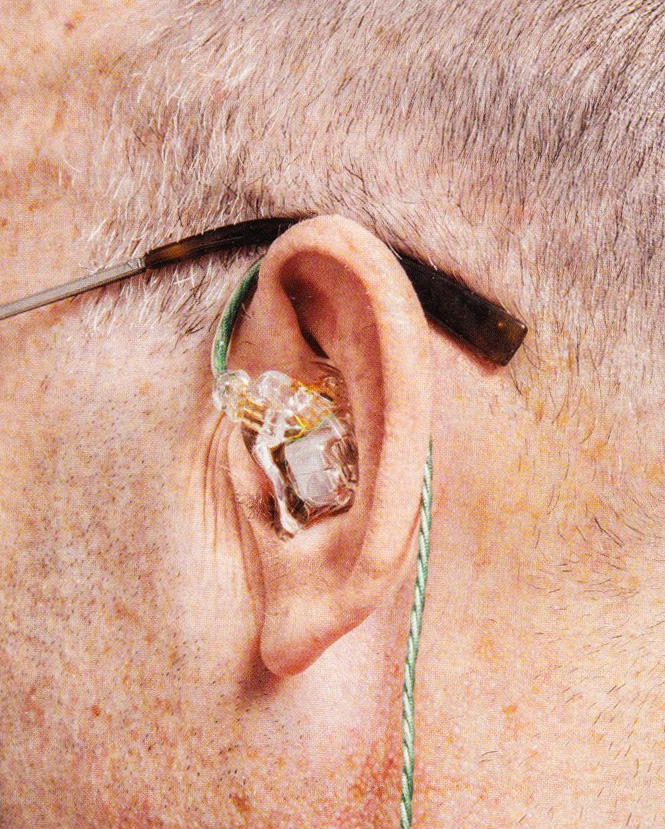
Today, he has a backpack full of them. To supplement his old-school hearing aid, he favors a $350 iPhone linked earpiece made by Sound World Solutions, a hearing hardware maker in Park Ridge, Ill., for whom he’s begun to consult. With the Sound World device on, he can amplify phone calls and streaming music as well as his sur-roundings. A third, $500 earpiece was custom-made by Ultimate Ears in Irvine, Calif., to help him detect a wider range of musical tones while composing. For restaurants and theaters, he has a $45 directional microphone that pairs with a $5 app to isolate desired voices. And for especially cacophonous places, he has spare $700 microphones, made by Etymotic Research in Elk Grove Village, Ill., that he can strap to companions.

Einhorn credits the audio patchwork with saving his career and his life. “It’s incredible,” he says over lunch in a busy restaurant, as he toggles the proper setting on his phone.

The Bluetooth-connected earpieces aren’t classified as hearing aids by the U.S. Food and Drug Administration. They’re called personal sound amplification products, or PSAPs. Basic versions of such devices have existed for more than a decade in lonely RadioShack aisles and a handful of other places. But in the past 18 months, advances in circuitry and low-energy Bluetooth transmission have helped developers radically improve the designs to make high-quality, long-lasting alternatives to hearing aids while keeping prices at a fraction of the industry standard.
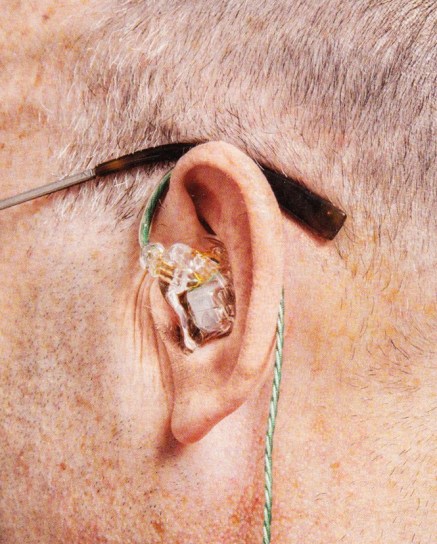
hearing-aid alternatives

Whatever regulators or insurers call them, PSAP manufacturers are angling to expand the $6 billion global market for hearing technology. Largely due to the cost, 75 percent of the 34 million Americans with hearing loss don’t use aids, says David Kirkwood, the editor of industry blog Hearing Health & Technology Matters. ‘A lot of people will continue to pay for traditional hearing aids,” he says. “But there are now inexpensive, easy-to-get alternatives.”

Part of the reason PSAPs are cheap is that they’re unregulated. Hearing-aid fittings and audiological calibrations account for much of the cost of aids from the big six makers-Siemens, Sonova, Starkey Hearing Technologies, William Demant, GN ReSound, and Widex. A midlevel pair that retails for $4,400 costs about $440 to manufacture, according to AARP. Research and development spending is also a factor: Unlike the free Bluetooth standard used by upstarts such as Sound World, old-school hearing aids run on proprietary signal processing and transmission technology. Siemens, Sonova, and Widex declined to comment; GN ReSound, Starkey, and William Demant didn’t respond to requests for comment.

Still, being kept out of doctors’ offices has been a huge problem for PSAP makers, says Venkat Rajan, who tracks medical devices for researcher Frost & Sullivan. While the size of the market can be difficult to gauge given the lack of regulation, anecdotal evidence suggests sales have been soft, he says. It doesn’t help that, according to industry journal the Hearing Review, the average American buying a hearing aid is 71 years old. “Trying to find that customer base has been difficult,” Rajan says.

The marketing of hearing aids, classified as medical devices by the FDA since 1977 is strictly regulated in the U.S. According to agency guidelines that predate the latest generation of equipment, PSAP makers aren’t allowed to market their products as medical devices. Instead, they’re supposed to be used recreationally by people who can already hear comfortably. The FDA, which wouldn’t say whether it plans to change its rules, occasionally issues warnings to companies it believes to be violating them, so PSAP ads tend to include at least one verbal somersault. An ad for Etymotic describes its latest product, the Bean, thusly: “Not a hearing aid but has many advantages.”

The $300 Bean is the brainchild of Mead Killion, the co-founder of Etymotic. He invented the analog hi-fi amplification technology behind the device back in 1988, but says it’s only since 2013 that circuitry has become cheap enough for the product to be worth manufacturing en masse. His company uses the same technology in adaptive earplugs designed for orchestra musicians or infantry troops to keep music or conversation audible while dampening loud noises. A decade ago, Killion failed to persuade the FDA that early PSAPs should be sold over the counter. He’s lobbying for a contract with the Department of Defense.

Normally, I hear fine, but I conducted a hands-on experiment shortly before an interview with Killion. It became clear that having professional help putting these things in is a good idea. Initially, one Bean in each ear made it easy to hear faraway gossip in a noisy Whole Foods. Then I pushed them too far, and suddenly could hear nothing at all. Killion said the problem was waxy buildup in my narrow ear canals, so the next step was a $150 cerumenectomy-that is, getting a doctor to scrape out gobs of wax and clear the blockage.

The era of internet diagnosis hasn’t eliminated the need for medical professionals, says Erin Miller, president of the American Academy of Audiology. “This is our biggest problem with the PSAPs in general,” she says. “We want to make sure someone has looked in the patient’s ear.” All the more reason, PSAP makers argue, to put their products in medical offices next to those from Starkey and ReSound. For now, the companies’ sales will be limited to true believers like Einhorn, the composer. “You have to remember that I’m a maniac,” he says. “I will do anything to hear as best as possible in any situation” –David Gauvey Herbert

___________________________

The bottom line New audio technology manufacturers are trying to break into the $6 billion hearing-aid market.
Behavior that Infringes of the Rights of Others

The Los Angeles Times reports that vaccinations have become off-limits in many online forums. “For the moment we ask you to refrain from posting about vaccines or measles,” read an updated rule for the Moms of Inglewood and Surrounding Communities page.

OK that may be the case on those forums and on some Facebook and Meetup groups but I am not afraid to speak my piece.

When I was a boy I had measles and mumps and chicken pox. All are serious illnesses. My parents feared being exposed to polio. I have a friend who lost a major part of her hearing thanks to measles or mumps. A devastating result from high fever. One in 100,000 cases results in death. Most of those who are infected and who die are less than five years old. The risk of death among those infected is usually 0.2%.

Anti-vax people can provide no reliable proof that vaccinations cause autism or any other disease. Freedom of choice is not an option when your choice may impact my family. It’s not just vaccinations. Our society should enforce laws that protect the innocent from the behavior of a few misguided individuals. This does not translate to government interfering with your private life. Freedom of religion does have its limits. Practice of behavior that infringes on the rights of others is unacceptable.