What will happen when Medicare runs out of money?

This news item in the Toronto Star, a large daily newspaper in Toronto, Canada poses a question that could easily be faced in the United States.  The questions:

  • Will America let people die who have little chance of recovery? 
  • Who will pay the bill?  Medicare? Medicaide? Private funds?
      Dying woman outlives her 90 days of home care so CCAC cuts her services

Published on Saturday September 29, 2012
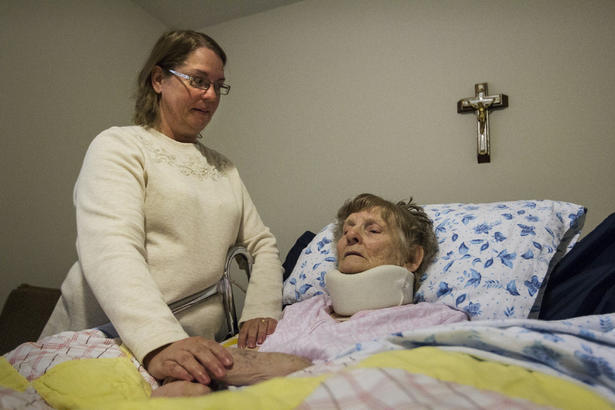
When Doris Landry was discharged from hospital with a life expectancy of one to two months, she entered the “Home First” program.

Offered by the Central Community Care Access Centre, the program provided a caseworker, personal support workers for eight hours every day, and medical equipment including a special bed, an oxygen machine, a wheelchair and a lift, so Landry could live her final days in the comfort of her niece’s home.

Her niece Charlene Dunlevy took care of her the other 16 hours of the day. “She’s good to me,” Landry says.

The only problem is a bittersweet one: Because Landry survived beyond the program’s 90 day funding period, she now faces reductions in care and uncertainty about the medical equipment.

Landry has cervical spinal stenosis and extensive nerve damage and lives with her niece in Lisle, Ontario, outside of Alliston. Lying in bed, she can manage a small squeeze of her hands, and with effort, a little movement in her arm.

Because of her condition, the bones in Landry’s neck are getting tighter, pinching her nerves. She is losing the power and sensation in her extremities, her voice is becoming weaker. She has difficulty swallowing, chokes often, and has problems breathing. She can’t move her limbs.

“I want to get out of bed,” she says as the air hums on its way through the special mattress. “The doctors tell me, ‘You’ll never get up again.’”

Home First is meant to divert elderly patients from long term care facilities after they are discharged from the hospital following an “acute episode.” The idea is that at-home support can eventually be lessened after the patient improves, or, it will give families 90 days to decide to transition into another form of care, like a long-term care home, which Landry does not want to do. Central CCAC has offered the program since 2009, and 1,713 clients have gone through it. The average 60-day stay (many transition out before 90 days) costs the ministry $10,500.

Born the fourth youngest in a family of seventeen children on Christmas Eve 1927 in New Brunswick, Landry is the last of her siblings. She is lucid, and on her good days, spunky and bright, with nails painted pink by a caring personal service worker. She wants to sit in the gliding rocking chair at the bedside, but she can’t get there. Her condition is terminal — but it is difficult to predict how much longer she will live. Her doctor says there is a prognosis of death in the next few months.

When the 90-day deadline was looming in August, Dunlevy says she was told that the bed would not be removed, but later she was informed all the equipment would have to go, and support would be reduced to three hours a day.

Dunlevy was told she could rent equipment and hire personal support workers. But the family can’t afford either option.

“I’m glad she didn’t die in three months. I hope she has many years to come,” Dunlevy said.

When reached by the Star on Friday, Cathy Szabo, the chief executive officer of Central CCAC, said that after 90 days, clients can stay at home, but the government does not fund the same level of service — legislation and regulations dictate that the CCAC can only provide up to 21 hours of care a week.

She said Landry could remain in the home with reduced care supplemented by hospice and other community organizations. She said equipment from volunteer services has been offered to the family, but if the needs exceed that, Landry could choose a long term care facility. She also noted that if Landry deteriorates, “we will restore service levels.”

Szabo said there was no intent to remove the hospital bed although “we did have conversations with them about how to secure additional equipment going forward in the future.”

She said to remove a hospital bed from a person who came into the program in her final stages of life but has now stabilized would be “cruel and mean.”

“We’re not about that. We aren’t going to take out the bed until there is another plan, if there is another plan for that bed,” she said.

Szabo said her staff had reported that certain equipment wasn’t in use, and that was the equipment that was going to be removed so other patients could use it.

“That is what we offered to take out of the home.”

The family says that isn’t the case — sure, they are not able to put Landry in the wheelchair on some days if she isn’t feeling well, but they try to get her out of her bed as much as they can and need the equipment to do that.

“I would give it to someone if we weren’t using it,” Dunlevy said.

They say the only equipment that has been offered is a medical bed from a local resident. While they are grateful, the mattress does not have air circulation like the CCAC bed and Dunlevy is worried Landry will have bedsores from “head to toe” because of her extremely limited movement.

When asked if the additional equipment was scheduled to be removed, Szabo said, “Not as far as I know.”

“We do need the family to work with us to help us get the right plan and care for the patient, if this lady stays at this same level for two years — and someone else does need the bed, and they just say, ‘No we’re not going to work with you guys we’re not going to make any plans with you,’ that is a very difficult situation. We only have a certain amount of money every year for medical supplies and equipment and that means somebody is on a wait-list for the bed,” Szabo said.

Landry’s palliative care doctor Monique Moreau, sent a request for “ongoing services” to the CCAC in August, and wrote a letter to local health authorities and health minister Deb Matthews on September 13, stressing that staying at home was the best option for Landry and the province’s finances.

Moreau did not get any response — and an email she sent on Monday to the CCAC went unacknowledged. On Friday, after the Star contacted the CCAC about the situation, Moreau received a phone call.

Moreau was told that Landry and her niece misunderstood about the removal of the equipment.

“I don’t think two people can misunderstand that much,” she said.

Moreau was told a case manager was going to visit the family on Monday to review the situation. Moreau believes that supplementary care from volunteers from a hospice will not be enough because those services only offer companionship.

Dunlevy, who works through a temp agency, has stopped working to care for her aunt. Now that service is being reduced further, she cannot return to work.

“I won’t have a choice, I can’t leave her alone. They’re putting us in a predicament,” she said. “I don’t know how we’re going to survive, but we will.”

Moreau, a former board member of the Central LHIN, understands the financial strain on the province.

“It’s not like we’re going to save the health care system a whole lot of money, unless the niece keeps her at home and quits her job and pays for everything,” she said.

Dunlevy says she understands that the CCAC’s hands are “probably tied because they don’t have the money,” but feels that the ministry needs to consider this problem.

Dunlevy and Landry are worried about the uncertainty ahead. For now, Landry can only lie in bed and wait, looking at the small Virgin Mary statue atop the television set.

“Pray for me,” she says. “I’m praying, but she doesn’t do too much.”

The High Cost of Extending Your Life

The Associated Press reports today that health care “Premiums averaged $15,745, with employees paying more than $4,300 of that, a glaring reminder that the nation’s problem of unaffordable medical care is anything but solved.”

I just completed reading an article in Newsweek (September 3, 2012) titled “How Much would you pay for three more months of life?”  It’s all  about the high cost of cancer treatments that can cost up to $188K for about six months of additional life. There is nothing in the article about where the money for this treatment will come from.  I do not imagine that most insurance companies will pay these high fees.  After all, the outcome is death not extended life.

Every family needs to discuss the reason for extending life of a pancreatic cancer patient for two weeks at cost of $15K.

Advanced Health Directives help family members decide a course of action.  Of course you have to read and understand the directive before the need arises.  Too many people do not.

‘The Girl from Ipanema’ turns 50

Remember the words from the song: “Tall and tan and young and lovely…”  The story is that the composer was inspired by the sight of Heloisa “Helo” Pinheiro.  Perhaps she was too in love with the sea.  I remember the couple next door to my parent’s home.   They went water skiing every weekend for years with their children.  She was a tall good looking woman of Scandinavian decent.  Yes a very attractive blond.

They were much younger than my parents.  I grew up and moved away.  One day at a visit I saw Jill.  At the age of 50 her skin looked like leather.

Do you see the similarities in this photo?

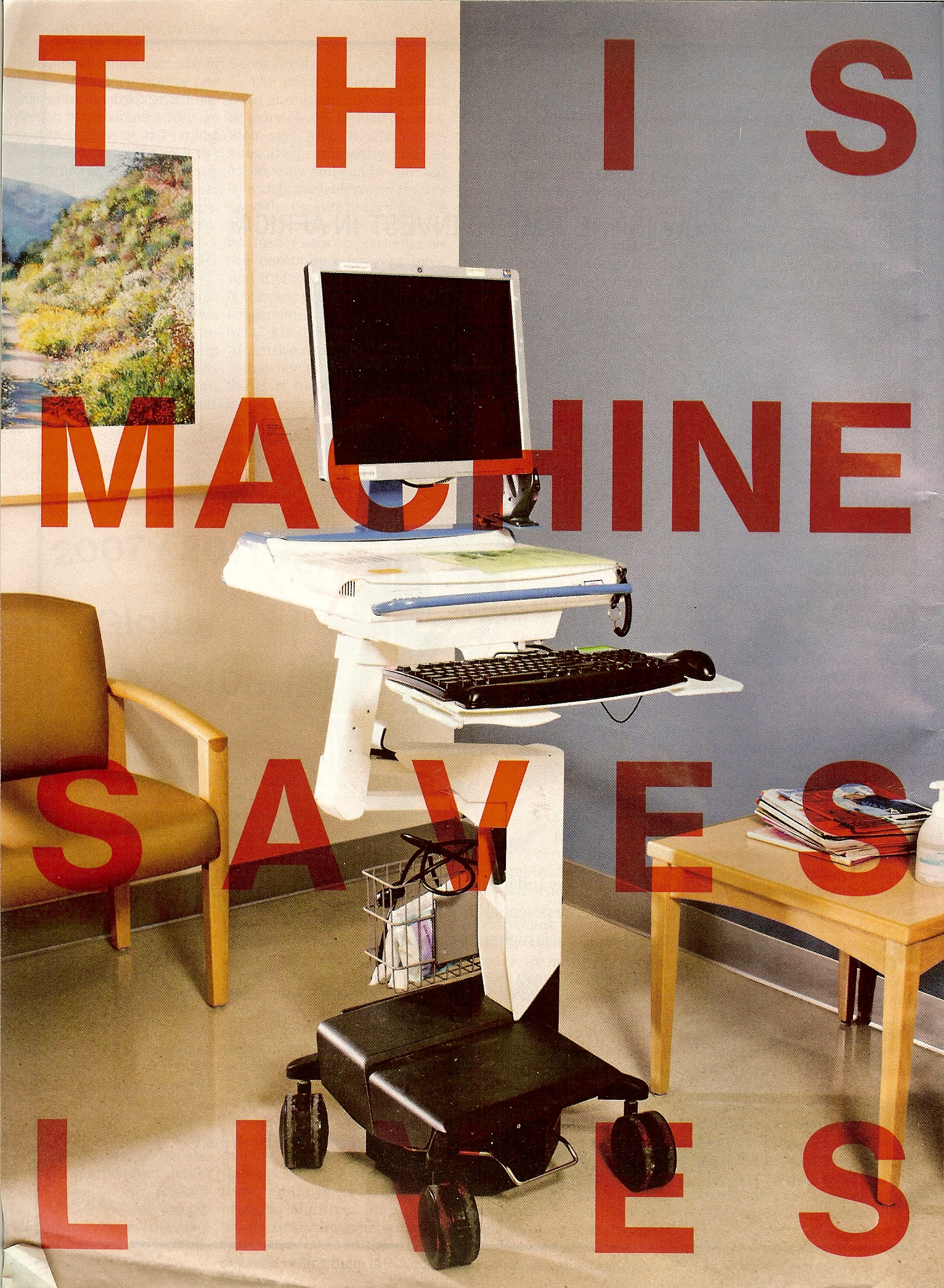
This Machine Saves Lives

picture is copy from Businessweek

My health care plan is provided by Kaiser Permanente.  It is an HMO.  It also happens to be the top rated health plan of all kinds in the state of California.  That includes PPO plans.  This result based upon studies sponsored by Consumer’s Reports and another reported in Newsweek a few years back.

When I joined, it was thanks to an employer provided health care plan. I had no choice.  At the time I thought this is care for the masses.  The employer provides the least expensive plan but can say “we provide health care to our employees and their families.”

Over the years other employers offered other plans but honestly they really were not any better than Kaiser.  So when it came to Medicare I re-joined Kaiser as it was the least expensive.

A few years ago Kaiser implemented their electronic records and communications system.  That received my immediate attention.  Why? You will ask.

1. Exchange secure e-mail with your doctor’s office in my message center. You also can go there to contact our Member Services and Web manager.

2. Wondering if you should book a visit? Consult our interactive symptom checker, or go straight to scheduling in the appointment center.

3. View your past visit information, plus get your latest test results, immunizations, health care reminders, and more in my medical record.  The record shows the results of every test.  It is a complete history of my health care.

4. Get the facts about your plan and benefits, download forms, and more in my plan and coverage.

5. You can manage your prescriptions here, or learn about specific medications in our drug encyclopedia.

6. Doctors send their prescriptions via the connected system directly to their pharmacy.  No more hand written prescriptions unless you choose to fill the order at a non Kaiser pharmacy.  Kaiser’s medications are as cheap as any place including Costco and Wal-Mart.

7. Orders for tests and x-rays are communicated to their labs.  There are no paper documents.

In the June 25-July1 issue of BusinessWeek there is a five page spread in the subject of improved care and lower costs that can be achieved using computerized records.

The article opens with the care at the Kaiser hospital in San Jose, California.  While in the outpatient area a man appeared to be having an epileptic seizure.  Should the doctor send the man to neurology, as he would an epileptic patient, or to emergency? The doctor looked up the patient’s records on the hospital’s electronic health record (EHR) system.  In an instant he saw that the man had a history of twitching episodes from which he recovered quickly. The patient was put on a cardiac monitor and confirmed that the man’s brain was not the source of his medical issues. The patient was outfitted with a pacemaker in a matter of hours.  The doctor says that the man might have died if he had gone to a neurology clinic. The doctors there don’t have cardiac monitors and might not have diagnosed his condition in time.  This situation was a perfect example of the benefit of EHR.

Despite the obvious benefits independent doctors and smaller practices are resisting the use of EHR.  Researching the subject on the internet brought these negative comments from medical informatics , a New York Times blog titled The Doctor vs. the Computer, and Physicians’ Use Of Electronic Medical Records: Barriers And Solutions.

Then there is Mike Koriwchak an otolaryngologist who blogs at The Wired Practice. He posted this commentary on Kevinmd.com.

After 5 successful years with electronic medical records (EMR), I am convinced that the promise of EMR to improve physician practices and to improve the health care system is real.

Insurance Company Death Panels

I received an e-mail plea from a member of change.org.  I underlined the critical words.

  • Danielle Gilbert is my friend and a former student, and she is fighting for her life. Danni has stage four colon cancer — but her insurance company is refusing to cover treatment that could buy her at least three more precious months with her two daughters and husband.

The email asks the recipients to petition Blue Cross to pay for the needed Avastin treatment. The treatment will cost about $8,300 per month.

Tell Blue Cross Idaho to cover cancer treatment that could buy Danni more precious time with her daughters and husband.”

Five years ago 17 year old Nataline Sarkisyan was denied a liver transplant by her family’s health insurer, CIGNA. A community up roar resulted in a change in their decision but it was too late and she died.

The two decisions were made by insurance companies. No one called the people at the insurance companies that made those decisions death panels. There is a group, wanting to kill national health care plans, calling government bureaucrats (who are most likely doctors) using the words “death panels” to describe those decision makers.

My own mother was approaching 96 and had advanced dementia. The care facility called my sister and me to advise she was suffering with shallow breathing and might not survive the night. My sister wanted her transferred to a hospital for intensive care. I asked what the benefit would be. She won’t be able to talk and she will still be unaware of her surroundings. It was a condition that had existed for two years. My sister relented and Mom passed away at 5 a.m. the next day.

All of the facts in these cases are never totally revealed. Unrevealed in the news stories about Nataline Sarkisyan is that she had recurrent leukemia, first diagnosed at age 14, had received a bone marrow transplant from her brother Bedros, November 27, 2007. She subsequently developed complications leading to multiple organ failure, including liver and kidney failure. This information was revealed in a Wikipedia entry. An article in the N.Y. Times does an excellent job of evoking your sympathy.

  • What is the real condition of the people involved?
    What are the real costs?
    What is the outlook for their recovery?

I do not understand why insurance company panels are better equipped to make the decisions.  After all they represent “for profit” insurance companies.

Obama Care is the Wrong Plan

No doubt, health care for all Americans is a wonderful idea.

I oppose this law for one single reason.  There are no controls or limits on the cost of insurance.  The explanations I have read say that insurance companies can make reasonable rate increases to cover their costs.   What is “reasonable?”  It appears that costs will increase for three reasons.

1) 10 to 15 million people will be added to insurance company rolls without adequate payments to cover their enrollment.

2) Those excluded from insurance because of pre-existing conditions will be now be added to the plans.

3) Insurance companies will be permitted to earn 20% of the fees they charge.

Without a plan to control medical costs no plan can survive. 

Just today I received a plea from change.org to sign a petition addressed to Blue Cross of Idaho. The insurance company refuses to pay the bill for the chemotherapy drug, Avastin.  It may prolong the life of a victim of stage four colon cancer for an additional three months.  According to the New York Times the cost will be about $8,300 per month.  It seems to be OK, in the minds of many people, for insurance companies to make these decisions but many people object to a government committee making the decisions. Why? What is the difference?

A better solution to this would have been a single payer system like Medicare.  The plan that has been adopted (Patient Protection and Affordable Care Act) is one that was proposed many years ago by Republicans.  It is the Massachusetts plan that was implemented by Mitt Romney.

Canada and most European nations seem to have addressed the issue of health care.  Care is available for everyone.  I am certain there are situations that their health care plans do not cover. Considering America is listed as the 41st in child mortality with the highest health care cost of any nation on Earth says we are doing a lousy job.  Quite shocking when we consider that the USA is the wealthiest nation on earth.

Supreme Court Chief Justice John Roberts Surprises Everyone

ObamaCare Lives

John Roberts
John Roberts

How could Chief Justice John Roberts have voted with the liberal justices in favor of Obama care? Charles Krauthammer has written a piece for the National Review contending that the “Commerce Clause contained, constitutional principle of enumerated powers [has been] reaffirmed.”  “Law upheld, Supreme Court’s reputation for neutrality maintained.”  He suggests that Roberts was more concerned with the Court’s reputation than the outcome of this case.  I disagree.

George Will, also writing in the National Review offered similar analysis.

We may never know Roberts’ thinking.  Considering the far reaching consequences of his (Roberts) decision I cannot believe that he would not be more concerned with the impact this law will have on almost every American.

John Roberts said the law was legal under the right of the Federal government’s power to tax.  The Obama administration denied the penalty against the non-insured is a tax.  Roberts obviously had to search out his justification for voting in favor of the law.  It must have come as a great surprise in the White House when they heard Roberts’ reasoning.

One thing is obvious.  The media proved that even their smartest commentators could not conjure the outcome nor explain the logic of John Roberts.

Health Care Mandates are not a New Idea

As a nation Americans are debating the power of the Federal government to pass laws that mandate our behavior in the area of health care. However, the Patient Protection and Affordable Care Act is not the first mandate pertaining to health care.

Three other mandates already exist. This information was posted in my local newspaper (Los Angeles Daily News).

Other health care mandates
The 1986 Emergency Medical Treatment and Active as Labor Act. It requires nearly all hospitals to treat and ‘or stabilize anyone needing emergency care, regardless .of ability to pay or legal U.S. residency. Critics call it an unfunded mandate. It was part of a budget law signed by President Ronald Reagan.
The 1996 Mental Health Parity Act. It prohibits group health plans from setting lower annual or lifetime dollar limits for mental health benefits as compared with medical a surgical benefits.
The 1996 Newborns’ and Mothers’ Health Protection Act. It requires plans offering maternity coverage to pay for at a least a 48-hour hospital stay following most normal deliveries, and 96 hours following a cesarean section. The mental health parity and maternal health laws were signed by President Bill Clinton.

Life Expectancy in America

Here is something that Barack Obama, John Boehner, Harry Reid, and other national leaders won’t address.  It’s hard to believe that the United States does not provide its citizens with the longest life expectancy of any country in the world. ABC World News reports we have the most expensive health care in the world.

Here we are in 36th place and tied with Cuba.  Postings of comments offer a variety of excuses for this ranking.  They range from our military involvements to gun use to long drives to work.  Canada is very similar to the United States but is in 11th place.  Israel is in 8th place but I wonder how many in that country are living with severe handicaps resulting from bombings.  Still,Israel’s ranking is quite surprising.      

The total number of U.S.lives lost in the Iraq and Afghanistanwars is 6,081.  The Census Bureau lists the 2008 number of death from auto accidents at 39,000 people.  Clearly the wars have not been the major contributor to America’s deaths.

The Los Angeles Times front page article today indicates that life expectancy for woman has declined in many rural areas.

Rank

Country (State/territory)

Life expectancy at birth (years)
Overall

Life expectancy at birth (years)
Male

Life expectancy at birth (years)
Female

1  Japan 82.6 78.0   86.1
2  Hong Kong 82.2 79.4   85.1
3  Iceland 81.8 80.2   83.3
4  Switzerland 81.7 79.0   84.2

In last place, 194th,  is Swaziland where life expectancy for both men and women is less than 40.