Was Christopher Columbus a Jew?

Hypothèse très intéressante et instrutive!……

The question: Was Columbus secretly a   Jew?

Today marks the 508th anniversary of the death of   Christopher Columbus.
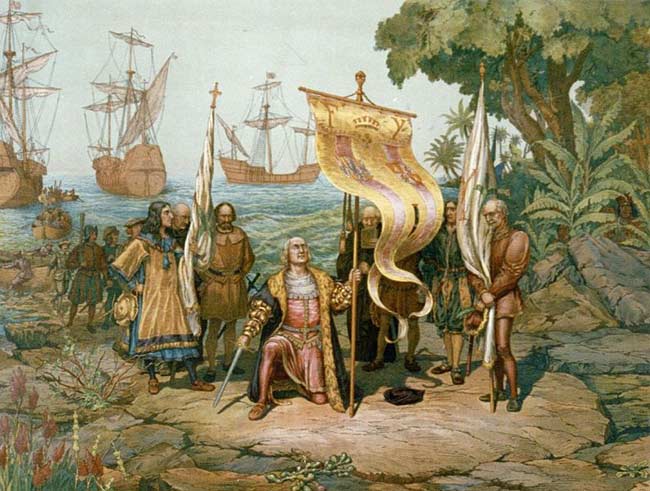
Everybody knows the story of Columbus, right?  He was an Italian explorer from Genoa who set sail in 1492 to enrich the Spanish monarchs with gold and spices from the orient.  Not quite.

For too long, scholars have ignored Columbus’ grand passion: the quest to liberate Jerusalem from the Muslims.

During Columbus’ lifetime, Jews became the target of   fanatical religious persecution.  On March 31, 1492, King Ferdinand and Queen   Isabella  proclaimed that all Jews were to be expelled from Spain.  The edict especially targeted the 800,000 Jews who had never converted, and gave them   four months to pack up and get out.

The Jews who were forced to renounce Judaism and embrace Catholicism were known as “Conversos,” or   converts.  There were also those who feigned conversion, practicing Catholicism   outwardly while covertly practicing Judaism, the so-called “Marranos,” or swine.

Tens of thousands of Marranos were tortured by the Spanish   Inquisition. They were pressured to offer names of friends and family members,   who were ultimately paraded in front of crowds, tied to stakes and burned   alive. Their land and personal possessions were then divvied up by the church and crown.

Recently, a number of Spanish scholars, such as Jose Erugo,   Celso Garcia de la Riega, Otero Sanchez and Nicholas Dias Perez, have   concluded that Columbus was a Marrano, whose survival depended upon the   suppression of all evidence of his Jewish background in face of the brutal,   systematic ethnic cleansing.

Columbus, who was known in Spain as Crist   bal Col n and didn’t speak Italian, signed his last will and testament on May   19, 1506, and made five curious — and revealing — provisions.

Two of   his wishes — tithe one-tenth of his income to the poor and provide an   anonymous dowry for poor girls — are part of Jewish customs. He also decreed to give money to a Jew who lived at the entrance of the Lisbon Jewish Quarter.

On those documents, Columbus used a triangular signature of   dots and letters that resembled inscriptions found on gravestones of Jewish cemeteries in Spain. He ordered his heirs to use the signature in perpetuity.

According to British historian Cecil Roth’s “The History of   the Marranos,” the anagram was a cryptic substitute for the Kaddish, a prayer   recited in the synagogue by mourners after the death of a close relative.   Thus, Columbus’ subterfuge allowed his sons to say Kaddish for their crypto-Jewish father when he died. Finally, Columbus left money to support the   crusade he hoped his successors would take up to liberate the Holy Land.

Estelle Irizarry, a linguistics professor at Georgetown   University, has analyzed the language and syntax of hundreds of handwritten   letters, diaries and documents of Columbus and concluded that the explorer’s   primary written and spoken language was Castilian Spanish. Irizarry   explains that 15th-century Castilian Spanish was the “Yiddish” of Spanish Jewry, known as “Ladino.” At the top left-hand corner of all but one of the 13   letters written by Columbus to his son Diego contained the handwritten Hebrew   letters bet-hei, meaning b’ezrat Hashem (with God’s help). Observant Jews have   for centuries customarily added this blessing to their letters.  No letters to   outsiders bear this mark, and the one letter to Diego in which this was   omitted was one meant for King Ferdinand.

In Simon Weisenthal’s book,   “Sails of Hope,” he argues that Columbus’ voyage was motivated by a desire   to find a safe haven for the Jews in light of their expulsion from Spain.   Likewise, Carol Delaney, a cultural anthropologist at Stanford University,   concludes that Columbus was a deeply religious man whose purpose was to sail   to Asia to obtain gold in order to finance a crusade to take back Jerusalem and rebuild the Jews’ holy Temple.

In Columbus’ day, Jews widely believed that Jerusalem had to be liberated and the Temple rebuilt for the   Messiah to come.

Scholars point to the date on which Columbus set sail as further evidence of his true motives. He was originally going to sail on   August 2, 1492, a day that happened to coincide with the Jewish holiday of   Tisha B’Av, marking the destruction of the First and Second Holy Temples of   Jerusalem. Columbus postponed this original sail date by one day to avoid   embarking on the holiday, which would have been considered by Jews to be an   unlucky day to set sail. (Coincidentally or significantly, the day he set   forth was the very day that Jews were, by law, given the choice of converting,   leaving Spain, or being killed.)

Columbus’ voyage was not, as is   commonly believed, funded by the deep pockets of Queen Isabella, but rather by   two Jewish Conversos and another prominent Jew.  Louis de Santangel and Gabriel  Sanchez advanced an interest free loan of 17,000 ducats from their own pockets   to help pay for the voyage, as did Don Isaac Abrabanel, rabbi and Jewish  statesman.

Indeed, the first two letters Columbus sent back from his   journey were not to Ferdinand and Isabella, but to Santangel and Sanchez,   thanking them for their support and telling them what he had found.

The   evidence seem to bear out a far more complicated picture of the man for whom   our nation now celebrates a national holiday and has named its capital.

As we witness bloodshed the world over in the name of   religious freedom, it is valuable to take another look at the man who sailed the seas in search of such freedoms — landing in a place that would   eventually come to hold such an ideal at its very core.

This entire discussion was on CNN Opinion.  I thought others would find it interesting

David Bancroft
On This Day Iwo Jima

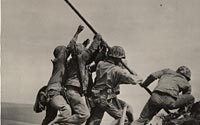
On Feb. 19, 1945, during World War II, some 30,000 United States Marines landed on the Western Pacific island of Iwo Jima, where they encountered ferocious resistance from Japanese forces. The Americans took control of the strategically important island after a month-long battle.

Do your remember this picture?  The photo also appeared on a U.S. postage stamp.

 Joe Rosenthal’s Pulitzer Prize-winning photograph taken on the Pacific island of Iwo Jima is one of the best-known war images ever made. The Allies  invaded  the island, more than six hundred miles off the coast of Japan, on February 19, 1945, hoping to establish a staging area for bombers. Rosenthal, a photographer for the Associated Press, landed under gunfire three hours after the invasion began. The Marines fought their way to the top of Mount Suribachi on February 23 and raised a small flag.  Later that same day, five Marines and a naval medicine corpsman raised this second, larger flag at the summit and were recorded  by Rosenthal. Contrary to popular belief, the moment was not staged. In thirty-one days of brutal fighting, 6,821 Americans died, including  three of the flag-raisers. Rosenthal inscribed this print to Wyoming  Democratic Senator Joseph O’Mahoney.

Explanation from the Library of Congress.

Las Médulas, SPAIN

From Our Place World Heritage

Site of the Day: Las Médulas  Our Place World Heritage Photographer: Geoff Mason (New Zealand)
In the 1st century A.D. the Roman Imperial authorities began to exploit the gold deposits of this region in north-west Spain, using a technique based on hydraulic power. After two centuries of working the deposits, the Romans withdrew, leaving a devastated landscape. Since there was no subsequent industrial activity, the dramatic traces of this remarkable ancient technology are visible everywhere as sheer faces in the mountainsides and the vast areas of tailings, now used for agriculture.

Are You Smarter Than a 12th Grader?

It’s hard to believe how poorly we are educated about our nation.   ABC News and the Associated Press both report our lack of knowledge about our country.  It’s no surprise.  Recently both Congresswoman Michele Bachmann and former Alaska Governor Sarah Palin recited incorrect information about America’s history.

Eighth Grade Sample Questions

1. Who was Thomas Jefferson and why was he important?

Refer to the passage below for questions 2 and 3:

“We hold these truths to be self-evident: That all men are created equal; that they are endowed by their Creator with certain unalienable rights; that among these are life, liberty, and the pursuit of happiness. That, to secure these rights, governments are instituted among men, deriving their just powers from the consent of the governed; that, whenever any form of government becomes destructive of these ends, it is the right of the people to alter or to abolish it, and to institute a new government. —1776

2. The quotation is from the:

A) Articles of Confederation B) Constitution C) Declaration of Independence D) Missouri Compromise

3. The primary author of the document was:

A) George Washington B) John Marshall C) Robert E. Lee D) Thomas Jefferson

4. What were the three main countries that made up the Axis powers in World War II?

A) Germany, Russia and Japan B) Italy, Japan and Russia C) Germany, Japan and Italy D) Germany, Japan and Great Britain

12th Grade Sample Questions

1. A consequence of Prohibition was

A) the failure of the Republicans in the 1928 presidential election B) the growth of organized crime C) the turning of public attention to pressing international issues D) widespread popular support for further moral reform

2. North Korea was helped by this ally during the Korean War:

A) Japan B) The Philippines C) Hong Kong D) China

3. President Franklin D. Roosevelt’s goal in supporting the Lend-Lease Act of 1941 was to

A) Encourage Japanese Americans to relocate voluntarily B) Use foreign investment as a way of stimulating the American economy C) Maintain an isolationist stance by providing only limited aid to both sides of the European conflict D) Assist Britain’s war effort without violating United States neutrality laws

4. Before the Vietnam War, the Vietnamese broke free from this colonizer:

A) Britain B) China C) France D) Russia

5. What main factors contributed to the growth of suburbs?

A) Increases in automobile ownership B) The building of a modern highway system C) Tax deductions for mortgage interest D) All of the above

6. In the 1970’s the United States economy was directly affected by

A) a sharp increase in the price of oil B) an increase in the cost of solar energy C) an overall decline in international trade D) a rapid decline in prices of consumer goods

7. The North Atlantic Treaty Organization (NATO) and the Warsaw Pact are best described as two

A) Organizations founded by the European Economic Community to promote trade between Europe and the United States B) Treaties negotiated between the allies and the Central Powers at Versailles after the First World War C)Bodies established by the United Nations to promote peace within multiethnic European countries such as Czechoslovakia and Yugoslavia D) Military organizations made up, respectively, of the United States and its allies and the Soviet Union and its allies during the Cold War

Answer Key

8th Grader Questions:

1. Thomas Jefferson was the third U.S. president and was the main author of the Declaration of Independence.

2. C

3. D

4. C

12th Grader Questions:

1. B

2. D

3. D

4. C

5. D

6. A

7. D

Sarah Palin’s Version of the Ride of Paul Revere

Maybe Sarah Palin was absent from school on the day they discussed Paul Revere.  Revere’s legendary status has continued for centuries due to Henry Wadsworth Longfellow’s poem “The Midnight Ride of Paul Revere.”

“He said to his friend, “If the British march
By land or sea from the town to-night,
Hang a lantern aloft in the belfry arch
Of the North Church tower as a signal light,–
One if by land, and two if by sea;
And I on the opposite shore will be,
Ready to ride and spread the alarm”

Sarah Palin’s explanation:

Manifest Destiny is Alive and Well

Right now we lack the FDR, a Teddy Roosevelt or  an Abraham Lincoln to lead the way.  Perhaps Former Sen. Rick Santorum will be that new leader.  The Associated Press reports that that Santorum said, “America belongs to God” and liberals and progressives are trying to change its divine footing.

Santorum, who is weighing a White House run, told a conservative conference Thursday that U.S. citizens are mere stewards of God’s gift. Santorum says he disagrees with critics of the United States who say the country is imperfect.

Will this be the new rallying call of the Tea Party?

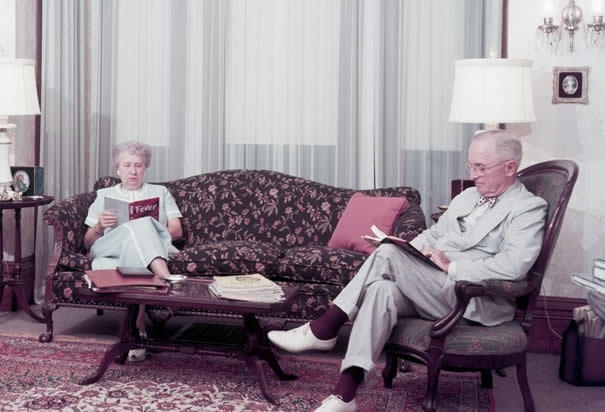
Harry and Bess

Harry Truman was a different kind of President.  He probably made as many, or more important decisions regarding our nation’s history as any of the other 42 Presidents preceding him. However, a measure of his greatness may rest on what he did after he left the White House.

The only asset he had when he died was the house he lived in, which was in Independence Missouri. His wife had inherited the house from her mother and father and other than their years in the White House, they lived their entire lives there.

When he retired from office in 1952, his income was a U.S. Army pension reported to have been $13,507.72 a year. Congress, noting that he was paying for his stamps and personally licking them, granted him an ‘allowance’ and,  later, a retroactive pension of $25,000 per year.

After President Eisenhower was inaugurated, Harry and Bess drove home to Missouri by themselves. There was no Secret Service following them.

When offered corporate positions at large salaries, he declined, stating, “You don’t want me. You want the office of the President, and that doesn’t belong to me. It belongs to the American people and it’s not for sale.”

Even later, on May 6, 1971, when Congress was preparing to award him the Medal of Honor on his 87th birthday, he refused to accept it, writing, “I don’t consider that I have done anything which should be the reason for any award, Congressional or otherwise.”

As president he paid for all of his own travel expenses and food.

Modern politicians have found a new level of success in cashing in on the Presidency, resulting in untold wealth. Today, many in Congress also have found a way to become quite wealthy while enjoying the fruits of their offices. Political offices are now for sale.  (sic. Illinois )

Good old Harry Truman was correct when he observed, “My choices in life were either to be a piano player in a whore house or a politician. And to tell the truth, there’s hardly any difference!

I say dig him up and clone him!!


Rabbi Arnold Stiebel, Ph.D.
Woodland Hills, CA
arnoldst@aol.com
 

Enough to Quiet Holocaust Deniers

It is now more than 60 years since the end of the Second World War in Europe.  This blog entry is in memory of the six million Jews, 20 million Russians, 10 million Christians and 1,900 Catholic priests who were murdered, massacred, raped, burned, starved and humiliated while the German and Russia peoples were looking the other way! Now, more than ever, with Iran among others, claiming the Holocaust to be “a myth,” it is imperative to make sure the world never forgets.

This linked story  was originally aired  on Sunday, June 24, 2007 on “60 MINUTES” about a long-secret German archive that houses a treasure trove of information on 17.5 million victims of the Holocaust. The archive, located in the German town of Bad Arolsen, is massive (there are 16 miles of shelving containing 50 million pages of documents) and until recently, was off-limits to the public. But after the German government agreed earlier this year to open the archives, CBS News’ Scott Pelley traveled there with three Jewish survivors who were able to see their own Holocaust records. It’s an incredibly moving piece, all the more poignant in the wake of this week’s meeting of Holocaust deniers in Iran.

Hitler’s  Secret Archive

CLICK on This Link–   

http://www.cbsnews.com/video/watch/?id=2274705n

The 21st Century World Economy Has Arrived

The United States was not interested in the rest of the world until WWII.  Our nation kept up its protectionist and no alliance philosophy until that war thrust us (were we dragged?) into a position of leadership.  Exceptions to that basic idea did occasionally occur.  There was the famous bombardment of pirates off the north coast of Africa in the early 1800s.  That was an independent action that led to know alliances.  WWI is the outstanding example of working together with other countries to defeat a common enemy.  At the end of that war the United States did not join the League of Nations.  Instead the country reverted to its no alliances philosophy.

The idea of no alliances apparently dates back to Thomas Jefferson. He extended Washington’s ideas in his March 4, 1801 inaugural address: “peace, commerce, and honest friendship with all nations, entangling alliances with none.” 

A Cato Institute article on free trade confirms the philosophy of high tariffs. The article provides a U.S. Department of Commerce graph that shows 30% import duties on durable goods until WWII.  Pat Buchanan, the conservative talk show host and former presidential candidate, still contends that the United States would be better off economically if trade barriers were in place.  He repeated that position on the McLaughlin Group on Friday August 21, 2009.  When was the last time he went shopping?  Walmart, Target, Sears, Best Buy, etc. are all part of the global market place.

It’s understandable why Buchanan and others believe that protectionism is the salvation for the United States.  We can’t compete with other nations for many goods and services.  Our cost of living is just too high.

Listed on President Barack Obama’s top five books to read this summer is Thomas Friedman’s The World is Flat.  It’s a book that tells us something we already know but in horrifying detail.  This book tells us about the interdependence of every nation in the world.  The quote “President Obama will probably learn of the operation from CNN” evidences how well we have connected everyone.  Even Mayanmar’s (Burma’s) secretive government has been unable to keep events in that country a secret from the world.  Neither 10th century Muslims nor Asian dictators can stop the interconnected world.  Visit Toronto, Canada and it’s like visiting the United Nations.  You will realize the world cannot be turned back.

The answer to our dilemma is innovation and invention.  This nation gave birth to assembly line manufacturing (Henry Ford’s factories), the telephone, the computer world, and the internet.  It was Thomas Edison who invented the light bulb and the first recording devices.  The largest and most successful aircraft manufacturing companies were built in the United States.  It’s that creativity that will revitalize this nation.

What will it be?  I don’t know.  It could be new car batteries or new ways to generate electricity or something else.


The new world has arrived.  Get excited!