In his first trip abroad, President Joe Biden told Allies “America Is Back.” My question is what are we back to? Will it be pre-WWII or post-WWII?
“The U.S. remains firm in its commitment to Ukraine’s sovereignty and territorial integrity in the face of Russian aggression and — and our support for Ukraine’s Euro-Atlantic aspirations,” Biden said at the outset of the discussion, touting new agreements to broaden cooperation on defense, energy and economic development.
In remarks Tuesday marking the end of 20 years of conflict in Afghanistan, Biden espoused something of a foreign policy doctrine, stating that the “fundamental obligation of a president … is to defend and protect America, not against the threats of 2001 but the threats of 2021 and tomorrow.”
Biden seems to be following in the footsteps of his predecessor. Trump policy was America First. In his inaugural address, President Donald Trump announced an America First approach to foreign policy and trade, which centers on reducing U.S. trade deficits and rebalancing burden sharing within alliances. He pressured NATO allies to spend more on their defense and even considered exiting NATO. He spoke of charging South Korea a fee for keeping troops in that country.
What would the United States do if China invaded Taiwan? Russia has already annexed Crimea which was part of Ukraine and other than sending some armament to Ukraine and the United States did nothing.
Our nation is beginning to look like America before WWII when even FDR promised to keep America out of wars in Europe and Asia. The United States adopted an official policy of neutrality between 1935 and 1939, Congress passed five different Neutrality Acts that forbade American involvement in foreign conflicts. The impetus for these laws came from a revitalized American peace movement, the revelations of war-profiteering by American munitions businesses during the Great War (WWI), and a widespread belief among Americans that their intervention in the European war had been fruitless.
The UK stood by its allies when Germany invaded Poland. The United Kingdom declared war on Germany on 3 September 1939, two days after the German invasion. France also declared war on Germany later the same day. The UK had not been attacked.
Under what circumstance would the United States go to war even though it was not attacked?
Richard Haass writing for the Brookings Institute in April 2000 wrote “Twenty-five years after the ignominious American withdrawal from what was then South Vietnam, this much is clear: the United States lost the war, but won the peace.”
The Pentagon on Sunday said it activated the Civil Reserve Air Fleet, ordering U.S. airlines to provide flights for the Afghanistan evacuation. The order reminded me of Dunkirk 1940. Reported in this article “861 pleasure craft and fishing boats were essential to the operation’s success in the shallow waters around Dunkirk.” It was the military defeat of an army on a beach of France and was a sad day in WWII. The British government claimed the retreat a victory. These are the kinds of words spoken in 1984 where white is black and defeat is victory. This article copied from THE CONVERSATION.
—
For Britons, Dunkirk is one of the proudest moments of World War II. The evacuation of 338,226 troops and other personnel from the beaches of northern France – which took place between May 26 and June 4 1940 – was an act of stubborn defiance by a plucky island nation against Hitler’s blitzkrieg. It was a victory snatched from the jaws of defeat.
Yet this was anything but a military success. Quite often we now forget the catastrophic defeat that led to “Operation Dynamo”.
On May 10, 1940, the British Expeditionary Force (BEF) – totalling approximately 400,000 at the height of the campaign and commanded by Lord Gort – was deployed in Belgium, alongside its allies, as part of a defensive line against German invasion. But by May 13, German units had pierced French defences and crossed the River Meuse near Sedan, close to the Belgian border in northeast France. Within a week, German panzer divisions had reached the French coast south of Boulogne, trapping the BEF and the French 1st Army in a small pocket around the channel ports, cutting them off from the main Allied force.
The British retreat to Dunkirk was controversial. But poor planning, intelligence, leadership, and communications had left the Allies in a desperate situation.
Prime minster Winston Churchill had promised the French that the BEF would play its part in a coordinated counterattack against the German flank. However, Lord Gort was preparing to evacuate his troops, apparently with the blessing of the secretary of state for war, Anthony Eden. To escape annihilation, the BEF staged a fighting retreat to the coast, and rescue plans were hastily made, including appeals for owners of “self-propelled pleasure craft between 30 and 100 feet” to contact the Admiralty.
Covered by rear-guard actions by both British and French units, exhausted troops converged on Dunkirk. Naturally, there was panic and chaos on the beaches. The town and port were bombed and time was running out. Discipline was often tested: historians have found anecdotal evidence that order was sometimes restored through the severest of measures, with guns being trained on troops by their own officers and men.
French involvement
Crucial time was bought by those covering the retreat. At Lille, the French 1st Army fought German forces to a standstill for four days, despite being hopelessly outnumbered and lacking any armour. The French forces forming a perimeter defence around Dunkirk were all either killed or captured.
British forces covering the retreat also paid a high price. Those who were not killed in the fighting became prisoners of war. But even that was no guarantee of safety. At the village of Le Paradis, 97 British troops who had surrendered were massacred by the SS. At least 200 Muslim soldiers of the French army met with the same fate.
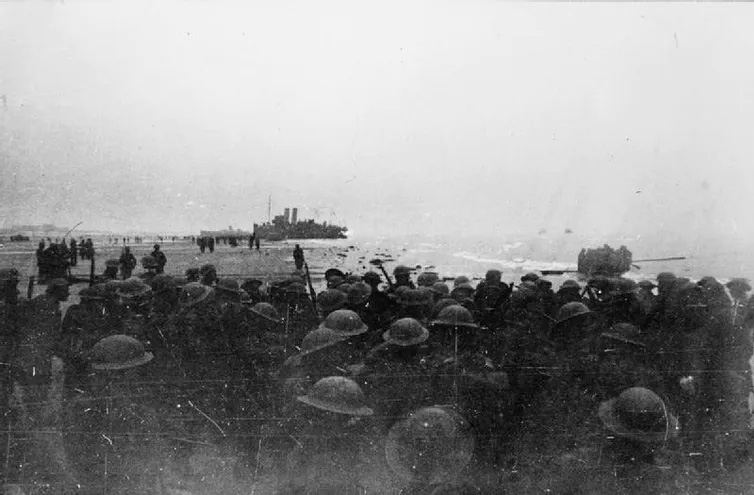
Men of the 2nd Royal Ulster Rifles awaiting evacuation at Bray Dunes, near Dunkirk, 1940.
As the quays of Dunkirk had been destroyed, evacuation had to take place from the shore itself, justifying the foresight of the Admiralty to co-opt the small ships. Troops were transported by these small craft to larger vessels of the Royal Navy and French Navy under frequent harassment from the Luftwaffe. Remarkably, however, Hitler was persuaded to halt the advance on land in favour of air strikes against the men on the beaches. The limitations of isolated air operations and the deteriorating weather that reduced the number of sorties (missions) flown probably saved many British and French lives.
The BEF was rescued, but this was far from a victory. More than 50,000 men had been lost (killed, missing, or captured) and an enormous number of tanks, guns, and trucks had been left behind, too.
Victims of spirit
The spirit of Dunkirk – the pride that the British people felt after the successful rescue of the country’s men – had its own casualties, too. The crucial role of the French army has subsequently been forgotten. The RAF, criticised for failing to cover the troops on the beach adequately, actually sustained huge losses of its own, as did both the British and French navies. German errors – particularly the aforementioned halt order – that allowed the escape to happen are understated.
Dunkirk has become the focal point for this moment in history, but other rescue missions took place that are not as well remembered. In total, over 558,000 British, French, Polish and Czech personnel were rescued from the beaches of northern France between May and June 1940 – an additional 220,000 to those who were evacuated from Dunkirk.
Most significantly, the role of the “little ships” has come to dominate the story of Dunkirk. Though these 861 pleasure craft and fishing boats were essential to the operation’s success in the shallow waters around Dunkirk, they were less significant in evacuations elsewhere. The boats are often viewed as an integral part of the people’s war, even though most of these ships were crewed by Royal Navy personnel, not civilians.
As novelist J.B. Priestley put it in his BBC radio broadcast of June 5, 1940:
What began as a miserable blunder, a catalogue of misfortunes and miscalculations, ended as an epic of gallantry. We have a queer habit – and you can see it running through our history – of conjuring up such transformations. Out of a black gulf of humiliation and despair, rises a sun of blazing glory.
In the 1850s, an anti-Catholic, anti-Irish, xenophobic movement burst on the political scene in the United States. At first a secret society, the Native American Party required its initiates to present proof of a Protestant pedigree, support mandatory Bible reading in public schools and a 21-year naturalization period for immigrants, use hand signals and passwords, and promise to respond to questions from outsiders by saying, “I know nothing.” Before it flamed out, the Know Nothing Party sent hundreds of its members to the U.S. Congress and state legislatures.
Their eyes wide shut, fingers stuck in their ears, Congressional Republicans are certain all they need to know is which way the wind is blowing – and that they shouldn’t do anything about the pandemic, the economy, voting rights or immigration because it might help Democrats.
Many Republicans support Donald Trump’s contention that he won the election. The Biden inauguration was based fraudulent counts. The January 6 insurrection was just a friendly group visiting the capitol. There was no riot.
What does it say about us that America’s 21st-century Know Nothing Party is unlikely to flame out as quickly as its 1850s ancestor?
A statue of Confederate Gen. Robert E. Lee stands in Market Street Park in Charlottesville Virginia. The city plans to remove it and a nearby statue of Confederate Gen. Stonewall Jackson on July 10.
It never made sense to me. The leaders of the Confederate States of America were traitors to the United States. It was an unrecognized breakaway state (country) that existed from February 8, 1861, to May 9, 1865, and that fought against the United States of America during the American Civil War. Despite that, members of the leadership of the Confederacy were honored with statues in the National Statuary Hall Collection in the Capitol.
On June 29th, the House of Representatives voted to remove Confederate statues from the Capitol building.
Are we sustaining Southerners hatred for Yankees by removing the statues?
This is all about keeping Americans in the dark about America’s history of bad behavior of things our leaders don’t want us to know about.
My education was in public schools. Philadelphia, Inglewood California, and Los Angeles. I wasn’t the smartest student but I wasn’t the dumbest. History and geography were the subjects I liked most but teachers provided scant facts.
We learned there was slavery but no one explained what that meant. One person owning another person. Counting slaves as 3/5 of a person in the census but the reason was never explained. Jim Crow laws were never even mentioned in school.
In practice, Jim Crow laws mandated racial segregation in all public facilities in the states of the former Confederate States of America and in some others, beginning in the 1870s. Jim Crow laws were upheld in 1896 in the case of Plessy vs. Ferguson, in which the U.S. Supreme Court laid out its “separate but equal” legal doctrine for facilities for African Americans. Moreover, public education had essentially been segregated since its establishment in most of the South after the Civil War in 1861–65.
Black Wall Street, former byname of the Greenwood neighbourhood in Tulsa, Oklahoma, where in the early 20th century African Americans had created a self-sufficient prosperous business district. The entire community was burned to the ground in 1921. I never learned of this until this year.
I was taught that American Indians were savages and they had no right to anything. Custer’s Last Stand was part of the fight against those savages. the federal government forced them to leave their homelands and walk hundreds of miles to a specially designated “Indian territory” across the Mississippi River. This difficult and sometimes deadly journey is known as the Trail of Tears. President Andrew Jackson had long been an advocate of what he called “Indian removal.”
The group of settlers known as the Donner Party resorted to cannibalism while snowbound in the Sierra Nevada mountains, for the winter of 1846–1847. Schools I attended never spoke one word of the event. When I learned of this there was one line in Britannica Encyclopedia, “cannibalism, necessity of” but no explanation. Britannica Encyclopedia has corrected that error.
There are people who deny the Holocaust ever happened despite the stories and photographs.
Today we have members of the Republican Party claiming that the January 6 insurrection at our Capitol never happened.
The Whole Truth and Nothing but the Truth? Probably not going to happen.
Donald Trump is not the first cult leader and he won’t be the last.
Juan Perón was a populist and authoritarian president of Argentina and founder of the Peronist movement. He set the country on a course of industrialization and state intervention in the economy in order to bring greater economic and social benefits to the growing working class, but he also suppressed opposition.
Luiz Inácio Lula da Silva, Brazilian politician who served as president of Brazil from 2003 to 2011. In 2006, as the end of his first term approached, the economy was growing, and Brazil’s poverty rate had fallen significantly. In July 2017, Lula was convicted on charges of money laundering and corruption in a controversial trial, and sentenced to nine and a half years in prison.
“Long live our teacher, our father, our leader, Comrade Stalin!” (1946 poster, Soviet Union). Stalin was the leader about whom the expression “cult of personality” was devised in 1956 by Nikita Khrushchev.
A cult of personality devoted to Colonel Muammar Gaddafi existed in Libyaduring his rule. His face appeared on a wide variety of items, including postage stamps, watches, and school satchels. Quotations from The Green Book appeared on a wide variety of places, from street walls to airports and even on pens, and they were also put to pop music for public release.
Donald Trump, past president of the United States, denies he lost the election in November 2020 and claims that thousands of ballots will be found in the states he lost will be found proving that he won the election. “The Fraudulent Presidential Election of 2020 will be, from this day forth, known as THE BIG LIE!” Trump said on Monday May 3, 2021. If anything the former President wields even more control of his party now as Republicans gather at rallies supporting his views.
Republican officials who once had the courage to condemn Trump’s insurrectionist rhetoric are now seeking to ingratiate themselves with his supporters — especially those who may run for President in future, including former South Carolina Gov. Nikki Haley and ex-New Jersey Gov. Chris Christie. Kevin GOP House leader, who at first said Trump bore responsibility for the January 6 riot, quickly visited the former President at his Mar-a-Lago resort and is anchoring his effort to win back the House for Republicans next year on the former President and his movement.
Some say Trump is destroying the American democracy as they pledge their support but in their hearts they know he has nothing to offer regarding the future.
The United States will survive the cult. As Ronald Reagan said in his farewell address, “For we must consider that we shall be as a city upon a hill. The eyes of all people are upon us. So that if we shall deal falsely with our God in this work we have undertaken, and so cause Him to withdraw His present help from us, we shall be made a story and a by-word through the world.”
Glendale confronts its racist past, apologizing for ‘sundown’ laws as reported in the Los Angeles Times on October 15.
Glendale now in essence saying ‘Oops, we are sorry we had those laws but you know we were frightened by the color of your skin and we feared there would be intermarriage. Oh, by the way we still believe in the superiority of White Christians over all other people. That includes Jews, Mexicans and any other group that that doesn’t look like us don’t and speak our language. We finally accepted Armenians when we noticed they do look rather White and they are Christians.’
Precinct Reporter Group, an African American news organization listed these cities as “sundown” cities.
California cities classified as “surely” sundown towns include Chico, Culver City, El Segundo, Fresno, Glendale, Hawthorne, La Jolla, Palmdale, San Marino and Taft. Cities that are now majority Black and Brown, including Compton and Inglewood in Southern California, previously barred Black residents. The list also includes some entire counties as surely sundown in the past.
Congressman Adam Schiff represents all of Glendale and surrounding areas. I wonder how many residents know he is Jewish. A delicious revenge.
This is one of the best WWII videos you will ever see! It brought a tear to my eye, along with a reaffirmation of the debt that we owe to “The Greatest Generation”.
The United States Declaration of Independence is the pronouncement adopted by the Second Continental Congress meeting at the Pennsylvania State House (now known as Independence Hall) in Philadelphia, Pennsylvania, on July 4, 1776. The Declaration explained why the Thirteen Colonies at war with the Kingdom of Great Britain regarded themselves as thirteen independent sovereign states, no longer under British rule.
“I pledge allegiance to the Flag of the United States of America, and to the Republic for which it stands, one Nation under God, indivisible, with liberty and justice for all.”