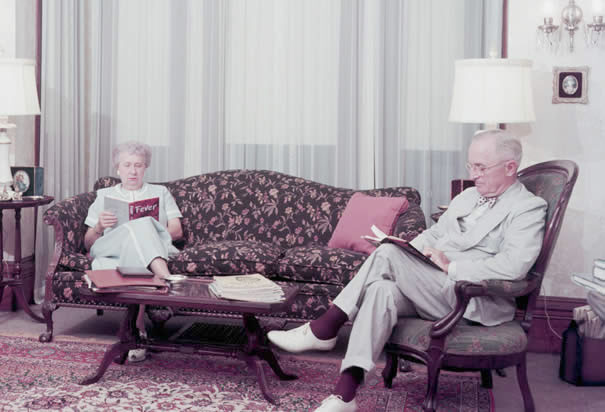
Harry Truman was a different kind of President. He probably made as many, or more important decisions regarding our nation’s history as any of the other 42 Presidents preceding him. However, a measure of his greatness may rest on what he did after he left the White House.
The only asset he had when he died was the house he lived in, which was in Independence Missouri. His wife had inherited the house from her mother and father and other than their years in the White House, they lived their entire lives there.
When he retired from office in 1952 his income was a U.S. Army pension reported to have been $13,507.72 a year. Congress, noting that he was paying for his stamps and personally licking them, granted him an ‘allowance’ and, later, a retroactive pension of $25,000 per year.
After President Eisenhower was inaugurated, Harry and Bess drove home to Missouri by themselves. There was no Secret Service following them.
When offered corporate positions at large salaries, he declined, stating, “You don’t want me. You want the office of the President, and that doesn’t belong to me. It belongs to the American people and it’s not for sale.”
Even later, on May 6, 1971, when Congress was preparing to award him the Medal of Honor on his 87th birthday, he refused to accept it, writing, “I don’t consider that I have done anything which should be the reason for any award, Congressional or otherwise.”
As president he paid for all of his own travel expenses and food.
Modern politicians have found a new level of success in cashing in on the Presidency, resulting in untold wealth. Today, many in Congress also have found a way to become quite wealthy while enjoying the fruits of their offices. Political offices are now for sale.
Good old Harry Truman was correct when he observed, “My choices in life were either to be a piano player in a whore house or a politician. And to tell the truth, there’s hardly any difference!
There is no back up information to support this opinion writer’s contentions. However, as I have written previously, the United States has a history of discrimination against minorities. The latest desecration of a Jewish cemetery in Missouri and the threatened attacks on mosques and Jewish community centers is no surprise to me. White American Christians have viewed all others as a threat to America since its founding. What troubles me about posting this opinion piece is its impact on those outside the United States that are reading the commentary. I hope some of you post some responses.
When the Nazis wrote the Nuremberg laws, they looked to racist American statutes
By James Q. Whitman, Los Angeles Times opinion page, February 22, 2017
The European far right sees much to admire in the United States, with political leaders such as Marine le Pen of France and Geert Wilders of the Netherlands celebrating events — such as the recent presidential election — that seem to bode well for their brand of ethno-nationalism. Is this cross-Atlantic bond unprecedented? A sharp break with the past? If it seems so, that’s only because we rarely acknowledge America’s place in the extremist vanguard — its history as a model, even, for the very worst European excesses.
In the late 1920s, Adolf Hitler declared in “Mein Kampf” that America was the “one state” making progress toward the creation of a healthy race-based order. He had in mind U.S. immigration law, which featured a quota system designed, as Nazi lawyers observed, to preserve the dominance of “Nordic” blood in the United States.
The American commitment to putting race at the center of immigration policy reached back to the Naturalization Act of 1790, which opened citizenship to “any alien, being a free white person.” But immigration was only part of what made the U.S. a world leader in racist law in the age of Hitler.
Then as now, the U.S. was the home of a uniquely bold and creative legal culture, and it was harnessed in the service of white supremacy. Legislators crafted anti-miscegenation statutes in 30 states, some of which threatened severe criminal punishment for interracial marriage. And they developed American racial classifications, some of which deemed any person with even “one drop” of black blood to belong to the disfavored race. Widely denied the right to vote through clever devices like literacy tests, blacks were de facto second-class citizens. American lawyers also invented new forms of de jure second-class citizenship for Filipinos, Puerto Ricans and more.
European racists followed these toxic innovations with keen interest. Of course they were well aware that America had strong egalitarian traditions, and many of them predicted that American race law would prove inadequate to stem the rising tide of race-mixing. Hitler, however, was cautiously hopeful about America’s future as a white supremacist state, and after he took power in 1933 his Nazi Party displayed the same attitude.
This is the background to a disturbing story: the story of the American influence on the Nuremberg Laws, the notorious anti-Jewish legislation proclaimed amid the pageantry of the Nazi Party Rally at Nuremberg in September of 1935.
At a crucial 1934 planning meeting for the Nuremberg system, the Minister of Justice presented a memorandum on American law. According to a transcript, he led a detailed discussion of miscegenation statutes from all over the United States. Moreover it is clear that the most radical Nazis were the most eager advocates of American practices. Roland Freisler, who would become president of the Nazi People’s Court, declared that American jurisprudence “would suit us perfectly.”
And the ugly irony is that when the Nazis rejected American law, it was often because they found it too harsh. For example, Nazi observers shuddered at the “human hardness” of the “one drop” rule, which classified people “of predominantly white appearance” as blacks. To them, American racism was sometimes simply too inhumane.
That may sound implausible — too awful to believe — but in their early years in power, the Nazis were not yet contemplating the “final solution.” At first, they had a different fate in mind for the German Jewry: Jews were to be reduced to second-class citizenship and punished criminally if they sought to marry or engage in sexual contact with “Aryans.” The ultimate goal was to terrify Germany’s Jews into emigrating.
And for that program, America offered the obvious model — even if, as one Nazi lawyer put it in 1936, the Americans had “so far” not persecuted their Jews. Of course the Nazis did not simply do a cut-and-paste job, in part because much of American law avoided open racism. (Laws intended to keep blacks from the polls did not explicitly name their target.) But American anti-miscegenation law was frankly racist, and the Nazi criminalization of intermarriage followed the American lead.
In a sense, this ugly tale about the history of American racism is also about American innovation gone awry. Today, we’re leaders in the creation of corporate law; back then, it was race law. Other countries, such as Australia, put legislative obstacles in the way of mixed marriages, but the United States went so far as to threaten long prison terms.
And we must not forget how tenaciously the racist rulebook that the Nazis admired held on in the United States. Anti-miscegenation laws were only struck down at the tail end of the civil rights era, in 1967. Race-based immigration policies did not fully end until 1968 — long after the Greatest Generation stormed the beaches of Normandy and liberated Nazi death camps.
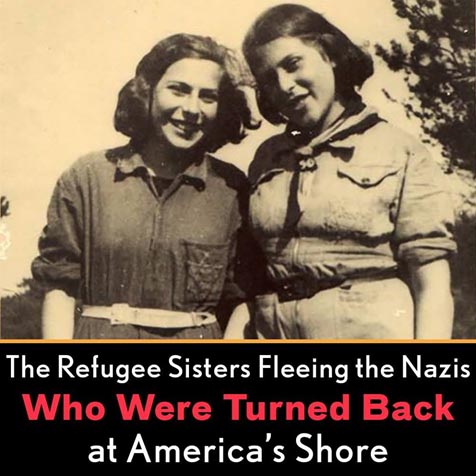
On May 13, 1939, a cruise liner, the MS St. Louis, carrying over 900 Jewish refugees desperate to escape the Nazis set off from Hamburg, Germany. Among their numbers were the two teenage girls pictured here, Sibyll and Ruthild Grünthal, who were traveling with their parents, Margarete and Walter. The St. Louis’ original destination was Havana, Cuba where the passengers hoped to seek refuge. But, anti-Semitic protests and editorials were cropping up all over the country and, by the time the ship arrived two weeks later, only a handful of passengers were allowed to disembark; the rest of the asylum seekers were told to take their pleas to the American government. This effort too would be in vain when the ship was blocked from docking at the port of Miami, their pleas for refuge going unanswered from all levels of the government. The ship’s captain, Gustav Schröder, even considered running the ship aground to allow the refugees to escape but U.S. Coast Guard vessels shadowed it to prevent it from approaching the shore. After also being denied refuge in Canada, the ship was eventually forced to return to Europe and many of the refugees it carried later died in the Holocaust, including both Sibyll and Ruthild, who were murdered at Auschwitz and Theresienstadt respectively.
In the United States at the time, the fear of the “other” was being used to stoke Americans’ paranoia and build support for repressive measures justified in the name of “national security.” At the time, government officials argued that refugees posed a security threat, with stories appearing in the media about German spies sneaking in among the refugees. Historians now believe that the concern about refugee spies or their threats to national security were blown far out of proportion but the damage at the time was done. The US shut the door on refugees in need like the ones on the St. Louis, and within two years, the anti-foreigner hysteria would even turn inward as over 100,000 Japanese-Americans were rounded up and sent to live for years in desert detention camps.
The voyage of the St. Louis and the shame such actions cast on American history have new potency today in light of the Administration’s permanent ban on Syrian refugees — of whom, in the United States, 75% are women and children under 14. As University of Michigan law professor James Hathaway observes, the St. Louis is just one example of “what happened when people slam doors shut on refugees.” Syria, he continues, is “probably the easiest example in the world today of people being massacred by a political tyrant. That we would not read the tea leaves of history and understand that the people fleeing are the enemies of our enemy is beyond comprehension to me.” The irrationality of banning refugees for security reasons given the extreme vetting they already undergo was even pointed out by the conservative think tank the Cato Institute which asserted: “[T]errorists who are intent on attacking U.S. soil have myriad other options for doing so that are all cheaper, easier, and more likely to succeed than sneaking in through the heavily guarded refugee gate. The low level of current risk does not justify the government slamming that gate shut.”
Enacting such a ban on last Friday’s Holocaust Remembrance Day has been viewed by many as shamefully symbolic. As Jewish educator Russel Neiss, who launched an education project focused on the St. Louis last week, told the Atlantic: “People always say that if you forget history then you will be doomed to repeat it. This is one of those moments where history gives us an opportunity to think about where we are now. When folks say ‘never again’ or ‘we remember,’ it is important for us to actually do so.” And, he reflects, “There’s something just about remembering the humanity of people that is getting lost in this debate. And when we talk about the importance of refugees being welcomed, we’re not talking about people who are coming here because they want to come here on vacation. We’re talking about people who are coming here because they’re fleeing for their lives. And if we escape that, if we ignore that, if we can’t remember that, then I don’t know what our humanity is really all about.”
Several civil rights groups are already taking legal action against the Administration’s illegal ban. To support these organizations’ legal fight with your donations and advocacy, visit the ACLU Nationwide (https://www.aclu.org/) and the National Immigration Law Center (https://www.nilc.org/). To learn more about how to take a stand as an individual, visit the Indivisible Guide (https://www.indivisibleguide.com/).
Despite the erection of the Statue of Liberty in New York harbor the United States has had a streak of discrimination against minorities that dates back to colonial times. Those of you non-Americans reading this blog may find this recitation disappointing. Americans have read all this before but not in this concise summary.
—
The First Group to face discrimination were Native Americans, who most Americans now call Indians or American Indians.
Europeans believed the original inhabitants of America were heathens and savages who needed to be civilized through Christianity and European culture. This led to genocide, mass murder, stolen land, attempts to wipe out Native American traditions, as well as forced assimilation through institutions like residential schools and the establishment of “Indian reservations”. To this day the term “redskin” is used to describe Native American.
Historians call the Bear River Massacre of 1863 the deadliest reported attack on Native Americans by the U.S. military—worse than Sand Creek in 1864, the Marias in 1870 and Wounded Knee in 1890. This link to a Wikipedia List of Indian Massacres will make most people sick.
—
Searching for cheap labor, early American colonists brought slavery to this continent by kidnapping Africans and bringing them to North America to work in their fields.
Many of the Africans brought to America starting in the 17th century arrived as slaves, kidnapped from their homelands in various parts of Africa. A number of them were known to be royalty and literate. African men, women, and children were stripped of their names and identities, forced to “Christianize”, whipped, beaten, tortured, and in many cases, lynched or hanged at the whims of their white masters, for whom slavery was key to maintaining their vast properties and land. Families were separated through the process of buying and selling slaves. While not all Africans in America were slaves, a large number were, particularly in the southern states. For those Africans in America who were free, discriminatory laws that barred them from owning property and voting, for example, as well as the belief in the intrinsic inferiority of dark-skinned peoples by the dominant white majority, held them back from full equality in the United States.
The Union victory in the Civil War may have freed African Americans but their lives were no picnic. Southern state legislatures passed restrictive “black codes” to control the labor and behavior of former slaves and other African Americans. Outrage in the North over these codes eroded support for the approach known as Presidential Reconstruction and led to the triumph of the more radical wing of the Republican Party. During Radical Reconstruction, which began in 1867, newly enfranchised blacks gained a voice in government for the first time in American history, winning election to southern state legislatures and even to the U.S. Congress. In less than a decade, however, reactionary forces–including the Ku Klux Klan–would reverse the changes wrought by Radical Reconstruction in a violent backlash that restored white supremacy in the South.
Disenfranchisement after the Reconstruction Era in the United States of America was based on a series of laws, new state constitutions, and practices in the South that were deliberately used to prevent black citizens from registering to vote and voting. These measures were enacted by former Confederate states at the turn of the 20th century. Their actions defied the intent of the Fifteenth Amendment to the United States Constitution, ratified in 1870, which was intended to protect the suffrage of freedmen after the American Civil War.
The sharp and sweeping rise of racial segregation in 20th century America is now subsiding but is still a reality for African Americans in many communities throughout the United States. Police stopping and harassing Black car operators has been well documented in recent years. The most obvious segregation were separate but equal schools (they weren’t equal), separate drinking fountains and toilet facilities, and housing segregation. Black Americans were denied employment and housing just because they were dark skinned.
—
The first significant Chinese immigration to North America began with the California Gold Rush of 1848–1855 and it continued with subsequent large labor projects, such as the building of the First Transcontinental Railroad. During the early stages of the gold rush, when surface gold was plentiful, the Chinese were tolerated, if not well received. As gold became harder to find and competition increased, animosity toward the Chinese and other foreigners increased. After being forcibly driven from the mines, most Chinese settled in enclaves in cities, mainly San Francisco, and took up low-wage labor, such as restaurant and laundry work. With the post-Civil War economy in decline by the 1870s, anti-Chinese animosity became politicized by labor leader Denis Kearney and his Workingman’s Party as well as by California Governor John Bigler, both of whom blamed Chinese “coolies” for depressed wage levels.
The Chinese Exclusion Act was a United States federal law signed by President Chester A. Arthur on May 6, 1882, prohibiting all immigration of Chinese laborers. The act followed the Angell Treaty of 1880, a set of revisions to the US–China Burlingame Treaty of 1868 that allowed the US to suspend Chinese immigration. The act was initially intended to last for 10 years, but was renewed in 1892 with the Geary Act and made permanent in 1902. The Chinese Exclusion Act was the first law implemented to prevent a specific ethnic group from immigrating to the United States. It was repealed by the Magnuson Act on December 17, 1943.
—
The Irish people faced much prejudice, racism and discrimination after their immigration to the United States because they were poor, uneducated, less skilled, considered disruptive and were Catholics in a land of Protestant dominance. The common perception was that the Irish were drunkards. From 1820 to 1860, 1,956,557 Irish arrived, 75% of these after the Great Irish Famine of 1845–1852 struck.
—
With Japan’s December 1941 bombing of Pearl Harbor in Hawaii, racism against Japanese-Americans intensified. Like Muslims after the 9/11 attacks, Japanese-Americans were targets of harassment, discrimination, and government surveillance. Members of the community lost homes, jobs, and businesses. But the worst blow was the February 1942 Executive Order signed by President Franklin D. Roosevelt that authorized the internment of Japanese-Americans. They were now deemed enemies of the state. Over half of the 120,000 Japanese-Americans sent to the camps were born and raised in the U.S. and had never set foot in Japan. Half of those sent to the camps were children.
—
Although Jews first arrived in America over 300 years ago and enjoyed a certain level of religious freedom, anti-Semitism was acceptable and common socially, as well as legally in some cases. For example, some states in the late 18th century barred those who were not Christian from voting or holding public office.
Job and housing discrimination were common throughout the 20th century. Examples are Father Charles Coughlin’s anti-Semitic radio rants in the 1930’s and Charles Lindbergh’s isolationist speeches accusing the Jews of pushing America into World War II. Henry Ford’s “The International Jew,” was published in his newspaper, The Dearborn Independent, which excerpted the infamous anti-Semitic forgery, “The Protocols of the Learned Elders of Zion.”
Henry Ford asserted that there was a Jewish conspiracy to control the world. He blamed Jewish financiers for fomenting World War I so that they could profit from supplying both sides. He accused Jewish automobile dealers of conspiring to undermine Ford Company sales policies. In 1919, he purchased a newspaper, the Dearborn Independent. He installed Charles Pipp as editor and hired a journalist, William J. Cameron, to listen to his ideas and write a weekly column, “Mr. Ford’s Page,” to expound his views. For a year, editor Pipp resisted running anti-Jewish articles, and resigned rather than publish them. Ford closed the Independent in December 1927. Ford died in 1947, apparently unrepentant.
—
Islamophobia is the term that has been coined to describe the current hostility toward Islam and Muslims in the United States, manifested in prejudice, harassment and discrimination. There is an anti-Muslim hate crime epidemic. Attacks on Muslim Americans have come in four waves since 9/11, said Corey Saylor, director of CAIR’s department to monitor and combat Islamophobia. According to the FBI, in 2001 anti-Islamic hate crimes spiked by 1,600 percent with 481 incidents. At least six mosque projects across the U.S., not just in New York, have faced bitter opposition in 2010. Now President Trump has stopped the entry of anyone from seven predominately Muslim nations. The president denies that his focus is on Muslims. He says it is an effort to deny terrorists entry into the United States. No terrorists have been identified from those seven nations.
There were only 8,000 cars and only 144 miles of paved roads.
The maximum speed limit in most cities was 10 mph.
The tallest structure in the world was the EiffelTower ! The average US wage in 1910 was 22 cents per hour.
The average US worker made between $200 and $400 per year.
A competent accountant could expect to earn $2000 per year, A dentist $2,500 per year, a veterinarian between $1,500 and $4,000 per year, and a mechanical engineer about $5,000 per year.
More than 95 percent of all births took place at HOME.
Ninety percent of all Doctors had NO COLLEGE EDUCATION!
Instead, they attended so-called medical schools, many of which were condemned in the press AND the government as ‘substandard.’
Sugar cost four cents a pound.
Eggs were fourteen cents a dozen. Coffee was fifteen cents a pound.
Most women only washed their hair once a month, and used Borax or egg yolks for shampoo.
Canada passed a law that prohibited poor people from entering into their country for any reason.
Crossword puzzles, canned beer, and iced tea hadn’t been invented yet.
There was no Mother’s Day or Father’s Day.
Two out of every 10 adults couldn’t read or write and only 6 percent of all Americans had graduated from high school.
Marijuana, heroin, and morphine were all available over the counter at the local corner drugstores.
Back then pharmacists said, ‘Heroin clears the complexion, gives buoyancy to the mind, regulates the stomach and bowels, and is, in fact, a perfect guardian of health’
( Shocking? DUH! ) Eighteen percent of households had at least one full-time servant or domestic help.
There were about 230 reported murders in the ENTIRE U. S.A. !
Many have theorized that Christopher Columbus was a Jew. The basis for that is the fact that the Spanish Inquisition was in process in 1492. The theory goes that Columbus and his crew were Jews escaping the Inquisition. There is no proof to support that idea. The following article may be factual or not. My daughter does have a Jewish friend whose family did emigrate from Jamaica to the United States.
Some Jews turned to piracy as a way to fight against Spain and Portugal, the hosts of the brutal Inquisition.
Jewish pirates? It’s not a joke. Turns out, some of the most well-known and respected buccaneers in previous centuries were Jews. These captains were not the dreaded pirates of popular imagination; many worked in the employ of Britain, the Netherlands, and other maritime powers, protecting those nations’ coasts and seas.
While many of the details of these captains’ lives are mysterious, historians have pieced together some details of their lives, giving us a glimpse into the little-known world of Jewish pirates. Here are eight interesting facts about Jews and piracy.
Abraham Henriques Cohen and the World’s Biggest Heist
Abraham Henriques Cohen started life as a secret Jew living under the Inquisition in his native Portugal. One of the most prominent merchants in Lisbon, he was discovered to be a practicing Jew in 1605 and publicly tortured, along with 150 other hidden Jews. This experience apparently led Cohen to decide to work against Spain and Portugal, the hosts of the brutal Inquisition.
After escaping to Amsterdam, Cohen seemingly became a secret agent for the Dutch navy, and made his way to the New World, settling in Jamaica, which was then a haven for Jews. He worked on behalf of the Netherlands to attack Spanish ships and frustrate Spain’s colonial designs in the New World.
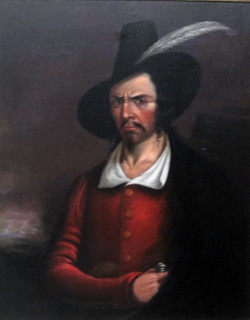
Cohen teamed up with one of the most feared pirates of the time, Sir Henry Morgan, with the tacit backing of both the Dutch and British governments. In 1628, along with Dutch folk hero Admiral Piet Pieterszoon Hein, Cohen captured a Spanish treasure fleet off the coast of Cuba. The ships were carrying gold and silver worth 11,509,524 guilders, around $1 billion today. It was the largest theft in the history of the Spanish fleet.
Cohen gave up piracy in old age when Sir Henry Morgan became Lieutenant Governor of Jamaica, and pardoned his longtime friend. The two lived out their days in Jamaica, their pirate ways behind them for good.
Jean Laffite, War Hero and Pirate
One of the most fabled and swashbuckling pirates of all time, Jean Laffite, was born in France in about 1780. He later wrote that his grandparents were Jews who were tortured by the Inquisition. This sparked a lifelong disdain for Spain in young Jean, and inspired him to turn to piracy to attack Spanish holdings in the New World where the Inquisition held sway.
Moving to the French colony of New Orleans, Jean Laffite and his brother Pierre founded a blacksmith shop, but they had a second secret profession as well: they held commissions from the Republic of Cartagena (in modern day Colombia) to intercept Spanish boats. They carried on this secret activity from a secluded colony in Barataria Bay, off the coast of New Orleans.
During the War of 1812, Laffite warned American troops of British invasion plans. He offered the help of his pirate gang to Gen. Andrew Jackson in the defense of New Orleans in exchange for a pardon for their pirate activities. Gen. Jackson agreed and Laffite’s gang fought with distinction. Jackson later called Laffite “one of the ablest men” of the Battle of New Orleans.
A few years later, in 1817, Laffite once again turned to piracy, taking nearly a thousand followers with him to the site of present-day Galveston, Texas. Until his death in about 1825, Jean Laffite remained one of the most feared pirates of the “Spanish Main,” the eastern coast of Spain’s holdings in the New World.
“Brotherhood of the Black Flag” and Buried Treasure
Sudel Deul, a 16th Century Jewish physician, was an early explorer of the Americas and is credited with introducing the potato to Europeans. His son Subatol found fame in a very different route: becoming one of the most feared pirates in the world.
Subatol formed an alliance with another son of a famous explorer who’d also turned to piracy: Henry Drake, son of the great British explorer Sir Francis Drake. Together the two buccaneers formed the “Brotherhood of the Black Flag”, leading a band of pirates in attacking Spanish ships off the coast of present-day Chile. It is said that the duo buried 6,000 pounds of Spanish gold and an even greater amount of silver near the Guayacan harbor in present-day Chile. No one has found the buried treasure yet, though seekers have discovered documents written partly in Hebrew, possibly written by Subatol.
Pirate Gravestones in a Jewish Cemetery
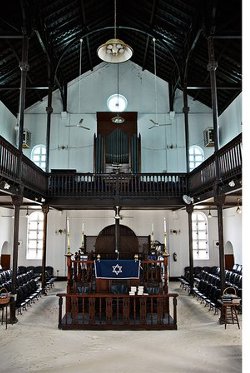
jamaicas-sole-synagogue
The island nation of Jamaica was once crawling with pirates; it seems that some of these were Jews. Seven gravestones in the old Hunt’s Bay Cemetery in Kingston bear unusual markings above Hebrew writing can be seen the familiar skull and crossbones of the pirate insignia. Similarly marked graves have also been found in Bridgeport, in the Bahamas, and in the old Jewish cemetery of Curacao.
Those buried in Hunts Bay were carried across the Cagway Bay from Port Royal, once called the Wickedest City in the World. These seven Jewish denizens might have helped contribute to that fearsome reputation with their pirate activities.
The Pirate Rabbi
Although Samuel Pallache trained as a rabbi in the late 1500s in Fez, Morocco, he preferred the seafaring life, eventually working as a privateer for both the Dutch government and for the Sultan of Barbary, in Morocco. Pallache negotiated one of the very first treaties between European and Middle Eastern nations: the 1610 agreement guaranteeing peace between the Netherlands and Morocco.
In 1614, Morocco and Spain were at war, and Pallache led a small Moroccan fleet that captured Spanish ships. Arrested by the Spanish ambassador, Pallache was tried for piracy. A letter to Dudley Carleton, British ambassador to Venice at the time, described the dashing Jewish buccaneer: “Here is a Jew Pirate arrested that brought three prizes of Spaniards into Plymouth . . . he shall likely pass out of here well enough for he has league and license under the King’s hand for his free egress and regress which was not believed until he made proof of it.”
Indeed, Pallache was eventually acquitted of piracy and set free. When he died in 1616, he was given a hero’s funeral. Every member of Amsterdam’s Jewish community marched in his funeral procession and they were joined by city elders and Prince Maurice of Nassau.
The “Great Jew”
Sinan Reis and his family fled the Spanish Inquisition in the early 1500s, settling in the city of Smyrna, in what is today Izmir, Turkey. There, Sinan became the right-hand man of one of the most famed pirates of all time, Hayreddin Barbarossa, who eventually became a sultan and commander in the Ottoman navy. The two sailed under a flag bearing a six-sided star, much like the Jewish Star of David.
The pair’s greatest victory came in 1538, in the Battle of Preveza, off the coast of Greece, when Ottoman forces led by Reis and Barbarossa defeated a flotilla of armed ships from Christian countries assembled by Pope Paul III, ensuring Ottoman dominance on the Mediterranean for generations to come. Sinan’s great bravery in that battle earned him the sobriquet “The Great Jew” from his Spanish enemies. The Ottoman Empire rewarded him by appointing him Supreme Naval Commander.
At the end of his life, Barbarossa dictated his memoirs to Sinan Reis, who created five hand-written volumes that are exhibited today in the Topkapi Palace in Istanbul and in the Istanbul University Library.
Israel Connections in the Caribbean
The Jewish homeland was never far from the thoughts of some Jewish seafarers. Yaakov Koriel worked as a buccaneer in the Caribbean in the early 1600s, until he changed his ways, moved to Israel, and studied Torah and Kabbalah in the Israeli city of Safed. He’d buried in that city, near the grave of his the famous Rabbi Isaac Luria, whose works he studied.
Another Jewish seafarer in the Caribbean, David Abrabanel, shared his name with a famous rabbi, Isaac Abrabanel. After his family was murdered in South America in the early 1700s, David adopted the nickname “Captain Davis” and sailed with British privateers. He eventually commanded his own ship, which he named The Jerusalem.
Israelis Fighting Pirates Today
The days of Jewish pirates on the high seas is over. Today instead, Israeli security teams are world leaders in opposing piracy and protecting cargo and passenger ships from modern-day pirates.
One such Israeli anti-piracy company, Mano International Security, gained international attention in 2009, when its Israeli guards fought off a daring attempt by Somali pirates to take over the Italian cruise ship Melody, which was sailing within a few hundred miles of the pirate-infested coast of Somalia with 1,500 passengers and crew on board. According to ship captain Ciro Pinto, Israeli guards fired shots over the heads of the bandits, eventually scaring them off.
“It was the first time we have encountered resistance” one of the Somali pirates was quoted as saying after the attack. “The guys acted exactly according to the regulations and I’m proud of them” Mano Nik, the company owner said.
This article is appropriate for Memorial Day.
~~~~~~~~~~~~~~~~~~~~~~~~~~~~~~
Once upon a time when our politicians did not tend to apologize for our country’s prior actions, here’s a refresher on how some of our former patriots handled negative comments about our great country.
JFK’S Secretary of State, Dean Rusk, was in France in the early 60’s when DeGaulle decided to pull out of NATO.
DeGaulle said he wanted all US military out of France as soon as possible.
Rusk responded, “Does that include those who are buried here?”
DeGaulle did not respond. You could have heard a pin drop.
~~~~~~~~~~~~~~~~~~~~~~~~~~~~~~
When in England, at a fairly large conference, Colin Powell was asked by the Archbishop of Canterbury if our plans for Iraq were just an example of ’empire building’ by George Bush.
He answered by saying, “Over the years, the United States has sent many of its fine young men and women into great peril to fight for freedom beyond our borders. The only amount of land we have ever asked for in return is enough to bury those that did not return.”
You could have heard a pin drop.
~~~~~~~~~~~~~~~~~~~~~~~~~~~~~~
There was a conference in France where a number of international engineers were taking part, including French and American. During a break, one of the French engineers came back into the room saying, “Have you heard the latest dumb stunt Bush has done? He has sent an aircraft carrier to Indonesia to help the tsunami victims. What does he intend to do, bomb them?”
A Boeing engineer stood up and replied quietly: “Our carriers have three hospitals on board that can treat several hundred people; they are nuclear powered and can supply emergency electrical power to shore facilities; they have three cafeterias with the capacity to feed 3,000 people three meals a day, they can produce several thousand gallons of fresh water from sea water each day, and they carry half a dozen helicopters for use in transporting victims and injured to and from their flight deck. We have eleven such ships; how many does France have?”
You could have heard a pin drop.
~~~~~~~~~~~~~~~~~~~~~~~~~~~~~~
A U.S. Navy Admiral was attending a naval conference that included Admirals from the U.S., English, Canadian, Australian and French Navies. At a cocktail reception, he found himself standing with a large group of officers that included personnel from most of those countries. Everyone was chatting away in English as they sipped their drinks, but a French admiral suddenly complained that, whereas Europeans learn many languages, Americans learn only English. He then asked, “Why is it that we always have to speak English in these conferences rather than speaking French?”
Without hesitating, the American Admiral replied, “Maybe it’s because the Brit’s, Canadians, Aussie’s and Americans arranged it so you wouldn’t have to speak German.”
You could have heard a pin drop.
~~~~~~~~~~~~~~~~~~~~~~~~~~~~~~
AND THIS STORY FITS RIGHT IN WITH THE ABOVE…
Robert Whiting, an elderly gentleman of 83, arrived in Paris by plane. At French Customs, he took a few minutes to locate his passport in his carry on.
“You have been to France before, monsieur?” the customs officer asked sarcastically.
Mr. Whiting admitted that he had been to France previously.
“Then you should know enough to have your passport ready.”
The American said, “The last time I was here, I didn’t have to show it.”
“Impossible.. Americans always have to show their passports on arrival in France!”
The American senior gave the Frenchman a long hard look. Then, he quietly explained, ”Well, when I came ashore at Omaha Beach on D-Day in 1944 to help liberate this country, I couldn’t find a single Frenchman to show a passport to.”
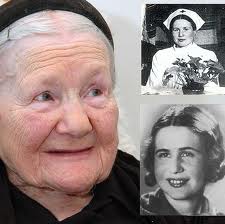
Irena Sendler
Died: May 12, 2008 (aged 98) Warsaw, Poland
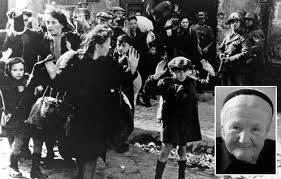
During WWII, Irena, got permission to work in the Warsaw ghetto, as a Plumbing/Sewer specialist.She had an ulterior motive. Irena smuggled Jewish infants out in the bottom of the tool box she carried.She also carried a burlap sack in the back of her truck, for larger kids.
Irena kept a dog in the back that she trained to bark when the Nazi soldiers let her in and out of the ghetto.
The soldiers, of course, wanted nothing to do with the dog and the barking covered the kids/infants noises.
During her time of doing this, she managed to smuggle out and save 2500 kids/infants. Ultimately, she was caught, however, and the Nazi’s broke both of her legs and arms and beat her severely.
Irena kept a record of the names of all the kids she had smuggled out, In a glass jar that she buried under a tree in her back yard. After the war, she tried to locate any parents that may have survived and tried to reunite the family. Most had been gassed. Those kids she helped got placed into foster family homes or adopted.
In 2007 Irena was up for the Nobel Peace Prize. She was not selected.Al Gore won, for a slide show on Global Warming.
Later another politician, Barack Obama, won for his work as a community organizer for ACORN.
In MEMORIAM – 65 YEARS LATER I’m doing my small part by posting this message.I hope you’ll consider doing the same. It is now more than 65 years since the Second World War in Europe ended. In memory of the 6 million Jews, 20 million Russians, 10 million Christians and 1,900 Catholic priests who were murdered, massacred, raped, burned, starved and humiliated!
Now, more than ever, with Iran, and others, claiming the HOLOCAUST to be ‘a myth’, It’s imperative to make sure the world never forgets,Because there are others who would like to do it again.
Is Donald Trump the new Hitler or a reincarnation of William Jennings Bryan? In a piece on U.S, News and World Reportweb site Daniel Klinghard, on March 4, 2016, thinks Trump is reminiscent of Bryan. Following is a slightly abridged version of the article.
Pundits and academics toyed for a while with branding Donald Trump with the scarlet H – warning of his rise as a replay of the fall of Weimar Germany and the emergence of Adolf Hitler. Trump’s suggestions that the government surveil mosques, deport undocumented Mexicans and prevent Muslims from entering the U.S. was originally hailed as more Nazi than American, until we reflected on the pervasiveness of NSA surveillance, the treatment of Japanese-Americans during World War II and the mass deportations of Operation Wetback in 1954. Indeed, there are enough examples of such Trumpisms in the American tradition for comparisons of demagoguery without having to conjure up Hitler.
Consider William Jennings Bryan, who captured the Democratic presidential nomination 120 years ago in 1896. He made a name for himself as a journalist (both before and after serving as a member of the House of Representatives) and importantly as an orator who toured the country to speak to populist groups and agitate for the abandonment of the gold standard and the adoption of a silver-based currency. In his appeal to lowbrow tastes, his ability to turn politics into popular entertainment and his willingness to play to prejudice against judgment, Bryan was closer to a modern-day reality TV star than Trump is to Hitler.
To secure the nomination, Bryan applied the same rhetorical style that he had honed in prairie schoolhouses and southern convention halls – a popular forum that had been all but ignored by party elites, but through which he generated a “silent majority” that struck the establishment by surprise in 1896.
Among the most popular tools of the Bryan campaign were a series of ill-informed and wildly popular pamphlets featuring a young boy who lectured bankers on the intricacies of global finance. Witty, anti-Semitic and grossly simplistic, they reassured voters that there were solutions to America’s economic woes – solutions so clear that a child could see them. Like Trump, Bryan appealed to what he deemed to be common sense and warned his listeners that anyone preaching moderation only intended to keep the common man in the dark.
Fifteen Democratic candidates received votes for the nomination at the 1896 convention, including six governors, five senators and the sitting vice president of the United States. They never overcame their interpersonal opposition to present a united front against Bryan, a former two-term representative and newspaper editor. Indeed, they hardly considered Bryan a serious contender until the convention met and he delivered his famous “Cross of Gold” speech decrying the gold standard and calling Democrats to an apocalyptic battle against the “Eastern Elites” who dominated both parties.
The elevation of Bryan had long-term implications for his party. His predecessor as Democratic nominee, President Grover Cleveland, had made his career following a formula of running on reform principles and governing pragmatically. After 1896, Cleveland was a man without a party. He refused to support Bryan and retired in despair when Republican nominee William McKinley trounced Bryan and set up the GOP for a thirty-year period of dominance.
Bryan remained the master of what was left of the Democratic Party, despite the clear flaws in his candidacy and his isolation from the party’s establishment – particularly from its traditional major donors, nearly all of whom abandoned the party after 1896.
It is easy to imagine the emergence of an analogous situation under a Republican collapse today, even if it is one with different policy objectives. In fact, if you look at a map of the 1896 electoral college results demonstrating Bryan’s loss, you’re looking at the basic parameters of a Trump loss (with some give and take around the edges, particularly Washington, Virginia and Florida).
If the Republicans of 2016 go the direction Democrats went with Bryan in 1896, it could mean years of wandering in the wilderness. We might look toward such a proposition with hope that the polarized politics of the past fifteen years would at last be broken. But we should also be warned of a democratic deficit, in which the incentives to mobilize in support of Democratic politics would wither along with the possibility of real party competition.
It appears that the folks in South Carolina have forgotten some major events that occurred when George W. Bush was president. Not all were his direct fault but he and his administration, in my opinion, did not take sufficient precautions. I did not have to refer to any publication or website for these occurrences. They are all clearly in my mind. They should be in yours too.
September 11, 2001 attack on the World Trade Center in New York City did occur eight months after he was inaugurated into office. The prior administration had warned of a possible terrorist attack.
HurricaneKatrina occurred on the morning on August 29, 2005. When the storm made landfall, it had a Category 3 rating on the Saffir-Simpson Hurricane Scale–it brought sustained winds of 100–140 miles per hour–and stretched some 400 miles across the Gulf coast. The History Channel says “Officials, even including President George W. Bush, seemed unaware of just how bad things were in New Orleans and elsewhere: how many people were stranded or missing; how many homes and businesses had been damaged; how much food, water and aid was needed. Katrina had left in her wake what one reporter called a “total disaster zone” where people were “getting absolutely desperate.” The Bush administration was widely criticized for its slow response to the disaster.
The invasion of Iraq occurred in the spring of 2003, the United States invaded Iraq in order to overthrow leader Sadaam Hussein (1937-2006), whose regime was accused of supporting international terrorist groups and possessing large caches of weapons of mass destruction (WMD). No WMD were found. 4,486 U.S. soldiers died in Iraq.
He began his presidency with a federal budget surplus; however, factors such as the enormous cost of fighting two wars (Afghanistan and Iraq) and the broad tax cuts led to annual budget deficitsstarting in 2002.
The 2008 financial crisis was the worst economic disaster since the Great Depression. The president was mostly absent from the efforts to save the economy. Instead it was his Treasury Secretary, Henry Paulson, who made requests to congress for funds to support the banking industry.
Perhaps the above listing of George W. Bush’s major administration failures would be a reason to suspect another Bush would not be welcomed to the White House.






 Coast Contact