First they came for the Communists
And I did not speak out
Because I was not a Communist
Then they came for the Socialists
And I did not speak out
Because I was not a Socialist
Then they came for the trade unionists
And I did not speak out
Because I was not a trade unionist
Then they came for the Jews
And I did not speak out
Because I was not a Jew
Then they came for me
And there was no one left
To speak out for me
Category: Jews
It Happened One Night
Khazaria the Thirteenth Tribe

The question is why are there so many Jews in Ukraine, today’s southern Russia, Poland, and Germany?
The Thirteenth Tribe is a 1976 book by Arthur Koestler[1] advocating the Khazar hypothesis of Ashkenazi ancestry, the thesis that Ashkenazi Jews are not descended from the historical Israelites of antiquity, but from Khazars, a Turkic people. Koestler hypothesized that the Khazars (who converted to Judaism in the 8th century) migrated westwards into Eastern Europe in the 12th and 13th centuries when the Khazar Empire was collapsing.
Koestler used previous works by Douglas Morton Dunlop, Raphael Patai and Abraham Polak as sources. His stated intent was to make antisemitism disappear by disproving its racial basis.
Popular reviews of the book were mixed, academic critiques of its research were generally negative, and Koestler biographers David Cesarani and Michael Scammell panned it. In 2018, the New York Times described the book as “widely discredited.”[2] Neither was it effective in disproving antisemitism, as antisemites merely adapted it — like prior work on the hypothesis — to argue the illegitimacy of present-day Jews.
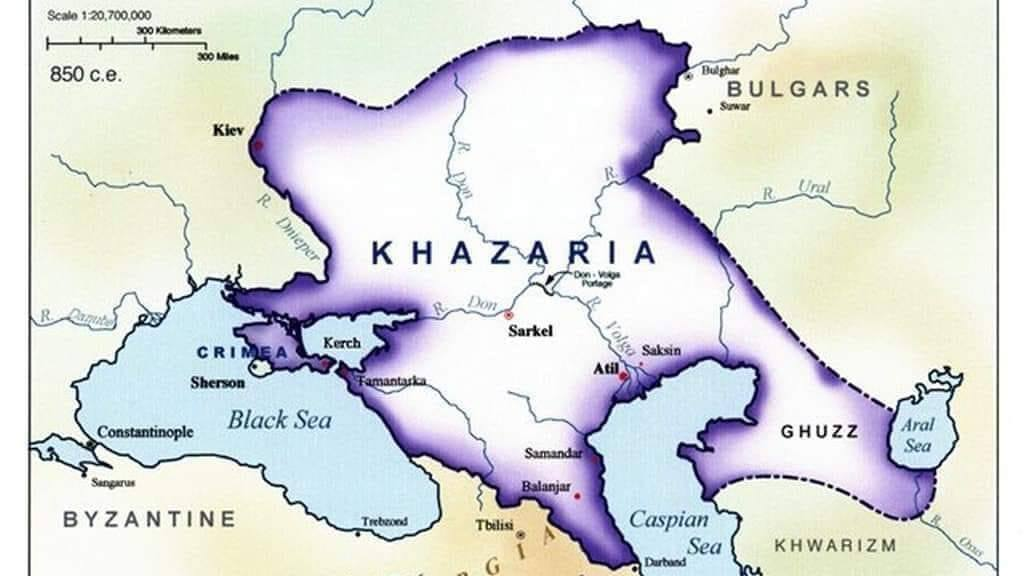
The Khazar Khaganate was a powerful and influential Turkic state that existed between the 7th and 10th centuries. Located primarily in the northern Caucasus and western steppes of modern-day southern Russia, the Khazar Khaganate controlled vast territories, including parts of the Volga River, the Crimea, and the Caspian Sea region.
Key Points about the Khazar Khaganate:
1. Origins: The Khazars were a semi-nomadic Turkic people who emerged as a political force following the collapse of the Western Turkic Khaganate in the mid-600s. They eventually established their own state, with a ruling class known as the Khaganate.
2. Religion: One of the most unique aspects of the Khazar Khaganate was the ruling elite’s conversion to Judaism sometime in the 8th or 9th century. The exact reasons for this conversion remain debated, but it set the Khazars apart from their Christian and Muslim neighbors, such as the Byzantine Empire and the Caliphates.
3. Trade and Economy: The Khazars were known for their significant role in the Silk Road trade network, controlling key trade routes between Europe, the Middle East, and Central Asia. Their capital, Atil, on the Volga River, was a major commercial hub.
4. Diplomatic Relations: The Khazar Khaganate maintained a strategic diplomatic balance between the Byzantine Empire and the Muslim Caliphates, often serving as a buffer state between the two. They also had interactions with the emerging Kievan Rus and other Slavic states.
5. Military Power: The Khazars had a strong military and often engaged in warfare with their neighbors. They were known for employing a mix of cavalry and mercenary forces, and their military might helped them maintain control over their vast territory.
6. Decline and Fall: The Khazar Khaganate began to weaken in the 10th century due to internal strife, economic pressure, and attacks from external forces. One key factor in their decline was the rise of the Kievan Rus, which defeated the Khazars in a series of campaigns, culminating in the destruction of Atil around 965 AD. By the early 11th century, the Khazar state had largely disintegrated.
7. Legacy: The Khazars are often remembered for their unique religious identity and their role in medieval trade and diplomacy. Their influence extended over a wide area, and they are considered a key player in the history of the Eurasian steppes.
The Khazar Khaganate holds a special place in history for its blend of Turkic nomadic culture, religious diversity, and strategic political positioning.
Jewish New Year starts tonight
Jewish Holidays 2024
Denial of the Holocaust in the Fall of 2024
Do you really want to elect Mr. Donald J. Trump and Senator JD Vance to the positions of president and vice president of the United States?
This is too sickening to even talk about or write about but I must.
Senator JD Vance, the running mate of former President Donald J. Trump, has declined to denounce the right-wing talk-show host Tucker Carlson for praising and airing the views of a Holocaust revisionist who falsely claimed that the Nazis’ destruction of European Jewry was not an intentional act of premeditated genocide.
Mr. Carlson is no stranger to controversy, but his recent interview with Darryl Cooper, whom he described as “the best and most honest popular historian in the United States,” has faced particularly fierce blowback.
The Nazis’ killing of almost six million Jews was meticulously planned, documented and pursued even after the tide of World War II had turned and Germany’s defeat was assured.
The German penal code prohibits publicly denying the Holocaust and disseminating Nazi propaganda, both off- and online. This includes sharing images such as swastikas, wearing an SS uniform and making statements in support of Hitler.
White House spokesman Andrew Bates said in a statement: “Giving a microphone to a Holocaust denier who spreads Nazi propaganda is a disgusting and sadistic insult to all Americans, to the memory of the over six million Jews who were genocidally murdered by Adolf Hitler, to the service of the millions of Americans who fought to defeat Nazism and to every subsequent victim of antisemitism.”
Top Democrat Schumer calls for new elections in Israel, saying Netanyahu is an obstacle to peace
WASHINGTON (AP) — Senate Majority Leader Chuck Schumer on Thursday called on Israel to hold new elections, saying he believes Israeli Prime Minister Benjamin Netanyahu has “lost his way” and is an obstacle to peace in the region amid a growing humanitarian crisis in Gaza.
Schumer, the first Jewish majority leader in the Senate and the highest-ranking Jewish official in the U.S., strongly criticized Netanyahu in a 40-minute speech Thursday morning on the Senate floor. Schumer said the prime minister has put himself in a coalition of far-right extremists and “as a result, he has been too willing to tolerate the civilian toll in Gaza, which is pushing support for Israel worldwide to historic lows.”
“Israel cannot survive if it becomes a pariah,” Schumer said.
—
The problem is that Israel’s “religious right” hold the view that they have a divine right to all of Gaza. Some of those people have blocked the roads to stop the delivery of food and medical supplies to Palestinians.
Consequence of Antisemitism
Harvard University President Claudine Gay resigned Tuesday January 2, 2024 amid plagiarism accusations and criticism over testimony at a congressional hearing where she was unable to say unequivocally that calls on campus for the genocide of Jews would violate the school’s conduct policy.
Obviously she was pressured to resign after many well off Jewish alumni demanded her removal.
More than 1,600 alumni of Harvard University say that they will withhold donations to the school until Harvard takes urgent action to address antisemitism on campus, part of a wave of challenges to colleges across the county in addressing hate speech sparked by the Israel-Hamas war.
High-profile billionaire alumni like Pershing Square founder Bill Ackman and former Victoria’s Secret CEO Leslie Wexner have already said that if Harvard doesn’t take steps to fix the problem they could face a donor exodus, but now the largest group yet of alumni — most of whom do not have billionaire status — are threatening to withdraw their donations.
Addtionally more than 70 U.S. lawmakers demanded the governing boards of three of the country’s top universities remove their presidents, citing dissatisfaction with their testimony at a hearing about antisemitism on campuses, according to a letter seen by Reuters.
In the letter, Republican Representative Elise Stefanik and Democratic Representative Jared Moskowitz demanded that the board of governors at Harvard University, the University of Pennsylvania, and the Massachusetts Institute of Technology oust their presidents or risk committing “an act of complicity in their antisemitic posture.”
Do You Oppose Jewish Genocide? ‘It Depends’ Is Not the Right Answer
Opinion by James D. Zirin
Of all universities, the Ivy League colleges of Harvard, Penn and MIT should know better. It’s very simple: Advocacy of genocide is abhorrent, dehumanizing; it instills fear and distress. It has no place on a college campus, or anywhere else in our society. It has no pedagogical value. It is murder, nihilism.
Just before I went into the Army, a lawyer friend, who had served, counseled me to give an evasive non-answer to any question I was asked: “Depends on the tactics and the terrain.”
So it is perhaps not surprising that a lawyer thought “Depends on the context” was the perfect answer for three university presidents (one of whom is now an ex-president) testifying before Congress if asked whether calls for the genocide of Jews on campus constituted bullying or harassment.
Context? What a dreadful word to use in the context of genocide. What is the context it would depend on — Auschwitz, Dachau, the pogroms of Russia in the 19th century, or the Jews’ convenience over 2,000 years as victims of dehumanizing oppression. And let’s not forget the 1,400 victims of Hamas’ Oct. 7 attack on Israel — women raped and murdered, babies slaughtered, men butchered in barbarous ways on another day that will live in bloody infamy.
At all of these universities, I am certain, burning a cross or erecting a gallows in front of a dormitory housing Black students — both forms of symbolic speech — would constitute bullying or harassment. I’m equally certain that statements targeting LGBTQ+ students would constitute bullying or harassment.
Interestingly enough, Harvard President Claudine Gay was dean of the university’s Faculty of Arts and Sciences on May 25, 2020, when George Floyd was murdered on the faraway streets of Minneapolis. She published a statement, declaring that “We have been here before, too many times,” that “the headlines stir an acute sense of vulnerability,” and that “we are confronted again by old hatreds and the enduring legacies of anti-black racism and inequality.” She said she feared for her teenage son and suggested she felt personally threatened by Floyd’s death. The tragic event, she wrote, illustrated “the brutality of racist violence in this country” and gave her an “acute sense of vulnerability.”
In nothing which Gay said last week before Congress did she show any understanding or empathy that Jewish students or their parents might have felt similarly vulnerable after Harvard condoned calls for the genocide of Jews.
The question put to the university presidents by Rep. Elise Stefanik (R-N.Y.) was not all that difficult. The three scholars likely would not have had such a hard time responding if it had been based on race, gender or sexual orientation. If asked whether the burning of crosses has any place on a university campus, rest assured that the answer would not have been “It depends.”
Jewish students should be treated no differently — and certainly no worse — than others. But the ideal outcome is not to coddle Jewish students or make them another overly protected class. It would be much better for these elite schools to reconsider many of their current practices. They ought to set consistent guidelines on free speech and enforce those. They ought to refrain from partisan statements on national and international issues, which are beyond their scope of responsibility.
Historian Niall Ferguson — among other things, a senior fellow at Harvard’s Belfer Center — has it right in a piece he recently wrote in The Free Press. Ferguson argues that the answers given by the troika of university presidents may have been technically correct under the First Amendment but constituted the “treason of the intellectuals.”
“The lesson of German history for American academia should by now be clear,” Ferguson writes. “In Germany, to use the legalistic language of 2023, ‘speech crossed into conduct.’ The ‘final solution of the Jewish question’ began as speech — to be precise, it began as lectures and monographs and scholarly articles. It began in the songs of student fraternities. With extraordinary speed after 1933, however, it crossed into conduct: first, systematic pseudo-legal discrimination and ultimately, a program of technocratic genocide.”
Germany and France both have more robust approaches to hate speech and incitement to genocide that have much to recommend them. But they’re flatly inconsistent with the way the Supreme Court has interpreted the First Amendment. There is obviously much to think about but, as far as fear of harm goes, violence or the threat of imminent violence obviously is not protected speech. So anyone who commits violence violence, or launches an imminent threat of violence, is breaching university rules.
But is this enough to nip genocidal ideation in the bud? Are the crazies among us more or less likely to become violent if they’re forbidden from engaging in speech about it? I’m not sure.
Perhaps university authorities are more likely to identify dangerous people in their communities if they’re allowed to speak their minds — otherwise, an attack comes without warning. But is it feasible for universities to identify the potentially violent students on campus after they have expressed odious views, put them in a digital dossier, and keep them under artificial intelligence until they attack a Jew heading to class?
One professor I know at Penn explained it this way:
“Oh, I fully agree with no threatening/no taunting/no cross burning. And all of those are prohibited by the Penn speech code. The issue is what to do about a call for genocide at a protest — someone chants ‘Kill all the —.’ I think that contributes nothing to discourse and has no place in a university community, and I would try to teach students norms of civility and respect. But I wouldn’t expel them for saying it, in part because I do think usually the best answer to bad speech is good speech, but more because I worry about giving university administrators the task of deciding who’s calling for genocide. In the Israel-Hamas conflict, for instance, each side accuses the other of genocidal goals, so supporting either side will be called endorsement of genocide. And I just don’t feel like student disciplinary proceedings are the place to decide who’s right about that. Administrators have a very hard time being neutral.”
Right. But can they be neutral about murder? And should university administrators take political positions at all? As Justice Jackson put it in his concurring opinion in Terniniello v. Chicago, “if the Court does not temper its doctrinaire logic with a little practical wisdom, it will convert the constitutional Bill of Rights into a suicide pact.”
Keeping students safe is of paramount importance. So I would forbid anyone on a college campus to advocate the murder of anyone.
James D. Zirin, author and legal analyst, is a former federal prosecutor in New York’s Southern District. He is also the host of the public television talk show and podcast, “Conversations with Jim Zirin.”
Hatred of Jews has Reached a New High
It’s called anti-Semitism.
Harvard President Apologizes for Congressional Testimony on Antisemitism. The president, Claudine Gay, told the campus newspaper that she “should have had the presence of mind” to answer differently.
The exchanges involving Congresswoman Elise Stefanik, Dr. Gay and two other university leaders, Elizabeth Magill of the University of Pennsylvania and Sally Kornbluth of M.I.T., have thrown three of the country’s most influential colleges into turmoil. On Thursday, a House committee opened an investigation into “the learning environments” on all three campuses, and Senator Kirsten Gillibrand, Democrat of New York, said the three presidents should leave their posts.
When the hate reaches a fevers pitch there is one place American Jews can go and feel safe. Israel. That is the reason that even Jews who believe Israel attacks on Gaza are too much still support that country.