What Is Hanukkah, and Why Do We Celebrate It?

Story by Lauren Cahn in the Reader’s Digest

Because Hanukkah and Christmas fall around the same time of year, people often wonder if Hanukkah is a Jewish version of Christmas. At least religiously speaking, it is not. Whereas Christmas marks the birth of Jesus, Hanukkah, which was celebrated for centuries before Jesus was born, commemorates something entirely different.

Hanukkah commemorates the victory in 164 B.C. of a group of Jewish people (the Maccabees) over the Syrian Greeks, who had been occupying the Land of Israel since before 167 B.C. Not only had the Greeks destroyed the Jewish Temple in Jerusalem, but they also banned the practice of Judaism entirely. After a three-year fight, the Maccabees liberated the temple—and won the Jewish people the right to practice their religion.

In 2023, Hanukkah begins at sundown on Thursday, Dec. 7, and finishes at sundown on Friday, Dec. 15. If you’re wondering why Hanukkah falls on a different date every year, it actually doesn’t, according to the Hebrew calendar. The rededication took place on the 25th day of the month of Kislev in 164 B.C. Every year since then, the start of Hanukkah has been on 25 Kislev. But the Hebrew calendar is lunar, meaning it follows the moon, whereas most of the rest of the world uses a solar-based calendar, which follows the sun. Because the lunar and solar calendars don’t line up precisely, Hanukkah can fall anytime from late November to late December.

“Never Again”

Despite all the support for Hamas in the United States and around the world supporters of Israel rally in Washington under heavy security, crying ‘never again’

Supporters of Israel are rallying by the thousands on Washington’s National Mall, voicing solidarity in the fight against Hamas and crying “never again.”

For those of you who do not understand the words “never again” it resulted from the killing of 6 million Jews by the Nazis in World War 2. Hamas wants to kill every Jew in Israel. That is their goal.

History of Israel

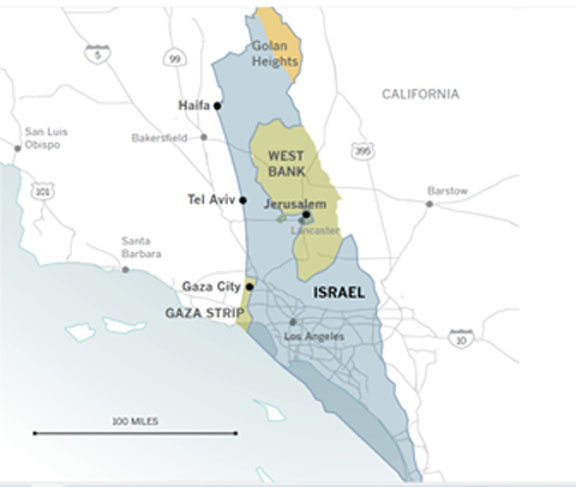
In 1948, the UN established the State of Israel, a nation of Jews. It is not a big area. Think Yosemite to San Diego. This map appeared in the Los Angeles Times.

The land of Israel has been populated by the Jewish people since 2000 BC. Here’s the timeline, in case you didn’t realize that it is their homeland.

1900 BC: Abraham chosen by God as the Father of the Jewish Nation.

1900 BC: Isaac, Abraham’s son, rules over Israel.

1850 BC: Jacob, son of Issac, rules over Israel.

1400 BC: Moses leads the people out of Egypt and back to Israel.

1010 BC: King David unites the 12 tribes into one nation.

970 BC: King Solomon, son of David, builds the first temple structure in Jerusalem

930 BC: Israel is divided into two kingdoms, the Kingdom of Israel and the Kingdom of Judah.

800s BC: The rise of the prophets, God’s messengers.

722 BC: Kingdom of Israel is conquered by Assyrians.

605 BC: Kingdom Judah is conquered by the Babylonians.

586 BC: Solomon’s Temple is destroyed by the Babylonians.

539 BC: Persians conquer the Babylonians and take control of Israel.

538 BC: The Jews return to Israel from exile.

520 BC: The Temple is rebuilt.

450 BC: Reforms made by Ezra and Nehemiah.

433 BC: Malachi is the end of the prophetic age.

432 BC: The last group of Jews return from exile.

333 BC: The Greeks conquer the Persian empire.

323 BC: The Egyptian and Syrian empire take over Israel.

167 BC: Hasmonean’s recapture Israel, and the Jews are ruled independently.

70 BC: Romans conquer Israel.

20 BC: King Herod builds the “second” temple

6 BC: Yeshua is born in Bethlehem

70 AD: Romans destroy the temple

After that, the people were captives to the Romans, Byzantines, Arabs, and Crusaders. Through all of these events, the Jewish people continued to live in Israel. There were more or less of them, depending on the centuries, but there was never a time when the Jews didn’t live in the land. They stayed, they built their communities, they raised their families, practiced their faith and they suffered at the hands of many outside rulers, but they always kept their faith. It is what sustains them, even now.

Israel Is Walking Into a Sympathy Trap

With help from The Atlantic Monthly

It’s a trap. Hamas’s ruthless and spectacular attack on southern Israel last Saturday was many things: an atrocity, a display of militant ingenuity, and a demonstration of the weakness of Israeli intelligence and defenses. Israel and the Palestinians have a long history of brutality against each other, but the Hamas killing spree outdoes anything seen since the founding of Israel in 1948.

Hamas surely would not have meticulously planned its audacious assault without also extensively planning a response to the hoped-for Israeli counterattack on the ground. The Israeli military will likely encounter a determined insurgency in Gaza. 

Iran and Hamas are counting on Israel to attack Gaza with such ferocity that the international sympathy of the past week toward Israel, even in the Arab world, evaporates quickly and is replaced by outrage at the suffering inflicted on the 2 million residents of Gaza. Those civilians have already been cut off from electricity, water, food, and medicine, all of which are controlled by Israel. They rely on everything from the outside world that is controlled by Israel.

Gaza has been an open-air prison for the Palestinians living there.  They have no way to leave.

Hamas and Iran hope that Israel will refuse to return to the status quo ante and will instead institute a prolonged ground occupation of Gaza, declaring that Hamas can no longer be allowed to pose such a threat. But Gaza, they trust, will be a slaughterhouse for Israeli soldiers, both during the immediate incursion and over time as the anticipated insurgency gains its footing.

Israel’s dilemma is Hamas’s goal is to eliminate the entire country and all of its Jewish citizens.  That is not going to happen. But the worldwide hatred of Jews predicts a never ending war for Israel.

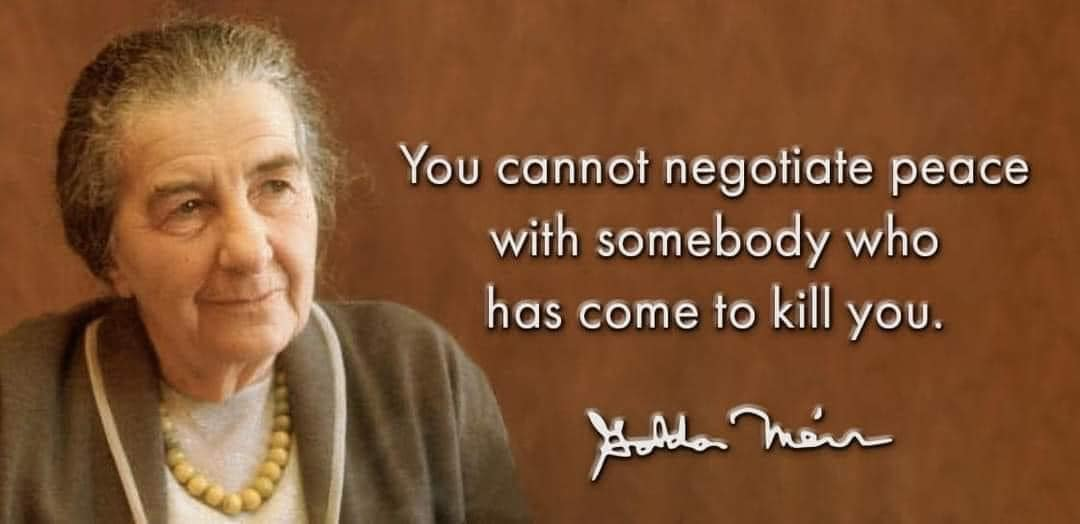
When Someone Comes to Kill You

This all started on May 14, 1948 when Israel established itself as a free nation.  At the time, the Jews were about a third of the population of Palestine the British Protectorate created after World War One. The following day, the armies of four Arab countries—EgyptSyriaTransjordan and Iraq—entered into parts of what had been British Mandatory Palestine, launching the 1948 Arab–Israeli War. The apparent purpose of the invasion was to prevent the establishment of the Jewish state at inception, and some Arab leaders talked about “driving the Jews into the sea”.

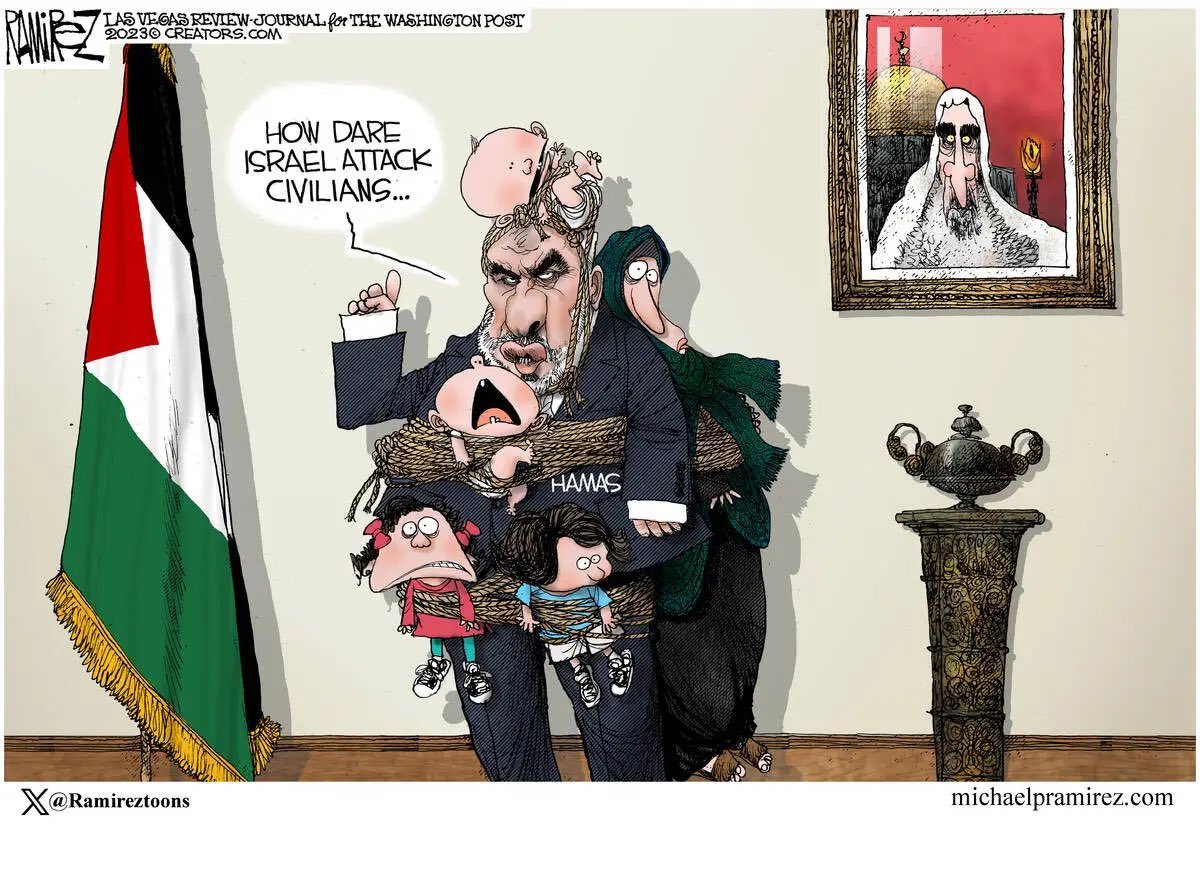
Hamas formed in late 1987 at the beginning of the first Palestinian intifada (uprising). Hamas is a Sunni Islamic group that does not recognize Israel’s right to exist and whose goals from the beginning have been to liberate Palestine from Israeli occupation through any means necessary.

Unlike the Palestinian Authority, Hamas does not support the so-called two-state solution — the creation of an independent and sovereign Palestinian state alongside Israel — as a permanent solution. It advocates for a Palestine from the Jordan River to the Mediterranean Sea, without an Israel. (Some extremists in the current right-wing Israeli government similarly believe in an Israel from the river to the sea, without Palestine. Israelis are not likely to kill millions of Palestinians to reach their objective as it is only the right-wing of their government that holds this view.

As is evident now, Hamas wants to kill every Jew to reach its objective.

This week revenge is the goal of the Israeli government.

Interesting Story on Yom Kippur

On a Northwest Airways flight from Atlanta, GA., a middle-aged, well-to-do woman found herself sitting next to a man wearing a kippa. She called the attendant over to complain about her seating.

‘What seems to be the problem Madam?’ asked the attendant.

You’ve sat me next to a Jew!! I can’t possibly sit next to this disgusting person. Find me another seat!’

‘Please calm down Madam.’ the attendant replied. ‘The flight is very full today, but I’ll tell you what I’ll do. I’ll go and check to see if we have any seats available in club or first class.’

The woman shoots a snooty look at the snubbed Jewish man beside her (not to mention many of the surrounding passengers).

A few minutes later the attendant returned. The woman could not help but look at the people around her with a smug and self-satisfied grin.

The flight attendant then says…’Madam, unfortunately, as I suspected, economy is full. I’ve spoken to the cabin services director, and club is also full. However, we do have one seat in first class.’

Before the lady has a chance to respond, the attendant continues…’It is most extraordinary to make this kind of upgrade, however, and I had to get special permission from the captain. But, given the circumstances, the captain felt that it was outrageous that someone should be forced to sit next to such a person.’

The flight attendant turned to the Jewish man sitting next to her, and said: ‘So if you’d like to get your things, sir, I have your seat in first class ready for you…’

The lady says indignantly ‘I think that The Captain must have made some kind of mistake.’

To which the attendant replied,’ No M’am.

Captain Cohen never makes any mistakes.’

Y. Korer