“Giant Sucking Sound” Returns

ABC World News reported just this past week that 98% of all clothes in the United States are imports.

It was reported in the Los Angeles Times on June 30, 2011 that the White House is pushing for free trade agreements with South Korea, Columbia, and Panama.   At the same time they are concerned about the loss of American jobs.  The concern is about “the 46 year old male, the family breadwinner, with a high school education who had worked more than a decade in a factory that is closing.”

This is astonishing.  The Democratic Party, they are the party that claims to be concerned about America’s middle class and poor, is pushing for these treaties to be passed.  The GOP opposes the treaties because of a requirement that training for those losing their jobs is included in the laws.  They too seem to favor exporting more jobs.

How many jobs have we lost to free trade?  The Economic Policy Institute estimates more than 500,000 job have been lost in the United States to Mexico.  US Bureau of Statistics lists imports from Mexico have increased from $134 billion on 2002 to $229 billion in 2010.  Exports in the same period increased from $97 billion to $163 billion.

The Most Feared Interview Question

“Tell Me About Yourself”

"Tell Me About Yourself"

When I was searching for a job I anticipated this question.  I had my answer prepared. 

If you’ve ever interviewed, you’ve probably gotten America’s LEAST favorite question, “Tell Me About Yourself.” Most applicants HATE it, because they don’t know how to answer and, usually, it comes at the start when logically, the interviewer doesn’t know anything about you. Let everyone else blow this one! If you have a killer answer ready, you can sew up the interview right here.  When I was searching for a job I anticipated this question. 

How To Answer The Question

Here’s your formula to shine: Before every interview, make a list of the qualities & skills they need for the position, then give specific examples of how you possess those traits. You want to show them that you are exactly what they need.

You can’t use just a list of words because people forgot words — that’s why we all make grocery lists. Actually, words are only 10% of our true communication, while your voice — the way you use your words — represents 20-25%, and the largest chunk, 65-70% is your image and body language. Since people believe what they see, you have to paint them a picture of how your skills meet their needs by reassuring them that you’re a great fit.

Suppose you’re interviewing for an administrative assistant position, with responsibilities including answering phones, taking messages, returning calls, and flexibly executing any/all assignments. Your most effective approach is to tell stories about similar past experiences.  “I’m good answering the phone, taking messages and making calls” will be easily forgotten. What detailed, distinctive examples can you offer to show you’ve got the goods?

Prepare to impress at your interview by making a list of 8-10 specific examples of when you worked really hard (on the job, through volunteer work, in school, extracurriculars, etc.) utilizing the skills they need. Interviewers are smart, but they’re not mind readers — they’ll only know what you tell them. And if YOU don’t reassure them you’re a great fit for the job, someone ELSE will, and THEY’LL be hired.

summarized from http://galtime.com/article/money/43161/13584/most-feared-interview-question

Affordable Cities

AARP has an article titled “Pinpointing Affordable Cities” that offers the top 10 most affordable cities in the United States.  First we need to define the word “city.”  Even merriam-webster.com has a difficulty doing that.  They call it “an inhabited place of greater size, population, or importance than a town or village.”

Wikipedia isn’t any better with this introduction, “A city is a relatively large and permanent settlement.[1][2] Although there is no agreement on how a city is distinguished from a town within general English language meanings, many cities have a particular administrative, legal, or historical status based on local law.”

Wikipedia’s link to the United States offers this disturbing definition. “The lack of a clear-cut definition of a city in the United States can lead to some counter-intuitive labeling; for example, before it was dissolved in 2002[49] Maza, North Dakota, with only 5 inhabitants, was a city as by North Dakota law any incorporated location is deemed a city regardless of size. California has both towns and cities but the terms “town” and “city” are considered synonymous. The nation’s top five largest cities are New York City, Los Angeles, Chicago, Houston, and Philadelphia.”

I choose to aribtrarily say that for a town to be a city it must have 1 million residence. Here then is the AARP list.  Most of the places they identify are not cities by my definition.  They will suffer from a lack of hospitals, doctors, art and music, employment opportunities, and other city venues.

1. Oklahoma City, Okla. has a population of about 560,000.  It’s not a city.

2. Pittsburgh, Pa. has a population of about 311,000.  It’s not a city.

3. Buffalo, N.Y. has a population of about 270,000.  It’s not a city.

4. Rochester, N.Y. has a population of about 206,000.  It’s not a city.

5. Nashville, Tenn. has a population of about 605,000.  It’s not a city.

6. San Antonio, Texas has a population of about 1,373,000.  It’s a city.

7. Houston, Texas has a population of about 2,257,000.  It’s a city. The fourth largest in the country.

8. Louisville, Ky. has a population of about 262,000.  It’s not a city.

9. Birmingham, Ala. has a population of about 230,000.  It’s not a city.

10. Austin, Texas has a population of about 786,000.  It’s not a city.

So, Tell Me A Little Bit About Yourself…

You’ve heard it before: An interview can make or break your chance of getting a job. But what exactly can go wrong?

1: So, tell me a little about yourself.

If your answer begins with anything remotely related to your place of birth, experiences in grade school, or your bad relationship with your parents, you can pretty much consider the interview over. And remember, this is often the first question you’ll face.

It’s hard to know what exactly an interviewer is looking for you to say to this question, but it’s safe to assume they want you to give a bit of background on your professional history. “Ask them where they’d like you to begin,” says Carolyn Thompson, an executive recruiter and author of 10 Steps to Finding the Perfect Job. Are they looking for your entire professional background, or just your most recent work experience? “It gives you a point to work forward or backward from,” Thompson explains.

Sign up for the latest in finance career news

It’s not all that difficult to completely blow a job interview.

Showing up late, wearing inappropriate clothing and answering your cell phone are a few good ways to kill your chances. But sticking your foot in your mouth will do the job as well.

Many hiring managers say that on occasion, candidates that seem perfect at first get crossed off the list by saying something senseless when asked a routine interview question.

Here are a few responses to some of those frequently asked questions that will be sure to kill the conversation and send you straight out the door.

2: Why do you want to leave your current job?

First and foremost, you should actually want to leave your job if you’re going on interviews. If you meet that qualification, you shouldn’t say you are just looking for a change and you definitely shouldn’t badmouth your employer.

“It’s ok to bring up a problem with your current employer,” says J. Patrick Gorman, co-founder of the iFind group, an executive recruiter based in New York, “but you have to show how you attempted to solve it so you don’t sound like a whiner.”

Rita Boyle, a senior executive search consultant with New Jersey-based Cornerstone Search Group, suggests explaining how the change is the next logical step for your career path.

“Explain why you’re running to their company instead of why you’re running away from your current one,” Boyle says

Other no-nos? Noting that you want to leave your company (or join a new one) because of anything relating to location, pay, or benefits.

3. What are your biggest strengths and weaknesses?

The worst way to answer this question is without the slightest pinch of modesty.

“‘Weaknesses? I don’t have any weaknesses,’ is the worst thing possible to say,” says Gorman. A less-obvious-but-still-awful answer? Identifying a weakness, but not explaining how you got through it, he says. It’s important to acknowledge your downfalls, but explain how you’ve been able to work around them as well.

When it comes to discussing strengths, don’t give yourself an endlessly glowing review — but don’t go with a one-size-fits-all answer, either.

Mark Herschberg, a career skills professor at the Levin Institute in New York City, says almost every candidate trots out a platitude about being smart or hard-working.

“In those cases, I respond, ‘95% of the candidates gave me that same answer, can you tell me anything that distinguishes you from them?'” he says.

4. How would your current or former colleagues describe you?

This is not an opportunity to simply re-frame your strengths. “There’s a difference between how you and everyone you work with would describe you,” says Thompson.

You should also steer clear of responses like “the only employee who did things right,” or “a great guy to hang out with after work,” says Lynne Sarikas, director of the MBA career center at Northeastern University’s College of Business Administration.

Think about what people at each level of the workforce look to you for, says Thompson. Your subordinates, for example, might say you’re fair, and are always looking to pass along useful knowledge and opportunities to gain experience.

5. What is your goal for the short term? Or the alternate: Where do you want to be in five years?

Never imply that you’ll be leaving in short order to start your own business, go back to school, or that you see yourself in the interviewer’s job. Another gaffe? Not knowing what your interviewer means by “short term.”

You might define short-term as the next six months, and your interviewer might be thinking in terms of the next 18 to 24 months, so it’s important to clarify the timeframe upfront. “A lot of people think ‘I know what my short-term goal is,’ but if you don’t know their definition of ‘short term,’ your answer may or may not be appropriate,” says Thompson.

6. Are there certain tasks or types of people you don’t like?

This is a particularly loaded question, according to Steven Raz, co-founder of Cornerstone Search Group, so make sure to tread carefully. Steer clear of any answer that is abrasive to authority figures, he counsels.

At the same time, Bruce Hurwitz of Hurwitz Strategic Staffing, aNew York City executive recruiting firm, advises not to feign a universally agreeable demeanor. Be honest here, and note the things you tend to avoid — whether it’s people who are overly chatty, or jobs that require endless data input — as long as the tasks or personalities aren’t going to be an inherent part of the role.

7. Do you have any questions?

If there’s a question that’s a guaranteed game-changer, it’s this one. Coming up blank is a good way to show that you aren’t thoughtful or interested in the job, says Raz.

And not just any questions in return are appropriate. No-nos include asking about compensation for the job, what the company does, if you can work from home, how much vacation time you’ll get, or if the drug and background testing are really mandatory. Ask queries that will help “match up your skills, experiences and accomplishments with what they’re looking for,” says Raz.

Instead of fumbling in the final minutes of the interview, be prepared with a few great questions that show you’re interested in both the company and the job.

8. Prepare and practice. 

Learn all you can about the company and practice the interview with a friend who will be honest when you have made a mistake.

Resource for this article is the Wall Street Journal.

Immediate Opening for Dispatcher in Burbank, California!!!!!

This email was sent to me today.
Good Afternoon,
 
We currently have an immediate need for a dispatcher in Burbank.  This group is seeking someone for at least 2 weeks possibly longer.  This group specializes in retail construction, retail equipment installation, and maintenance.
 
Qualifications:
– 2 years dispatch experience
– Basic to intermediate computer knowledge
– Strong data entry skills
– Ability to work in a fast paced environment
 
If you are interested in this opportunity please send a copy of your resume for review.  If you know someone who could be a good fit for the position please feel free to send them this information.
 
Thank you!
Bridget Firestone
Professional Staffing Resources
West LA: 310-478-6100
East LA: 818-847-1990
Fax: 858-875-0999
bfirestone@mypsr.com

America’s Jobs – Part 2

The ultimate hypocrisy!

We all think of General Electric as the all American company.  That company has provided Americans with everything electric from vacuum cleaners to radios and television sets.  We still have a 13” color television in the kitchen that won’t die.  The company was started by Thomas Edison.  Remember President Ronald Reagan was a television spokesperson for GE before he entered politics.

That is all changed now. The company has a reported 287,000 employees around the world.  It has expanded to manufacturing jet engines for aircraft to building nuclear electrical generating facilities.  After the tsunami in Japan it became public that the six reactors in the Fukushima I Nuclear Power Plant had been designed by General Electric.

Big American companies that we all thought were loyal Americans have rapidly shifted their workforces abroad.  Calling Time Warner for aid with my Wi-Fi system I learned that the nice lady helping me was located in Manila, Philippines.  She had perfect English.

When did offshoring become so prevalent? The trend began in earnest in the late 1970s at large manufacturers such as General Electric. GE’s then CEO, Jack Welch, who was widely respected by other corporate chieftains, argued that public corporations owe their primary allegiance to stockholders not employees. Therefore, Welch said, companies should seek to lower costs and maximize profits by moving operations wherever is cheapest. “Ideally,” Welch said, “you’d have every plant you own on a barge to move with currencies and changes in the economy.” Not only did GE offshore much of its manufacturing, so did its parts suppliers, which were instructed at GE-orchestrated  “supplier migration seminars” to “migrate or be out of business.”

President Obama Picks Jeffrey Immelt, GE CEO, To Run New Jobs-Focused Panel .  And you thought that Barack Obama was for the American people.

America’s Jobs – Part 1

The Great Recession resulted in the loss of 8 million jobs in the United States.  Since the recovery started 1 million jobs have been added to the national payrolls. Neither the Republicans nor Democrats have enacted a single piece of legislation that is likely to bring back those lost jobs.

Why aren’t U.S. corporations hiring?

Actually, many of them are.  They’re just not hiring Americans.  The reason is that most Americans corporations have become global in their operations.  U.S. corporations have slashed their American payrolls by 500,000 jobs since the start of the Great Recession.  At the same time they have hired over 700,000 workers overseas.  Those new hires are not just in Asia.  They are in Mexico and other Latin American nations too.  Technicolor’s DVD/CD production facilities were in three locations in the United States but are now in Monterey, Mexico.  That one company alone employed more than 3,000 Americans before the move.  In 1992 53% of Ford Motor Company employees were in the United States and Canada but today that number has declined to 37%.

The reason is very simple.  The cost of labor in Mexico is one fifth the cost in United States and Canada.  Chinese workers assembling computers, iPads and other electronic devices are earning less than $400.00 per month (Foxconn, a Taiwanese company is the primary supplier for both H-P and Dell as well as Apple).  Foxconn is expanding to other countries.  Just today there are reports that the company will be opening an assembly facility in Brazil.

Unless there are tariffs put in place this situation will not change.

Part Time Jobs

These are better than no job.  Whether you need the money or just like the camaraderie, these positions fit the bill.

From AARP,  October 13, 2010

1. Librarian Assistant/Aide

The nitty-gritty: Duties might include fielding questions, shelving books, helping patrons check out, tracking overdue material and sending notices, as well as cataloging and keeping an eye out for lost and damaged items.
The hours: Schedules vary widely. Big libraries, or those on university campuses, tend to keep the doors open 24 hours a day, while small, local libraries might offer limited day and evening hours.
Median pay range: Small libraries can be cash-strapped and rely on volunteers, but at colleges, large city locations and specialty niche libraries, pay can range from $7.69 to $17.82 per hour. Those figures can more than double, depending on experience and where you live.                                                                                                                                                                                                                                                  Qualifications: Experience working in libraries is desirable, as is an undergraduate or master’s degree in library science. Larger libraries favor research skills using library resources, databases and other tools, along with the ability to get along with the various denizens of the library. Some skills that will help: Knowledge of word processing, data entry and online searching, ability to keep accurate records, understanding of library operations and general secretarial skills. Love of books is a given.

2. Bookkeeper

The nitty-gritty: In small businesses, bookkeepers handle a full sweep of financial recordkeeping. You might take care of purchasing office supplies and processing payroll. Other duties can include establishing and maintaining inventory database systems, tracking accounts receivable and accounts payable, maintaining checking and savings accounts, producing financial reports, following up on delinquent accounts, and overseeing audits and reviews.
The hours: Vary by business. Frequently limited to one week mid-month and one at the end of the month for invoicing or bill-paying functions.
Median pay range: $10.23 per hour to $24.25; $50 or more is possible depending on advanced training/degrees and location.
Qualifications: A degree in accounting is desirable. A Certified Public Accountant (CPA) certification is best. Relevant experience or formal training in accounting/auditing services is a plus. Other key skills: data entry, detail-oriented, and adept with financial and related computer software. Handy with a calculator.

3. Personal and Home-Care Aide

The nitty-gritty: You typically help elderly, ill or disabled people with everyday activities ranging from bathing and getting dressed to running errands. Other duties might include light housekeeping, companionship, grocery shopping, meal preparation and medication monitoring.
The hours: If you’re working at someone’s home, three or four hours a day, two or three days a week, might be all they require. These jobs are often booked through a home-care agency. You might opt for a part-time position in an assisted living facility or hospice. A word of caution: Some positions require lifting patients and lots of time on your feet. If you have physical limitations, ask about the requirements of a specific client before signing on.
Median pay range: There tends to be a lot of turnover, so job openings are plentiful, especially helping the elderly in-home as well as at assisted-living and hospice facilities. Expect $7.36 per hour to $12.45; $35-plus depending on experience and certification.
Qualifications: Some employers may require a Certified Nurse Assistant (CNA) certification. CPR training and a driver’s license are helpful too. Good bedside manner is a must.

4. Handyman

The nitty-gritty: If you tackle this as a self-employed fix-it-up service, figure on a smorgasbord of odd jobs that range from tightening loose door handles to repairing running toilets. It can be a toss-up of woodworking, plumbing, electrical and even painting projects. There are more structured opportunities in this arena with building owners who hire part-time workers to perform basic maintenance. This is one job, even on a part-time basis, that requires a certain level of fitness and stamina.
The hours: If it’s your own business, you can call the shots, even working weekends-only. Part-time schedules for building maintenance will depend on the owners’ needs. Some might prefer to have a handyman on call for emergencies, while others might like to have you on-site and available to residents during specific hours.
Pay range: $10 to $20 an hour, and up to $50 for certain custom work.
Qualification: Be competent in various aspects of home improvement, have your own tools, be self-motivated and have good customer-service skills. Be on a first-name basis with the manager of your local hardware store.

5. Medical Assistant

The nitty-gritty: Administrative tasks in doctors’ offices are usually the bulk of the workload. In essence, you’re performing front-office duties, such as checking in patients, verifying insurance information, answering telephones, scheduling appointments and typing. You may also be the one who maintains supplies. Some assistants help physicians with procedures and prepare medical records. If you have the training, you may perform direct patient care such as conducting an EKG, specimen collection, wound care, medication administration and checking vital signs.
The hours: Varies by practitioner, but generally weekdays.
Pay range: $9.98 to $19.21 per hour; $25-plus depending on location and experience.
Qualifications: Some employers permit you to learn on the job, but a certificate of training from a nationally recognized Medical Assistant Program or National Certification as a Certified Medical Assistant is preferred. Related experience can sometimes serve in lieu of formal training and/or certification. Knowledge of medical terminology is useful. The sight of blood shouldn’t make you squeamish.

How Many Americans Really Want Jobs?

via How Many Americans Really Want Jobs? – Daniel Indiviglio – Business – The Atlantic.

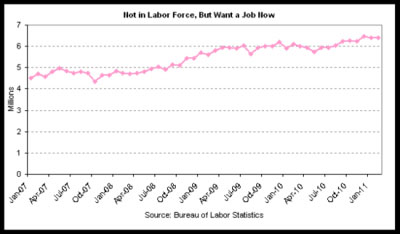
This morning, we learned that the economy added 192,000 jobs as the unemployment rate ticked down to 8.9%. That put the number of unemployed Americans at 13.7 million — but this doesn’t tell the entire story. This number does not take into account Americans who, for various reasons, are not considered in the labor force. Some of them still want jobs right now, even by the Bureau of Labor Statistics’ standards. What would the picture look like if we include these Americans?

For starters, how many were there? In February, BLS estimates 6.4 million Americans want jobs now, but are not considered part of the workforce. They are not included in the tally of unemployed Americans.

If you add these additional workers into the number of unemployed, you find that just over 20 million Americans want a job right now, but do not have one. That’s obviously a much grimmer picture than the 13.7 million that the headline number suggests — it’s nearly 50% higher.

This new calculation of Americans who want a job also shows a much larger portion of the nation struggling to find work, compared to the 8.9% unemployment rate. The portion of Americans who want a job was 12.6% in February.