Robots are coming. A quarter US workers at risk!


As reported in USA Today one man is sitting “alone atop a tractor with a specialized mechanical attachment” that now performs the work of 30 people.

The Los Angeles Daily News reported “Members of the longshoremen and warehouse workers union picketed outside a meeting of the L.A. Board of Harbor Commissioners Thursday morning, Jan. 24, protesting the approval of a permit that will allow a major terminal operator to increase automation at the Port of Los Angeles.”

According to a new Brookings Institution report one fourth of all jobs in this country are at risk due to automation.

Without a job what will those people who lack the capacity to learn complex job functions do?  This will most likely be a world wide problem.  We as a nation will not let them starve.  Most likely more people will be on a welfare program.

This won’t happen in 2019 but the structure of our society will be changing before this century is over.

The Largest U.S. Trade Deficit Is With China

Why is President Donald Trump imposing tariffs on China?

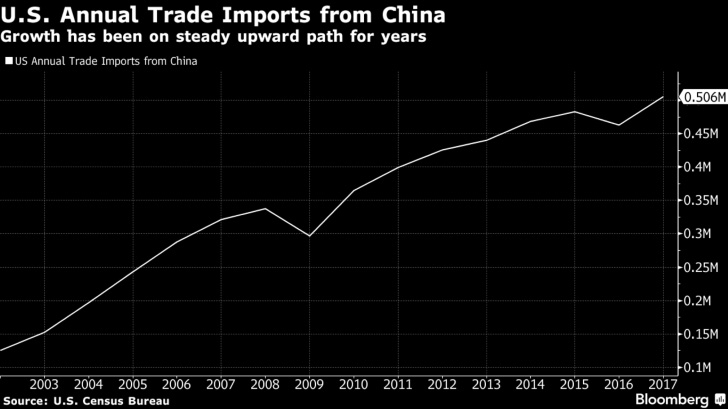
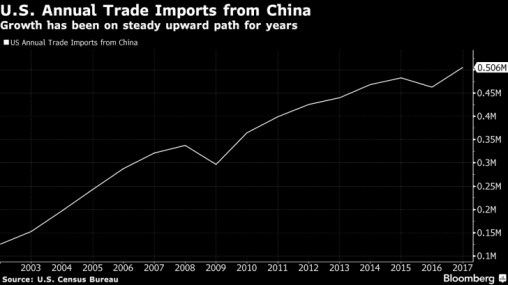
More than 65 percent of the U.S. trade deficit in goods was with China. The $375 billion deficit with China was created by $506 billion in imports. The main Chinese imports are consumer electronics, clothing, and machinery.

America only exported $130 billion in goods to China.

As this graph indicates this is not a new phenomenon. It goes back to the late 1900s.
China currently assembles the majority of Apple’s iPhones in its Shenzen, China, location by Foxconn. That company maintains factories in countries across the world, including Thailand, Malaysia, the Czech Republic, South Korea, Singapore, and the Philippines. A second company, Pegatron, is a relatively recent addition to the iPhone assembly process also in China.

High End clothing brands we all lust after really have to work hard to minimize the production costs while keeping their products “luxurious” and “high end”. China is their go to manufacturing location. Who are they?
1. PRADA
2. COACH
3. ARMANI
4. BURBERRY
5. MULBERRY
6. MARC JACOBS
7. D&G

Chinese factories manufacture winter coats, gloves, mittens and hats for consumers around the world. These factories also produce maternity clothes and infant clothes as well as wedding dresses and tuxedos. Underwear, T-shirts and slips are among the items exported from China to consumers around the world. Sports caps are also produced in China as are belts and bras.

Luggage, machinery, and furniture are also made in China.

The consequence of the outsourcing of all that manufacturing has resulted in a major loss of good paying blue collar jobs in America.

Trump is correct when he points out that both political parties stood by and did nothing as the jobs left the country.

We couldn’t stop the outsourcing but our government did nothing to train people in new jobs that are needed in the 21st century.

While Trump has accurately identified the problem he does not appear to understand the needed solution. His solution of applying tariffs will only harm the American economy by raising the cost of consumer goods.

Article I of the US Constitution vests the power to set tariffs in Congress. The president has the power to impose tariffs at his discretion only because Congress has passed laws granting him that power. If Republicans in Congress think Trump has a bunch of dumb, destructive ideas about trade, they could pass new laws that strip him of that power.

Congress is in total grid lock. They won’t do anything to counter the new tariffs.

We are headed for a trade war. The last time that happened was 1930. Smoot-Hawley Tariff Act, formally United States Tariff Act of 1930, also called Hawley-Smoot Tariff Act, U.S. legislation (June 17, 1930) that raised import duties to protect American businesses and farmers, adding considerable strain to the international economic climate of the Great Depression.

Wall Street bankers are not given to grovelling. But in June 1930 Thomas Lamont, a partner at J.P. Morgan, came close. “I almost went down on my knees to beg Herbert Hoover to veto the asinine Hawley-Smoot Tariff,” he recalled. “That Act intensified nationalism all over the world.”

Toys “R” Us and the Leveraged Buyout

This is capitalism at its worst.

Corporate raiders were the final straw that ended Toys “R” Us.  Bain Capital was founded in 1984 by Bain & Company partners Mitt Romney, T. Coleman Andrews III, and Eric Kriss, after Bill Bain had offered Romney the chance to head a new venture that would invest in companies and apply Bain’s consulting techniques to improve operations.  Those techniques destroyed companies but made Bain a success for its owners.

The Toys “R” Us collapse is not a new phenomenon. It has made buyers of companies rich and destroyed the target company. Blame the private equity firms Bain and Company, KKR & Co. L.P. and Vornado Realty Trust for the bankruptcy. Toys “R” Us was taken private by KKR, Bain and Company, and Vornado in 2005, it took on a lot of debt, leaving the company with repayments that have crippled it in a period of declining sales.

A leveraged buyout, commonly referred to as an LBO, is a transaction that companies use to acquire other businesses. The buyout involves a combination of equity from the buyer, along with debt that is secured by the target company’s assets. The deal is structured so that the target company’s assets and cash flows are used to pay for most of the financing cost. The main disadvantage of this financing is that, once the deal is completed, the target business is very leveraged. This scenario allows for little margin of error. A problem with liquidity, such as the loss of a few key customers, could put the business in serious distress.

Rolling Stone magazine reports that of the 25 companies that private equity firms bought in the 1980s that borrowed more than $1million in junk bonds, half went bankrupt.

Do you remember Mervyn’s department stores?  It was an American middle-scale department store chain based in Hayward, California, and founded by Mervin G. Morris. It carried national brands of clothing, footwear, bedding, furniture, jewelry, beauty products, electronics, and housewares.  Mervin G. Morris founded the first Mervyn’s store in San Lorenzo, California on July 29, 1949.  By 1978 the company had grown to a chain of more than 50 stores in three states,[7] and Mervyn’s was acquired by the Dayton Hudson Corporation (now Target Corporation). Mervyn’s kept its separate identity as a Dayton Hudson subsidiary. In September 2008, Mervyn’s sued the private equity firms involved in the leveraged buyout of the chain, alleging that the deal had stripped the retailer of its real estate assets, forcing it into bankruptcy. Mervyn’s said in the suit that Cerberus Capital Management and its partners had used the increased rent to finance the buyout.

31,000 Toys ‘R’ Us employees: No job and no severance

Poverty in California

It’s hard to believe that there is significant poverty in California. The Los Angeles Homeless Services Authority say there are over 57,000 homeless in this county alone. That reality is made obvious by the growing number of homeless encampments that have sprung up all over the city.

More than a third of California households have virtually no savings and are at risk of financial ruin. That data was compiled by Prosperity Now, a Washington, D.C.-based organization seeking to help people — particularly people of color and those with limited income — achieve financial security and prosperity. Even if the data is half as bad as reported it would still mean that about 15% of the population is in serious trouble.

The report says that more than 37 percent of California households have so little cash saved that they couldn’t live at the poverty level for even three months if they lost a job or suffered another significant loss of income.

No emergency fund
The scorecard also shows that 46 percent of households in the Golden State didn’t set aside any savings for emergencies over the past year, a higher percentage than the national rate of 43.7 percent.

It doesn’t help that 21.1 percent of California jobs are in low-wage occupations. The scorecard found that 21.4 percent of Californians experienced income volatility over the past year, a situation that most often results from irregular job schedules.

Households of color
It gets worse for households of color. They are nearly twice as likely to live below the poverty line as white households — 18.2 percent compared to 9.7 percent — and they are much less likely to own a home or other assets that could help boost their long-term financial stability.


Less than half of California’s households of color (43.9 percent) own homes, compared to 62.5 percent of white, non-Hispanic households. Moreover, 60.7 percent of Latino households and 56.7 percent of black households have virtually no savings and are considered “liquid asset poor,” compared to 28.2 percent of white households fitting that category.

“Beyond providing a cushion to get families through emergencies, increased savings and wealth allow families to invest in their futures and gain ground for future generations,” Prosperity Now President Andrea Levere said in a statement. “It’s clear that far too many people are stuck in economic limbo.”

High housing costs
Lars Perner, an assistant professor of clinical marketing at the USC Marshall School of Business, said California’s high housing costs have put many households on shaky financial ground.

“The cost of housing in California is exorbitant,” he said. “That’s a big part of the problem. People pay a disproportionate amount of their income toward housing.”

The report finds that nearly 20 million U.S. households (16.9 percent of the total) have zero or negative net worth. That means they owe more than they own.

Getting on track
The scorecard suggests several policies that could help get struggling households on track, including adopting policies that encourage saving, increasing the minimum wage, providing better access to home ownership and boosting retirement security.

Workable solutions are lacking. Meetings by various community groups might be interesting to attend but none of our elected government officials have any worthwhile ideas.

Evolution of American Industry

Valued at nearly $20 trillion, the U.S. economy is the largest in the world. Maintaining a competitive edge necessitates remaining diversified and dynamic. While this means that some U.S. industries thrive, others inevitably decline or are rendered obsolete.

As certain industries fade, so do hundreds of thousands of American jobs. 24/7 Wall St. analyzed employment figures from 2006 to 2015 from the Bureau of Labor Statistics to determine the 25 fastest dying industries. Employment in each industry on this list declined by at least 43%, and in the top two by at least 80%.

At least one of three broad factors is behind the decline in each of the fastest dying industries. The first factor is cost reduction. Cheaper labor abroad has caused many American companies to outsource manufacturing operations. In China, for example, the minimum monthly wage in the garment industry is less than $150 a month. Perhaps not surprisingly, the bulk of clothing Americans import was made in China.

Click here to see America’s 25 dying industries.

Click here to see America’s 25 thriving industries.

In addition to outsourcing, robotic automation in U.S. factories have hurt employment in manufacturing. The sector has shed nearly 2 million jobs in the past decade, a 12.8% decline. Of the 25 fastest dying industries, 10 are in the manufacturing sector, and seven of those are related to clothing and other textiles.

The second cause for massive employment declines in certain industries is the wide adoption and exponential growth of new technologies. Online streaming services and on-demand programming are largely responsible for the 61% employment decline in DVD and video tape manufacturing and the 89% decline in the video rental industry. Similarly, the proliferation of cellphones and smartphones has greatly reduced employment in both telephone manufacturing and photofinishing, industries where employment has declined by 51% and 60%, respectively.

Finally, broad macroeconomic conditions have also contributed to lower employment in many industries. Most notably, within the last 10 years, the subprime mortgage crisis and resulting recession have contributed to a considerable drag on construction. Since 2006, new home construction has declined by 51%. Over the same time period, the broad construction sector has shed over a million jobs, or 15.3% of total employment. The land subdivision and framing industries were hit especially hard, with employment declining by 57% and 55%, respectively.

To identify the dying industries, 24/7 Wall St. reviewed employment growth from 2006 through last year for 704 U.S. industries in the fourth level of detail in The North American Industry Classification System (NAICS) by the U.S. Census Bureau. All data, including the number of establishments within each industry, average weekly and annual wages, as well as breakouts of these data over government, private, and local levels were retrieved from the U.S. Bureau of Labor Statistics’ (BLS) Quarterly Census of Employment and Wages (QCEW). The BLS tracks industry employment by tallying the number of workers in establishments whose primary sources of revenue fall within a given industry. As a result, a given establishment along with all of its employees may be reclassified depending on business decisions and market performance. For the finance and insurance industry, where the primary source of revenue for a fund, trust, or financial vehicle can change from a single trading decision, industry employee counts may not be comparable from one year to the next. To help ensure that 10-year employment changes reflected natural growth, all industries related to the management of funds, trusts, and other financial vehicles were excluded.

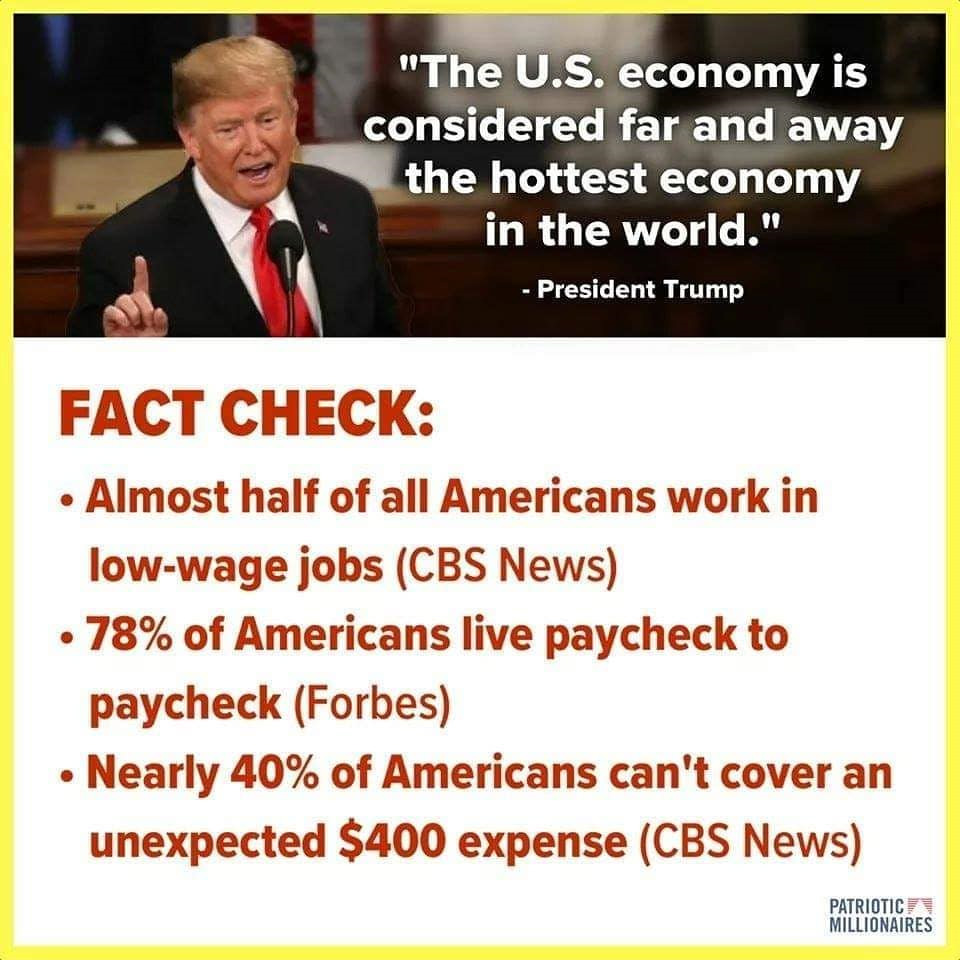
This is not the kind of data Donald Trump wants to see.  He, along with millions of people who have lost their jobs, does not want to face the realities of a world economy.  Instead of working to retain outdated technologies the US government should be spending its time training the population in technologies of the 21st century.  We have the money to change but we lack the will.

Amazon plans to create more than 100,000 full-time jobs in America

Amazon said Thursday that it plans to create more than 100,000 “full-time, full-benefit” jobs in the United States over the next 18 months.

That sounds wonderful!

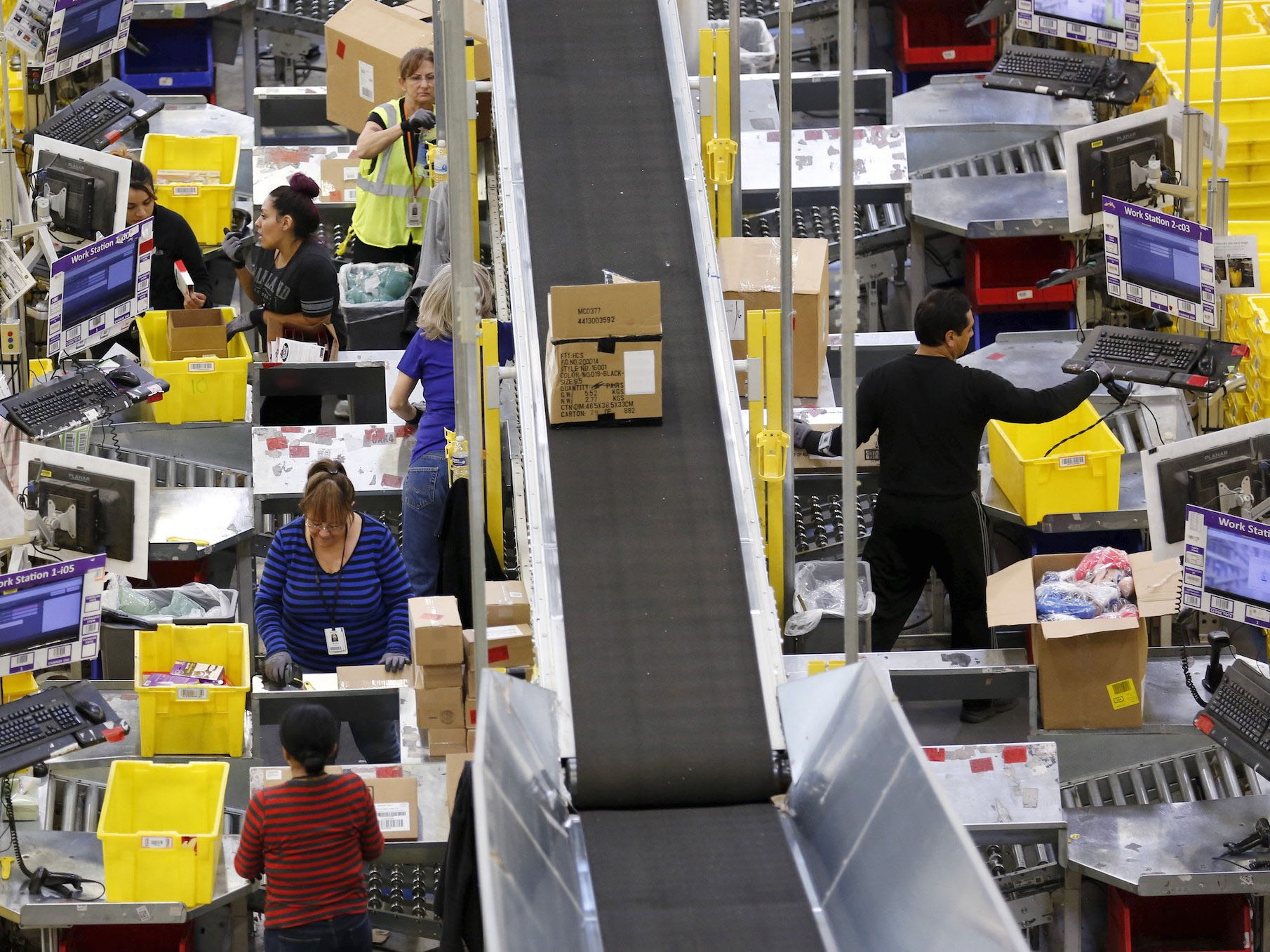
Don’t expect Amazon to hire 100,000 coders, however. Much of its current and future workforce is made up of employees working warehouse jobs and answering phones.  The average fulfillment associate annual salary is $24,000.  That equates to $461.54 per week or $11.53 per hour.  Of course if you don’t have a job, $11.53 an hour might sound like at least enough to put some food on the table.

amazon-packaging-line
Amazon packaging line

Amazon says the jobs will offer “highly-competitive pay, health insurance, disability insurance, retirement savings plans and company stock.”  That is good!

Where are the middle class jobs?  They are not at Amazon.  They are not at Walmart.

Low paid jobs are now becoming the new normal in America.

Barely Half of 30-Year-Olds Earn More Than Their Parents

Sorry, Young People: You Probably Won’t Make as Much Your Parents Did

As wages stagnate in the middle class, it becomes hard to reverse this trend

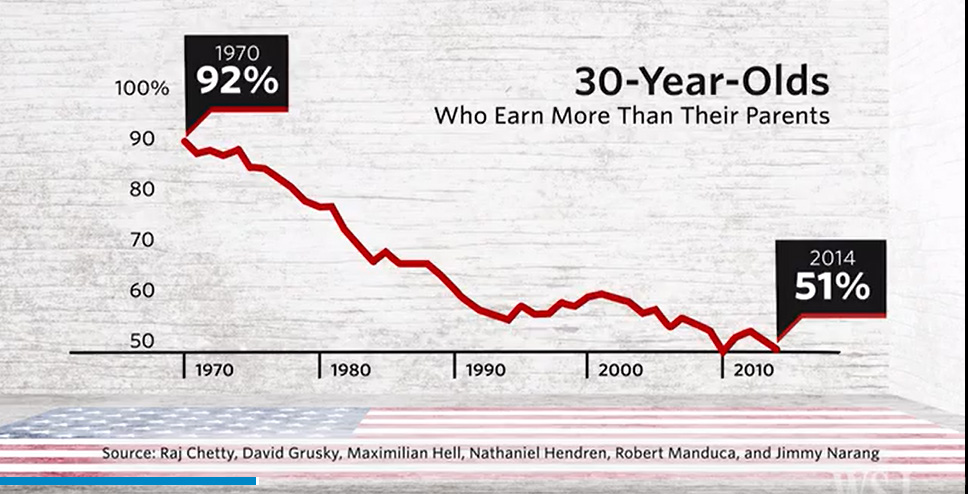
From a report in the Wall Street Journal dated December 8, 2016.   Barely half of 30-year-olds earn more than their parents did at a similar age, a research team found, an enormous decline from the early 1970s when the incomes of nearly all offspring outpaced their parents. Even rapid economic growth won’t do much to reverse the trend.

30-year-olds-earning-less-than-their-parents

Wage stagnation has taken heavy toll since 1970s

“My parents thought that one thing about America is that their kids could do better than they were able to do,” said Raj Chetty, a prominent Stanford University economist who emigrated from India at age 9 and is part of the research team. “That was important in my parents’ decision to come here.”

What’s more, even if President-elect Donald Trump fulfills his promises of rapid economic growth, the trend won’t be reversed significantly. Even if income levels grew 3.8%, the percentage of 30-year-olds who out-earn their parents would bump up to just 62%, the Wall Street Journal reports.

The study was conducted by economists and sociologists at Stanford, Harvard and the University of California. They used tax and census data to compare the earnings of 30-year-olds starting in 1970 to that of their parents.

What the report does not do is explain why wages are stagnant. I will give you my take on this horrible reality. I did earn more than my parents but only because of inflation.

When I married in 1969 my salary was $10,000 per year. According to the United States bureau of Labor Statistics your income today, based upon the CPI Inflation Calculator, that salary equates to $65,866.  My father never earned that inflation adjusted salary.

There have been many reasons for the stagnant salaries.  Three come to mind almost immediately. 

First management earned ten to twenty times the average income of most employees in the earlier parts of the 20th century.  Today management earns 200 to 300 times the average income of most employees.

Second many jobs have been outsourced other countries.  That has resulted in more potential employees seeking the remaining jobs.  Thus with more people looking for work employers can push down the pay they have to offer.

Third, many jobs have been automated thanks to artificial intelligence (AI), and computerization.   Have you seen the inside of an auto manufacturing facility?  Automation has eliminated many jobs from welding to painting.  Warehouses are now so automated that less material handlers are needed.  Office workers, I am one of them, now have computers that perform many of the manually performed functions that were done using typewriters and spreadsheets. That too reduced manpower needs. Less manpower translates to an oversupply of workers and that translates to lower pay. It is all about supply and demand.

It is unlikely that any government of any political party will change this trend.  I hope I am wrong.

There are no Affordable Housing Requirements in Los Angeles

We have a living problem in Los Angeles that is prevalent in all the large coastal metropolitan areas of California. The cost of housing is too high for many families.

Los Angeles County has added more than 475,000 jobs since the depths of the Great Recession, and it’s expected to gain another 334,200 jobs by 2020 according to the Los Angeles County Economic Development Corp. in a report they just released. The families that have these jobs cannot afford most of the housing in this area.

The L.A. County report notes that more than a third of the county’s projected job openings over the next five years will require workers without a high school diploma and no work experience. Another 30 percent will go to people with a high school diploma or the equivalent with no work experience.

As the number of jobs has grown so has the number of new apartments throughout the area. The problem is that the new housing is renting for what the builders and owners say are “market rates.” Those are rates that I call “unaffordable rates.” Despite the need for affordable dwellings the cities and towns of the Los Angeles metropolitan area have approved the construction of those unaffordable units for those obtaining the new jobs.

In my own community the local community council approved a 150 unit development that consists of one bedroom, two bedroom, and three bedroom units. The two bedroom units are going to rent for $2,200 per month. Older two bedroom units are currently renting for $1,500 to $1,700 per month.

apartment-house-proposed-in-silver-lake

Rendition of Apartment House Proposed in Silver Lake District

Developers seem to think that 10% of their new projects devoted to “affordable housing” is sufficient. A 33 unit project in my community includes 3 affordable units. A proposed 67-unit apartment complex in Silver Lake area includes seven of the units to be reserved for “very low-income residents.”

Citing an affordable housing crisis of “epic proportions,” the California Supreme Court made it easier Monday for cities and counties to require developers to sell some housing at below-market rates. The unanimous decision, written by Chief Justice Tani Cantil-Sakauye, follows study after study documenting a lack of affordable housing in the state, especially in California’s coastal regions.

The decision clears the way for Los Angeles and other cities to require developers to sell a percentage of the units they build at below -market rates as condition of a building permit. Developers also could be given the option of paying into a fund for low-cost housing.

Where is the Los Angeles City Council and the Los Angeles County Supervisors? There is no law that requires affordable housing in new developments. The city will permit variances to zoning and use that as an opportunity to require affordable housing.