America’s Free Enterprise System Is Coming to an End!

attSo the wealthy have the power to do as they wish. These are oligarchs. They are only interested in accumulating unbelievable wealth that will provide their family generations of luxurious living without ever having to work a day in their lives. As our society evolves into a nation controlled by those very wealthy, the vast majority of Americans are becoming ever poorer. Donald Trump talks about the shrinking middle class and the 45 million people either in poverty or near poverty. He is correct in pointing out the discrepancy but he really doesn’t have a solution. He is one of those oligarchs. Those oligarch just don’t care no matter what they say.

Thus we see AT&T buying Time Warner. In what way will this benefit society? It won’t. What it will do is put more power in the hands of a few. It will be a more controlled society.

Wells Fargo may pay a fine but its power remains. The rest of the banking industry is just happy they have not been caught in some other manipulation.  The former Wells Fargo CEO John Stumpf “retires” with a $100 Million plus retirement package.

This is a sad collapse of the free enterprise system where individuals can open small businesses and make a living. Privately owned drug stores, food markets, and hardware stores were part of the American well of life. Now its Walgreens, Walmart, Kroger, and Home Depot that control the price we pay and the jobs we have.

“What have you got to lose?”

This second debate and the November election is all about Donald Trump. You are either for or against him. It is Donald Trump’s election to win or lose. Votes for Hillary Clinton are really vote against Donald Trump. Trump has put himself front and center.

The first 30 minutes of the second presidential debate was VERY nasty. Donald Trump’s effort to deny he is an abuser of women was a failure. I cannot imagine that any women in America is willing to support him based on his comments about a Miss Universe contestant and the video recording of him on a bus at Universal Studios in Studio City. Billy Bush has been suspended from the Today Show based on that tape.

Examples started from the first question asked by Anderson Cooper:
“You called what you said locker room banter. You described kissing women without consent, grabbing their genitals. That is sexual assault. You bragged that you have sexually assaulted women. Do you understand that?”

TRUMP: “No, I didn’t say that at all. I don’t think you understood what was — this was locker room talk. I’m not proud of it. I apologize to my family. I apologize to the American people.”

Later in the debate

TRUMP: “Well, you owe the president an apology, because as you know very well, your campaign, Sidney Blumenthal — he’s another real winner that you have — and he’s the one that got this started, along with your campaign manager, and they were on television just two weeks ago, she was, saying exactly that. So you really owe him an apology. You’re the one that sent the pictures around your campaign, sent the pictures around with President Obama in a certain garb. That was long before I was ever involved, so you actually owe an apology.” 

The remainder of the debate saw Trump hold his own against Hillary Clinton. Some have thought one of them won the debate but to me it was a tie.

Both Trump and Clinton may have liked each other at one time (the Clinton’s were at Trump’s last wedding) but it was obvious that they have developed a real hatred.

Donald Trump’s response to the American Muslim women looking for a reason to support him was not given a shred of response that would encourage her to give him any support. Likewise the Black man was not given any reason to give him support. In both cases Trump was short on details on how he would reach out to those communities.

Hillary Clinton smiled through the entire debate and remained unflapped by Trump’s attacks.

I doubt that many people changed their view of these candidates as a result of watching this debate.

I predict Donald Trump will win the election. The reason is that Hillary Clinton has offered nothing new. Many people have lost their jobs. Trump may not bring them back but “What have you got to lose?”

The Impact of Technology on Blue Collar Workers

We are about to select a new American president in a world that is rapidly becoming more technically advanced than anyone could have imagined in the year 2000. Remember that as the year many of us were concerned that clocks would stop, power grid systems might fail, and commercial aircraft might fall from the sky. Of course none of that happened. What has happened is the rapid advance of technology and a globally connected society. Thomas Friedman’s “The World is Flat” (Published April 5, 2005) was not only a recognition of a changing world economy but the need for America to look forward and plan for the new economy.

Take just one new technology, autonomous (self driving) cars and trucks, that is predicted to be launched by the year 2020 to 2025 and consider the impact and you will understand that no one – no president of the United States – can stop the impact on the public in either the United States or other countries.

Don’t Tell The Teamsters: But Driverless Trucks Are Already Here.  Driverless trucks are operating in an Australian mine. When those trucks arrive in America the Teamsters will fight with everything they have to stop those autonomous trucks. Feather bedding will be a prominent part of their strategy. There are currently 900,000 active working Teamsters in the United States and Canada. There are approximately 3.5 million professional truck drivers in the United States, according to estimates by the American Trucking Association.

What will all those families that rely on those truck driving jobs do when they are replaced by self driving trucks? As a nation we have not looked forward. We have looked back.  Technology’s impact on the trucking industry is simply one example of the changing work environment.

Donald Trump promises to bring back the jobs that have been lost due to out sourcing. It is not clear what will motivate the return of jobs other than tariffs that could start a trade war.

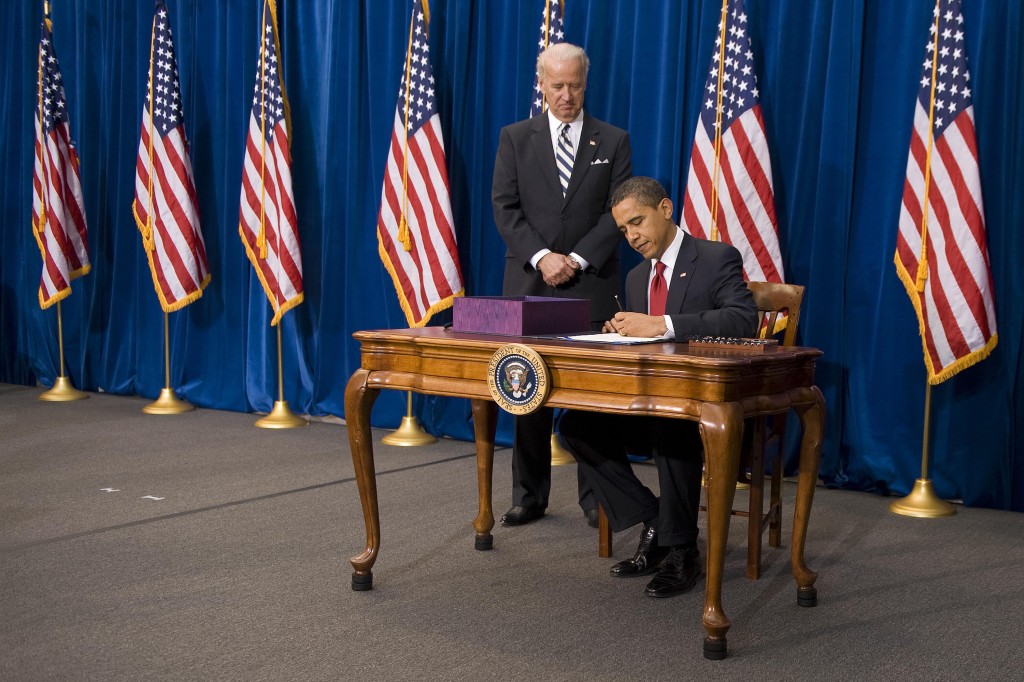
Hillary Clinton says she will propose investing in infrastructure, manufacturing, research and technology, clean energy, and small businesses. The costly $787 billion spending bill that President Barack Obama signed into law soon after taking office had little effect. It was argued that it was insufficient.

obama-signs-the-american-recovery-and-reinvestment-act-of-2009

In all of the Trump and Clinton ideas there is no consideration of the future.

Goodbye to Chain Department Stores

Macy's North Hollywood Closing 8-4-2016The Sears near my home was in a shopping center that includes many of the major department store chains including Macy’s, Nordstrom’s, Target, and Neiman Marcus. The store is now sealed off with metal siding and block walls.

The impact of Amazon and other on-line sales companies is really starting to take its toll.   Amazon, Wal-Mart Lead Top 25 E-commerce Retail List. Total annual retail e-commerce sales are $201 billion, according to the 180 companies tracked by eMarketer. For the top 25 retailers, total annual e-commerce sales come in at $159 billion, with Amazon Inc., Wal-Mart Stores Inc. and Apple Inc. taking the top three spots. According to eMarketer, Amazon’s e-commerce sales are $79.3 billion while Wal-Mart has $13.5 billion and Apple totals $12 billion. After Walmart is Apple, Staples, and Macy’s.   More than 50% of Williams-Sonoma’s sales are done on-line.

So while Macy’s may be seeing an increase in-line sales they are closing or have closed at least 40 stores this year. Four in the Los Angeles area include their Century City store (that is next to Beverly Hills). This list does not include all of the targeted stores as they just today announced the closing of a North Hollywood store that was opened 61 years ago by May Company.

Fortune magazine reports that 78 Sears and Kmart stores are also closing.

There are many other chains of specialty stores from women’s fashions to sporting goods and sportswear that are also facing declining sales.

What will happen to all the malls that have been built across the nation? One high end mall in Woodland Hills California, called the Promenade, is now mostly deserted and rumor has it that the buildings will be torn down and apartment houses will replace the shopping. Westfield is the owner and has not revealed its plans.

Does this also means more lost jobs? Well, no.  New distribution centers are being erected by the on-line retailers.

Nothing is forever!

Some Good News

The news is all about what bad things have happened during the day or all the way to yesterday. It’s time to write about some good things that have happened.

-Surge of new jobs. The Bureau of Labor Statistics reported that 287,000 new jobs were created last month (June). New jobs have been created every month starting March of 2010. The unemployment rate I 4.9%. All those new jobs were not high paying but that is a record worth advertising.

-The S&P 500 has almost reached it record set May 20, 2015 when the index reached 2134.72. Friday it was almost there again closing at 2129.90.

-JCPenney is adding 350 jobs in LA and Orange counties in California. That is a company that many expected to go out of business this year.

-When Sharay Santora and her two children first arrived in downtown Dallas on Thursday to join the Black Lives Matter protest, she said the interaction between marchers and officers was peaceful, loving. Officers lined the streets as a massive crowd marched past.

“They gave us high-fives, hugs, were taking selfies,” Santora, 37, told The Washington Post. “It was such an instance of love and understanding, that ‘I’m here for you.’  You could feel it. There was no animosity in the air. That was the feeling throughout.”

Santora said marchers noted “these people who came out to protect us, we’re going to be out there for them.”

She plans to take her children to memorials for the fallen officers, for the same reason she has taken her children to Black Lives Matter demonstrations: “You’re either part of the solution, or you’re part of the problem. Even if you don’t know what to do, you can do something, even if it’s showing love.”

Maybe, just may be, the tragedy in Dallas can bring all of us to our senses.

Report predicts LA County will add 346,000 jobs by 2020

This is both good and bad news.  Metropolitan Los Angeles is experiencing growth while many other large cities are shrinking. Chicago come to mind as a city that has lost 1/3 of its population.  The key sentence in the following article is Unfortunately, many of those jobs are low paying positions that would make it tough for someone to support a family.” The median price of a home in LA County is $526,000 according to Zillow. They have gone up 6.5% over the past year and Zillow predicts they will rise 1.6% within the next year. The solution for low paid workers is to commute to work. That could mean a one and half hour travel time.   Many people are doing exactly that. Outbound freeways are jammed with cars every evening.

LA County Home Construction 

A new report from the Los Angeles County Economic Development Corp. reveals that L.A. County will add 346,00 jobs between 2015 and 2020, including 20,900 in the construction industry. Leo Jarzomb — Staff photographer

By Kevin Smith, San Gabriel Valley Tribune

Posted: 06/01/16, 12:41 AM PDT | Updated: 14 hrs ago

Los Angeles County is expected to add 346,000 jobs between 2015 and 2020 across a broad range of industries, according to a report released today.

The Los Angeles County Economic Development Corp.’s annual “People, Industries and Jobs” report shows that 123,000 of those jobs will be in the city of Los Angeles.

Construction, professional and business services, education and health services and leisure and hospitality will see the biggest growth rates in percentage terms. But the lion’s share of new jobs will come from administrative and support services (57,560), Food services and drinking places (39,510), social assistance (34,30) and professional and technical services (33,300).

Unfortunately, many of those jobs are low paying positions that would make it tough for someone to support a family.

On the plus side, construction is expected to add 20,900 jobs, which bodes well for both housing activity and commercial expansion.

Southern California’s construction industry took a heavy hit during and after the Great Recession, which began in late 2007 and ended in June 2009, as developers pulled back on building housing projects and commercial developments — sometimes curtailing activity altogether.

“We’ve been waiting for that industry to rebound,” said economist Christine Cooper, the LAEDC’s senior vice president and lead author of the report. “It has just been really hard.”

But the industry is rebounding and Southland developers have a variety of residential projects in the works.

KB Home, for example, has 10 housing developments underway in Los Angeles County in such communities as Santa Clarita, Van Nuys, Palmdale, Pomona, West Covina and Los Angeles.

An annual report on the company’s website shows that KB delivered 8,196 homes throughout its various U.S. markets last year compared with 7,215 the previous year and 7,145 in 2013. KB’s revenues have likewise risen, topping out at more than $3 billion last year compared with the $2.4 billion the company generated in 2014.

“As the housing market recovers, construction industries are expected to make a robust recovery,” the LAEDC report said. “Housing starts are showing signs of life after a dismal few years, and will be needed to meet pent-up demand.”

The report notes, however, that L.A. County’s economic recovery has been generally disappointing and that the region didn’t recover all of the jobs that were lost during the recession until last year. Moreover, the recovery that has taken place doesn’t take into account the job growth needed to accommodate the county’s ongoing population and labor force growth.

The report also shows a clear correlation between educational attainment and unemployment.

In 2014, the jobless rate for L.A. County residents with a high school education or the equivalent was 9.4 percent, nearly double the 5 percent rate for those with a bachelor’s degree or higher. That same kind of disparity played out in the city of L.A.

The median annual earnings for an L.A. County resident with a high school education or the equivalent was $26,049 in 2014. That figure is dismal when compared with the yearly median income of someone with a bachelor’s degree ($50,976) or someone with a graduate or professional degree ($71,596).

The largest share of working residents in the county (33.3 percent) earn $15,000 to $35,000, and nearly 8 percent earn just $15,000 or less. Still, Cooper said progress is being made on the education front.

“We’ve been doing these reports for a number of years and we’re seeing that more young people are gaining higher levels of educational attainment,” she said. “We see that as a really bright spot.”

That may be bright. But a not-so-bright portion of the study shows that nearly 323,300 of the 2.19 million families who were living in Los Angeles County in 2014 had their incomes fall below the poverty level in the previous 12 months. A large portion of that number included children and young working age adults.

Single mothers with children under 18 accounted for nearly 40 percent of those living below the poverty line.

“The good news is that our region is adding jobs across most industries, and is expected to continue its expansion,” Cooper said. “However, although we are seeing some job growth in high-paying industries, it is clear that not enough of our projected job gains are skilled, well-paying jobs that will support middle class incomes. We need to work together to change this trajectory, by fostering job creation in our leading export-oriented industries, which tend to pay higher wages and strengthen regional prosperity overall.”

Cooper said California’s new minimum wage requirements, which will boost the minimum wage to $15 an hour by 2022, will likely have some negative effects.

“Some businesses will choose to replace lower skilled workers will people who have higher skills,” she said. “And it will also lead to an increase in automation.”

The Domino Effect of Outsourcing

From coast to coast, middle-class communities are shrinking

Fully 1 in 3 Americans who work in the manufacturing sector are receiving some form of public assistance, according to a study released this week by the UC Berkeley Center for Labor Research and Education. Of those who came to their positions through temp agencies half are on some type of safety net program. This was reported by CNBC.

I took a drive up to the Griffith Park Observatory here in Los Angeles last month. It wasn’t for going inside the building. It was a windy day and I anticipated a beautiful view from the parking lot. I was not disappointed. I obtained a photo that included a view of Catalina Island on the horizon. The distance is about 35 miles from the observatory.

I chose an alternate route back home and drove by Los Angeles City College. To my shock the sidewalk across the boulevard was lined with the tents and shelters of the homeless packed closely together. According to the Los Angeles Times there are now an estimated 44,000 homeless people in Los Angeles County. How did the numbers get so big?

Sports Chalet (more than 50 locations primarily in California) and Sports Authority (463 stores) are closing all of their stores. They started those closings last month. Kohl’s is closing 18 stores and laying off more than 1,500 employees. Where will the laid off workers go?

Back in November 2015 Macy’s Department stores reported a sharp drop in quarterly sales and lowered their forecast for 2016. Macy’s reported unsold goods piling up in their stores. Today they reported another quarter of sinking sales and once again slashed its financial targets for the rest of the year.

Meanwhile where are the jobs of the past here in Los Angeles and elsewhere in the United States? Those were the thousands of aerospace engineering jobs that were a major contributor to the strong California middle class that are mostly gone. The falloff in manufacturing jobs during the past 14-year period has caused factories to shed about 5 million workers from their payrolls nationally. Factories from all over the nation have moved to other countries. In their place are low paying service jobs that offer pay rates as low as $7.25, $15, and $25 an hour. Those jobs do not support a middle class family. They certainly do not support a Macy’s or Sports Authority price line.

Discount chains like T.J. Maxx and fast-fashion retailers such as H&M offering jeans as cheap as $17 and polo shirts for $10 are succeeding because that’s all today’s workers can afford.

So businesses keep outsourcing your work to low cost countries because you see it as a way to higher profits. Just remember that those of us left with those low paid jobs will be shopping at Walmart, Target, and the other afore-mentioned discount stores.  The vicious cycle continues to drive people from the middle class to poor and homeless.

Don’t tell me you do not know what happened to the middle class.

Manufacturing and Minimum Wage Jobs in the 21st Century

Lower taxes might help domestic manufacturers but when the cost of labor in other countries is one-tenth the cost in the United States lost jobs will not be returned to this country.

Individuals assembling Apple’s iPhones in China allegedly work long hours for low pay. They work 11-hour shifts at a rate of $1.50 per hour. During each shift they are docked 20 minutes of pay (I assume for a lunch break). There earnings are $268 per month before overtime. This information is from a report in Business Insider.

GM, Ford Boost Mexico Output With $26-a-Day Workers.  Mexico’s share of North American auto production may rise at a quicker pace as General Motors Co., Ford Motor Co. and Chrysler Group LLC seek out workers making less than 10 percent of what their U.S. counterparts earn. This information is from a report in Bloomberg Businessweek.

For example crib maker Stanley Furniture Co. misjudged the willingness of Americans to pay more for domestically produced goods when cheaper imports are available. Meanwhile, the husband-and-wife entrepreneurs who founded 20-year-old Chesapeake Bay Candle have struggled to find workers who can do basic math. This information is from a report in The Wall Street Journal.

 Los Angeles, once the epicenter of apparel manufacturing has seen the outsourcing of jobs to China and Southeast Asia due to lower labor costs.

Do you really believe that Donald Trump will bring those assembly jobs back to the United States? Donald Trump does not agree with the idea of a $15 per hour minimum wage. I heard him say that. Los Angeles was once the epicenter of apparel manufacturing Los Angeles was once the epicenter of apparel manufacturing, attracting buyers from across the world to its clothing factories, sample rooms and design studios. But over the years, cheap overseas labor lured many apparel makers to outsource to foreign competitors in far-flung places such as China Los Angeles was once the epicenter of apparel manufacturing, attracting buyers from across the world to its clothing factories, sample rooms and design studios. But over the years, cheap overseas labor lured many apparel makers to outsource to foreign competitors in far-flung places such as China

Just to add to the difficulty in keeping jobs in America paid family leave regulations have been passed in New York and California.

Most web sites contend that government regulations are a significant cost to business in the USA. The problem is that every regulation has its supporters.

Unless Donald Trump intends to drive up the cost of clothing, cars, and electronic devices there is no way he can bring those jobs back to the United States. His ideas will spark a trade war.

The solution is retraining in areas short of workers. CNN posted an article listing 30 jobs needing most workers in next decade. How many people will take the opportunity by at least investigating the opportunities?

Technological Unemployment

From Wikipedia: “Perhaps the earliest example of a scholar discussing the phenomena of technological unemployment occurs with Aristotle, who speculated in Book One of Politics that if machines could become sufficiently advanced, there would be no more need for human labour.”

It has been reported repeatedly that Queen Elizabeth I of England refused to grant a patent for a weaving machine because it would put the hand weavers out of work. She was correct. It did.

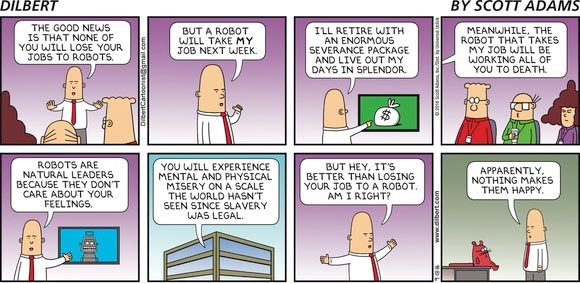
I was talking with an acquaintance about the effects of AI (artificial intelligence) and IT (information technology) on the work environment and the elimination of many jobs. A touch plate at a fast food ordering counter could replace an order taker. So could many other jobs.

One job I held for 7½ years was a scheduling supervisor in a factory. I had decided to quit after about four years. The work was tedious and very stressful. It took me the next 3½ years to find work that would pay more and appeared to offer a chance of advancement. I was responsible for all the production schedules and work orders in the factory. If something went wrong in the middle of the night, the night foreman called me. Today that job would be done more accurately by a computer generated program that could accomplish my 40 plus hour weekly job in minutes.

My father was a structural engineer. He retired just as computers were beginning to be used to calculate stress analysis. His calculation tool was a slide rule. He was a mathematical genius. Today those calculations can be more accurately accomplished using a computer that would provide the results in minutes not hours. The drafting of the structure can now be provided by a computer driven drafting machine rather than a draftsman.

Perhaps the order taker at the fast food counter will still have a job preparing the order. Perhaps the mathematical genius will be working on a program in Silicon Valley. One thing is certain. All jobs that can be mechanized and/or computer driven will result in fewer jobs.

I rarely take my car to a repair garage because they too have been fitted with longer lasting components. Thanks to a well-made furnace and plumbing in my house the need for service maintenance is reduced. That means there is no growing need for service industry workers.

I have yet to hear anyone, neither politician, corporate leader, nor social engineer, explain how even the brightest people will care for their families when the number of jobs is in decline.

We have a serious societal challenge and no answers. Joel Kotkin and other commentators have observed the issue. Now what?