$15 Minimum Wage: Booby Prize for American Workers

By Joel Kotkin

(Joel Kotkin is R.C. Hobbs Presidential Fellow in Urban Studies at Chapman University. He is executive editor of New Geography … where this piece originated and executive director of the Center for Opportunity Urbanism.)

Almost everything that Mr. Kotkin has written is accurate. It is something those who pushed the $15 minimum wage law in Sacramento knows. The question Mr. Kotkin and everyone objecting to the new minimum wage fails to answer is: How does this society contend with a population that “has seen a rapid decline in traditional blue-collar jobs?” Those blue-collar citizens are the driving force behind the crowds drawn by Donald Trump and Bernie Sanders. They may not have the answers but they understand that the masses are in dire straits. Or perhaps there is no solution and Mr. Kotkin is correct in concluding that we are going to return to a feudal society.

This article has been abridged.
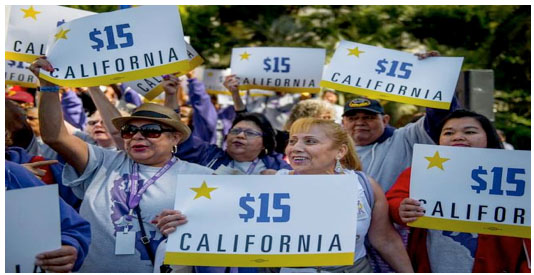
$15 California

NEW GEOGRAPHY–In principle, there is solid moral ground for the recent drive to boost the minimum wage to $15, with California and New York State taking dramatic steps Monday toward that goal. Low-wage workers have been losing ground for decades, as stagnant incomes have been eroded by higher living costs.

Yet if the campaign to boost the minimum wage reflects progressive ideals, the underlying rationale also exposes the failure of these high-priced cities to serve as launching pads for upward mobility for the vast majority of their residents. In effect, the fight for $15 is a by-product of giving up – capitulating on the idea that better opportunities can be created than the menial service jobs that increasingly are the only opportunities for the urban poor. Higher wages will make these jobs moderately more tolerable, while further cementing the wide gulf between the haves and have knots.

New York, San Francisco, LA and Seattle are at the forefront of a new urban economy, based on industries such as finance, technology and media, that generally creates jobs for the highly educated only. Virtually every region at the cutting edge of the minimum wage movement has seen a rapid decline in traditional blue-collar jobs — notably in manufacturing — which often paid well above the minimum wage, and offered potential for further individual advancement.

In these and other core cities, we are seeing something reminiscent of the Victorian era, where a larger proportion of workers are earning their living serving the wealthy and their needs as nannies, restaurant workers, dog-walkers and the like. In New York City, as of 2012, over a third of workers were employed in low-wage service jobs, a percentage that rose through the recovery from the Great Recession, according to a study by the Center for an Urban Future.

Given shrinking opportunities for middle and working class people, it’s not surprising that many seek a more direct redress from the government.

Essentially the minimum wage campaign rests on the notion that traditional middle class uplift cannot be achieved. The problem is, a $15 an hour income represents hardly enough to pay the rent for a small apartment anywhere near the blue cities where the new minimum will hit first.

The  impact in California will, if anything be larger, as the wage hike will be imposed in a wider fashion on a hugely diverse state.

To be sure, higher wages could be a blip in wealthy and thoroughly de-industrialized places like San Francisco – if higher labor costs boost the price of beet-filled ravioli, it doesn’t undermine the market in a place where hipsters and elite workers still have dollars to spend.

Perhaps the greatest beneficiaries of the minimum wage hike will not be the bulk of lower wage workers in blue states, but the people who increasingly dominate their economies.

And as the American Interest recently predicted, those most likely to benefit down the line from the higher wages will be the tech companies that will come up with the software and automated systems that replace the service jobs now made less economically competitive by the wage hikes. It’s not a loony fringe concept: the President’s Council of Economic Advisers recently estimated that lower-wage service jobs have an 80% probability of being automated.

So in the end, a $15 minimum wage, set in the low growth economy of our times, may end up boosting the very class-based hierarchies that are already increasingly evident. Ultimately it may represent a case of a well-intentioned measure that, while sounding radical, only accelerates our road back to feudalism: a society dominated by the few where many depend on the generosity of their betters and the middle class, already shrinking, fades into the dustbin of history.


The Downside of Minimum Wage Laws

OPI InfiniteShine nail polish OPI is a nail polish manufacturer in North Hollywood California. They employ about 400 people at that facility. The company is owned by Coty Inc. That company has ten brands of cosmetics. They have announced their decision to move the manufacturing facility to North Carolina.

The North Hollywood facility includes marketing and sales offices. You can be fairly certain that no more than 10% of that 400 employees are involved in the marketing and sales. Those jobs are relatively high paying office functions. In other words about 360 jobs will be leaving the North Hollywood facility.

Cosmetics manufacturing consists of many low paid jobs. The minimum pay in California is now $10 an hour. That minimum in North Carolina is $7.25 an hour. It doesn’t take a genius to understand why the manufacturing is moving out of California.

The idea of raising the minimum pay is commendable but how much consideration was taken on the impact. There will now be 360 low paid factory workers without jobs.

Toyota moved most of its operations from a Los Angeles area suburb just two or three years ago. They moved to a Dallas Texas suburb. No doubt the cost of labor played into that decision.

There is the question. Have we really helped the poorest paid in California when jobs are driven from the state by higher minimum wage laws?

Buy-Outs, Forced Retirement and Age Discrimination

Your employer is in financial difficulty and needs to find a way of saving cash until there is a recovery.

If you work for a newspaper or magazine you are in an industry that is in serious decline then recovery is in doubt. The Washington Post seems to have recovered thanks to a purchase by Jeff Bezos, founder of Amazon. BusinessWeek magazine was bought by Michael Bloomberg and is thriving. Newsweek and U.S. News and World Report are gone. Tribune Publishing Company that owns the Chicago Tribune, the Los Angeles Times and other newspapers is in dire straits.  The Los Angeles Times is currently attempting to offer buy-outs to their staff.  Sports writer Bill Dwyre, a gray-haired man with years of experience and probably high pay just announced his retirement.  Other outstanding columnists with that paper are probably also going to take their leave.

General Motors and Ford Motor Company both went through some very difficult economic times as have   many other companies.

In every instance they all followed the same path. Cut the high cost employees and reduce the pay to the remaining employees. I know people who were part of the buy-out, those who faced the reduced pay, and those who were simply laid-off. I was party to that situation more than once.

The issue for those losing their jobs is their age. Once you are older, 55 or older, obtaining another job at the same pay as was previously received is difficult and in most cases impossible.

Age discrimination is rampant and impossible to prove. “Age discrimination involves treating someone (an applicant or employee) less favorably because of his or her age. The Age Discrimination in Employment Act (ADEA) only forbids age discrimination against people who are age 40 or older.” That is the statement posted on the EEOC on their web site.

From Forbes magazine dated January 31, 2014

The Ugly Truth About Age Discrimination (abridged)

“So then the headhunter said something that took my breath away,” said my caller, Philip.

“He told me that his client looked at my resume and said it looked great, but then he found my LinkedIn profile and decided I’m a little long in the tooth for the job.”

I was silent. That took my breath away, too.

“Long in the tooth?” I asked. “As in old?”

“Exactly,” said Philip. “The headhunter actually told me that the client said I was too old for the job. I asked him if that was illegal – I’m pretty sure it is – and he said that the client’s view is that if they don’t interview me, I’m not a candidate, so it’s not discrimination.”

“That’s false,” I said, but even as I said it, I knew that it doesn’t make any difference.

What is Philip going to do – sue the employer he never met because a third-party recruiter told him that one hiring manager made an inappropriate comment? So-called Failure to Hire cases are notoriously hard to bring and even harder to prove. As long as the organization ends up hiring someone who is qualified for the job, how could Phil ever prove that he was rejected because of his age? It’s not as though the organization is going to publish the new hire’s age for all the other candidates to see.

Age discrimination is everywhere. I hear more examples of age discrimination than I hear about sex discrimination, racial discrimination and every other kind put together. I expect that’s because some employers believe that older workers aren’t as nimble or perhaps aren’t as easy to train. Some of them undoubtedly worry that an older person is necessarily overqualified, and thus likely to bolt the minute a better job comes along.

I was there too. At the age of 60 in an interview the president of the company, he asked me if I was a grandfather. My answer was no and that was accurate. The thought running through my head was I would not be obtaining this job. To my surprise I did receive the job offer. I went on to two promotions proving that older employees can thrive.  Could I have brought a successful suit against that employer? There was no proof that the question was asked.

I know of no solution. Businesses thrive, businesses shrivel, life goes on. As the population ages the issue of age discrimination will fade away.

GE says it may move up to 500 jobs overseas

When Donald Trump said “we-are-led-by-veryverystupidpeople” you probably thought he was exaggerating.  The GOP lead congress refused to re-authorize the U.S. Export Import Bank on the grounds that it was helping companies that don’t need any help.  This is the consequence of that very stupid decision.

By ASSOCIATED PRESS

General Electric LogoGeneral Electric Co. may move about 500 American jobs overseas because Congress did not renew a government program that allows foreign companies to borrow money to buy U.S. products, the industrial conglomerate said Tuesday.

Authorization for the U.S. Export Import Bank was not approved by Congress, forcing it to stop lending July 1. Foreign companies use the agency to buy expensive U.S. products when bank loans are not possible.

As a result, GE says 100 jobs from a Houston plant that makes gas turbines will move to Hungary and China in 2016. The Fairfield, Connecticut, company says those countries have lending options in place for customers.

“We do not make today’s announcements lightly and in fact, have done everything in our power to avoid making these moves at all, but Congress left us no choice when it failed to reauthorize the Ex-Im Bank this summer,” said John Rice, GE’s vice chairman.

Another 400 jobs could be created in France instead of factories in South Carolina, Maine and New York if the company wins projects it is bidding on. The projects require financing, and the export credit agency in France has agreed to provide it.

GE said it’s bidding on projects valued at $11 billion that require export financing. It said it has reached agreement with the French export credit agency to provide a line of credit for global power projects. GE said the line of credit will initially support potential orders in international markets that include Indonesia.

To access the required export credit for its customers of its aeroderivatives turbines, GE will move its final assembly from the U.S. to Hungary and China. As related projects are bid and won in these two product lines, GE said it will move approximately 500 jobs from Texas, South Carolina, Maine and New York to France, Hungary and China.

The embattled and little-known banking agency has been at the center of a fight between tea party Republicans who say it’s not needed and Democrats and some Republicans — backed by manufacturers and large businesses — who say it promotes trade and helps create jobs.

The Ex-Im Bank’s principal role is to guarantee commercial bank loans to foreign businesses and governments to buy U.S. products. U.S. taxpayers would be responsible for a loan if a company operating overseas defaults on a bank loan used to buy a product made by a U.S. company.

Copyright © 2015, Los Angeles Times

Being a Boss is not the same as being President of the United States

Let’s consider the leading outsiders who want the GOP nomination.

When you’re the boss there is no democracy involved. You make the rules and all of your employees must do as they are told. That includes department heads and company CEOs. So when Donald Trump, owner of a large business or Carly Fiorina, when she was CEO of Hewlett Packard gave an order it had to be followed. The consequence of not following your orders is their termination.

When you are a legislator you must sit with other legislators and agree on a plan that is then acted into law. You alone cannot command anyone to do anything (other than your immediate staff).

Those differences between being the boss and working with others to initiate orders are the reasons that CEOs and bosses are not necessarily successful in elected office. Former President Ronald Reagan never was a boss. He was an actor and in show business you must learn to get along with others to make a movie or television program.

Donald Trump owns his business. It is not listed on a stock exchange. When he gives an order to his employees they do as they are told. Not following Trump’s directions can lead to termination.

Carly Fiorina at HPCarly Fiorina tried to do what she wanted in Hewlett Packard but even as CEO, while still being as boss, she still had a boss. That was the roll of the Board of Directors. Carly Fiorina left Hewlett Packard effective immediately upon termination. There were no goodbye parties.

Doctor Ben Carson probably had a team of assistance who responded to his direction. They too had no choice.

The skill set to work successfully in politics is not the same as being the boss. You may like what the non-politicians say but can they carry out their promises? Well not if they use the same skill set used as a boss.

Cities Grow or Die

Updated May 22, 2015 because of data reported in the Los Angeles Daily News.

Chicago, Detroit, Philadelphia, and Baltimore are examples of large cities that are dying.  They all have one common issue. A lack of jobs.  Cities that are thriving are growing and they all have one common reason.  New jobs.  Los Angeles grew in population by 136,243 people since the last census says the U.S. Census Bureau.  That is a growth of just the city and does not include surrounding towns such as Long Beach which have all seen similar or greater population increases.

I live near the very end of the northwest part of Los Angeles. The nearby boulevard ends about 2 miles west of my home. Despite that fact the traffic is busy all of the time. It is obviously crowded during rush hours. Simply put, we have run out of space. The land beyond the end of the city has been set aside as protected land to preserve open space with the idea of establishing a wildlife park to protect both animals and native habitat.

The question is how do we provide housing for the growing population? The answer is more apartments and condominiums. With that conclusion in mind the city has decided to permit that kind of construction. Cities do not remain static. They either grow or shrink. The growth is into the suburbs, more high rise buildings, or a combination. Spread of the Los Angeles area is a fact and is probably known throughout the world. The travel times has become nightmares for some people driving as long as two hours to get to work. Finally the city has become wiser and now has started permitting the dreaded high rise housing. Many in our city are continuing to fight this kind of construction.

Thus we have arrived at a time when many new proposals are being submitted to neighborhood councils and the city council for approval. In my area:

  •  Two part with phase 1 for the construction of a 7-story, 193,000 sqft building to house 170 apartments including 13 live-work units and 5,700 sqft restaurant. There will also be parking for 258 cars and 196 bikes.  The 2nd phase is for the construction of 166,000 sqft commercial office building with 10,000 sqft for restaurant and retail space. There will also be parking for 490 cars and 254 bikes. The office buildings being replaced are modern two story structures.
  •  A 707 unit apartment complex that was the home of Panavision manufacturing consisting of a one story building and parking lot.
  •  A 300 unit apartment complex most likely replacing one or two story office buildings.
  •  A 4,000 multifamily unit development on the former Rocketdyne facility that is expected take 10 years to complete. That project is in the design phase and has not been released for public scrutiny. The information released to date says that the buildings will vary in height from 6 to 18 stories high.
  • The former Catalina Yachts manufacturing site will be converted into 600 units.

That is a total of 5,777 housing units which more than likely means an additional 11,000 people and their cars added to already congested boulevards. To make the additional housing more palatable new nearby shopping centers and business offices will provide jobs.

Westfield Village #3

You don’t like it? Some alternative places to live are Fresno, California and Medford, Oregon. Those are two nice communities that are not faced with large growth but do offer a pleasant climate and many of the benefits of larger cities. 

Elected to Office but Unaware and Really Don’t Care

Inside the beltway: Is your representative aware of happenings in the world?

As reported in the Los Angeles Times

A bipartisan group of senators is seeking a federal investigation into alleged abuses in a popular visa program that has been linked to layoffs of U.S. workers in favor of cheaper foreign labor, the Los Angeles Times has learned.

“We are concerned about recent information that has come to light regarding the abuse of the H-1B visa program by Southern California Edison (SCE) and other employers to replace large numbers of American workers,” wrote Sen. Richard J. Durbin of Illinois, the Democratic whip, and Sen. Jeff Sessions (R-Ala.), who led the bipartisan group.

All of these senators are in league because they all know they must show concern for their constituents. This is a case of crocodile tears for those who are have lost their job or about to experience the same fate as Edison employees. Our free enterprise system says employers have every right to lower all their costs no matter who is impacted. Bank and technology companies are two of the most obvious adopters of the programs to cut labor costs. The shock is that it has taken this long for our senators to become aware of the outsourcing of American jobs. Maybe it’s not such a shock. After all some senators deny having ever used e-mail.

One must ask, where have these senators been? Haven’t they had at least one situation when they needed telephone help from a company and been transferred to a help line in India or the Philippines? Wait perhaps it is accurate to say they have been unaware. Senator Lindsey Graham, Republican of South Carolina, said on NBC’s “Meet the Press” on Sunday March 8 said has never, ever sent an email.

As reported in the New York Times

Nor does Senator Charles E. Schumer, Democrat of New York. “Maybe once every four months, I do one email,” he said, with evident relish. “I like to communicate by talking directly to people. I find it’s an important part of humanity to understand not just the words that are said, but how they’re said, the tone they’re said in, the speed they’re said with.”

Jim Manley, a Democratic strategist and longtime former Hill staff member, recalled that one of his bosses, Senator Edward M. Kennedy, Democrat of Massachusetts, could not use his BlackBerry “if his life depended on it.”

Luddite: One who fears technology (or new technology, as they seem pleased with how things currently are…why can’t everything just be the same?)

Cancer Research, Cures, and Making Money

AbigailNabbyAdams Smith (July 14, 1765 – August 15, 1813) was the firstborn of Abigail and John Adams, founding father and second President of the United States.

In 1810, Nabby was diagnosed with breast cancer, followed by a mastectomy in 1811. … The cancer continued to spread throughout her body, and she died, aged 48. That was 200 years ago.

ABCNews.com says that $415 Million is spent annually by Medicare for the treatment of breast cancer.

Total average Medicare spending per patient for initial phase care of breast cancer (2 months prediagnosis–365 days postdiagnosis) was $21,000 (2002 US$) in 2002 (Figure 2).4 Surgery and radiation cost little on a per-patient basis: $5700 and $4500 (2002 US$), respectively, and were used in 91% and 51% of patients, respectively. In contrast, chemotherapy and other inpatient services were used in about 25% of patients, but at a higher per patient cost ($12,800 [2002 US$]). If the data used for this analysis were expanded to include continuing care and end-of-life care, there would be a marked difference in spending patterns. The United States spent an estimated $62,900 to $94,300 per person for end-of-life breast cancer care during 2010 – See more at: http://www.ajmc.com/publications/evidence-based-oncology/2012/2012-2-vol18-n1/the-economics-of-cancer-care-in-the-united-states-how-much-do-we-spend-and-how-can-we-spend-it-better#sthash.BSrLsaip.dpuf.

So millions of dollars are spent treating people with this horrible disease. Billions more are spent on research for a cure. The National Cancer Institute’s (NCI) budget for FY 2013 was approximately $4.8 billion. Overall, NCI’s budget has been relatively flat in recent years. During the period from 2005 through 2013, the NCI budget averaged $4.9 billion per year.

Lots of people making lots of money.   

How dare I suggest this thought? Isn’t cancer cures and cancer research an industry that makes large amounts of money? Lesley Stahl on 60 Minutes discovers the shock and anxiety of a cancer diagnosis can be followed by a second jolt: the astronomical price of cancer drugs.


If you had a cure for just one of those cancers, breast cancer, how many people would need to find another job?  How many companies would be earning less money?

Women Shouldn’t Ask for Raises?

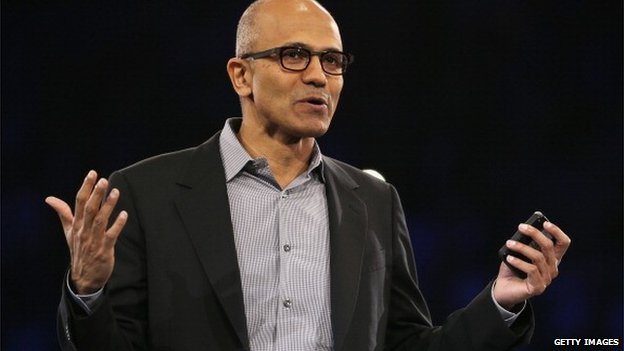
Satya Nadella, CEO of Microsoft

The boss of Microsoft, Satya Nadella, has apologised for remarks he made advising women not to ask for a pay rise but to have “faith in the system”.

Could you imagine Bill Gates, founder of Microsoft, saying these things?

Microsoft Chief Executive Satya Nadella issued an apology Thursday evening to all company employees following the backlash he received for comments he made about women asking for raises.

Nadella was a featured speaker at a Phoenix conference for thousands of women professionals in computing when he was asked what advice he would give to women who aren’t comfortable asking for a raise.

“It’s not really about asking for the raise, but knowing and having faith that this system will actually give you the right raises as you go along,” Nadella told the moderator, Maria Klawe, in front of the gathering of women engineers. Nadella went on to say that women who don’t ask for raises have an “additional superpower … because that’s good karma, it’ll come back.”

Klawe, a computer scientist and Microsoft board member, immediately shot back, “This is one of the very few things I disagree with you on,” and was applauded by audience members.

The CEO’s response received blowback almost immediately. “Does this mean Microsoft is developing karma currency to pay your bills?” Twitter user Jame Ervin wrote. “Waiting for karma to solve wage gap.”

“I sort of doubt that Satya Nadella got to be CEO by trusting in karmic ‘super powers,’” Twitter user Scott Starr wrote.

Shortly after his speech, Nadella tweeted that he “was inarticulate” about how women should ask for raises. He added that the tech industry needs to close the gender pay gap “so a raise is not needed because of bias.”

Thursday night, he issued a formal apology via email: “I answered that question completely wrong,” Nadella wrote. “I believe men and women should get equal pay for equal work. And when it comes to career advice on getting a raise when you think it’s deserved, Maria’s advice was the right advice. If you think you deserve a raise, you should just ask.”

Copyright © 2014, Los Angeles Times

Erin Burnett on her CCN Out Front program interviewed Susie Orman about the outspoken Nadella.  Obviously Orman condemned the Nadella statement.  Others that could be interviewed would be Meg Whitman, Sarah Palin, and Hillary Clinton.  Do you suppose any of them would be talking about karma ‘super powers?’

Nadella seemed to recognize his mistake, later walking back his comments through Twitter:

Satya Nadella         @satyanadella

Was inarticulate re how women should ask for raise. Our industry must close gender pay gap so a raise is not needed because of a bias


What can you expect from a man who comes from a country where rape is common place and mistreatment of women is the norm?

The United States is the Arms Maker for the World

When you want the very best in military hardware buy American. Ours is the highest quality and most reliable. Our arms are the equivalent of Lexus, BMW, and Mercedes Benz high quality cars.

President Dwight Eisenhower famously warned the U.S. about the “militaryindustrial complex” in his farewell address. To this day armament manufacturers have provided thousands of well-paying jobs to Americans. With the wind down of the wars in Iraq and Afghanistan and reduced military budgets there has been a significant reduction in those arms purchases.

The Los Angeles Times reports that “Three days after the U.S. fired 47 cruise missiles into Syria last week, the Pentagon signed a $251-million deal to buy more missiles from Raytheon Co.”

Thanks to the president’s “no boots on the ground” plans we are all happy to know that our children will have limited exposure to the Middle East war zone.

Why are we in this war at all? Congress won’t vote money for America’s infrastructure or other domestic spending proposals. However, given any threat abroad and the need for more jobs at home, why not keep shooting those GPS guided bombs? After all the cost of those guidance systems is a mere $25,000 each.

Make war, make money, and no boots on the ground. Perfect! Something both Democrats and Republicans can both agree on.

The militaryindustrial complex is alive and well.