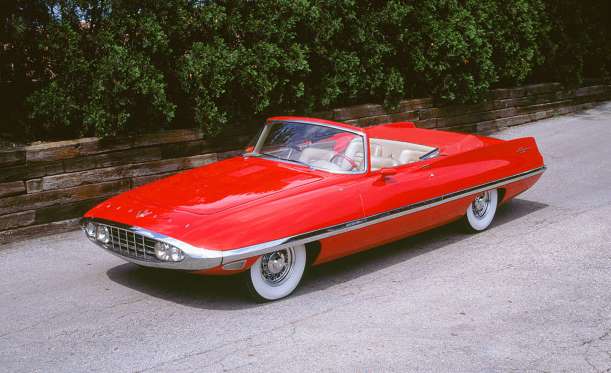
Sad Destruction of U.S. Economy by Madman

The U.S. unemployment rate rose to 4.2% in March 2025, the highest level since November and slightly above market expectations of 4.1%.

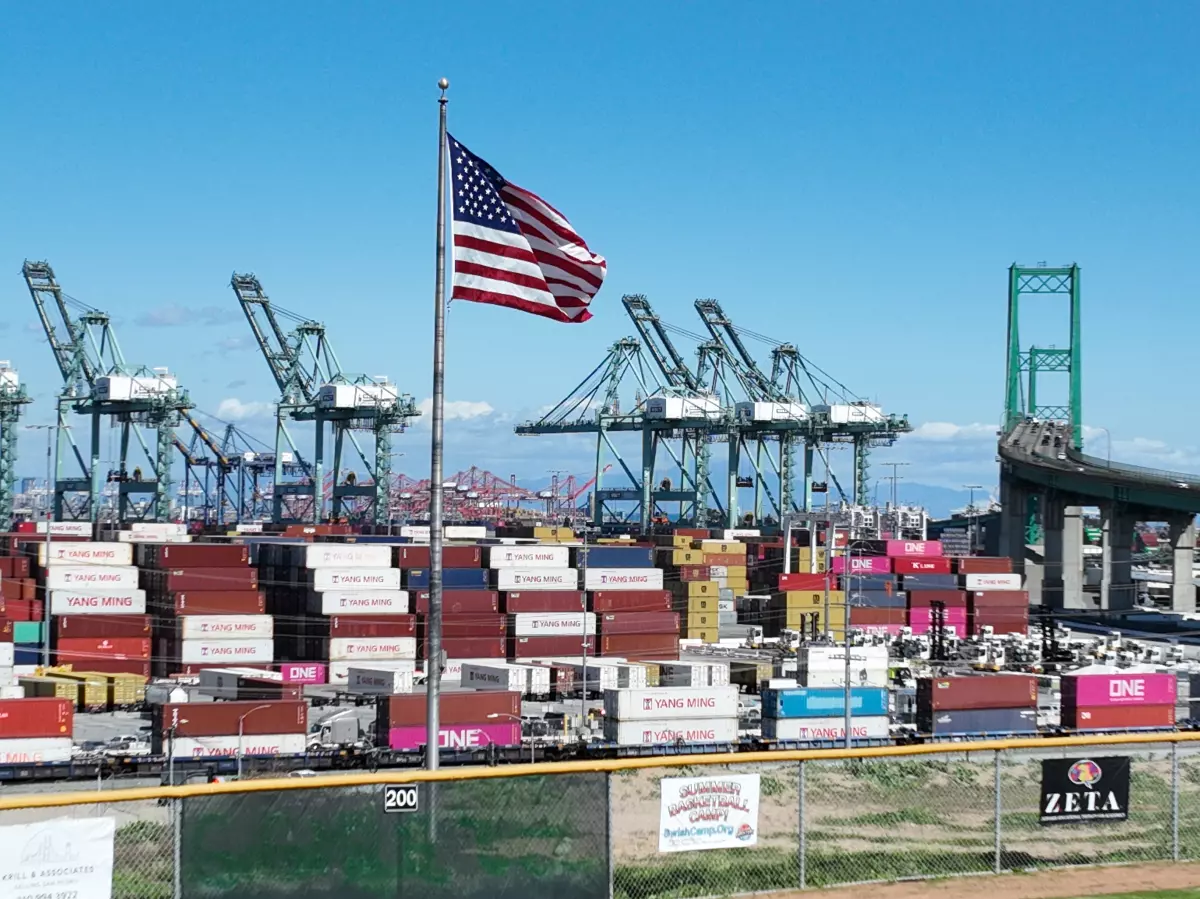
The Port of Los Angeles alone supports 136,000 jobs in the city. The combined Port of Los Angeles and Port of Long Beach support 186,000 jobs in the Los Angeles/Long Beach area. 

California Gov. Gavin Newsom on Wednesday announced a lawsuit contesting President Trump’s executive authority to enact international tariffs without congressional support, which he likened to the commander-in-chief taking a “wrecking ball” to America’s global reputation.

The legal action argues that the International Emergency Economic Powers Act that Trump cited to impose tariffs does not grant the president the ability to unilaterally adopt tariffs on goods imported to the U.S. The suit from California is the first challenge from any state against Trump’s trade policy.

California’s legal case rests on an argument that the International Emergency Economic Powers Act, which specifies the actions the president can take if he declares a national emergency in response to a foreign national security, foreign policy or economic threat, does not give Trump the authority to enact tariffs.

“The reality is the U.S. Constitution gives Congress the power of the purse,” Bonta said. “It’s Congress’ responsibility to set and collect taxes, duties and excises, including, yes, tariffs, not the president’s. Congress hasn’t authorized these tariffs, much less authorized imposing tariffs only to increase them, then pause them, then imminently reinstate them on a whim, causing our nation and the global economy whiplash. Trump is attempting to override Congress and steamroll the separation of powers.”

The tariffs appear to be on weak legal ground, given the president’s decision to rely on the International Emergency Economic Powers Act, said Stratos Pahis, associate professor of law and co-director of Block Center for the Study of International Business Law at Brooklyn Law School.

Donald Trump, an unsuccessful business man, with a high approval rating by the public, is destroying America’s economy and the G.O.P. is bowing to his wishes.

The question is where the people needed for all those manufacturing jobs come from?

War Means Jobs and Profit

Daddy Warbucks couldn’t be happier.  800 people are working at a factory in Lima, Ohio that rebuilds Abrams tanks and “is building 15 to 20 armored vehicles per month, including tanks, it can easily boost that to 33 a month and could add another shift of workers to build more if needed.” Those numbers are reported in an AP article appearing in the LA Times.

I know we need to support Ukraine with military hardware but is that number 15 to 20 vehicles?  Why?  I understand providing munitions but this article was about hardware.

“Part of it is figuring out … what’s the best one that can allow us to get the Ukrainians tanks in as timely a fashion as we can” without disrupting foreign military sales, said Secretary of the Army Christine Wormuth.

Sales to who is my question.  I Googled for the answer. U.S. arms exports in 2021, by country

  Saudi Arabia1389
Australia   Qatar   Japan   United Kingdom 4 countries929   906   875   875
South Korea646
Netherlands586
Israel550
Norway                                                                                         455
India  425

United Arab Emirates                                                                 274

Denmark                                                                                    226     

Italy                                                                                      214    

The plus to this situation is the are 800 American families with good incomes.  General Dynamics is earning a good profit for every unit they deliver.  A few other companies like Lockheed Martin and Raytheon are also the beneficiaries of the war machine.

Incidentally if you don’t get it, Daddy Warbucks was a character from the classic comic strip Little Orphan Annie and the stage musical based on it.  He was a war profiteer (someone who makes money through military contracts).

Last call for these cars

It’s all about demand.  The Chevrolet Cruze and the Chevrolet Volt have been on the market for a very short time but apparently never met public approval.  Kelly Blue Book (an expert on car pricing and quality reports that these cars will not be produced in 2020.  Should we care?

VW Bettle 2019

Buick Cascada
Cadillac CTS
Cadillac ATS Coupe
Chevrolet Cruze
Chevrolet Volt
Ford Taurus
Ford Fiesta
Lincoln MKT
Volkswagen Golf Sportwagon
Volkswagen Beetle

Robots are coming. A quarter US workers at risk!


As reported in USA Today one man is sitting “alone atop a tractor with a specialized mechanical attachment” that now performs the work of 30 people.

The Los Angeles Daily News reported “Members of the longshoremen and warehouse workers union picketed outside a meeting of the L.A. Board of Harbor Commissioners Thursday morning, Jan. 24, protesting the approval of a permit that will allow a major terminal operator to increase automation at the Port of Los Angeles.”

According to a new Brookings Institution report one fourth of all jobs in this country are at risk due to automation.

Without a job what will those people who lack the capacity to learn complex job functions do?  This will most likely be a world wide problem.  We as a nation will not let them starve.  Most likely more people will be on a welfare program.

This won’t happen in 2019 but the structure of our society will be changing before this century is over.

America’s Economy is Booming

Now that Donald Trump has been president for over a year he gets the credit for what happens to the United States economy. Good or bad he will be blamed or honored. 

As it stands today that makes his presidency a success.  Despite a recent decline the stock market has reached new highs, car sales are high, and job growth has gone from quite good to very good.  Tax cuts have put more money in everyone’s pocket.

313,000 jobs were created in the month of February 2018. This is not fake news.  This is a report from the Bureau of Labor Statistics that was released today.

Trump’s primary reason for giving him your vote was that he would bring back jobs.  He appears to be on track to fulfill that campaign promise.

Democrats may believe they have a chance of winning control of the House of Representatives in November but that has to be based on Trump’s personal behavior, his continued support of the NRA, and his support of White nationalist groups.  While those are upsetting issues, “It’s the economy, stupid” coined by Bill Clinton strategist James Carville still is the primary issue.  It still holds true today.

The Democratic Party has not been the friend of labor.   They talked a good game as the United States was overwhelmed with low cost imports that drove out car manufacturing to garment manufacturing to electronics manufacturing.  Your iPhone is made in China and Bangladesh and China probably made most of the clothes you wear.  

If the GOP holds both houses of Congress in this fall’s election be prepared for even more changes to American life.

America’s Car Sales

I continue to be a fan of midsized sedan automobiles. They offer enough space to provide comfortable accommodations for four people and with a little squeezing accommodate three people in the back seat along with a trunk that will hold two large suitcases for travel.

I don’t have to climb into sedans as I must if I drive an SUV or crossover vehicle. I can slide into a car with ease. So it is surprising to me that those SUVs or crossovers are now more popular than cars.

The other thing I find surprising is that American brands are not the big sellers. Could it be that Americans prefer quality over brand? Obviously the answer is yes.

Sales of midsized cars for the first 8 months of 2017.


Toyota Camry          247,775        Market share 20%

Honda Accord         221,013         Market share 18%

Nissan Altima          183,292         Market share 15%

Ford Fusion            138,489          Market share 11%

Chevrolet Malibu     117,173         Market share 10%

Hyundai Sonata        97,929         Market share   8%

Kia Optima                74,722         Market share   6%

Volkswagen Passat   45,994        Market share   4%

Subaru Legacy          33,559        Market share   3%

Mazda 6                   24,814        Market share   2%

Chrysler 200             16,562        Market share   1%

Buick Regal                 8,288        Market share >1%

All Others                   1,122        Market share >1%


Toyota’s U.S. sales chief, Bill Fay, said consumers’ shift from cars to SUVs is one of the most dramatic the industry has ever seen. Three years ago, trucks and SUVs represented 50% of the U.S. market. They closed 2016 at 63% of total sales, and analysts don’t see that changing anytime soon. Boomers and millennials both like the space and the higher ride that SUVs offer, and improvements in fuel economy make them competitive with cars. The Honda CR-V was the bestselling SUV in the U.S. last year, with sales up 3% to 357,335.

Obviously I am in the minority.                        

What’s Wrong with California?

To answer the title question: Nothing!

The talk at some discussion groups that I attend revolves around the argument that California and especially Los Angeles is on the verge of collapse due to high taxes, high public debt, and a significant loss of private enterprises moving to other states. That perception is not in keeping with reality.

For the most part Californians accept the multi-ethnic makeup of the society. Thus we find large populations of Asians and Hispanics throughout the state. The Los Angeles LGBT Center is one of the largest and most experienced providers of LGBT health and mental healthcare, supported by a research team working to advance the care and treatment of lesbian, gay, bisexual, and transgender people.

California alone as a nation would economically be the 6th largest economy in the world. The five ahead of us are the U.S., China, Japan, Germany and the United Kingdom. The U.S. Bureau of Economic Analysis reported that California’s GDP was $2.5 trillion in 2015, up 4.1 percent from a year earlier.

California is the largest producer of Pima cotton in the United States. The California cotton industry provides more than 20,000 jobs in the state and generates revenues in excess of $3.5 billion annually.

California is largest producer of fresh vegetables in the United States says the US Department of Agriculture. California strawberries are found in the markets of Toronto Canada.

Industry Week lists the 500 largest U.S. companies each year. Last year California surged ahead of Texas, 64 companies to 55. By revenue, the biggest manufacturers in California together contributed $881 billion to the state’s coffers, while the biggest in Texas contributed $847 billion. There is not one other state that employs over 1 million people in manufacturing. Texas at 750,000 is in second place. This is US Census data.

40% of all imports and exports of the U.S.A. are moved through the Los Angeles/Long Beach harbor facilities. This figure does not include goods that are shipped by air cargo.

Speaking of air traffic, Los Angeles International Airport (LAX) is the third busiest in the United States.  That makes Los Angeles a major tourist destination. Santa Monica, Beverly Hills, Hollywood, and the amusement parks draw millions of people and that means thousands of jobs.

San Francisco and San Diego are major tourist destinations for the entire world.  Last year we stayed at the Fisherman’s Wharf Sheraton Hotel.  The desk informed me that their primary of guests comes from other countries.   

Los Angeles is a world leader in architecture. The Los Angeles Times this past Sunday (May 21, 2017) published a catalogue of 186 pages showing the works of major architect in this city. Titled DesignLA, it pictured the work of those talented people who include Frank Gehry.

As to education, California has some of the most highly regarded universities in the world. UCLA, USC, UC Berkley, Stanford, and CSUN are just the top of an outstanding educational system that draw thousands of students from around the world.

Silicon Valley and San Francisco are the heart of high tech for the entire world.  Facebook, Google, Apple, Tesla are the four most famous of those companies but there are many others as well.

Los Angeles is still home to important aerospace companies including JPL, Rocketdyne, and Space X. 

Los Angeles is the entertainment capital of the world. All the major movie studios are based in metropolitan Los Angeles. All television networks have large studios in Los Angeles.

New Jersey has the highest effective property tax rate at 2.38% and is followed closely by Illinois (2.32%), New Hampshire (2.15%), and Connecticut (1.98%). California is happily in 34th place with an effective rate of .81%. My source: https://taxfoundation.org/

California gasoline tax will be the highest in the nation thanks to the latest increase in that tax that will take effect November 1, 2017. This is clearly a serious mistake.

California state government bonds are rated AA- by both Fitch and Standard and Poor’s, Aa3 by Moody’s.

I have not even discussed the weather that is the most obvious reason there was a mass migration to California after WW2 and is still a major drawing point for so many in the rest of the United States. We moved from Philadelphia where you can rely on rain if you plan a picnic in the park and that is in the summer. Winters can best be described as miserable at best.

Evolution of American Industry

Valued at nearly $20 trillion, the U.S. economy is the largest in the world. Maintaining a competitive edge necessitates remaining diversified and dynamic. While this means that some U.S. industries thrive, others inevitably decline or are rendered obsolete.

As certain industries fade, so do hundreds of thousands of American jobs. 24/7 Wall St. analyzed employment figures from 2006 to 2015 from the Bureau of Labor Statistics to determine the 25 fastest dying industries. Employment in each industry on this list declined by at least 43%, and in the top two by at least 80%.

At least one of three broad factors is behind the decline in each of the fastest dying industries. The first factor is cost reduction. Cheaper labor abroad has caused many American companies to outsource manufacturing operations. In China, for example, the minimum monthly wage in the garment industry is less than $150 a month. Perhaps not surprisingly, the bulk of clothing Americans import was made in China.

Click here to see America’s 25 dying industries.

Click here to see America’s 25 thriving industries.

In addition to outsourcing, robotic automation in U.S. factories have hurt employment in manufacturing. The sector has shed nearly 2 million jobs in the past decade, a 12.8% decline. Of the 25 fastest dying industries, 10 are in the manufacturing sector, and seven of those are related to clothing and other textiles.

The second cause for massive employment declines in certain industries is the wide adoption and exponential growth of new technologies. Online streaming services and on-demand programming are largely responsible for the 61% employment decline in DVD and video tape manufacturing and the 89% decline in the video rental industry. Similarly, the proliferation of cellphones and smartphones has greatly reduced employment in both telephone manufacturing and photofinishing, industries where employment has declined by 51% and 60%, respectively.

Finally, broad macroeconomic conditions have also contributed to lower employment in many industries. Most notably, within the last 10 years, the subprime mortgage crisis and resulting recession have contributed to a considerable drag on construction. Since 2006, new home construction has declined by 51%. Over the same time period, the broad construction sector has shed over a million jobs, or 15.3% of total employment. The land subdivision and framing industries were hit especially hard, with employment declining by 57% and 55%, respectively.

To identify the dying industries, 24/7 Wall St. reviewed employment growth from 2006 through last year for 704 U.S. industries in the fourth level of detail in The North American Industry Classification System (NAICS) by the U.S. Census Bureau. All data, including the number of establishments within each industry, average weekly and annual wages, as well as breakouts of these data over government, private, and local levels were retrieved from the U.S. Bureau of Labor Statistics’ (BLS) Quarterly Census of Employment and Wages (QCEW). The BLS tracks industry employment by tallying the number of workers in establishments whose primary sources of revenue fall within a given industry. As a result, a given establishment along with all of its employees may be reclassified depending on business decisions and market performance. For the finance and insurance industry, where the primary source of revenue for a fund, trust, or financial vehicle can change from a single trading decision, industry employee counts may not be comparable from one year to the next. To help ensure that 10-year employment changes reflected natural growth, all industries related to the management of funds, trusts, and other financial vehicles were excluded.

This is not the kind of data Donald Trump wants to see.  He, along with millions of people who have lost their jobs, does not want to face the realities of a world economy.  Instead of working to retain outdated technologies the US government should be spending its time training the population in technologies of the 21st century.  We have the money to change but we lack the will.

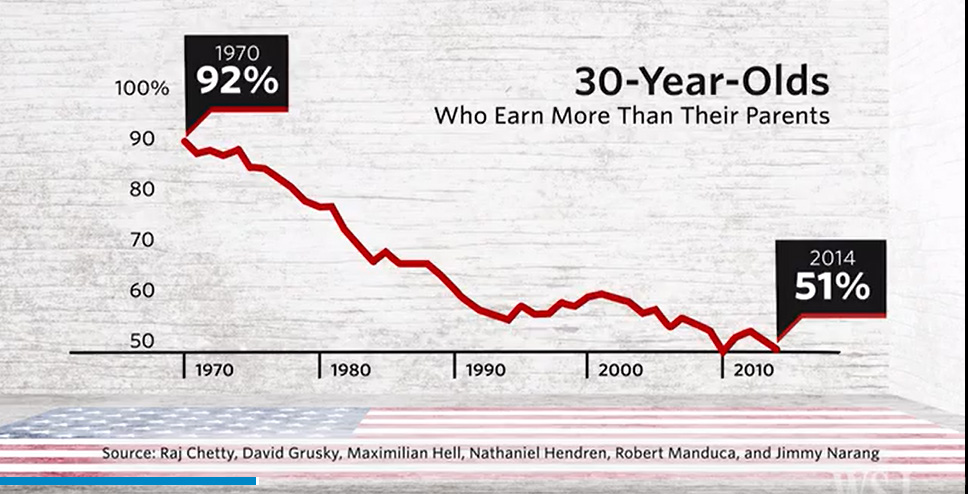
Barely Half of 30-Year-Olds Earn More Than Their Parents

Sorry, Young People: You Probably Won’t Make as Much Your Parents Did

As wages stagnate in the middle class, it becomes hard to reverse this trend

From a report in the Wall Street Journal dated December 8, 2016.   Barely half of 30-year-olds earn more than their parents did at a similar age, a research team found, an enormous decline from the early 1970s when the incomes of nearly all offspring outpaced their parents. Even rapid economic growth won’t do much to reverse the trend.

30-year-olds-earning-less-than-their-parents

Wage stagnation has taken heavy toll since 1970s

“My parents thought that one thing about America is that their kids could do better than they were able to do,” said Raj Chetty, a prominent Stanford University economist who emigrated from India at age 9 and is part of the research team. “That was important in my parents’ decision to come here.”

What’s more, even if President-elect Donald Trump fulfills his promises of rapid economic growth, the trend won’t be reversed significantly. Even if income levels grew 3.8%, the percentage of 30-year-olds who out-earn their parents would bump up to just 62%, the Wall Street Journal reports.

The study was conducted by economists and sociologists at Stanford, Harvard and the University of California. They used tax and census data to compare the earnings of 30-year-olds starting in 1970 to that of their parents.

What the report does not do is explain why wages are stagnant. I will give you my take on this horrible reality. I did earn more than my parents but only because of inflation.

When I married in 1969 my salary was $10,000 per year. According to the United States bureau of Labor Statistics your income today, based upon the CPI Inflation Calculator, that salary equates to $65,866.  My father never earned that inflation adjusted salary.

There have been many reasons for the stagnant salaries.  Three come to mind almost immediately. 

First management earned ten to twenty times the average income of most employees in the earlier parts of the 20th century.  Today management earns 200 to 300 times the average income of most employees.

Second many jobs have been outsourced other countries.  That has resulted in more potential employees seeking the remaining jobs.  Thus with more people looking for work employers can push down the pay they have to offer.

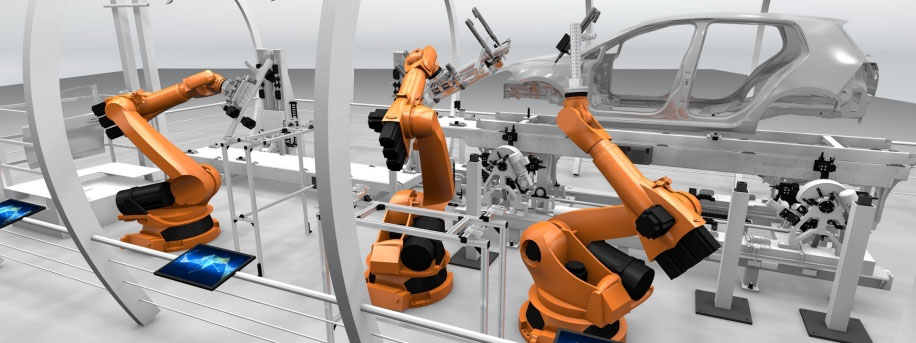
Third, many jobs have been automated thanks to artificial intelligence (AI), and computerization.   Have you seen the inside of an auto manufacturing facility?  Automation has eliminated many jobs from welding to painting.  Warehouses are now so automated that less material handlers are needed.  Office workers, I am one of them, now have computers that perform many of the manually performed functions that were done using typewriters and spreadsheets. That too reduced manpower needs. Less manpower translates to an oversupply of workers and that translates to lower pay. It is all about supply and demand.

It is unlikely that any government of any political party will change this trend.  I hope I am wrong.

The Greatest Concept Cars of the 1950s

In the 1950s, the American economy was booming, the suburbs were sprawling, and automobiles took on newfound importance. At the same time, inventions, pop culture, and technological innovations touched our lives in new ways, from the Space Race and the credit card to the Barbie doll and beyond. With jet planes and research rockets soaring above us, not even the sky was the limit anymore.
Few objects of any sort embodied the spirit, the extravagance, and the confidence of 1950s America as well as the concept, or “idea,” cars displayed at the country’s auto shows and, in some cases, on its roads. Designers and engineers experimented with wild styling, clever features, and new solutions to old problems, some of which worked and some of which didn’t. The Jet Age was upon us, and the carmakers were not about to let us forget it. And so you don’t forget them, here is a collection of what we consider to be the greatest concept cars of the decade.

1951-gm-lesabre

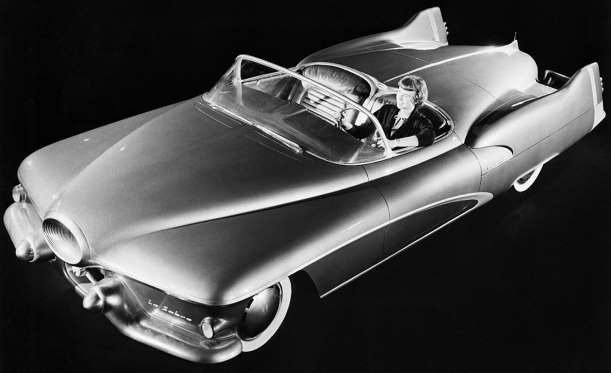
1951 GM LeSabre

No company put out more captivating concept cars in the 1950s than General Motors, in large part thanks to GM design boss Harley Earl, who dazzled the world in 1951 with the GM LeSabre. The LeSabre (a name not yet associated with Buick) captured the dawning Jet Age from every angle, starting with the protuberant center grille that concealed twin headlamps. Its distinct, fuselage-like upper body contours flowed all the way to its afterburner-like center taillamp, all flanked by low and wide fenders and tailfins sprouting from its outboard flanks. The latter theme continued to define the era. The LeSabre was a runner, too, powered by a 335-hp aluminum supercharged V-8 with a rear-mounted automatic transaxle. But unlike most concept cars that followed, the LeSabre was no trailer queen: Earl used it as his everyday ride for a few years, ultimately putting 45,000 miles on it. Strong public reaction to the LeSabre helped convince GM to include concept cars in its famous Motorama traveling car shows of the 1950s.
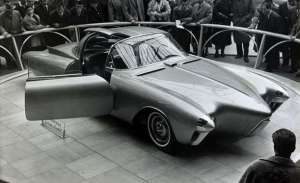
1956-oldsmobile-golden-rocket 
1956 Oldsmobile Golden Rocket

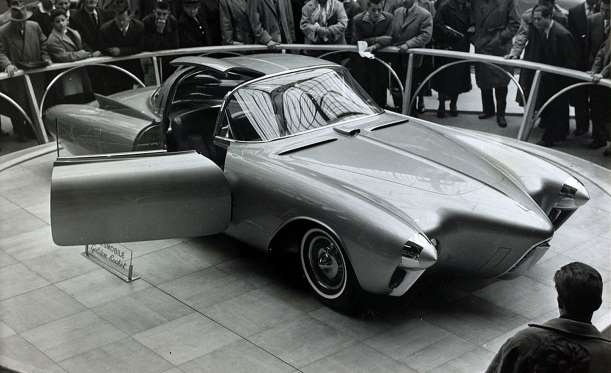
Oldsmobile was a powerhouse in the 1950s, and its shark-nosed Golden Rocket concept, which made the rounds as part of 1956’s General Motors Motorama, showed how ambitious the brand was. Decidedly sporty, if a little strange-looking with its round headlamps tucked between the skinny grille and high-set, missile-like fenders, the fiberglass-bodied Golden Rocket could have outaccelerated a Corvette at the time, thanks to its 275-hp V-8 and lithe 2500-pound curb weight. Sadly, few of its nifty styling features made production, save for the wraparound split-rear-window treatment, which appeared on the 1963 Corvette. As fast as it was, its luxury features were equally interesting, including a power-tilting steering column, seats that automatically raised and swiveled out when the doors opened, and twin roof panels that tilted upward to facilitate ingress and egress, adding even more drama to arrival.

 1954-lincoln-futura
1954 Lincoln Futura

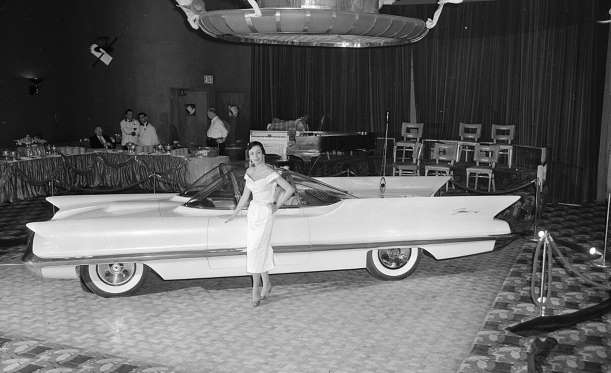
Italian coachbuilder Ghia kept busy in the 1950s and built the gorgeous Lincoln Futura in 1954 for display at the 1955 Chicago auto show. The Futura’s furrowed brow was the most consequential styling element as far as Lincoln was concerned, but the car itself became a cultural icon more than a decade later when, in 1966, it was given a batlike face, fluted fins, and black-and-orange paint, becoming—you guessed it—the Batmobile for the Batman series. Fifty years later, it remains one of the most famous and beloved automobiles in history, selling at auction in 2013 for $4.6 million.
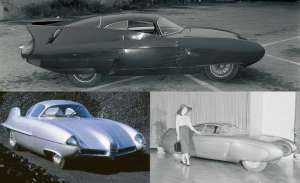
 1953-1954-and-1955-alfa-roneo-b-a-t-cars
1953, 1954, and 1955 Alfa Romeo B.A.T. Cars

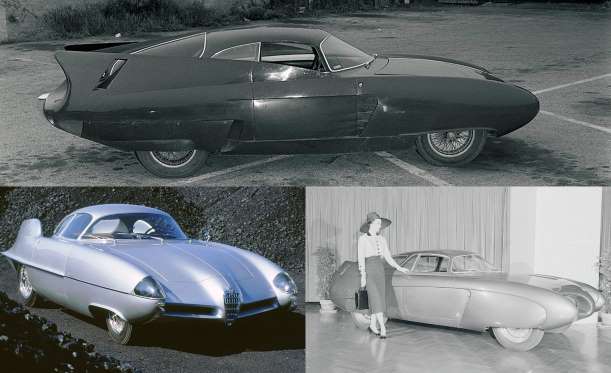
Concept cars weren’t just an American thing. In the early 1950s, Alfa Romeo commissioned its fellow Italians at the Bertone design house to assist its aerodynamic research efforts. The collaboration resulted in three amazing B.A.T. (Berlinetta Aerodinamica Tecnica) concept cars: B.A.T. 5, B.A.T. 7, and B.A.T. 9. No relation to Bruce Wayne’s favored ride, Alfa’s trio appeared in successive order at the 1953, 1954, and 1955 Turin auto shows brandishing tapered greenhouses, curved fins, and fenders that were covered in smooth bodywork. Each car looked more producible than the one before it, but they were never built for customers. They did, however, help Alfa Romeo gain a better understanding of aerodynamics, with the best one claiming a heroically low 0.19 drag coefficient, a figure achieved only by the GM EV1 and the Volkswagen XL1 in modern times.
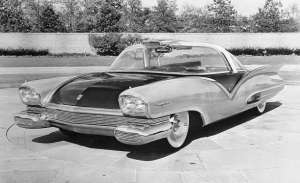
 1955-ford-mystere
1955 Ford Mystere

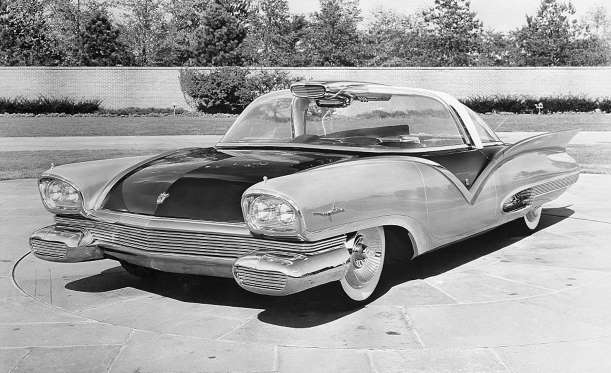
With its one-piece glass roof, forward-thrusting front fenders, and dual afterburner taillamps, the Ford Mystere could hail from no other time than the 1950s. The Mystere’s four passengers would enter and exit through the rear-hinged swing-up canopy, with the overhead scoop providing much-needed ventilation considering how much sunshine the cabin would get (and that there was no way to open the glass). Intended for a gas-turbine engine mounted in the back, the Mystere is said to have arrived at the 1956 Chicago auto show unable to move under its own power. It also supposedly had a radio telephone between the front seats and an aircraft-like “throw over” steering system that could be moved for operation from either front seat.

 1956-1957-chrysler-dart-diablo

1956–1957 Chrysler Dart/Diablo

Of the numerous Chrysler/Ghia collaborations of the 1950s, the 1956 Dart/Diablo was arguably the greatest. This concept was built on the chassis of a 1956 Chrysler 300 and was originally dubbed the Dart, featuring a low, ovoid, horizontal grille rendered in chrome that streaked all the way down its clean, unadorned body sides. With its smooth body and inset wheels, the Dart was extremely aerodynamic, so gigantic fins were used for stability as well as style. It originally featured a trick, if unreliable, retractable hardtop that slid back in three positions—sunroof, landau, and fully retracted—but in 1957 it was sent back to Ghia, where the elaborate roof was swapped for a more conventional ragtop and the tailfins were shaved down to more relatable proportions. Thus equipped and renamed the Dart Diablo, the nearly 21-foot-long show car was shown to the public at the 1958 Chicago auto show. In 2013, it sold at auction for a cool $1.4 million.