Robots Are Coming For Our Jobs

This is not an April Fool’s Joke!

Donald Trump and Bernie Sanders may say that they want to help the blue collar, working class, and middle class income Americans but neither has a solution for the oncoming displacement of most laboring and office jobs as wells as many technical jobs.

Japan is number one in the world in operational robots with 310,508 units. There’s even a hotel staffed almost entirely by robots that opened last year in Nagasaki, Japan, according to BAML (Bank of America Merrill Lynch). The United States is in second place (168,623) with Germany in a close third place. This was reported just today on Business Insider.

Coincidentally the Los Angeles Times had an opinion piece in today’s paper that starts with the words “A viral video released in February showed Boston Dynamics’ new bipedal robot, Atlas, performing human-like tasks: opening doors, tromping about in the snow, lifting and stacking boxes.” That article refers to a White House report that says “Most occupations that pay less than $20 an hour are likely to be automated into obsolescence.” Powerhouse consultancies like McKinsey & Co. forecast that 45% of today’s workplace activities could be done by robots, AI or some other already demonstrated technology. Truck drivers and baristas will be replaced too. Some professors argue that we could see 50% unemployment in 30 years.

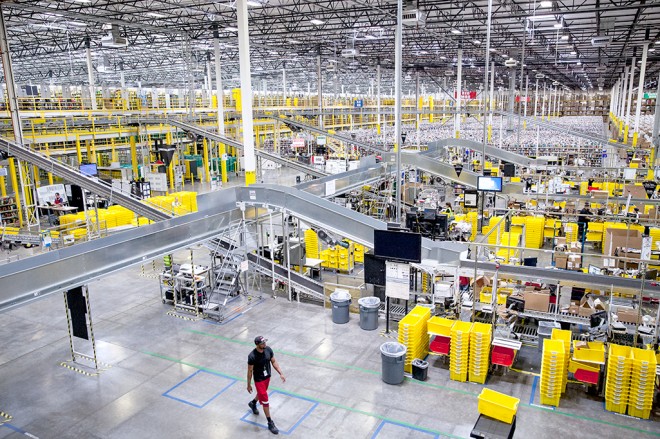
AMAZON-PHOENIX-WAREHOUSE

A rare peak inside Amazon’s massive wish-fulfilling machine

We think we have problems now but a coming so-called Fourth Industrial Revolution will bring changes to society that most of us have yet to imagine.

Auto Manufacturers Cannot be Trusted

Once again we have been reminded that auto manufacturers cannot be trusted. Remember that fact when you shop for your next car.

I always held Toyota in the highest regard. I used Toyota as a standard when urging my employees to do their best. I would say, “I want Toyota quality.” Those were my words in the 1980s and 1990s, well before Toyota’s developed an acceleration problem that cost lives. In my opinion there has never been an adequate explanation of the cause of that problem. Toyota ended up paying out a staggering $1.3 billion to settle lawsuits related to unintended acceleration, and in some of those cases the drivers were probably at fault.

General Motors kept quiet about the ignition switch that would shut off while their cars were in motion. That too cost lives. 13 people died. Almost 780,000 Chevrolet Cobalts and Pontiac G5s were recalled and the company paid a $35 million fine. What is sad is that it would have only cost 57 cents to fix each faulty ignition switch.

Now we have the VW installed software that masks the real performance of its diesel cars. There is no direct impact on the buyers of the cars but the company and its dealers will notice a substantial decline in sales.  The company management is to blame for this stupid decision.  20% of German exports are cars shipments.  Imagine what the impact will be on German factories.

How many other industries lie about their products?  

The United States is the Arms Maker for the World

When you want the very best in military hardware buy American. Ours is the highest quality and most reliable. Our arms are the equivalent of Lexus, BMW, and Mercedes Benz high quality cars.

President Dwight Eisenhower famously warned the U.S. about the “militaryindustrial complex” in his farewell address. To this day armament manufacturers have provided thousands of well-paying jobs to Americans. With the wind down of the wars in Iraq and Afghanistan and reduced military budgets there has been a significant reduction in those arms purchases.

The Los Angeles Times reports that “Three days after the U.S. fired 47 cruise missiles into Syria last week, the Pentagon signed a $251-million deal to buy more missiles from Raytheon Co.”

Thanks to the president’s “no boots on the ground” plans we are all happy to know that our children will have limited exposure to the Middle East war zone.

Why are we in this war at all? Congress won’t vote money for America’s infrastructure or other domestic spending proposals. However, given any threat abroad and the need for more jobs at home, why not keep shooting those GPS guided bombs? After all the cost of those guidance systems is a mere $25,000 each.

Make war, make money, and no boots on the ground. Perfect! Something both Democrats and Republicans can both agree on.

The militaryindustrial complex is alive and well.

Another Sad Military Adventure for the U.S.A.


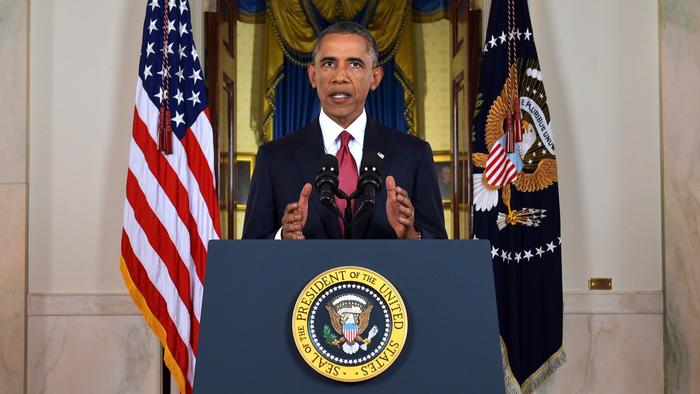
obama-address 09-10-2014

Our president has succumbed to the war mongers.

President Obama’s speech to destroy ISIS (or ISIL) was for the most part excellent. The latter part of the speech where he spoke of the United States recovering from the Great Recession was irrelevant.

He told us his plans to accomplish the goal. He placed only one condition on those plans. There will be no American army doing the ground fighting. Without spelling out every detail he implied that American forces would be used in Syria.

I have one big problem with this military adventure. The president did not tell Americans why we need to be involved in the effort. Other questions:
• Where is the evidence that America will be attacked if ISIS is not destroyed?
• What interests of the United States will be effected by the rise of ISIS?
• Who will do the ground fighting if it’s not Americans?
• How can we rely on the Iraqi army when they dropped their weapons and ran away in the face of attack by ISIS?
• Why hasn’t the Arab League lead this fight?
• Given our track record in the Middle East, why will the outcome of this war be any different?
• When will we know we have won the fight?

Two things we can be sure of is that the manufacturers of military hardware will be earning more money and American lives will be lost.

California set for more exports, strong manufacturing


Los Angeles Harbor
Los Angeles Harbor

Click on above photo to see a full screen view of ship unloading operations

The outlook for growth in California is optimistic, according to a Beacon Economics report predicting expansion in manufacturing and exports and a job market recovery driven by more than low-wage work.

The report, conducted for City National Bank, notes that 56% of new jobs created in the state in the last year are in industries with average annual wages above $50,000. Most of those positions, according to the report, are full-time.

The findings seem to challenge other economists’ assertions that wages aren’t keeping pace with the job recovery. More low-wage positions will be created or opened by 2020 in Southern California than will mid-level or high-paying jobs, according to the Center for Continuing Study of the California Economy.

But according to Beacon, employers in the professional and business services field added 24,300 new jobs statewide since the fourth quarter. That’s more than half of the 44,200 net nonfarm job gains made in the state in the same period.

That’s more than half of the 44,200 net nonfarm job gains made in the state in the same period. The industry pays $29.11 an hour on average as of May, according to the Bureau of Labor Statistics.

The Beacon report also said that California’s 1.2% job growth in the first quarter trailed the 1.5% nationwide rate.

But Los Angeles and Orange counties each created 12,200 new jobs in the first quarter, helping pull the statewide unemployment rate down 0.3 percentage point from the fourth quarter to 8.1%.

And the Central Valley, often maligned as an economic dead zone, is showing surprising strength, according to Beacon.
The south San Joaquin Valley, which includes Fresno, Tulare and Kern counties, has boosted nonfarm employment by more than 50% in the last 25 years. The population has also swelled at nearly double the overall state rate.

The workforce participation rate in the state ticked up to 62.6% from 62.4% the previous quarter and the proportion of people working part-time due to economic reasons fell 0.6 percentage point to 6.8%, according to the report.

Beacon added that California’s growth slowed slightly in the first quarter due to the frigid, stormy weather bedeviling the rest of the country earlier this year.

Real gross state product, a metric of economic output, grew just 2.8% after surging 4.2% during the fourth quarter, according to the report. But manufacturing, thought by many experts to be a shriveling industry, continues to support a generous portion of the California economy.

The state is responsible for producing a quarter of the computers and electronics made in the country, according to the report. The products, which constitute nearly half of all California manufacturing output, are centered in Silicon Valley and, to a lesser degree, in the Los Angeles metropolitan area.

Beacon estimates that exports leaving California rose 2.8% in the first quarter from the fourth. The effects of a weak dollar, slower growth in China, Europe shaking off its recession and Japan emerging from a decade-long stagnancy will likely propel increasing outbound trade for the rest of the year.

Copyright © 2014, Los Angeles Times

Los Angeles Harbor


Free Trade Brings Creative Destruction

The Trans Pacific Partnership (TPP) is a brainchild of Barack Obama.  Consider this posting I made on February 22, 2014.

Creative destruction occurs when something new kills something older. A great example of this is personal computers.  Free Trade is another example.

NAFTA was President Bill Clinton’s naive plan to increase American trade while helping our neighbors.  It has not worked out as promised.


Mexico becoming a driving force in auto production

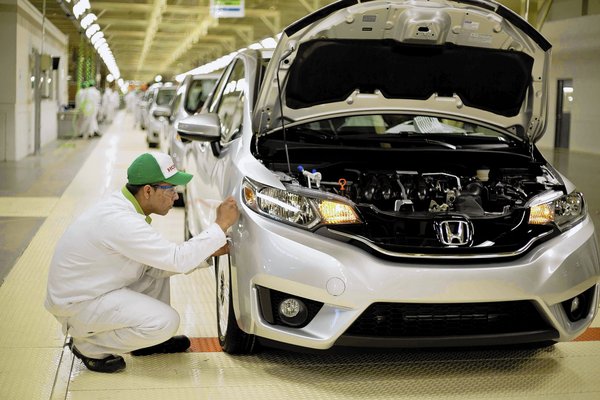
Honda Fit rolls off the assembly line at a new $800 million factory near Celaya, Mexico

Mexico, with its low labor costs, has been the beneficiary of the free trade agreement.  More products have entered the United   States from Mexico than ever before.    In 2013, according to our census bureau, $226 Million in products were exported and $280 Million were imported.  That number is on a path to increase dramatically over the next few years.  The reason is that Mexico has become the assembly floor for many products made in other countries.  The Los Angeles Times article titled “Mexico becoming a driving force in auto production” tells of the average hourly labor cost in their assembly plants of $8 versus an average hourly rate in the United States of $37.  These are the kinds of pay rates that drove American manufacturers to southern states in the USA.

What is the United States doing about this financial advantage?  Nothing!  Rather, the president of the United States, the Prime Minister of Canada, and the President of Mexico have just had meetings in Mexico at a town named Toluca (home of the Fiat 500 assembly plant), near Mexico City, discussing ways to further the NAFTA agreement.

Barack Obama claims to be concerned about the poorest in our nation and enhancing middle class opportunities.  How are more free trade agreements bringing jobs to the non-tech workers that assemble cars, refrigerators, and televisions?  They are not.  It’s creative destruction at work.

Where the jobs are

When I post a column it does not receive the attention of a recognized commentator. Perhaps this piece appearing in today’s print edition of the Los Angeles Times will make the desired impression. This isn’t something new. I have posted the same observations. I am just not as creative a writer.

Jeff Danziger is a political cartoonist and author of “Rising Like the Tucson,” a novel about the Vietnam War.

By Jeff Danziger
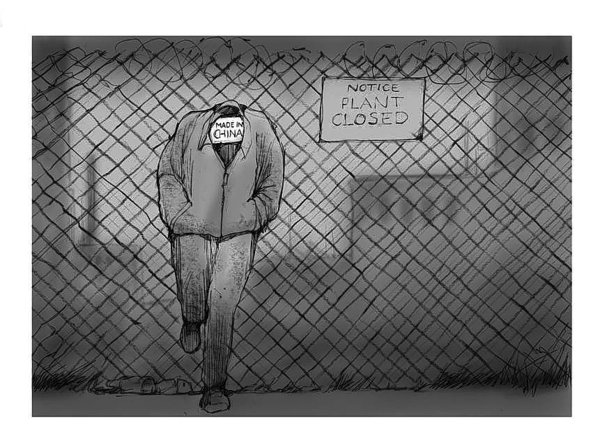
LA  la-oe-0102-placeholderBillions of workers around the world now compete with American workers to make stuff and offer services. (Jeff Danziger / For The Times / December 31, 2013)

January 2, 2014

Yes, there’s an explanation for why the U.S. is choking on the dust of China, India and others. But break it to the kids gently.

A friend recently got stuck when he tried to explain to his son, who was struggling to find a job, how our economy got to be the way it is. He asked my help since I am a well-known crank on the matter. I offered him three short anecdotes:

Last summer I was in a Home Depot standing in front of a veritable mountain of new air conditioners. They were all from China, which was no surprise. But to be annoying I asked a passing clerk where they were made. He was a young man, hired more for the spring in his step than his knowledge of international sourcing. We both looked at the boxes, piled in a pyramid, eight levels high. The boxes didn’t say anything about China. But they did say “Made in PRC.”

“Are these from China?” I asked.

He paused a moment. “No, they’re from Puerto Rico.”

Or consider this example from last month: A textile factory in Italy caught fire and seven workers were killed. They were all imported Chinese nationals working for Chinese companies operating in Italy so they could put a “Made in Italy” label on their cloth.

A third example: The city of New York decreed a few years ago that each bedroom in the city must have a carbon monoxide detector. There are roughly 11 million bedrooms in New York City, so the law created a huge market. Further, the devices have a life of five years, after which they must be replaced, so the continuing market was also guaranteed. A manufacturing enterprise could hardly find a surer customer base.

But was there a rush of companies here in the United States gearing up to manufacture 11 million devices for this guaranteed sale? No. Almost all the detectors were made in China or Taiwan.

Over the last 20 years, countries around the world have ditched their communist governments, or at least turned their backs on strict communist economic principles. At the same time, India and other Asian nations have rapidly moved into global trade. This has meant billions more workers around the world competing with American workers to make stuff and offer services. At the same time, shipping has become more efficient and economical, and international communication has become cheap, instantaneous and simple. And since the international workers are willing to accept extremely low wages, they have the advantage. Around the world, subsistence farmers have transformed themselves into subsistence factory workers.

And during this entire period, what did the United States government do to meet this challenge? Nothing. Our clueless, bellowing national leaders from both parties took no action to meet the effect of this new competition. Many American companies embraced the changes, happy to make profits off underpaid Asian workers while allowing huge swaths of American industry to die.

Two observations are often made to justify this disruptive period. The first is that the situation is an inevitable outgrowth of globalization and natural economic laws. In this scenario, nothing that the foreign manufacturers have done to U.S. workers differs from what American manufacturing did to the older economies in Europe. Lower costs and cheaper goods will always gain market share. Sometimes that share will be 100%.

A second explanation holds that what we are seeing is the necessary cost of the death of communism. Under this logic, communism was held in place by violence and oppression, and sooner or later it would have to be maintained by wars. Countries that depend on each other economically are less likely to go to war, not wanting to fight with their customers or suppliers. Thus the resulting pain of unemployment is preferable to wholesale conflict.

But are those two observations valid? To assess them, we have to understand our history. War, it is said, is God’s way of teaching Americans geography. Perhaps unemployment is how we learn economics. Are Americans, whose jobs have been shipped overseas, the walking wounded in the war against Marxist totalitarianism? That’s a stretch, but perhaps it will make lawmakers feel better when they vote to cut off unemployment benefits. If you’re keeping score, they can shout, capitalism has defeated communism. We won. Oh, by the way, don’t bother to show up for work Monday.

It’s hard to explain all this to younger Americans, who are generally a hopeful and cheerful lot. It means hinting that a great deal, maybe all, of what they have been taught so far in school is wrong, or at best useless. It means offering a full explanation of human nature, including its awful and miserable characteristics, its meanness and its fearful avarice.

That information is no fun to deliver. The worst human traits should be broken to the young in small pieces, so the facts can be digested and compared with what they already know.

My friend invited me over to talk to his son, suggesting I could explain the new economic realities more clearly than he could.

No, thanks, I said. He’s your kid. You do it.

http://www.latimes.com/opinion/commentary/la-oe-danziger-economics-manufacturing-20140102,0,5173795.story#ixzz2pHFEnMJ5
Military-Industrial Complex Equals Jobs

The 223rd and final C-17 cargo plane was delivered to the Air Force last week. The plane was manufactured at Boeing (the old Douglas Aircraft facility) in Long Beach, California.  That’s the last airplane manufacturing facility in Southern California.  The plant will be closed by 2015 and will result in the loss of 3,000 jobs.

Here is the problem. While Boeing cited sequestration, the Pentagon has made it clear for several years that it didn’t require more C-17s. However, lawmakers pushed through more orders to preserve jobs.

As reported in Businessweek, October 29, 2009, “Every year since 2006, the Pentagon has said that it has enough C-17s. And every year, Congress overrules the military and authorizes funds for additional planes. In October the Senate approved $2.5 billion in the 2010 budget for 10 more C-17s, which would bring the fleet to 215.”

The United States has created high paying jobs by ordering complex technology and other aerospace/biotech products from American companies.  To a great extent the military-industrial complex has been the driver of jobs.

We give $1.3 billion of aid to Egypt in the form of military hardware.  We even gave Russia $126 million in aid in 2010.

 Top Recipients of U.S. Military Aid, FY2010

Country $ U.S.   millions
Afghanistan

6,800.3

Israel

 2,799.5

Egypt

 1,301.9

Iraq

 1,006.0

Pakistan

 913.9

Jordan

 303.8

Somalia

 204.0

Colombia

 185.8

Russia

126.8

Sudan

104.9

Mexico

96.0

Poland

 55.6

Is this the only way we can provide our citizens with good jobs?

Saying Goodbye to the Middle Class

In 1914, Henry Ford started an industrial revolution by more than doubling wages to $5 a day—a move that helped build the U.S. middle class and the modern economy. After World War II the return of the GIs and the benefits they received prompted an educated society that wanted homes and cars.   Union jobs with good benefits along with little competition from other nations made the United States into an industrial power house that lasted for decades.

Then big business realized that there was an opportunity to save money by outsourcing the manufacture of the things we buy.  The government accommodated those businesses by negotiating free trade agreements with many nations.  Communications with the entire world became easier and cheaper.

People in the poorest nations of the world could be trained to operate the machines that made things Americans want to buy.  They would work for one fourth the rate of pay or less than American workers.

Today my computer, television, home theater, camera, and my clothes are all made in another country.  The people who used to make those things are now either unemployed or working in low paid service jobs (tourism, retail, fast food, and other jobs that pay less than $15 an hour).  The middle management jobs are now part of those outsourced functions.  Call the help line for Earthlink or Hewlett-Packard and you will be speaking to someone in India or the Philippines.

“A middle-age middle manager who was laid off is not going to be miraculously rehired in that position or anything like it. Same with the factory worker and the receptionist and the copy editor. They’re finished. Many of the people who held those positions have already pulled out of the workforce and others are moving into different jobs (often at lower pay levels)” writes Mark Lacter on LA Observed.

Do not look for Congress or any government agency to solve this problem.  They have no solutions.

Those desperate people who have taken jobs that pay half of what they previously earned are no longer part of the middle class.  Those that have not obtained any job at this point are living on their accumulated wealth.  Neither of those groups will be spending money as they had in the past.  Thus the bifurcated economy of the wealthy and the poor.  This means the end of the middle class in America.  That is the big picture.