Decline of Manufacturing Jobs in America

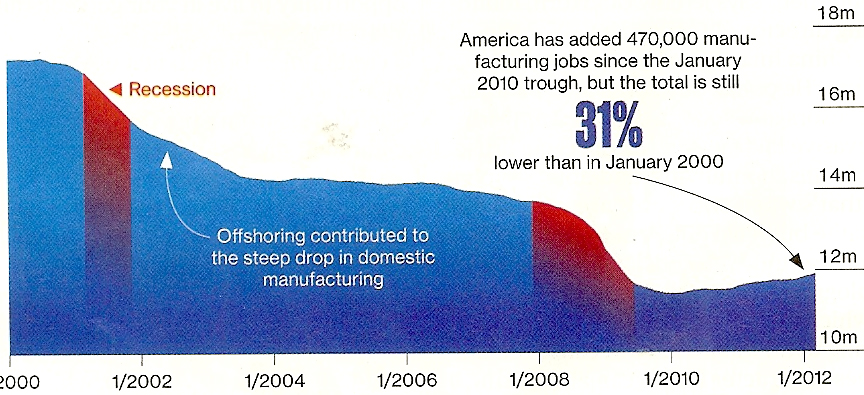
 The Long Goodbye: Number of U.S. Manufacturing Jobs

The graph was in Businessweek April 16-April 22, 2012.  It tells the story of the continuing loss of manufacturing jobs in the United States.  Those that believe that America will become a “service society” are in a dream world.  No nation thrives on services alone.  Actually we are already outsourcing many services to Asian countries.  Dell Computer, Citi Bank, Hewlett Packard, and the Los Angeles Times are just FOUR of the many companies that have out sourced their customer service.

Notice that this graph reflects what many of us already knew.  Decline in manufacturing has been a decades old event.

Finally Good News About Our Economy

I tried helping retail establishments in my area.  I told my wife she should buy the clothes she has delayed purchasing.  That will cost a few hundred dollars.  Then I went into Best Buy on Black Friday and ordered a new 50 inch television.

Not only was Black Friday a banner day for total sales but the unemployment rate dropped to 8.6% for November.  This is the lowest unemployment rate in two and a half years.

The higher sales even over flowed into car and light truck sales.  A local Ford dealer that claims to be the biggest sales company in the country, Galpin Ford, reported that their sales over the Thanksgiving Day weekend were five times the number of vehicles sold in 2010.  Look at these extraordinary national sales figures.

U.S.car and light truck sales for top 10 automakers

Nov. sales

Pctg. Change from   Nov.’10

Year-to-date sales

2011 share

GM

180,402

+7.0%

2,269,446

19.7%

Ford

166,441

+13.3%

1,933,654

16.8%

Toyota

137,960

+6.7%

1,466,530

12.7%

Chrysler

107,172

+44.5%

1,231,095

10.7%

Nissan

85,182

+19.4%

941,607

8.2%

Honda

83,925

-6.4%

1,042,055

9.0%

Hyundai

49,610

+21.8%

594,926

5.2%

Volkswagen

38,283

+28%

398,654

3.5%

Kia

37,007

+39.1%

442,102

3.8%

Mercedes-Benz

28,257

+46.7%

239,006

2.1%

Industry total

994,721

+13.9%

11,534,206

100%

Source: Autodata                                               from Los Angeles Times

Obviously no one knows if the optimism will continue but this sort of behavior is contagious.

There are some things to be concerned about.  First if we buy we do not save and that means less money for an emergency or retirement. Europe is in a financial mess and if it isn’t solved soon it will impact the United States.

Just for the month of December let’s all think positive and do positive things.  It just might change our behavior and attitude in 2012.

Consumer Reports Confirms Our Worst Fears

American auto manufacturers can’t build high quality cars.

The federal government’s aid to the American auto industry saved thousands of jobs.  That is a good thing.  Unfortunately the government has done a poor job of picking winners in the private industry arena.  Solyndra is the best example of a failed investment.  That project cost us $500 million.  The US government is also helping Tesla, the car company building an all electric car that costs over $100,000 each.

So it is no surprise that the American auto industry is failing to bring quality products to market.  It’s not news!  The best of the bunch is Ford that managed to get into the top 10 according to a Consumer Report subscriber survey.  That was last year’s survey.  This year Ford fell to 20th place.  The summary of results was printed in the Los Angeles Times.  These findings are based on responses on 1.3 million vehicles owned or leased by subscribers to Consumer Reports.

The top 10
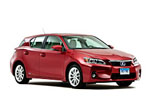
1. Lexus CT200h
2. Honda CR-Z
3. Infiniti QX56
4. Scion xD
5. Toyota Highlander (4-cyl.)
6. Lexus ES
7. Nissan Titan
8. Honda Fit
9.Toyota Prius
10. Toyota RAV4 (4-cyl.)
The bottom 10
1. Jaguar XF
2. Jaguar XJ
3. Audi Q5 (V6)
4. Chevrolet Silverado 2500
5. GMC Sierra 2500
6. Nissan Z
7. Volkswagen Routan
8. Ford Edge (AWD)
9. Mini Cooper Clubman S
10.Lincoln MKX (FWD)

Apple Plans To Invest In a Sharp Factory

Apple Inc. (AAPL), that is the company that manufactures iPod, iPad, and iPhone, has $76 billion in cash on hand.  That is more money than the GDP of 2/3 of the world’s countries.

Morningstar reported today that Apple will “invest $1 billion in Sharp’s Kameyama plant in Japan, without elaborating.  Their source is a Reuters news agency report.

One comment on this story read in part:                                                              “But not in the USA. Now, if we are talking about job creation tell us Mr. Jobs why Apple is not helping out. Surely we can make LCD screens here. Where is your corporate responsibility to country?”

A second comment contradicts the first saying in part:                                      “You can’t force (or expect) companies to accept lower returns due to patriotism, nationalism etc. Capital is portable, it is agnostic. It seeks the highest risk adjusted returns, just like water flowing downhill. The solution is creating an environment where Companies are better off investing here, rather than outside the country. There are tons of drivers for this, regulatory, legal, labor costs, tax, FX hedging etc.”

My opinion is both are correct.  We are faced with a conundrum.  A company’s first loyalty should be to its shareholders.  At the same time there ought to be some loyalty to your nation.  Here is perfect opportunity for the president of the United States to get on the phone and talk to the COO of Apple, Timothy D. Cook , and perhaps to Steve Jobs too.  “How can we induce you to bring jobs back to the States?”  A good negotiator could make some headway.  Perhaps the negotiator is the president’s chief of staff, Bill Daley, who is known to have excellent ties to the business community.

When Bill Daley is done talking to Apple executives he needs to move on to the leaders of other large American companies.

Bad News for the Unemployed

Businesses Use of More Automation means Fewer Workers

CBS Evening News featured a news item this past week about a Georgia factory, Impulse Manufacturing, that uses robots to do much of the welding, lasers to cut through sheets of steel, and computers to track productivity.  The owner, Ron Baysden, says a laser can churn out one part in 30 seconds — work that used to take 18 men and 30 minutes to complete.  He went on to say “A lot of my competitors did not survive 2009.  We survived because we spent a lot of money and investments in technology.”

Newsweek also had an article this week titled “Who Needs Humans?”  The article offered the same message.  The magazine provided these five situations that are humorous but ominous.

Librarian
A new library at the University of Chicago boasts a robotic system that can find and fetch books faster than humans can.

Bartender
Ohio’s Motoman Robotics sells a robot bartender called RoboBar that mixes drinks in less time than humans-and can crack lame jokes, too.

Taxi Driver                                                                                                  Google has been working on a car that can drive itself, and is asking the city of Las Vegas for permission to try it out as a taxi service.

Call Girl                                                                                                             Why hire an “escort” when you can buy Roxxxy, a sex robot by Bell Labs, who comes with lifelike skin and artificial intelligence?

Soldiers
The Pentagon is making a big push into robotic fighting systems, like the MULE, Lockheed Martin’s robotic truck that can fire missiles at an enemy.

Then there are the maquiladoras.  They are the manufacturing plants in Mexico located near the United States border.  They are located in many of the towns and cities from Tijuana to Reynosa and Rio Bravo.  Maquiladoras are owned by U.S., Japanese, and European countries and some could be considered “sweatshops” composed of young women working for as little as 50 cents an hour, for up to ten hours a day, six days a week.  Courtesy of NAFTA (the North American Free Trade Agreement), taxes and custom fees are almost nonexistent, which benefit the profits of corporations.

What is even more astonishing is that the Obama administration along with Republicans is planning to pass free trade agreements with Colombia, Panama, and South Korea.  They will create jobs.  The jobs happen to be in those countries, not the United States.  The explanation for this is simple.  Our elected officials want to be re-elected.  It’s big business that give the big donations. 
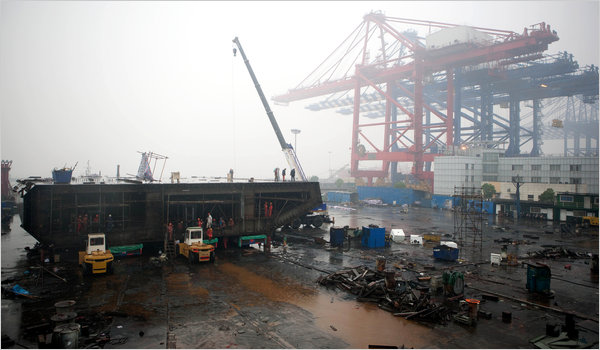
An American Bridge Made in China

Workers at Shanghai Zhenhua finish the welding on a section of the eastern span of the San Francisco-Oakland Bay Bridge

The United States had established itself as the industrial center of the world.  Somehow we have lost that standing to China.  It should be a wake up call to America when we must import steel spans for a new San Francisco-Oakland Bay Bridge from a country that we considered our economic opponent.  Should we blame Richard Nixon and Henry Kissinger for opening trade with China? No!  We should we blame ourselves for our own in-fighting while the rest of the world passes us by.

The New York Times featured this article “Bridge Comes to San Francisco With a Made-in-China Label” in today’s paper.  The eye opener in the story is Pan Zhongwang, a 55-year-old steel polisher, is a typical Zhenhua worker. He arrives at 7 a.m. and leaves at 11 p.m., often working seven days a week. He lives in a company dorm and earns about $12 a day.

How can America compete in a global world that will pay some of its workers $12 a day?  We must set aside our political and philosophical ideas and come together or the United States will cease to be the power it was in the 20th century.

American Made – Not Anymore

We were walking down Colorado Boulevard in the Old Town sectionof Pasadena, California after lunch at a Cheesecake Factory restaurant. That ended our search for interesting craft stores.  My wife is an avid crafter. As I read the signs on each store there was one titled “American Apparel.”  Wow! I back tracked to the store and pulled my wife into a women’s clothing store where the clerk informed us that indeed everything sold is American made.  How novel!

This is where the Cheesecake Factory is at on the corner in 2010

The Cheesecake Factory is on this corner in 2010.  The front of the building has not changes.

More of such stores ought to do well except what will it cost the consumer?  Apparently too much.  The last light bulb manufacturing company left the United States three months ago. Maytag and Whirlpool washing machines aren’t made here either.  The New York Post on line posted Not made in the USA on today’s web site edition. The essence of the article is “outsourcing, in this recession, has highlighted America’s most intractable problem: the permanent loss of blue collar jobs.” 

It’s not news.  We all know that most of the things we buy, with the exception of food, is made in another country.  The outsourcing has become so common that even the Los Angeles Times provides customer service from the Philippines.

What will happen to all those people laid off from factories and service companies?  If they lack a college education they will either find something to do that can’t be outsourced or they will become part of a new class of poor people in America.  The unemployment rate for college educated people, according to the U.S. Bureau of Labor Statistics is 5%.

Tragic Unemployment

We have Exported American Jobs

ALAN GREENSPAN, to David Gregory on “Meet the Press” on August 1, 2010: “I think we’re in a pause in a recovery, a modest recovery, but a pause in the modest recovery feels like a quasi-recession. Our problem basically is that we have a very distorted economy in the sense that there’s been a significant recovery in a limited area of the economy, amongst high income individuals … Large banks, who are doing much better, and large corporations … are in excellent shape. The rest of the economy, small business, small banks, and a very significant amount of the labor force — which is in tragic unemployment, long-term unemployment — that is pulling the economy apart.”

Apple Inc. the company responsible for the iPad, iPod, iPhone, and Mac computers, had revenues $15.7 Billion in the quarter just ended.  Their income before taxes was $6.136 Billion.  Their net income after taxes was $3.253 Billion.  Clearly the cost of making, advertising and distributing all their marvelous electronic gadgetry was the biggest issue for them.  It was not their taxes.  Of course lower taxes wouldn’t hurt.  This data was collected from Morningstar.

All of the items they develop are manufactured in China or other countries that have much lower labor costs.  That is the problem facing the United States and all major industrialized nations.  Manufacturers must make their products in low labor costs countries to be more profitable.

The problem surrounding service jobs is in many ways even more alarming.  Dozens of companies have sent their customer service departments to Asia.  My own experience confirms this fact.  Companies I have telephoned linking to a nation there include Citi Bank, Dell Computer, Earthlink, and the Los Angeles Times.  Labor  costs for those functions is at least one fifth the cost in the United States or Canada.

Where does that leave the unemployed Americans who used to work in factories or the service sector?  The 22 million people affected by the Great Recession will either take lower paying jobs than the ones they used to have or they will have to find other professions.

Neither Republicans nor Democrats have offered one worthwhile idea that will re-employ those who have lost their jobs during the past two years.  Lower taxes will not bring hundreds of thousands of jobs, that are no longer in America, back to these shores.  The lower taxes that Republicans promote will add to the $1 Trillion or more of unspent money that corporations are now holding for some future investments and even higher pay for their already well paid management.

You may want to read Newsweek vs Businessweek: Growing American Jobs.”