$15 Minimum Wage: Booby Prize for American Workers

By Joel Kotkin

(Joel Kotkin is R.C. Hobbs Presidential Fellow in Urban Studies at Chapman University. He is executive editor of New Geography … where this piece originated and executive director of the Center for Opportunity Urbanism.)

Almost everything that Mr. Kotkin has written is accurate. It is something those who pushed the $15 minimum wage law in Sacramento knows. The question Mr. Kotkin and everyone objecting to the new minimum wage fails to answer is: How does this society contend with a population that “has seen a rapid decline in traditional blue-collar jobs?” Those blue-collar citizens are the driving force behind the crowds drawn by Donald Trump and Bernie Sanders. They may not have the answers but they understand that the masses are in dire straits. Or perhaps there is no solution and Mr. Kotkin is correct in concluding that we are going to return to a feudal society.

This article has been abridged.
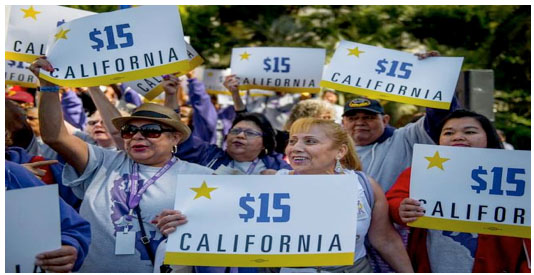
$15 California

NEW GEOGRAPHY–In principle, there is solid moral ground for the recent drive to boost the minimum wage to $15, with California and New York State taking dramatic steps Monday toward that goal. Low-wage workers have been losing ground for decades, as stagnant incomes have been eroded by higher living costs.

Yet if the campaign to boost the minimum wage reflects progressive ideals, the underlying rationale also exposes the failure of these high-priced cities to serve as launching pads for upward mobility for the vast majority of their residents. In effect, the fight for $15 is a by-product of giving up – capitulating on the idea that better opportunities can be created than the menial service jobs that increasingly are the only opportunities for the urban poor. Higher wages will make these jobs moderately more tolerable, while further cementing the wide gulf between the haves and have knots.

New York, San Francisco, LA and Seattle are at the forefront of a new urban economy, based on industries such as finance, technology and media, that generally creates jobs for the highly educated only. Virtually every region at the cutting edge of the minimum wage movement has seen a rapid decline in traditional blue-collar jobs — notably in manufacturing — which often paid well above the minimum wage, and offered potential for further individual advancement.

In these and other core cities, we are seeing something reminiscent of the Victorian era, where a larger proportion of workers are earning their living serving the wealthy and their needs as nannies, restaurant workers, dog-walkers and the like. In New York City, as of 2012, over a third of workers were employed in low-wage service jobs, a percentage that rose through the recovery from the Great Recession, according to a study by the Center for an Urban Future.

Given shrinking opportunities for middle and working class people, it’s not surprising that many seek a more direct redress from the government.

Essentially the minimum wage campaign rests on the notion that traditional middle class uplift cannot be achieved. The problem is, a $15 an hour income represents hardly enough to pay the rent for a small apartment anywhere near the blue cities where the new minimum will hit first.

The  impact in California will, if anything be larger, as the wage hike will be imposed in a wider fashion on a hugely diverse state.

To be sure, higher wages could be a blip in wealthy and thoroughly de-industrialized places like San Francisco – if higher labor costs boost the price of beet-filled ravioli, it doesn’t undermine the market in a place where hipsters and elite workers still have dollars to spend.

Perhaps the greatest beneficiaries of the minimum wage hike will not be the bulk of lower wage workers in blue states, but the people who increasingly dominate their economies.

And as the American Interest recently predicted, those most likely to benefit down the line from the higher wages will be the tech companies that will come up with the software and automated systems that replace the service jobs now made less economically competitive by the wage hikes. It’s not a loony fringe concept: the President’s Council of Economic Advisers recently estimated that lower-wage service jobs have an 80% probability of being automated.

So in the end, a $15 minimum wage, set in the low growth economy of our times, may end up boosting the very class-based hierarchies that are already increasingly evident. Ultimately it may represent a case of a well-intentioned measure that, while sounding radical, only accelerates our road back to feudalism: a society dominated by the few where many depend on the generosity of their betters and the middle class, already shrinking, fades into the dustbin of history.
Owning a Home in North America

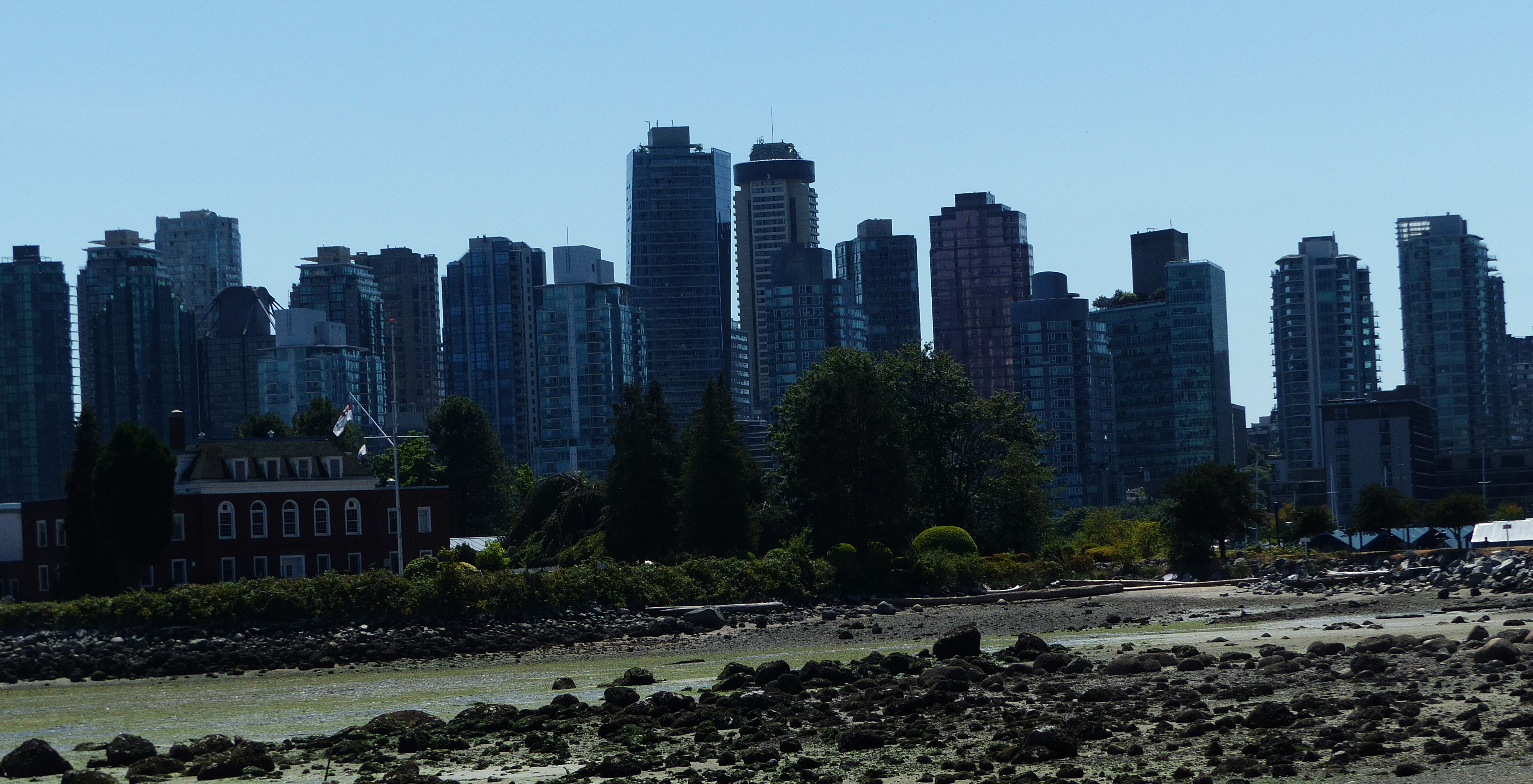
Vancouver Skyline from the bay in Stanley Park

Just this past July 22 we returned from a trip that included five days in Vancouver, British Columbia, Canada. While there we rode one of the Hop On Hop Off city tours. The guide was obviously quite knowledgeable about the city. It is a city of many very attractive 20 to 30 story high buildings. She informed us that the cost of the apartments in those buildings started at $1 million (Canadian). Although the Canadian dollar is currently about 30 cents lower in value than the American dollar it has been almost identical during the past few years. So the cost of living in Vancouver is high.

Meanwhile here in California the cost of homes has been equally as high.  The median home price value in San Francisco is over $1 million reports Zillow. They say it’s a 12.7% increase during the past year and predicts even higher prices in the coming five years.

Down here in Los Angeles Home sales reached a nine-year high in July, prices climbed 5.5% from a year earlier, according a report out Tuesday from CoreLogic a company that tracks home prices throughout southern California. The Los Angeles Times reports that Zillow says “Los Angeles and Orange County are the least affordable housing market in the country.”

Interestingly Portland, Oregon is the city that has experienced the least impact of the inflated home prices with median home prices of about $327,000. However not to be out done their prices have also risen over 10% in the past year.

However as the price of homes has risen the average family income has not risen by comparable amounts. In Portland, Oregon median family income was $55,571 in 2013. In Los Angeles that number was $48,466. Using the old standard of qualifying to buy a home 2½ to 3 to times your family annual income that calculates to a home costing $150,000. No wonder so many young adults are still living with their parents.

What is causing inflated home prices? Googling that question shows lots of analysis but no answers. Here is my take.

Most cities have run out of space for new building. That translates into more high rise housing. Those kinds of structures are expensive to build. Those buildings are townhouse/condominiums translate into expensive homes. Even Los Angeles, a city known for single family homes, has turned to more apartment housing because travel times have become too long (a 1½ hour drive to the airport or to work has become the norm). Average families simply cannot afford that style of housing so they move to the outer edge of the city. That’s where I live.

Thousands of people from other nations have been buying homes in the United States and Canada because it is a safe place to invest their money. That demand has driven up the price of American and Canadian homes. There have been a series of news items and opinion pieces in the Los Angeles Times that have pointed to this growing trend. 47% of Vancouver is now populated by Asians. The San Gabriel Valley area of metropolitan Los Angeles has experienced a growing Asian population to the point that many long time residents have voiced their concern about the changing demographics. Those voices made their way into the newspaper.

http://www.bankrate.com says, “International homebuyers have been pouring billions of dollars into the U.S. housing market as they take advantage of lower home prices and a weaker dollar.” “When buying a home in the United States, foreign buyers often pay cash because it’s a much easier, quicker process, says real estate agent Baro Shalizi of Shalizi Real Estate, in Santa Fe, N.M.” When an elderly acquaintance of mine sold his home for more than $700,000 the buyer paid for it in cash. That all cash offer made the sale easy and eliminated all other offers.

Now cities are confronted with the question of providing decent housing for young families that have median incomes. Without the needed homes there is an impact on the buying habits of those families. They will live with their families. That translates to reduced purchases of refrigerators, lawn mowers, and everything else that homeowners buy.

There will be one of three consequences or perhaps some combination. 1) Government does nothing and young families double up to buy a home or continuing living with parents. 2) There will be subsidized housing for the median income families. 3) More people living farther from the big cities in order to buy a home and that results in more commuters.

Hillary Clinton is NOT the Best Choice for President

Hillary_Clinton_official_Secretary_of_State_portrait_crop[1]THE MESSAGE – “Middle-class economics a focus of Clinton’s bid,” by AP White House Correspondent Julie Pace: “Boosting economic security for the middle class and expanding opportunities for working families, key issues that her campaign says will be heralded by a results-oriented ‘tenacious fighter.’ … If Clinton’s strategy sounds familiar, it might be because … Obama framed the choice for voters in 2012 as between Democrats focused on the middle class and Republicans wanting to protect the wealthy and return to policies that led to the Great Recession.”

I am an un-loyal Democrat. I re-registered as an Independent in about the year 2000. That was before Arnold Schwarzenegger ran for governor of California (2003). To my Democratic friends I was disloyal.  I voted to remove the Democratic governor, Gray Davis, and install Schwarzenegger. I believe there was one other time I voted for a Republican.

Hillary Clinton is not the best choice for the Democratic Party. She represents positions and behavior that are not in keeping with my views.

My arguments with her are as follows:

  • Voted for the invasion of Iraq. That country has been in chaos ever since.
  • Convinced President Obama that the disposal of Muammar Gaddafi as leader of Libya was the right thing to do. That country has been in chaos ever since.
  • Refuses to provide an explanation of her role in the Benghazi attack. The remark, “What difference does it make?” does not reveal what she knew and when she knew it.
  • Kept all of her e-mail on a separate private e-mail server. She has deleted at least 30,000 messages without any outside review.

Add to that she was intimately involved in her husband’s presidency. That was a presidency that took specific actions that were not in the best interest of the American people.

  • NAFTA was the free trade agreement that was supposed to bring more jobs to the United States. It has not worked out that way. Whirlpool and Technicolor both moved their manufacturing facilities to Mexico. Honda built a new assembly plant in Mexico for sales of their cars in the United States. Mexican agriculture now exports their products to the United States. Every one of those Mexican industries has reduced the number of American jobs. The seeds of NAFTA were planted during the George H. W. Bush administration.
  • It was President Bill Clinton who signed the repeal of the Glass–Steagall Act. Two provisions of that 1933 law restricted affiliations between commercial banks and securities firms. The consequence was greater growth of American banks and ultimately the Great Recession of 2008.
  • China-PNTR Enacted in October 2000. This Act was a crucial step to complete a major trade goal of the Clinton-Gore Administration, opening China’s markets to American manufactured goods, farm products and services by allowing China to become part of the WTO, forcing it to slash import barriers against American goods and services. The act also opened China’s ability to become a prime exporter of their manufactured goods to the United States without tariff barriers.

Has any of the laws she and her husband supported benefited middle class Americans? The answer is obvious. Yes the Republicans do support business over working Americans with arguments that don’t hold water. The problem for Hillary Clinton is that her ideas are no better than those of GOP candidates. Simply saying she wants all children to have the same opportunities as her new granddaughter, Charlotte, does not make it so. She is linked to the wealthy and Wall Street. Her willingness to take America into war is unacceptable.

America’s Peasants

The working masses of America don’t think of themselves as peasants. Oh no, wisely America’s wealthy came up with a much more palatable description. They are part of the middle class.  Everyone is part of the middle class.  I know wealthy people who tell me they are part of the middle class. The wealthy in Bel-Aire and Calabasas call themselves upper middle class. It seems that the middle class is everyone.

So explain the following to me.

Sixteen million children were on food stamps as of the end of last year, the highest number since the nation’s economy tumbled in 2008. That is 1 in 5 of all children in America. 46.5 million people in the United States are on food stamps. That means more than 14% of our 320 million people are too poor to afford food. These fact are reported by the Associated Press.

A new study released by Morgan Stanley revealed income inequality ranked fourth among concerns of the high-net-worth individuals nationally, behind the 86% citing increasing foreign conflicts, the 81% pointing to fears of terrorism in the U.S., and the 80% noting the U.S. government budget deficit.

The same Morgan Stanley study indicated that those with $100,000 or more to invest made up 21% of U.S. households. In other words 79% of all American households have less than $100,000 to put in a bank or invest in stocks and bonds. That translates into millions of retired people who live almost totally on Social Security and millions of younger people wondering what their retirement will look like.

Can those families with college age children send their children to college? The answer is obvious. Children must qualify for a student loan or their education comes to an end. California’s famous community colleges now cost $46 per unit or $736 per semester. I recall when those schools were free to every high school graduate.

Another part of this story is the wealthy who earn millions of dollars a year and pay the lowest tax rate with thousands of dollars earned that are not taxed at all. One example is tax free municipal bonds. If you own $1 million of those bonds the interest earned is not taxed. If you decide to sells those bonds to earn a profit after owning them for more than one year, your profits will be taxed at 15%. Since 2003, certain dividends known as qualified dividends (Qualified dividends are generally dividends from shares in domestic corporations) have been subject to the same tax rates as long-term capital gains, which are currently taxed at 15%.

In other words if I work for a living, 40 hours a week every week of the year and earn $50,000 a year my joint income tax is about $4,700. However if I am lucky enough to earn my $50,000 in municipal bond interest my income tax is NOTHING.

The problem for the middle class who work for a living is that there is no one who speaks for them in Washington. Oh, the Democrats claim they do but that is a lie. They had control of both the House and the Senate for the first two years of the Obama administration and no relief or help was provided. Meanwhile the wealthy who say they are concerned with income inequality have happily accepted the ever growing divide between the rich and poor. Corporate managers now earn 200 to 300 times the income of the rest of us.

The middle class? What middle class is there? It’s primarily older people who managed to save for their retirement. One day there will be an uprising by the masses who will finally recognize that they are the victims of a system that milks them. It won’t come too soon for me.

HELP ME PLEASE – I AM CONFUSED!

When it comes to Israel, the world seems to be upside down.

I always said that the true Palestinians are the Jews, always remembering in my youth that the Jerusalem Post was originally called the Palestine Post and we would always refer to Palestine when collecting funds for the Jews living in Palestine to defend themselves against the Arabs.  נושא:הועבר: HELP ME PLEASE – I AM CONFUSED!

ISRAELI LEADERS:

BENJAMIN NETANYAHU,

Born 21 October 1949 in Tel Aviv, Israel (formerly Mandate of Palestine)

EHUD BARAK, Born 12 February 1942 in Mishmar HaSharon , British Mandate of Palestine

ARIEL SHARON, Born 26 February 1928 in Kfar Malal , British Mandate of Palestine

EHUD OLMERT, Born 30 September 1945 in Binyamina-Giv ‘ at Ada , British Mandate of Palestine

ITZHAK RABIN, Born 1 March 1922 in Jerusalem , British Mandate of Palestine

ITZHAK NAVON, Israeli President in 1977-1982. Born 9 April 1921 in Jerusalem, British Mandate of Palestine.

EZER WEIZMAN, Israeli President in 1993-2000. Born 15 June 1924 in Tel Aviv, British Mandate of Palestine


ARAB “PALESTINIAN” LEADERS :

YASSER ARAFAT, Born 24 August 1929 in Cairo, Egypt

SAEB EREKAT, Born April 28, 1955, in Jordan. He has Jordanian citizenship.

FAISAL ABDEL QADER AL-HUSSEINI, Born in1948 in Bagdad, Iraq.

SARI NUSSEIBEH, Born in 1949 in Damascus, Syria 

MAHMOUD AL-ZAHAR, Born in 1945, in Cairo, Egypt.

So, if I understand this correctly, the Israeli leaders, who were born in Palestine, are called/considered “Settlers” or  more accurately, “Occupiers.”   While Palestinian Arab leaders who were born in Egypt, Jordan, Syria, Iraq and Tunisia are called “Native Palestinians”?

THAT makes perfect sense.


DAVID BANCROFT

A Progressive Estate Tax in the United States

This idea won’t become law but it should.

By:  Sen. Bernie Sanders (I-Vt.)

Huffington Post

Monday, September 8, 2014

The founders of our country declared their independence from what they viewed as a tyrannical aristocracy in England. More than two centuries later, today’s tyrannical aristocracy is no longer a foreign power. It’s an American billionaire class which has unprecedented economic and political influence over all of our lives.

Unless we reduce skyrocketing wealth and income inequality, unless we end the ability of the super-rich to buy elections, the United States will be well on its way toward becoming an oligarchic form of society where almost all power rests with the billionaire class.

In the year 2014, the U.S. has by far the most unequal distribution of wealth and income of any major country on earth. This inequality is worse than at any time in our country’s history since 1928. Today, the top 1 percent owns about 37 percent of the total wealth in this country. The bottom 60 percent owns only 1.7 percent of our nation’s wealth.

At a time median family income is $5,000 less than it was in 1999, the net worth of the top 400 billionaires in this country has doubled over the past decade. The top 1 percent now owns more wealth than the bottom 90 percent of Americans and one family, the Walton family of Wal-Mart, owns more wealth than the bottom 40 percent of Americans. 

In terms of income, the top 1 percent earns more than the bottom 50 percent. Since the Great Recession of 2008, 95 percent of all income gains in the U.S. have gone to the top 1 percent. While the rich have become even richer, more Americans are living in poverty than at any time in our nation’s history. Today, half of Americans have less than $10,000 in savings. We have the highest rate of childhood poverty – 22 percent – than any major country on earth.

More than a century ago, President Theodore Roosevelt recognized the danger of massive wealth and income inequality and what it meant to the economic and political well-being of the country. In addition to busting up the big trusts of his time, he fought for the creation of a progressive estate tax to reduce the enormous concentration of wealth that existed during the Gilded Age.

“The absence of effective state, and, especially, national, restraint upon unfair money-getting has tended to create a small class of enormously wealthy and economically powerful men, whose chief object is to hold and increase their power,” the Republican president said. “The really big fortune, the swollen fortune, by the mere fact of its size acquires qualities which differentiate it in kind as well as in degree from what is passed by men of relatively small means. Therefore, I believe in … a graduated inheritance tax on big fortunes, properly safeguarded against evasion and increasing rapidly in amount with the size of the estate.”

Roosevelt spoke those words on Aug. 31, 1910. They are even more relevant today.

A progressive estate tax on multi-millionaires and billionaires is the fairest way to reduce wealth inequality, lower our $17 trillion national debt and raise the resources we need for investments in infrastructure, education and other neglected national priorities.

I will shortly introduce legislation that will:

• Call for a progressive estate tax rate structure so that the super wealthy pay their fair share of taxes. The tax rate for the value of an estate above $3.5 million and below $10 million would be 40 percent. The tax rate on the value of estates above $10 million and below $50 million would be 50 percent, and the tax rate on the value of estates above $50 million would be 55 percent.

• Include a billionaire’s surtax of 10 percent. This surtax on the value of estates worth more than $1 billion would currently apply to fewer than 500 of the wealthiest families in America worth more than $2 trillion.

• Close estate tax loopholes that have allowed the wealthy to avoid billions in estate taxes. Some of the wealthiest Americans in this country have exploited loopholes in the tax code to avoid paying an estimated $100 billion in estate taxes since 2000. My bill would close those loopholes.

• Exempt the first $3.5 million of an estate from federal taxation ($7 million for couples), the same exemption that existed in 2009. Under this legislation, 99.75 percent of Americans would not pay a penny in estate taxes. 

This legislation would exempt more than 99.7 percent of Americans from paying any estate tax while ensuring that the wealthiest Americans in our country pay their fair share.

I agree with former Labor Secretary Robert Reich who wrote, in support of this legislation, that America “is creating an aristocracy of wealth populated by heirs who don’t have to work for a living yet have great influence over how the nation’s productive assets are deployed.” He is right in calling the proposal that I’ve laid out “a welcome step toward reversing this trend.” Let’s fight together to see that it is implemented.

Why the Rich get much Richer

Monopoly ManOn My 28 I posted a commentary titled Goodbye Middle Class.” On June 26 David Lazarus posted this column in the Los Angeles Times.

His column abridged, (underlined and bold not part of the Times editing)   At CVS Caremark, it doesn’t pay to be really good at your job. The nation’s second-largest drugstore chain adjusts its annual raises to how much an employee makes. The higher your salary, the lower your raise. The top workers at CVS stores — those earning the highest hourly wage for their job classification — are “red lined” by the company and receive no raises at all. CVS, which gave its chief executive a 26% raise last year to almost $23 million in total compensation, isn’t alone in making sure its rank-and-file workers don’t make too much money.

And this is why, in any discussion of income inequality, we keep reaching the same point — the rich get richer, while everyone else gets table scraps. “It’s not personal. It’s business,” said Mike Lipis, a Los Angeles compensation consultant. “You’re trying to make the most of your limited compensation dollars.”

I wrote recently about a report showing that the head of CVS, Larry Merlo, enjoyed the widest gap in the country between a CEO’s salary and that of his less-worthy underlings. According to compensation researcher PayScale, Merlo’s $12.1-million salary last year was 422 times the size of the median CVS wage of $28,700.

A top-performing CVS pharmacy technician earning a base wage of $9.30 an hour will similarly merit a 4.75% raise. But a red-lined pharmacy technician earning $15.67 an hour will see no raise.

Politicians have an excellent issue for the coming elections. It’s a good bet that none of them will even address the pay discrepancy. The reason? The source of the contributions for their campaigns.

Don’t look for the media to emphasize the salary discrepancies. Those heading the media companies are some of the highest paid people.

Leslie Moonves, CEO of CBS Corp.  $62,157,026 in 2012

Philippe P. Dauman, CEO of Vaicom Inc.$37,165,750 in 2013

Marissa A. Mayer, CEO of Yahoo Inc.  $36,615,404 in 2012

Robert A. Iger, CEO of Disney Co.  $34,321,055 in 2013

David M. Zaslav, CEO of Discover Communications $33,349,798 in 2013

Goodbye Middle Class

The J.C. Penney closing of 33 stores is a reflection of the decline of the middle class. Comments by readers of this Huffington Post article, I believe, accurately appraises this situation. There is nothing being said about how Penney’s will recover.

Sears Holdings Corp. (SHLD:US) plunged the most in more than a year after forecasting a fourth-quarter loss and saying sales during the holiday period dropped. The loss in the quarter ending Feb. 1 will narrow to $250 million to $360 million, or $2.35 to $3.39 a share, the Hoffman Estates, Illinois-based company said yesterday in a statement. The net loss a year earlier was $489 million, or $4.61 a share.

If these stalwarts cannot survive the message is clear. The middle class, that was the bread and butter for those retail stores, is shrinking away.

It is not an overnight event. As those middle incomes and retired middle class families die the replacements come in just two categories. They are the poor and the well to do. Evidence of this situation is the age of McDonald’s employees. The average age of a fast-food worker in 2013 was almost 30. That is data published by Bloomberg Businessweek. The Bureau of Labor Statistics says that more than 35% of the unemployed have been in that predicament for more than 27 weeks. Most of them had well paying middle class jobs.

Meanwhile the median annual compensation for the CEOs of S&P 500 firms is now reported to be above $10 Million. Carol Meyrowitz, the CEO of TJX, earned over $20 Million in 2013. TJX owns Marshall’s, TJ Max, and Homegoods stores. Anthony Petrello was the highest paid CEO earning more than $68 Million last year.

Of course the board of directors of every company is free to pay whatever they deem a fair salary. Government does not set salaries in a free society. Those CEOs must be worth the pay they receive. Or is it the rich protecting the rich? Does the CEO work harder than the clerk?

So what is to become of most Americans? Look for more food stamps, more housing subsidies, and more broken homes.

Private enterprise does not care about its employees. They are interested in maximizing their profits. Don’t like it? Open your own business. That is the way capitalism works.

Raising the Minimum Wage is No Solution

Remember when cars cost $3,500 and a house cost $30,000?  Inflation raised your pay, the cost of that car, and houses are still just as unaffordable.

Over my many working years I have benefited from the increased minimum wage rates as well as the union won rate increases.  I have always been part of the administrative staff and always on a salary.  Some were weekly rates, some were monthly rates, and there was once even an annual salary.  I receive no overtime pay but my high pay rate is supposedly offset by better pay than the hourly employees.  Not true.

Huffington Post reports that 13 States Will Raise Their Minimum Wage For The New Year It seems like a good idea.  After all who could argue with the idea of increasing the pay for those least paid who clearly are in a world of hurt?  Many need food stamps and housing subsidies to survive.

Those salaried jobs of mine have not brought me to wealth.  So I can relate to the poorest paid.

The problem for me is that a pay hike for everyone still leaves the poorest paid at the bottom of the pyramid. Now they face proportionately higher cost for rent, food, and the other necessities of life.  They will be no better off than they had been before the pay increase.  Inflation will destroy their gains.

San Francisco is a city with a minimum rate of $10.55 per hour. The new rate in January will be $10.74.  The cost of living in San Francisco is 164% of the national average.  How has the high minimum rate helped the lowest paid workers?  It hasn’t!

Is there a solution?  I know of none.