Don’t Need A Will? Think Again!


by Jane Bryant Quinn in the May 2017 AARP Bulletin

Just do it. Your heirs will thank you.

Does everybody need a Will? The straight answer is yes. That’s true even for people who think they don’t have a dime to leave to anyone. What if you were in an accident and died later of injuries, and your estate won a $l million settlement? Who gets the money?

Admittedly, that’s a little far out. You might get away without having a will if, say, you’re a renter living on Social Security with no savings. If you have savings, a pay-on-death account will pass that money to named beneficiaries when you die.
But there are hitches to any no-will scheme, says attorney Patrick Lamon of Bilzin Sumberg in Miami. To begin with, a random financ.al asset almost always turns up. Examples might be a rental deposit that’s returned or a medical reimbursement. Those checks will be made out to the deceased. How do your heirs get them cashed?

If you had a will, you’d have named an executor to cash checks, pay off creditors and distribute any money or property to your beneficiaries. Without one, your heirs will have to ask a court to appoint a personal administrator. Usually, it will appoint your surviving spouse or a child. But you risk a family fight over who should be in charge.

Some couples try to go will- free by putting everything into joint names. Joint assets pass to the other owner automatically. So do assets with beneficiary forms, such as individual retirement accounts. But something is inevitably left out typically, a car, Lannon says. Heirs would need an administrator to transfer title. Even if the joint-asset strategy works for the first death, what happens when the other spouse dies? He or she should make a will, which you both could have done from the start.

When there’s no will, state law dictates who gets the house, car, savings and other assets. Those laws vary widely. A surviving spouse might get everything in one state but only one-third in another, with the rest going to your children. If you have no children, half might go to a spouse and half to your parents.

Lawyers are the best source for reliable wills. Your lawyer will also remind you that you need a durable power of attorney and a health care proxy, so someone can manage your finances and make medical choices if you’re unable to do so yourself.

If you’re allergic to lawyers, you can find free, state-specific will forms online. In most states (not all), handwritten wills are also accepted, provided that they were witnessed properly. DIY should be better than nothing. But be careful.

Jane Bryant Quinn is a personal finance expert and the author of “How to Make Your Money Last” She writes regularly for the AARP Bulletin.

Cars and Trucks to Avoid in 2017

Consumer Reports is a wonderful organization for giving unbiased reviews on everything from paint to cars to toasters.  They can do this because they take no advertising.  Compare that behavior with car magazines, photo magazines, and home décor magazines that thrive based on the level of advertising they obtain.  In other words it is unlikely that Popular Photography will give a negative review of a Nikon camera or Motor Trend will write negative issues about a Ford.

Thus we come to a list of vehicles that CR has defined as the “10 Least Reliable Cars.”  The report was just emailed out this morning.

cr-least-reliable-car-2017-fiat-500l-pr-10-16

With an overall rating of 35 out of 100 the Fiat 500L is ranked as the worst of the worst.  The road test was a 50 out of 100. “Reliability ranks at the bottom of our charts.”

Next to the bottom is the Ford Fiesta. Trouble spots: clutch replacement, rough-shifting or slipping transmission, noises and leaks, power equipment.  I can attest to this car’s poor rating based upon my own experience.  Hertz gave me no choice in Seattle despite my reservation for a mid-sized car.  Cramped, uncomfortable seats, and very noisy at freeway speeds.

Jeep Renegade has an overall score of 42.

Cadillac Escalade has an overall score of 44.  Reliability is much worse than average.  With a price range of $73,395 – $97,795 General Motors should be ashamed of trying to sell this vehicle.

Chrysler 200  has an overall score of 47.

Ram 2500 has no overall rating.

Tesla Model X  has no overall rating but has a Reliability is much worse than average.

Ford Focus  overall score of 50

Chevrolet Tahoe rating is 51 /GMC Yukon rating is 51

Chevrolet Suburban   overall 54  /GMC Yukon XL   overall 50.

Is it any wonder that European, Japanese, and South Korean cars are so successful in America?  My question is when will they learn?

The Low Pay for Low Skills Lie

No one wants to be poor and no one wants to ask for aid from welfare offices. Unfortunately some people simply lack the abilities needed to successfully attend college. In fact some people struggle to graduate from high school. That is the reason we have a population of poor adults that will always have an income barely above the minimum wage for their entire lives.

In a world where high tech skills are the driving force and innovations that are eliminating many low skill jobs, the least able in society must accept simple jobs that do not provide a living wage.

Those poor people may be hard working but there simply is not enough family income to pay the cost of food, clothing, housing, and the other basics that the rest of us take for granted. Society’s solution is welfare.

The argument given by so many people against raising the minimum wage is that the jobs they do are not worth any more than that low pay.

Thus we, society, are subsidizing all industries that employ minimum wage personnel. We are giving them welfare. Society makes the poor feel even worse about their condition by requiring them to apply for welfare, present food stamps to markets, and other degrading actions.

The solution is to require employers to pay a “living wage” for the lowest skill jobs. Those people in that category would no longer receive welfare aid. The only people receiving welfare aid would be the mentally and physically handicapped. What about single mothers with young children? Require employers to provide child care either on site or through payments to child care facilities.

Of course there would be a chorus of objections to the cost burdens placed on employers. The answer is that society is currently paying the bill through welfare payments and that translates to higher taxes.

Conservatives who object to subsidies should be happy with reduced government size and Liberals should be happy to know that even the least able in society will receive a living wage.

The Wealthy Paint a Rosy Picture

Who can we believe?

( Bloomberg) — March 12, 2015 / Household wealth in the U.S. increased from October through December by the most in a year as stock prices advanced to an all-time high at the end of 2014. Net worth for households and non-profit groups rose by $1.5 trillion in the fourth quarter 1.9 percent from the previous three months, to $82.9 trillion, the Federal Reserve said Thursday from Washington in its financial accounts report, previously known as the flow of funds survey.

A report like that would make you believe that Americans are all richer and feeling quite confident about the future. The rest of that Bloomberg article was just as upbeat. It proves how numbers can give a distorted view of the world. Those numbers were provided by the Federal Reserve.

Wait this really isn’t what it appears to be. USA Today offered this additional piece of information: But the wealth gains are flowing mainly to affluent Americans. Broad stock market averages have jumped more than 150% from their trough in the spring of 2009. But roughly 10% of households own about 80% of stocks.

The reality is that millions of families live paycheck to paycheck. The majority do not have significant savings for their retirement. The Median Value of Assets for Households in 2011 was $68,828.00. Married couples over 65 years had the highest wealth at a Median Value of $284,790.00. Take away the value of their home and you realize that many senior citizens are primarily relying on their Social Security income. The source for this data is the U.S. Census Bureau.

This data says two things to me. 1) You cannot rely on the reporting from just one publication for complete information. 2) There is a great economic divide in this nation.

2015

Happy Face 

Happy New Year!!

The New Year could be one of the best for Americans. There are many indicators to support this forecast. That would not include Nouriel Roubini. He has a history of negative forecasts so I wouldn’t pay attention to him.

Beaconomics forecasts Incomes, Consumer Spending on the Rise: As job growth continues, worker incomes are expected to expand in 2015, something that will keep consumer spending growing and encourage those who have dropped out of the workforce to re-enter.

The GDP for the third quarter of 2014 initially reported growth of 3.5% and subsequently has raised that number to 5%. Unemployment is now reported at 5.8% which is not great but is definitely going in the right direction. The stock market has set new records this year and is now at a new high that won’t help everyone but will motivate people to spend and perhaps hire more people.  Gasoline is at unbelieveably low prices.

Goldman Sachs’s chief economist Jan Hatzius just published answers to what he believes are the eight top questions for next year.

Here’s a list of the questions asked by Business Insider and a quick summaries of his thoughts:

  1. Will the US economy continue to grow above trend? Yes. Domestic strength should offset weakness from other economies.
  2. Will the dollar appreciation weigh on growth? Yes, but it’s manageable in the short term because of lower oil prices.
  3. Will the housing recovery accelerate? Yes, especially in the single-family sector. Household formation should improve as young adults move out of their parents’ homes.
  4. Will consumer spending growth accelerate? Yes, as real disposable income increases because of lower oil prices.
  5. Will capital spending growth accelerate further? No. Business capital spending does not look depressed relative to the long-term fundamentals and the decline in oil prices is likely to take a toll on energy sector.
  6. Will wage growth move into the 3%-4% range identified by Chair Yellen as “normal”? No. There’s still slack in the labor market as measured by the U6 underemployment rate.
  7. Will core inflation rise toward the Fed’s 2% target?No. The dollar is strong, wage growth is low, and depressed oil prices should have a negative impact.
  8. Will the Fed hike rates by the June FOMC meeting? No, because inflation probably won’t hit the 2% target. “Based on our below-consensus forecasts for wage and price inflation we expect the first funds rate hike to occur after June 2015; our base case is September,” Hatzius said.

So in summary, the US economy will grow together with the dollar, faster than its global peers. But inflation below the Fed’s target will push its rate hike back to at least September, and the impact of lower oil prices will continue to be felt throughout the economy.

Read more: http://www.businessinsider.com/jan-hatzius-top-questions-for-2015-2014-12#ixzz3NFdpC9as

The United States is Home to Millionaires

This is one topic that will not be discussed in the campaign for president in 2016. The U.S.A. is a home for millionaires. There are more in this country than any other nation in the world. The opportunity to become a millionaire is the reason so many people look for every way to enter this nation.

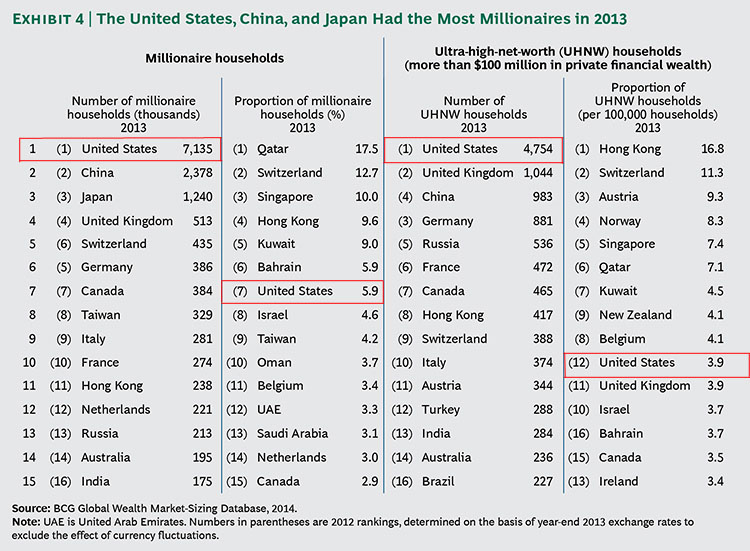
The Boston Consulting Group (BCG) posted this interesting article about wealth in the world this past June titled “Global Wealth 2014: Riding a Wave of Growth.”

Even as the income discrepancy between the average American and the top income earners has become more extreme the number of millionaires around the world has risen to new heights the numbers of millionaires in the United States has grown even more. BCG states: “As the debate over the global polarization of wealth rages on, one thing is certain: more people are becoming wealthy. The total number of millionaire households (in U.S. dollar terms) reached 16.3 million in 2013, up strongly from 13.7 million in 2012 and representing 1.1 percent of all households globally.”

MIllionaires Chart

The number of millionaires in the United States exceeds the total of the next 13 nations combined with 7,135. Among the ultra-rich (families with $100 million in wealth) shown in the third column above, once again the United States has more than four times as many as the next nation (United Kingdom).

The inflow of immigrants to the United States isn’t just the poor. The wealthy are doing their very best to grab a piece of the American pie. Businessweek had an article in the October 20-26 issue about Arcadia, California – a suburban community of Los Angeles that has been inundated with wealthy Chinese buying homes and building mansions there.

Arcadia CA

There is a possibility that you can be a millionaire in the United States. It’s easier than almost any other country in the world. So that’s why we won’t be changing the laws pertaining to millionaires. We won’t penalize you for becoming one too! It is what makes America great. It’s everyone’s goal. You don’t have to know anyone to make it happen. Anyone can be the next Steve Jobs, Bill Gates, or Sara Blakley.

Republican Party Stands Opposed to Social Welfare

Social Welfare is the various social services provided by a state for the benefit of its citizens.

In the United States the range of services includes Social Security (a program that guarantees a stipend to all senior citizens), Medicare (a program that provides health care to all senior citizens), minimal support for those unable to earn a living (usually referred to as welfare), and unemployment benefits (for those who lost their jobs through no fault of their own). Those are the primary programs that American residents are entitled to when there is a need.

In every instance those programs have been opposed by the G.O.P. In every instance those programs were instituted when a Democrat held the office of President of the United States.

The current chairman of the House Budget Committee, Republican Congressman Paul Ryan has sustained the Republican view on social welfare programs with the following words copied from his web site.

The current Medicare program attempts to do two things to make sure that all seniors have secure, affordable health insurance that works. First, recognizing that seniors need extra protection when it comes to health coverage, it pools risk among all seniors to ensure that they enjoy secure access to care.

Second, Medicare subsidizes coverage for seniors to ensure that coverage is affordable. Affordability is a critical goal, but the subsidy structure of Medicare is fundamentally broken and drives costs in the wrong direction. The open-ended, blank-check nature of the Medicare subsidy drives health-care inflation at an astonishing pace, threatens the solvency of this critical program, and creates inexcusable levels of waste in the system.

Ryan’s solution:
Beginning in 2024, for those workers born in 1959 or later, Medicare would offer them a choice of private plans competing alongside the traditional fee-for-service option on a new Medicare Exchange. Medicare would provide a premium-support payment either to pay for or to offset the premium of the plan chosen by the senior.

The Medicare Exchange would provide seniors a competitive marketplace in which they could choose a plan the same way members of Congress and federal employees do. Every plan, including the traditional fee-for-service option, would participate in an annual bidding process to determine the federal contribution seniors would receive to purchase coverage. Health-care plans would compete for the right to serve Medicare beneficiaries.

What Ryan calls “the president’s partisan health-care law” is an appointed government board like the FCC, the FDA, the FAA, and dozens of other appointed boards. He favors the unelected bureaucrats in privately owned insurance companies that answer to private enterprise. His view is those government bureaucrats aren’t as reliable to private company bureaucrats.

Ryan goes on to say The President’s partisan health-care law creates an unaccountable board of 15 unelected bureaucrats—the Independent Payment Advisory Board—empowered to cut Medicare in ways that will result in denied care and restricted access for seniors. The bureaucrat imposed cuts threaten critical care for current seniors and fail to strengthen Medicare for future generations.

So is it the blank-check nature of Medicare or 15 unelected bureaucrats that will be threatening current seniors? Ryan has covered both possibilities in his contradictory analysis.

The point is that Republicans are trying their very best to end Medicare, Social Security, and all other social welfare programs. They offer no substitutes. Their obsession with free market principles is the view of the rich who say they have no responsibility for the less well off.

There are many other reasons to oppose Republicans but that will be addressed on another day.

Organic Food – It’s all about the Money

From the USDA National Agricultural Library

“Organic farming entails:
• Use of cover crops, green manures, animal manures and crop rotations to fertilize the soil, maximize biological activity and maintain long-term soil health.
• Use of biological control, crop rotations and other techniques to manage weeds, insects and diseases.
• An emphasis on biodiversity of the agricultural system and the surrounding environment.
• Using rotational grazing and mixed forage pastures for livestock operations and alternative health care for animal wellbeing.
• Reduction of external and off-farm inputs and elimination of synthetic pesticides and fertilizers and other materials, such as hormones and antibiotics.
• A focus on renewable resources, soil and water conservation, and management practices that restore, maintain and enhance ecological balance.”

I am sure you understood the meaning of this double talk. I am especially fascinated with the meaning of “Use of biological control, crop rotations and other techniques to manage weeds, insects and diseases.”

costco-organic-price-list-863x1024

COSTCO has jumped on the band wagon of organic foods. On my last visit they handed me their special offer valid from Jan 13 to Feb 9. It was a catalog of 26 items. All items are marked USDA ORGANIC.

Huffington Post has this headline Organic Food Is Not Healthier Than Conventional Produce: Study.” The report said “Stanford University doctors dug through reams of research to find out – and concluded there’s little evidence that going organic is much healthier, citing only a few differences involving pesticides and antibiotics.”

“Consumers can pay a lot more for some organic products but demand is rising: Organic foods accounted for $31.4 billion sales last year, according to a recent Obama administration report. That’s up from $3.6 billion in 1997.”

No wonder COSTCO has decided to offer organic foods. It’s the money!

Raising the Minimum Wage is No Solution

Remember when cars cost $3,500 and a house cost $30,000?  Inflation raised your pay, the cost of that car, and houses are still just as unaffordable.

Over my many working years I have benefited from the increased minimum wage rates as well as the union won rate increases.  I have always been part of the administrative staff and always on a salary.  Some were weekly rates, some were monthly rates, and there was once even an annual salary.  I receive no overtime pay but my high pay rate is supposedly offset by better pay than the hourly employees.  Not true.

Huffington Post reports that 13 States Will Raise Their Minimum Wage For The New Year It seems like a good idea.  After all who could argue with the idea of increasing the pay for those least paid who clearly are in a world of hurt?  Many need food stamps and housing subsidies to survive.

Those salaried jobs of mine have not brought me to wealth.  So I can relate to the poorest paid.

The problem for me is that a pay hike for everyone still leaves the poorest paid at the bottom of the pyramid. Now they face proportionately higher cost for rent, food, and the other necessities of life.  They will be no better off than they had been before the pay increase.  Inflation will destroy their gains.

San Francisco is a city with a minimum rate of $10.55 per hour. The new rate in January will be $10.74.  The cost of living in San Francisco is 164% of the national average.  How has the high minimum rate helped the lowest paid workers?  It hasn’t!

Is there a solution?  I know of none.

Saving for Retirement

Living in one of the highest cost of living cities in the nation made saving for retirement a very difficult task.  Los Angeles-Long Beach California had a composite index of 136.4% on 2010.  The issue is the cost of housing.  That is 207.1% or more than twice the national average.  Costs for other things like food, utilities, and transportation are just slightly over the national average.  A middle class income left little for savings.

Even if you don’t live on the Pacific coast or in Manhattan you are probably unprepared to meet retirement expenses.  That is the results according to a survey by Fidelity Investments.

The problem with this survey is the sponsor.  Fidelity Investments wants to encourage you to increase your savings rate because managing savings investments is their business.

We live in a consumption economy.  The stores keep trying to sell you the latest, greatest whatever.  There is hardly a day that does not have a Macy’s ad in the newspaper.  Internet web sites all have links to the things you probably didn’t know you needed.  The credit card only helps you to buy the stuff you really do not need.

Ban credit cards in your house. Shop at Sears and Penney’s.  Stay out of Macy’s, Lord and Taylor’s, and Nordstrom’s.

Before you pay a single bill each month pay yourself in the form of a fixed amount of savings.