Basic Digital Camera Sales Are Falling

This article appeared in the Los Angeles Times dated December 23, 2011

http://latimesblogs.latimes.com/…echnology/2011/12/phone-camera-photos.html

The essence is 27% of photos and videos taken this year were shot with smartphones — up from 17% last year. Not surprisingly, sales of the basic digital point-and-shoot cameras suffered.

For the upper-level point-and-shoots — with optical zooms of 10x or greater and an average price of $247 — unit sales grew 16%. And digital single-lens-reflex cameras — with an average retail price of $863 — were popular enough that some camera shops were out of them the week before Christmas. Unit sales were up 12%.

All of this according to a survey by NPD Group (formerly National Purchase Diary), a leading North American market research company.

Las Médulas, SPAIN

From Our Place World Heritage

Site of the Day: Las Médulas  Our Place World Heritage Photographer: Geoff Mason (New Zealand)
In the 1st century A.D. the Roman Imperial authorities began to exploit the gold deposits of this region in north-west Spain, using a technique based on hydraulic power. After two centuries of working the deposits, the Romans withdrew, leaving a devastated landscape. Since there was no subsequent industrial activity, the dramatic traces of this remarkable ancient technology are visible everywhere as sheer faces in the mountainsides and the vast areas of tailings, now used for agriculture.

Superzoom, SLR-like (bridge) Cameras

Digital Photography Review is my favorite photography web site.  It’s an English company that tries to appeal to the entire world.  Not only do they provide reviews of all the new cameras, lenses, and printers they provide articles on photo techniques, technology, glossary of photo terminology, and a variety of other topics.  Also there are forums where everyone can offer their opinion.

What makes this site particularly appealing is that it is owned by Amazon.com.  While they do provide connections to buy photo equipment they are not tied to any brand.

I am the owner of two small point and shoot cameras and one superzoom.  My favorite is the superzoom.  I thought it appropriate to copy this one commentary from their last roundup of superzoom cameras in 2010.

“The latest generation of superzoom cameras incorporate such large zoom ranges that, if you were to try to match them for use on a full-frame DSLR, you’d end up with something so large and imposing you’d expect it to need a special weapons export licence. {notice how they spell license}  Even on these small-sensor cameras, the lenses are necessarily large enough to dominate the design of the cameras. The result is that most of these superzooms look pretty much like SLRs – a hand-grip with a large protruding tube at the front.”

That paragraph encapsulates my preference for the superzoom.  Now I am awaiting the reviews of the newest batch of superzooms.  Mine is three years old and still operates just fine but may not have all the latest features.

Four Tips for Photographing Fireworks

Thanks to Costco Photo Center, without the advertising, and some additonal information.

  1. Turn the camera’s flash off.  If you are including people in a shot you can try the Night Portrait flash setting, but otherwise, shut if off.
  2. Turn off Autofocus.  Autofocus will probably have difficulty finding the right focal point for fireworks.
  3. Set the camera to Manual and the f/stop to the largest possible aperture (lowest aperture number).  Remember with f/stop, the smaller the number the bigger the aperture.
  4. Set the shutter speed to 1/60th of a second.  It’s a good place to start but be sure to experiment with slower speeds like 1/30 & 1/15 (this will probably require a tripod).

6 common photography mistakes (and how to avoid them)

  • Richard I’Anson
  • Lonely Planet Author

Whether you’re on the other side of the world or wandering your own neighbourhood, you’ll soon realise that the sights that have you reaching for your camera are fleeting photo opportunities.

With this in mind, you really need to be prepared to capture such moments. Here are the six most common mistakes that can leave you with an ordinary image – instead of the masterpiece it should have been.

1. Not having a strong point of interest

The very first thing to consider is the subject – what is it and why are you taking a photo of it? Successful images have a point of interest: the key element around which the composition is based. It’s probably the thing that caught your eye in the first place and should be able to draw and holds the viewer’s attention.

2. Not getting close enough to the subject

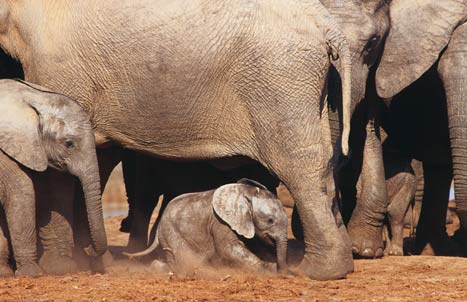
Good compositions leave no doubt as to the subject of the photograph. How do you make sure this is clear? A good way to start is to fill the frame with your subject. This helps to eliminate unnecessary or unwanted elements and overcomes the common mistake of making the subject too small and insignificant, which leaves the viewer wondering what the photo is supposed to be of. Often just taking a few steps towards your subject or zooming in slightly will make an enormous difference.
3. Focusing on the wrong part of the composition

The sharpest part of the image should be the point of interest, so take care when focusing. If something other than the main subject is the sharpest part of the composition the viewer’s eye will rest in the wrong place.

Most compact cameras and all SLRs have a focus-lock facility, activated by depressing the shutter release button halfway, which you should be confident using. It allows you to produce more creative and technically better pictures by locking the focus on the main subject then recomposing without the camera automatically refocusing.

4. Placing the subject in the middle of the frame

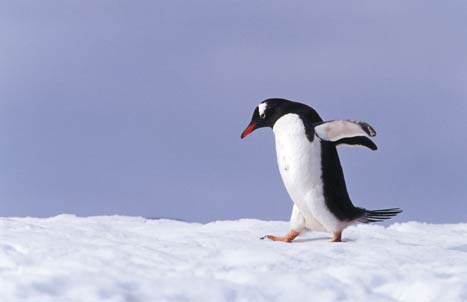
Centering the subject often contributes to a static composition so you should aim to place the point of interest away from the centre of the frame. As you’re thinking about where to place the point of interest, keep in mind the ‘rule of thirds’ that has traditionally been the starting point for successful composition. As you look through your viewfinder or study the LCD screen, imagine two vertical and two horizontal lines spaced evenly, creating a grid of nine rectangular boxes.

Try placing the point of interest, or other important elements, on or near the points where the lines intersect. For example, if you’re taking a portrait, the subject is the person’s face and the point of interest would be their eyes. In a landscape the point of interest may be a boat floating on a lake; place the boat on one of the intersections and also position the horizon near one of the horizontal lines.

5. Including elements that conflict with the subject

Avoid including other elements that conflict with the main subject. Look at the space around and behind your subject and make sure nothing overpowers it in colour, shape or size. What you leave out of the frame is just as important as what you leave in.

Do you really want power lines running across the facade of the most beautiful building in the city? It’s fine if you do, but not if you didn’t notice them in the first place! Scan the frame before pressing the shutter release, looking for distractions and unnecessary elements.

6. Not thinking about the direction of the light

The direction of the light and how it is illuminating your subject, whether it’s the natural light of the sun, incandescent lighting indoors or at night or flashlight, can make or break a photograph. That’s why it’s vital to observe the light. If you are aware that it’s striking your subject in the wrong place – for example, if the facade of a beautiful monument is in shade, or if someone’s hat is casting a shadow over half their face – then you can take action.

Either move the subject, move yourself or, if the subject isn’t going to disappear, wait a while or return at the appropriate time of day. Once you’re in the habit of considering how the light is falling on your subject you can select a viewpoint and time of day so that the light enhances your subject, rather than detracts from it.

Happy photographing!

Kodak, a Company That Lost It’s Way

Eastman Kodak 4Q Profits for 2010 fell 95%.  This is the company that started the age of hobbyist photography.

Camera’s date back to 1817 but it was George Eastman who developed a simple box camera with a fixed-focus lens and single shutter speed, which along with its relatively low price appealed to the average consumer.

No matter what brand of film camera you owned most of the film was produced by Eastman Kodak.  Most people simply referred to the film as Kodak Film.

Way back in 1975 — when Kodachrome color slides and Kodak Instamatics were all the rage — Kodak researcher Steve Sasson built the first digicam, cobbled together from spare parts and leading edge digital technology. More details here.

The management at Kodak foolishly did not see the future.  Other companies did see the future in digital photography.  Kodak clung to film cameras too long and relied on the income the film provided too long and was left behind.

This is not the first famous company to disappear.  Remember RCA, Zenith, Montgomery Ward, and Woolworth’s? Someone has compiled a list at http://www.walletpop.com/photos/companies-that-have-vanished/.

Yellowstone National Park

Established in 1872, Yellowstone is the nation’s oldest national park and one of the most visited. It’s known for its geysers and hot springs. Indeed, Yellowstone contains 60% of the world’s geysers, including Old Faithful, its most famous, and the Grand Prismatic Hot Spring, America’s largest hot spring. The park also houses a rich collection of historical artifacts in its museum, library and research centers. In this series of photos, Los Angeles Times photographer Anne Cusack captures the colors and textures of Yellowstone in the late summer.

I spent a summer working at Fishing Bridge Camp next to Yellowstone Lake while going to college.  Then I followed up by taking my wife and children there on two more trips.

Anne Cusack’s camera is a Canon EOS-1D Mark IV Pro Digital SLR Camera.  The Body Kit (without lens) cost $4,999.00.  That is just a little bit more than most of us will pay for a good camera.  These photos just begin to tell the story.

http://www.latimes.com/travel/la-tr-yellowstone-photos,0,3815159.htmlstory