‘new chapter of American greatness’

The Washington Post offered the following on line article summarizing President Donald Trump’s address to a joint session of the Congress of the United States.  The summary was a strictly non-partisan report.  It is not “fake news.”
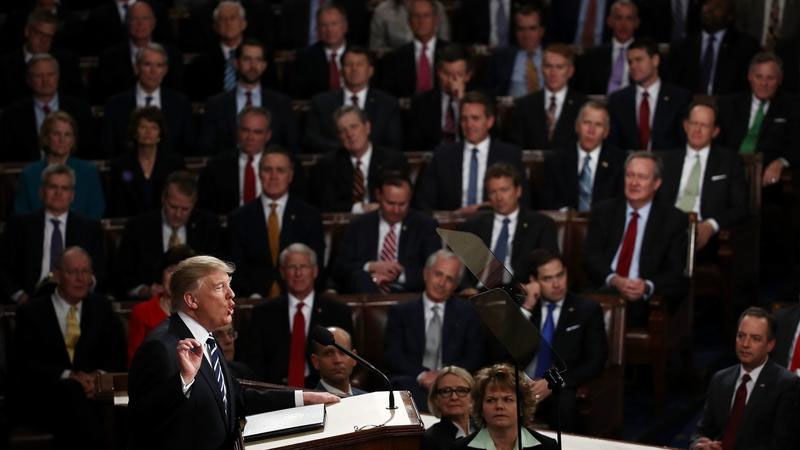
president-trump-addresses-a-joint-session-of-congress-on-tuesday-2-28-17

Trump lays out plan for ‘new chapter of American greatness’ in speech to Congress

by Philip Rucker, Sean Sullivan, Abby Phillip

President Trump sought to repackage his hard-line campaign promises with a moderate sheen in his first joint address to Congress Tuesday night, ushering in what he termed “a new chapter of American greatness” of economic renewal and military might.

Seeking to steady his presidency after a tumultuous first 40 days, Trump had an air of seriousness and revealed flashes of compassion as he broadly outlined a sweeping agenda to rebuild a country he described as ravaged by crime and drugs, deteriorating infrastructure and failing bureaucracies.

Trump’s speech touched on his plans to overhaul the nation’s health-care system and tax code, but was short on specifics. Struggling to steer a bitterly divided nation with his job approval ratings at historic lows, Trump effectively pleaded with the American people to give him a chance and to imagine what could be achieved during his presidency.

“We are one people, with one destiny,” Trump said quietly near the end. “The time for small thinking is over. The time for trivial fights is behind us. We just need the courage to share the dreams that fill our hearts.”

Trump extended olive branches to his opponents. He called on Congress to pass paid family leave, a reference to a long-held Democratic Party priority that brought liberal lawmakers to their feet to applaud. And he pledged to work with Muslim allies to extinguish Islamic State terrorists, going so far as to acknowledge the killings of Muslims as well as Christians in the Middle East.

Still, Trump did not back away from his most controversial policies. He used typically bellicose language to describe the fight against the Islamic State, calling it “a network of lawless savages that have slaughtered Muslims and Christians, and men, women and children of all faiths and all beliefs.”

The president forcefully defended his travel ban — an executive order that was halted in federal court — as necessary to prevent the entry of foreigners who do not share America’s values.

“We cannot allow a beachhead of terrorism to form inside America,” Trump said. “We cannot allow our nation to become a sanctuary for extremists.”

Pulling from his campaign speeches and others since taking office, the president ran off a list of accomplishments since taking office and issued promises for the year ahead.

“Above all else, we will keep our promises to the American people,” he said.

He touted “billions” in new investments by American companies in the weeks since his inauguration, seeking to highlight the actions his administration has taken to keep his campaign promises.

He vowed to usher in “historic” tax reform, as he appeared to nod to a House Republican “border adjustment” plan, but did not explicitly endorse it.

“Currently, when we ship products out of America, many other countries make us pay very high tariffs and taxes — but when foreign companies ship their products into America, we charge them nothing or almost nothing,” said Trump.

The “border adjustment” is shorthand for a House GOP proposal to tax imports, which some Republicans oppose. Trump didn’t use those words in his address. But his remarks could be seen as a hopeful sign for those Republicans hoping he will back it unequivocally.

Trump’s comments were received with some bipartisan applause and some jeers from Democrats, especially during his mention of a lobbying restriction that some feel does not go far enough.

While his speech pulled upon many of his earlier themes, the president seemed more subdued in his delivery, sticking more to the teleprompter and avoiding the bombastic rhetoric of the campaign.

Reiterating a much-repeated campaign promise, Trump vowed midway thorough his speech to “repeal and replace” the Affordable Care Act but stopped short of resolving disagreements among Republicans about how to do that.

While Trump did not explicitly endorse a specific step-by-step approach to repealing and replacing the federal health-care law, he did say that a replacement plan must utilize “tax credits,” which is a victory for House Republicans leaders who have looked at replacing the Obamacare subsidies with such credits.

“We should help Americans purchase their own coverage, through the use of tax credits and expanded Health Savings Accounts — but it must be the plan they want, not the plan forced on them by our government,” said Trump.

Some House and Senate conservatives oppose the idea of creating tax credits. But supporters of it can now turn to Trump’s words as they seek to build support for the idea.

In one of the speech’s tenser moments, House Minority Leader Nancy Pelosi (D-Calif.) who was seated in the audience, looked on, shaking her head as Trump criticized the law. Pelosi helped then-President Barack Obama pass the law and has sharply criticized Republicans for trying to undo it. Trump appeared to be pointing someone out in the crowd when he called the law a “disaster.” It was not immediately clear whether he was singling out Pelosi or someone else.

Trump told a series of stories to highlight his calls for reforms to the Food and Drug Administration and public education.

He pointed to two women who sat in the gallery as a guest of first lady Melania Trump. One who was diagnosed with a rare disease and treated with a new drug. A second who was able to attend a private school and become the first person in her family to graduate from high school and college.

Both anecdotes drew bipartisan applause from members of Congress in the audience.

He also pressed his policies on immigration, including his controversial proposal to build a wall along the U.S.-Mexico border.

“We want all Americans to succeed —- but that can’t happen in an environment of lawless chaos. We must restore integrity and the rule of law at our borders,” said Trump. “For that reason, we will soon begin the construction of a great wall along our southern border. It will be started ahead of schedule and, when finished, it will be a very effective weapon against drugs and crime.”

Trump challenged members of Congress who disagree with him: “I would ask you this question: what would you say to the American family that loses their jobs, their income, or a loved one, because America refused to uphold its laws and defend its borders?”

He did call for Republicans and Democrats to work toward reforming the immigration system into a merit-based program focused on the “well-being of American citizens.”

Trump argued that the country’s current focus on low-skilled immigration hurts American workers and strains the country’s finances.

The comments come hours after Trump said in a meeting with journalists that he would support comprehensive immigration reform efforts with a pathway to legalization for law abiding immigrants.

At his remarks before Congress, Trump did not specify the parameters of a compromise he would be willing to accept. But he outlined a preference for a system that favors immigrants who are able to support themselves financially.

“I believe that real and positive immigration reform is possible, as long as we focus on the following goals: to improve jobs and wages for Americans, to strengthen our nation’s security, and to restore respect for our laws,” Trump said.

Trump also vowed to take on “radical Islamic terrorism,” a divisive term that many have taken issue, arguing it unfairly singles out the Muslim religion.

He also pledged to announce new steps to bolster national security and “keep out those who would do us harm,” weeks after his executive order barring immigration from seven predominantly Muslim countries was halted by a federal judge.

Pointing to statistics on terror convictions by foreigners from the Department of Justice, Trump said that it was “reckless” to allow foreigners into the country who could then perpetrate attacks on Americans.

“We cannot allow a beachhead of terrorism to form inside America — we cannot allow our Nation to become a sanctuary for extremists,” Trump said.

The comments drew mixed reaction from the gathered lawmakers.

Though Trump did not specifically mention the travel ban, he suggested that new efforts to put in place “improved vetting procedures” would be forthcoming.

Later in his speech, there were some audible groans in the crowd as Trump announced that he has ordered the Department of Homeland Security to create on office to address victims of crimes committed by undocumented immigrants. The office is called “VOICE” — which stands for “Victims of Immigration Crime Engagement.”

As he often did on the campaign trail, Trump mentioned Jamiel Shaw, whose teenage son was killed by an undocumented immigrant.

Central to Trump’s promise to strengthen the nation’s security is a proposal to massively infuse the military with new spending, including eliminating the defense sequester, which had put caps on military spending.

Trump this week announced that his budget would include a request for a $54 million increase in military spending accompanied by corresponding cuts in other parts of government.

“To keep America safe we must provide the men and women of the United States military with the tools they need to prevent war and —- if they must —- they have to fight and they only have to win,” Trump said.

In a highly emotional moment, President Trump lead an extended tribute to a U.S. Navy SEAL William “Ryan” Owens, the first U.S. service member to die in the line of duty during Trump’s administration.

With Owens’s widow, Carryn, sitting in the audience, Trump called him “a warrior and a hero” who gave his life for his nation.

“Ryan’s legacy is etched into eternity,” Trump said. “For as the Bible teaches us, there is no greater act of love than to lay down one’s life for one’s friends.

“Ryan laid down his life for his friends, for his country, and for our freedom — we will never forget Ryan,” Trump added.

The comments, which were received with protracted applause, come in the midst of a tense time for Trump. Owens died during a raid in Yemen that left him and civilians dead, prompting a series of investigations by the Defense Department.

Owens’s father, William Owens, has also spoken out against the raid, questioning why it was authorized so quickly after Trump came into office.

Trump defended the raid on Tuesday, saying that his Defense Secretary Jim Mattis recently told him that it was a “highly successful raid that generated large amounts of vital intelligence that will lead to many more victories in the future against our enemies.”

As Trump spoke, Owens’ widow stood and wept openly as the room applauded her.

While not delving too much into foreign policy during his speech, the president said the United States was willing to “find new friends” and noted that the U.S. has forged relationships with former enemies.

The comment came as growing intrigue rises about possible ties his campaign had to Russia and its efforts to influence the election.

While he did not mention Russia explicitly, the comments were reminiscent of what Trump often said on the campaign trail — that it would be a good thing for the United States to have a productive relationship with Russia, even as many U.S. lawmakers in both parties remain deeply skeptical of the Russian government’s intentions.

Trump began the night by strongly denouncing recent threats to Jewish community centers across the country and condemned a recent attack on Indian immigrants in Kansas.

“We are a country that stands united in condemning hate and evil in all its forms,” Trump said.

His speech quickly turned, however, as he declared that the “earth shifted beneath our feet” in 2016 as he took a victory lap over his election victory and nodded to his signature campaign themes.

“The chorus became an earthquake — and the people turned out by the tens of millions, and they were all united by one very simple, but crucial demand, that America must put its own citizens first,” said Trump.

The president closed his speech with a call for unity and an end to “trivial fights,” a comment that, coming from a president known for carrying out small feuds with his detractors on social media, elicited groans from some lawmakers.

Trump seemed to indicate that his speech represented a dawning of a new phase for the country and for his presidency.

“We will look back on tonight as when this new chapter of American Greatness began,” Trump said. “I am asking all citizens to embrace this Renewal of the American Spirit. I am asking all members of Congress to join me in dreaming big, and bold and daring things for our country.

“And I am asking everyone watching tonight to seize this moment,” Trump concluded.

Mike DeBonis and Kelsey Snell contributed to this report.

Nazi Laws were Based on Racist American Statutes

There is no back up information to support this opinion writer’s contentions.  However, as I have written previously, the United States has a history of discrimination against minorities.  The latest desecration of a Jewish cemetery in Missouri and the threatened attacks on mosques and Jewish community centers is no surprise to me. White American Christians have viewed all others as a threat to America since its founding.  What troubles me about posting this opinion piece is its impact on those outside the United States that are reading the commentary.  I hope some of you post some responses.

When the Nazis wrote the Nuremberg laws, they looked to racist American statutes

By James Q. Whitman, Los Angeles Times opinion page, February 22, 2017

The European far right sees much to admire in the United States, with political leaders such as Marine le Pen of France and Geert Wilders of the Netherlands celebrating events — such as the recent presidential election — that seem to bode well for their brand of ethno-nationalism. Is this cross-Atlantic bond unprecedented? A sharp break with the past? If it seems so, that’s only because we rarely acknowledge America’s place in the extremist vanguard — its history as a model, even, for the very worst European excesses.

In the late 1920s, Adolf Hitler declared in “Mein Kampf” that America was the “one state” making progress toward the creation of a healthy race-based order. He had in mind U.S. immigration law, which featured a quota system designed, as Nazi lawyers observed, to preserve the dominance of “Nordic” blood in the United States.

The American commitment to putting race at the center of immigration policy reached back to the Naturalization Act of 1790, which opened citizenship to “any alien, being a free white person.”  But immigration was only part of what made the U.S. a world leader in racist law in the age of Hitler.

Then as now, the U.S. was the home of a uniquely bold and creative legal culture, and it was harnessed in the service of white supremacy. Legislators crafted anti-miscegenation statutes in 30 states, some of which threatened severe criminal punishment for interracial marriage.  And they developed American racial classifications, some of which deemed any person with even “one drop” of black blood to belong to the disfavored race. Widely denied the right to vote through clever devices like literacy tests, blacks were de facto second-class citizens. American lawyers also invented new forms of de jure second-class citizenship for Filipinos, Puerto Ricans and more.

European racists followed these toxic innovations with keen interest. Of course they were well aware that America had strong egalitarian traditions, and many of them predicted that American race law would prove inadequate to stem the rising tide of race-mixing. Hitler, however, was cautiously hopeful about America’s future as a white supremacist state, and after he took power in 1933 his Nazi Party displayed the same attitude.

This is the background to a disturbing story: the story of the American influence on the Nuremberg Laws, the notorious anti-Jewish legislation proclaimed amid the pageantry of the Nazi Party Rally at Nuremberg in September of 1935.

At a crucial 1934 planning meeting for the Nuremberg system, the Minister of Justice presented a memorandum on American law.  According to a transcript, he led a detailed discussion of miscegenation statutes from all over the United States. Moreover it is clear that the most radical Nazis were the most eager advocates of American practices. Roland Freisler, who would become president of the Nazi People’s Court, declared that American jurisprudence “would suit us perfectly.”

And the ugly irony is that when the Nazis rejected American law, it was often because they found it too harsh.  For example, Nazi observers shuddered at the “human hardness” of the “one drop” rule, which classified people “of predominantly white appearance” as blacks.  To them, American racism was sometimes simply too inhumane.

That may sound implausible — too awful to believe — but in their early years in power, the Nazis were not yet contemplating the “final solution.” At first, they had a different fate in mind for the German Jewry:  Jews were to be reduced to second-class citizenship and punished criminally if they sought to marry or engage in sexual contact with “Aryans.”  The ultimate goal  was to terrify Germany’s Jews into emigrating.

And for that program, America offered the obvious model — even if, as one Nazi lawyer put it in 1936, the Americans had “so far” not persecuted their Jews.  Of course the Nazis did not simply do a cut-and-paste job, in part because much of American law avoided open racism. (Laws intended to keep blacks from the polls did not explicitly name their target.) But American anti-miscegenation law was frankly racist, and the Nazi criminalization of intermarriage followed the American lead.

In a sense, this ugly tale about the history of American racism is also about American innovation gone awry. Today, we’re leaders in the creation of corporate law; back then, it was race law. Other countries, such as Australia, put legislative obstacles in the way of mixed marriages, but the United States went so far as to threaten long prison terms.

And we must not forget how tenaciously the racist rulebook that the Nazis admired held on in the United States. Anti-miscegenation laws were only struck down at the tail end of the civil rights era, in 1967. Race-based immigration policies did not fully end until 1968 — long after the Greatest Generation stormed the beaches of Normandy and liberated Nazi death camps.

James Q. Whitman is a professor of comparative and foreign law at Yale Law School. He is the author of “Hitler’s American Model: The United States and the Making of Nazi Race Law.”  

How to Destroy the Republic

Sen. John McCain, R-Ariz. listens during a news conference on Capitol Hill in Washington, Wednesday, March 28, 2012, to discuss a Congressional resolution condemning the government of Syria for crimes against humanity and supporting the right of the people of Syria to be safe and to defend themselves. (AP Photo/Jacquelyn Martin)

Senator John McCain, a conservative Republican from Arizona, slammed President Donald Trump’s attacks on the media this week by noting dictators “get started by suppressing free press.”

“I hate the press,” the Arizona Republican sarcastically told NBC News’ Chuck Todd on “Meet the Press.” “I hate you especially. But the fact is we need you. We need a free press. We must have it. It’s vital.”

But he continued, “If you want to preserve — I’m very serious now — if you want to preserve democracy as we know it, you have to have a free and many times adversarial press,” McCain said in the interview. “And without it, I am afraid that we would lose so much of our individual liberties over time. That’s how dictators get started.”

“They get started by suppressing free press, in other words, a consolidation of power — when you look at history, the first thing that dictators do is shut down the press,” McCain said. “And I’m not saying that President Trump is trying to be a dictator. I’m just saying we need to learn the lessons of history.”

Imagine if President Trump announced that he wanted to oust California from the United States. If it weren’t for us, after all, Trump would have won the popular vote he so lusts after by 1.4 million votes. Trump just might be happy with the Calexit petition. Petition signature gathering for a “Calexit” vote was approved by the California Secretary of State on January 27. If approved by California voters it would begin the long, multi-step process for withdrawing California from the United States.

Read those 14 Characteristics Of Fascism listed on this web site and elsewhere and tell me Donald Trump is not on the path to creating a dictatorship.

33 false things Donald Trump has said as president so far

donald-trump-2-3-17


U.S. President Donald Trump has a history of saying false things, big and small. Canada’s Toronto Star newspaper’s Washington Bureau reporter Daniel Dale has been tracking them all.

This is Mr. Dale’s current running tally of the bald-faced lies, exaggerations and deceptions the president of the United States of America has said, so far.

33. Feb. 3, 2017 — Twitter
The claim: “Thank you to Prime Minister of Australia for telling the truth about our very civil conversation that FAKE NEWS media lied about.”
In fact: The media did not lie about their phone call, which was not civil. A senior Trump official acknowledged to the Washington Post that it had been “hostile and charged,” and prominent news outlets in both countries reported that Trump had berated Malcolm Turnbull. Turnbull denied that Trump had “hung up” on him, but he did not deny that the call had ended abruptly after 25 minutes, as the Post reported. “Was it cut short?” an Australian radio host pressed Turnbull. “The call ended courteously. That’s all I want to say about that,” Turnbull responded.

32. Feb. 2, 2017 — White House meeting with Harley-Davidson
The claim: “I love Australia as a country, but we had a problem where for whatever reason, President Obama said that they were going to take probably well over 1,000 illegal immigrants who were in prisons, and they were going to bring them and take them into this country. And I just said, ‘Why?’…1,250. It could be 2,000, it could be more than that.”
In fact: The people in question are refugees, not illegal immigrants, who are living in island detention centres off of Australia. As Australia’s prime minister repeatedly told Trump, and as Trump’s own press secretary concurred, the agreement covers 1,250 people, not 2,000.

31. Feb 2, 2017 — Twitter
The repeated claim: “Do you believe it? The Obama Administration agreed to take thousands of illegal immigrants from Australia.”
In fact: The people in question are refugees, not illegal immigrants; the agreement covers 1,250 people, not “thousands.”

30. Feb. 2, 2017 — Twitter
The claim: “Iran was on its last legs and ready to collapse until the U.S. came along and gave it a lifeline in the form of the Iran Deal: $150 billion.”
In fact: Iran was nowhere near collapse before it signed the 2015 nuclear deal with the U.S. and five other major countries. Iran did not get $150 billion in the deal. Rather, a smaller amount of Iranian assets were unfrozen. The Treasury Department told Congress in 2015 that total Iranian assets were estimated at $100 billion to $125 billion; it put the “usable liquid assets” at around $50 billion. John Kerry, then the secretary of state, said Iran would get about $55 billion.

29. Jan. 30, 2017 —Remarks at the White House
The claim: “But we cut approximately $600 million off the F-35 fighter, and that only amounts to 90 planes out of close to 3,000 planes. And when you think about $600 million, it was announced by Marillyn (Hewson), who’s very talented, the head of Lockheed Martin. I got involved in that about a month ago. A lot was put out, and when they say a lot, a lot meant about 90 planes. They were having a lot of difficulty. There was no movement and I was able to get $600 million approximately off those planes.”
In fact: Whether or not Trump secured additional discounts from Lockheed, he is wrong that there had been “no movement” until he got involved: the company had been moving to cut the price well before Trump was elected, multiple aviation and defence experts say. Just a week after Trump’s election, the head of the F-35 program announced a reduction of 6 to 7 per cent — in the $600 million to $700 million range.
“Trump’s claimed $600 million cut is right in the ballpark of what the price reduction was going to be all along,” wrote Popular Mechanics. “Bottom line: Trump appears to be taking credit for years of work by the Pentagon and Lockheed,” Aviation Week reported, per the Washington Post.

28. Jan. 30, 2017 — Twitter
The claim: “Only 109 people out of 325,000 were detained and held for questioning. Big problems at airports were caused by Delta computer outage, protesters and the tears of Senator Schumer.”
In fact: This is false and misleading in multiple ways. The Delta computer outage happened a full day and a half after the chaos over Trump’s ban on all new refugees and on travel by nationals from seven mostly Muslim countries. The peaceful protesters at airports did not cause “big problems.” Nor, of course, did Schumer’s emotional speech.
In reality, the poorly explained order caused confusion around the word, resulting in hassles at airports and beyond for tens of thousands of people — far more than were detained upon entry. And while it is not clear if Trump was correct that “only” 109 people had been detained at the time, Homeland Security officials said a day later that 721 people had been denied boarding.

27. Jan. 29, 2017 — Facebook statement on travel ban affecting seven predominantly Muslim countries
The claim: “My policy is similar to what President Obama did in 2011 when he banned visas for refugees from Iraq for six months.”
In fact: Trump is wrong that Obama “banned” Iraqi refugees. After two Iraqi refugees were arrested on terrorism charges, Obama increased scrutiny of new refugee applicants, slowing down the process significantly, but did not ban Iraqis entirely or ban all new refugees. Iraqi refugees were admitted to the U.S. in every month of 2011, government figures show, and 9,388 were admitted in total in 2011.

26. Jan. 28, 2017 — Twitter
The claim: “Thr (sic) coverage about me in the @nytimes and the @washingtonpost gas (sic) been so false and angry that the times actually apologized to its dwindling subscribers and readers.”
In fact: This claim is false in two ways. First, the Times’ subscriber base is growing, not dwindling: the company says it added more than 300,000 subscribers in the fourth quarter of 2016. Second, the Times never apologized for its Trump coverage; Trump was referring to a post-election letter, a kind of sales pitch, in which Times leaders thanked readers and said they planned to “rededicate ourselves to the fundamental mission of Times journalism.”

25. Jan. 27, 2017 — Interview with Christian Broadcasting Network’s David Brody
The claim: “Do you know if you were a Christian in Syria it was impossible, very very, at least very very tough to get into the United States? If you were a Muslim you could come in, but if you were a Christian, it was almost impossible.”
In fact: There is no basis for the claim that U.S. authorities are treating Christian applicants from Syria worse than they treated Muslims. While a very small percentage of the Syrian refugees accepted by the U.S. in 2016 were Christian — 0.5 per cent, according to FactCheck.org — Christians make up a similarly tiny percentage of the Syrian refugees in nearby countries: 1.5 per cent in Lebanon, 0.2 per cent in Jordan.

24. Jan. 27, 2017 — Interview with Christian Broadcasting Network’s David Brody
The claim: “The Cuban-Americans — I got 84 per cent of that vote, and they voted in big numbers.”
In fact: Trump got nowhere near that percentage of the Cuban-American vote. Writes NBC: “According to exit polls, Trump won 54 per cent of the Cuban American vote in Florida, where two-thirds of people of Cuban descent live. Latino Decisions’ election eve poll showed he got about 48 per cent of the Cuban American vote nationally and 52 per cent in Florida.”

23. Jan. 27, 2017 — Press conference with United Kingdom Prime Minister Theresa May
The claim: “I happened to be in Scotland at Turnberry cutting a ribbon when Brexit happened and we had a vast amount of press there. And I said Brexit — this was the day before, you probably remember, I said Brexit is going to happen and I was scorned in the press for making that prediction. I was scorned.”
In fact: Trump was not in Scotland the day before the Brexit vote. He was there the day after. When he was asked about Brexit the day before the vote, he told Fox Business, “I don’t think anybody should listen to me because I haven’t really focused on it very much.” He did not venture a prediction that day.

22. Jan. 26, 2017 —Interview with Fox News’s Sean Hannity
The claim (on companies creating jobs): “Here’s another thing with the media. ‘Oh, they would’ve done it anyway. They weren’t going to do it.’ You see, Jack Ma. He had no intention of doing it until I got elected. And he went down and he said, ‘I’m only going to do this because of Donald Trump.’ And nobody put that in the papers, which is OK.”
In fact: It is not exactly clear whether Ma made his proposal to “create one million” U.S. jobs as a direct result of Trump’s election, but Trump’s claim about media bias is false regardless: upon coming down the elevator at Trump Tower, Ma, the executive chairman of Chinese e-commerce company Alibaba, did not actually tell reporters that he had made the proposal “because of Donald Trump.” He said nothing of that sort at all.

21. Jan. 26, 2017 — Interview with Fox News’s Sean Hannity
The claim: “And a wall protects. All you have to do is ask Israel. They were having a total disaster coming across and they had a wall. It’s 99.9 per cent stoppage.”
In fact: Exact numbers do not exist, but Israel’s barrier with the West Bank stops far fewer than “99.9 per cent” of people who seek to cross. The New York Times reported at length last year on “a thriving smuggling industry that allows untold numbers of people to pass over, under, through or around what Israelis call the security barrier.” A police spokesman said “hundreds” of illegal crossers were detained every week.

20. Jan. 26, 2017 — Interview with Fox News’s Sean Hannity
The claim (on refugees): “We’ve taken in tens of thousands of people. We know nothing about them. They can say they vet them. They didn’t vet them. They have no papers. How can you vet somebody when you don’t know anything about them and you have no papers?”
In fact: Refugees to the U.S. are rigorously vetted. The process includes multiple kinds of background and security checks and at least two interviews with U.S. representatives. Regardless of their paperwork situation, and regardless of one’s opinion on how good the vetting is, the U.S. knows far more than “nothing” about the refugees it approves.

19. Jan. 26, 2017 —Speech to Republican legislators at retreat in Philadelphia
The claim: “Here in Philadelphia, the murder rate has been steady — I mean, just terribly increasing.”
In fact: The number of Philadelphia homicides in 2016, 277, was actually down from the 280 in 2015. While both years represented an increase from 2013 (246 homicides) and 2014 (248 homicides), the overall trend has been downward: Philadelphia had 391 homicides in 2007 and 331 in 2008. The number of homicides as of Jan. 31, 30, was higher than the 19 at the same time in 2016 but about the same as the 27 in 2015. Regardless, the murder rate is never calculated on a month of data.

18. Jan. 25 — Interview with ABC’s David Muir
The claim (about Chicago): “So, look, when President Obama was there two weeks ago making a speech, very nice speech. Two people were shot and killed during his speech. You can’t have that.”
In fact: There were not only no homicides during Obama’s speech but no shootings at all, the Chicago Tribune reported based on police data.

17. Jan. 25, 2017 — Interview with ABC’s David Muir
The claim: “Look, Barack Obama — if you look back, eight years ago when he first ran — he was running for office in Chicago … and he was laughing at the system because he knew all of those votes were going to him … he was smiling and laughing about the vote in Chicago.”
In fact: This is a gross mischaracterization of Obama’s remarks and behaviour during the 2008 campaign. He did not laugh or smile about the voting system in Chicago, and he did not suggest in any way that he was going to be receiving fraudulent votes. He acknowledged that his party had sometimes “monkeyed” with Chicago elections “in the past.”

16. Jan. 25, 2017 — Interview with ABC’s David Muir
The claim: Regarding voting fraud: “You look at Philadelphia, you look at what’s going on in Philadelphia.”
In fact: There is no evidence of a significant voter fraud problem in Philadelphia.

15.Jan. 25, 2017 — Interview with ABC’s David Muir
The claim: Regarding voting fraud: “Chicago, look what’s going on in Chicago. It’s only gotten worse.”
In fact: There is no evidence of a significant voter fraud problem in Chicago, and there is no evidence that its voting system has become increasingly plagued by fraud.

14.Jan. 25, 2017 — Interview with ABC’s David Muir
The claim: Regarding his false claim of “millions” of possible illegal voters: “Those were Hillary votes. And if you look at it they all voted for Hillary. They all voted for Hillary. They didn’t vote for me. I don’t believe I got one. OK, these are people that voted for Hillary Clinton.”
In fact: These large numbers of illegal voters did not “all” vote for Clinton because they do not exist. Even if they did, it would be impossible for Trump to know that not a single one voted for him, since the ballot is secret. This claim is simply absurd.

13.Jan. 25, 2017 — Interview with ABC’s David Muir
The claim: “Now you’re telling me Pew report has all of a sudden changed.”
In fact: Trump was trying to use a 2012 Pew report as supposed evidence of widespread voter fraud. Muir told him he was wrong — not because the report changed but because it never showed what Trump falsely claims it showed. “The Pew study I directed doesn’t address voter fraud at all,” report leader David Becker told the Washington Post this weekend. Rather, the study addresses non-fraud voter registration issues, such as people remaining on one state’s rolls after they move to another.

12.Jan. 25, 2017 — Interview with ABC’s David Muir
The claim: Muir: “I called the author of the Pew report last night. And he told me that they found no evidence of voter fraud.” Trump: “Really? Then why did he write the report?” Muir: “He said no evidence of voter fraud.” Trump: “Excuse me, then why did he write the report? According to Pew report, then he’s — then he’s grovelling again.”
In fact: Grovelling means “to draw back or crouch down in fearful submission.” Becker is doing the opposite: publicly explaining his work, and explaining why the president is wrong.

11. Jan. 25, 2017 — Interview with ABC’s David Muir
The claim: Regarding Healthcare.gov: “Remember the $5 billion website?”
In fact: Healthcare.gov did not cost $5 billion. The Obama administration offered a figure of less than $1 billion, while an analysis by Bloomberg found that it cost just over $2 billion.

10.Jan. 25, 2017 — Interview with ABC’s David Muir
The claim: With regard to his speech to the Central Intelligence Agency earlier in the week: “They showed the people applauding and screaming and they were all CIA. There was — somebody was asking (press secretary) Sean (Spicer) – ‘Well, were they Trump people that were put’ — we don’t have Trump people. They were CIA people.”
In fact: Most of the audience was indeed made up of CIA personnel, but Trump is wrong that there were no “Trump people.” Spicer told the press that “maybe 10” people in attendance were part of Trump’s entourage; CBS News reported that an official familiar with the event said Spicer was inaccurate, as Trump and his allies brought about 40 people.

9.Jan. 25, 2017 — Interview with ABC’s David Muir
The claim: “I think you’re demeaning by talking the way you’re talking. I think you’re demeaning. And that’s why I think a lot of people turned on you and turned on a lot of other people. And that’s why you have a 17 per cent approval rating, which is pretty bad.”
In fact: Saying “you” here, Trump wrongly conveys the impression that Muir himself has 17 per cent approval. In fact, there is no polling on Muir. Trump appears to have actually been referring to a 2016 poll about Americans’ views on the media. In that poll, the media’s approval rating was 19 per cent.

8. Jan. 25, 2017 — Interview with ABC’s David Muir
The claim: “No, no, you have to understand, I had a tremendous victory, one of the great victories ever. In terms of counties I think the most ever, or just about the most ever.”
In fact: Trump’s victory was not close to one of the biggest of all time. He lost the popular vote, and his Electoral College margin ranks 46th out of 58 elections. Trump did far better in terms of counties, winning more than any candidate since Ronald Reagan, but he was well short of setting the record or even “just about” tying it: Richard Nixon won more than 2,950 counties in 1972, far exceeding Trump’s 2,623.

7.Jan. 25, 2017 — Interview with ABC’s David Muir
The claim: “In terms of a total audience including television and everything else that you have we had supposedly the biggest crowd in history. The audience watching the show. And I think you would even agree to that. They say I had the biggest crowd in the history of inaugural speeches.”
In fact: “They” can mean anyone, but no expert is declaring that Trump had the biggest inauguration crowd in history. Obama’s 2009 inauguration drew far more people in person and far more television viewers. Trump’s claim relies on the people who watched the inauguration on online streams. It is possible that these people gave him a record, but it is impossible to know for sure.

6. Jan. 23, 2017 — Private meeting with Congressional leaders
The claim: Trump told Congressional leaders that “he lost the popular vote to Hillary Clinton in last November’s election because between three million and five million ‘illegals’ cast ballots, multiple sources told Fox News.”
In fact: This claim, also reported by numerous other major media outlets, simply has no basis in reality. Trump’s own lawyers said in a legal filing that “all available evidence suggests that the 2016 general election was not tainted by fraud.” The National Association of Secretaries of State — the state officials who run elections — said they “are not aware of any evidence that supports the voter fraud claims made by President Trump.”

5. Jan. 21, 2017 — Speech at Central Intelligence Agency headquarters
The claim: “So a reporter for Time magazine — and I have been on their cover, like, 14 or 15 times. I think we have the all-time record in the history of Time Magazine. Like, if Tom Brady is on the cover, it’s one time, because he won the Super Bowl or something, right? I’ve been on for 15 times this year. I don’t think that’s a record, Mike, that can ever be broken. Do you agree with that?”
In fact: Trump’s numbers are well off. He has been on the cover 11 times, Time told Politico, which is not even close to a record: Richard Nixon was on 55 covers. Even if we generously give Trump a pass here — he said he was on covers “like” 14 or 15 times, and he wasn’t sure if he had a record — he his claim about this year is flat wrong. Trump was on eight covers in 2016 and another one on the 2017 week he was speaking here — so either eight or nine total, depending on how you count, not 15.

4. Jan. 21, 2017 — Speech at Central Intelligence Agency headquarters
The repeated claim: “It was almost raining, the rain should have scared em away, but God looked down and He said, we’re not going to let it rain on your speech. In fact, when I first started, I said oh no. First line, I got hit by a couple of drops, and I said this is too bad … but the truth is that, it stopped immediately, it was amazing, and then it became really sunny.”
In fact: Neither of these claims is true. The rain did not stop immediately, and the sky then remained cloudy.

3. Jan. 21, 2017 — Speech at Central Intelligence Agency headquarters
The repeated claim: “Honestly, it looked like a million and a half people. Whatever it was it was, but it went all the way back to the Washington Monument.” Later: “…all the way back to the Washington Monument, was packed.”
In fact: The crowd, which may not have even been half a million people strong, did not come close to reaching the Washington Monument.

2. Jan. 20, 2017 — Post-inauguration Salute To Our Armed Services Ball
The claim: “Even the media said the crowd was massive … that was all the way back down to the Washington Monument.”
In fact: The major media reported that the crowd was much smaller than Barack Obama’s two inauguration crowds, though in line with the inaugurations of other Republicans. The crowd did not come close to reaching the Washington Monument.

1. Jan. 20, 2017 — Post-inauguration Liberty Ball
The claim: “I looked at the rain, which just never came. We finished the speech, went inside, it poured … it’s like God was looking down on us.”
In fact: The rain began right at the beginning of Trump’s speech. During the inauguration itself, Rev. Franklin Graham told Trump, “Mr. President, in the bible, rain is a sign of God’s blessing. And it started to rain, Mr. President, when you came to the platform.”

The Big Lie

A big lie (German: große Lüge) is a propaganda technique. The expression was coined by Adolf Hitler, when he dictated his 1925 book Mein Kampf, about the use of a lie so “colossal” that no one would believe that someone “could have the impudence to distort the truth so infamously.”

“If you tell a lie big enough and keep repeating it, people will eventually come to believe it. The lie can be maintained only for such time as the State can shield the people from the political, economic and/or military consequences of the lie. It thus becomes vitally important for the State to use all of its powers to repress dissent, for the truth is the mortal enemy of the lie, and thus by extension, the truth is the greatest enemy of the State.” Joseph Goebbels

Joseph Goebbels, launched a massive campaign to convince the German people that the Jews were their enemies. Having taken over the press, they spread lies blaming Jews for all of Germany’s problems, including the loss of World War I. One outrageous lie dating back to the Middle Ages claimed that Jews engaged in the ritual killings of Christian children and used their blood in the unleavened bread eaten at Passover [source: Landau].

Donald Trump is proving himself to be a fabricator of colossal untruths and an expert liar. Here’s a partial list of false statements he has made: The United States is about to take in 250,000 Syrian refugees; African-Americans are responsible for most white homicides; and during the 9/11 attacks, “thousands and thousands” of people in an unnamed “Arab” community in New Jersey “were cheering as that building was coming down.”

Despite photographs taken at the same time from the same location, Donald Trump’s press secretary insisted that the crowd at the Trump inauguration was at least as big as the crowd at the 2008 inauguration of Barack Obama.

2009-inaugeration-left-2017-inaugeration-right
2009 inauguration left   2017 inauguration right

President Donald Trump believes millions of votes were cast illegally in last year’s election. White House press secretary Sean Spicer said that on Tuesday, but he wouldn’t provide any concrete evidence for the claim, which has long been debunked. “The President does believe that, I think he’s stated that before, and stated his concern of voter fraud and people voting illegally during the campaign and continues to maintain that belief based on studies and evidence people have brought to him,” Spicer said.

“Alternative facts” are the words used by Kellyann Conway when confronted by many Sunday morning news shows are all part of the big lie strategy.

Donald Trump’s win of the presidency is not in doubt. No Democrats challenged the election results. Why is he besmirching his win? Will he continue to offer his own reality on other situations?

donald-trump-always-self-confident

Perhaps Trump’s focus on his election results is simply Vanity. Merriam Webster definition: the quality of people who have too much pride in their own appearance, abilities, achievements, etc. : the quality of being vain. : something (such as a belief or a way of behaving) which shows that you have too much pride in yourself, your social status, etc.

What will happen when President Donald Trump is confronted with a foreign leader who challenges his position or ideas? I fear the consequences for the United States.

Dear Mr. Trump

This is a very funny and entertaining letter to Donald Trump.  It was printed in the Los Angeles Times on January 19, 2017.

By Ariel Dorfman

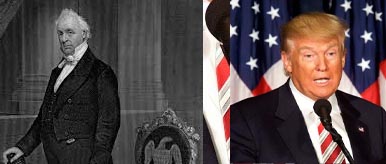
james-buchanan-donald-trump

Sir: How long have I waited for your advent, prayed for someone like you to come along? All these years, since my death in 1868, I have watched each election cycle, hoping that finally my savior would appear, a man — heaven forbid it should be a woman! — who would rescue me from my status as the worst president in the annals of the United States.


Limited as your knowledge of our past may be, surely you are aware that I have been blamed for the secession of the Southern states in 1861, just as my term was ending. Unfairly faulted for the Civil War that ensued, I am now relieved to know that the presidency will soon be in the hands of someone who will, I am certain, go down in history as a leader who most bitterly divided the nation and wreaked havoc with the foundations of our democracy.


I am excited, indeed, about your chances of outshining me. If you persist in your campaign to drill, extract and pollute, if you enable the climate deniers and help to overheat our spacious skies, you will have led us, not to the brink of a conflagration that killed a mere million, but to a more substantial achievement of worldwide significance: taking the whole of humanity to the brink of extinction. That is a record that will considerably exceed my own lapses and make me seem a paragon of wisdom to future citizens (at least, those who survive).

As to the peoples’ daily lives, you are likely to far surpass the harm I have wrought there as well. Many families cursed my name as they received news of their maimed or dead kin, but many more will curse yours when their well-being deteriorates as you assault the country’s healthcare system.


Regarding corruption, I am also hopeful you will outstrip me. My offenses (accused of bribery, extortion and abuse of power by a congressional committee) will be deemed petty compared to those that loom for you, guaranteeing an administration rife, at all levels, with sleaze and conflicts of interest. But do not tarry over your manifest financial or ethical dilemmas. I managed to avoid impeachment and so will you, given your proven ability to convince your supporters that facts do not matter. Would that such talents had been bestowed upon me, and oh that television and social media had been invented in my day. I could have blamed Mexico for our Civil War.


Could you address two other matters? The first is abortion. It was during my presidency, in 1859, that the American Medical Assn. urged the criminalization of women who terminated their pregnancies, and you have the chance to revert our laws and customs to that pristine moment when the gentle sex recognized that their bodies belonged to their menfolk. And then Cuba. I tried in vain to buy that island from Spain and then favored invading it. You can complete my dream. Extend the reach of our empire into the Caribbean and beyond, intervene vigorously in the affairs of enemy and allied nations. Pay special attention to China, where I made the mistake of being only marginally involved in the Second Opium War. I am sure you will do better when you engage the Chinese in the First Asian Trade War.


I am not alone in urging you to stubbornly follow your instincts. Other deceased presidents also entertain high expectations for your reign. Richard Nixon wishes that your slurs and insults would make people forget his own foul language, and he eagerly anticipates manifold Trumpgates that will make Watergate seem small potatoes. Warren G. Harding is certain that your outrages will go far beyond the Teapot Dome scandal, which fraudulently favored the oil companies. And Herbert Hoover, reviled for ignoring the oncoming Great Depression, is confident you will be even more obtuse, and when you precipitate a worse economic catastrophe his actions will thus appear less disastrous. He expects you will also best him in union-busting and the massive deportation of immigrants.


Presidents who occupy the top tier of favorite leaders, including several Founding Fathers, have reproached me for appealing to what they call the worst angels of your nature. They are preparing a collective message counseling moderation and praying that you are not further deranged by the power of your high office.


Franklin Roosevelt believes that informing you that he regrets the internment of Americans of Japanese origin will discourage you from a roundup of Muslim Americans. Harry Truman, haunted by the ghosts of Hiroshima, would press you to abolish nuclear weapons instead of starting a devastating arms race. Dwight Eisenhower intends to reiterate his warning against the military-industrial complex — so naïve, our Ike, unable to realize that representatives of those powers are about to be blatantly ensconced in your Cabinet. And Mr. Lincoln, whose party you have terribly transmogrified, trusts that if he were to whisper daily guidance in your ear, the Republic might, once more, be saved.


I have no doubt that you will not heed him or any other meddling altruist.


After all, I send these words of encouragement inspired by your own example. You have taught me that it is better to bolster one’s image in the Presidential Celebrity Sweepstakes than to sacrifice oneself for the good of the country.


And so, farewell, until the moment you join the former presidents on the other side of death, when I will be delighted to steer you to the very bottom of the heap, where I have languished for a century and a half. What a pleasure finally to be able to look down upon someone who has done damage to the United States in ways unimaginable to me in my most desolate dreams.


With my sincere thanks for all your efforts to rescue me from the nethermost abyss and from the title worst of the worst, I am, sir, your humble servant,
James Buchanan

Ariel Dorfman’s latest book is the memoir “Feeding on Dreams.” He and his wife divide their time between Chile and North Carolina, where he is emeritus professor of literature at Duke University.

Why there is No Peace between Israelis and Palestinians

This posting is motivated by the United Nations Security Council condemnation of Israel’s decision to build new housing in Israel occupied West Bank.

The story is old but people reading this blog need to understand how Israelis and Palestinians have come to this sorry place in history.  This is not a complete history of all the wars fought between Arabs and Israel. Nor is there any reference to Hamas and Hezbollah in this discussion, who are both sworn enemies of Israel.

  • When the state of Israel was created by an action of the United Nations in 1948 the Arab population in that area refused to recognize the creation of a Jewish state. Immediately after Israel declared itself a state the surrounding nations attacked.  Arabs lost that war.
  • In 1967 the Arab nations surrounding Israel gathered armies on the borders of Israel in preparation to invade. Those countries were Syria, Jordan, and Egypt.  The Israelis actually started the war before the Arab countries attacked.  Israel won that war driving the Syrians out of the immediately adjoining area, pushing the Jordanians to the east of the Jordan River and taking all of the Sinai Peninsula from Egypt and occupying all the land of Egypt to the Suez Canal.  In the process Israel also occupied parts of southern Lebanon.
  • Israel reached an agreement with Egypt to withdraw from all of the land they had won in the 1967 War in exchange for Egyptian recognition of the State of Israel. The EgyptIsrael Peace Treaty was signed in Washington, D.C., United States on 26 March 1979, following the 1978 Camp David Accords.
  • The Jordan-Israel Peace Treaty was signed on October 26, 1994, at the southern border crossing of Wadi ‘Araba. The treaty guaranteed Jordan the restoration of its occupied land (approximately 380 square kilometers), as well as an equitable share of water from the Yarmouk and Jordan rivers. Moreover, the treaty defined Jordan’s western borders clearly and conclusively for the first time.
  • Israel remains in control of what was part of Jordan, the area west of the Jordan River, and Gaza, a small strip of land along the Mediterranean Sea that had previously been controlled by Egypt, and the Golan Heights that were previously part of Syria.
  • Israel withdrew its settlements in Gaza in 2005. That amounted to about 8,500 people being relocated in the hopes of bringing some peace to that area. Repeated missile attacks from Gaza into Israel’s pre-1967 territory has resulted in repeated bombing of the area by the Israeli Defense forces.  The most recent bombing occurred in 2014.
  • Efforts to create a two state solution between Israel and the occupied Arab territories have been unsuccessful primarily because the leadership of the Palestinians refuse to recognize Israel’s right to exist.
  • Israelis take the position that the spoils of war is they get to decide what happens in the areas they occupy. Thus building Jewish communities in areas that are primarily Palestinians is a fair consequence of the wars they have won.  The rest of the world through the United Nations disagrees.
  • Neither Israelis nor Palestinians trust their opponents to honor their words.

Hatred makes a peace agreement an unlikely outcome in the next few years.  New leadership for both Israel and the Palestinians is the only hope for a settlement and permanent peace.

Happy New Year

David Bancroft

Bill O’Reilly admits that he is a Racist

It is not often that a White Christian of considerable fame admits that he is a racist.  That is exactly what Bill O’Reilly did on his “O’Reilly Factor” program on Tuesday, December 20, 2016.

He pointed out that it is the White establishment that is in control of this nation.  Essentially telling his viewing audience that minorities want to take control.  O’Reilly said, “This is all about race. The left sees white privilege in America as an oppressive force that must be done away with, therefore white working class voters must be marginalized, and what better way to do that then center the voting power in the cities.”

What he did not tell his audience is that White Christians will soon be the minority race in the United States.

The change is already happening throughout the country.  In California the change has already become significant. Hispanics now make up 39% of the population and Whites make up 38.4%.  That White population includes Jews.  Jews are at least 3% of the population. That leaves the White Christians at 35.4%.

“The left wants power taken away from the white establishment and they want a profound change in the way America is run,” said Bill O’Reilly.

From the Christian Science Monitor

December 21, 2016 Bill O’Reilly doesn’t want the Electoral College – or the disproportionate power it brings rural, white voters – to disappear.

In a two-and-a-half minute introduction to the segment, the conservative Fox News anchor threw his support behind the system, insisting its survival was necessary to ensure that voters in predominantly rural states are not overrun by a growing population of minorities in city centers.

“The left sees white privilege in America as an oppressive force that must be done away with.” he told The O’Reilly Factor viewers on Tuesday. “The left wants power taken away from the white establishment. They want a profound change in the way America is run. Taking voting power away from the white precincts is the quickest way to do that.”

The segment has left liberals reeling, with many calling Mr. O’Reilly’s comments racist, saying he appears to prefer white votes holding additional influence over ballots cast by minorities. But for some, O’Reilly’s comments illuminate a larger segment of the population that fears the eroding influence of white voters in a rapidly changing America – the very group that President-elect Donald Trump rallied to win key swing states.

Those disappointed with Mr. Trump’s victory have protested the centuries-old system and called for a shift to a popular vote that would create equity among individual votes nationwide. Others have pushed back, arguing that the system put in place by the Founding Fathers in 1787 is a traditional and key element of the US democratic process.

O’Reilly is correct from a mathematical standpoint: The Electoral College does place an emphasis on votes from those in rural, and generally white, areas, allowing a vote cast in Wyoming, for example, to have 3.6 times the influence of one cast in California. But that doesn’t necessarily mean the system is working better for them, says George Edwards, a professor of political science at Texas A&M University.

Under the current system, candidates focus their attention on big swing states such as Ohio, Pennsylvania, and Florida, never taking the time to visit with voters in large swaths of rural America. That lack of access can hinder voter turnout in states as different as Wyoming and California.

“Right now, the candidates ignore rural areas,” Dr. Edwards tells The Christian Science Monitor in a phone interview. “You can’t do worse than nothing. Any change in the system can’t make them worse off than nothing.”

In O’Reilly’s view, however, a popular vote system would essentially strip states like Wyoming of their voice in the presidential election. Under today’s system, Democratic and Republican candidates alike spend time in places like Iowa and New Hampshire, not only drumming up support but also taking time to hear directly from voters about what issues are important to them.

In the segment, he argued that abolishing the electoral college would make large cities such as New York, Los Angeles, Chicago, and Houston more appealing campaign destinations for Democratic candidates, who may seek to win favor with minorities and urban dwellers and tip the national vote to the left while largely ignoring white voters living in “fly-over” states.

“[Liberals] well know that neutralizing the largely rural white areas in the Midwest and South will ensure liberal politicians get power and keep it,” O’Reilly said. “White working class voters must be marginalized. And what better way to do that than center the power in the cities?”

O’Reilly’s characterization that the push to abolish the Electoral College is driven by a desire to overthrow the reign of “white privilege” on the electoral process has drawn particular critisism from both ends of the political spectrum.

Juan Williams, a Fox News contributor and regular substitute host for The O’Reilly Factor, dismissed O’Reilly’s claim that race is the driving factor in the debate around the Electoral College.

“There is a racial overlay,” Mr. Williams said on the show. “But not everybody who is challenging the Electoral College is doing it because of race. Lots of people think it should be ‘one person, one vote’ no matter where you live in America. But if you’re out in the sticks now your vote is now worth more than a vote in California.”

That’s a major sticking point for proponents of the popular vote. But, in O’Reilly’s view, simply reverting to a system based on the popular vote would not just bring the weight of a single vote in California in line with a vote in Wyoming, it would also tip the entire election into the hands of Californians.

With more than 39 million residents, California is the most populous state, making up roughly 12 percent of the United States population. In the 2016 presidential election, Hillary Clinton won California by 4.3 million votes. If the same were to happen under a popuar vote system, California could in effect cancel out the votes of a whole handful of smaller states.

Bu Dr. Edwards, who wrote the book “Why the Electoral College is Bad for America,” suggested that if the popular vote were the law of the land, the campaign in California – and ostensibly the outcome – would have been very different.

As it is now, candidates take for granted that California will go blue. But there are nearly 5 million registered Republicans in California, 30 times as many as in Wyoming. If every vote was to be weighed individually, Republican and Democratic candidates alike would spend time in the state – a point Donald Trump alluded to shortly after the election.

“[Candidates] don’t run ads in California. They don’t invest in the ground game in California,” Edwards says. “But they would. They would take their case to people everywhere because all those votes count.”

Are Rich People the Best Managers for the United States government?

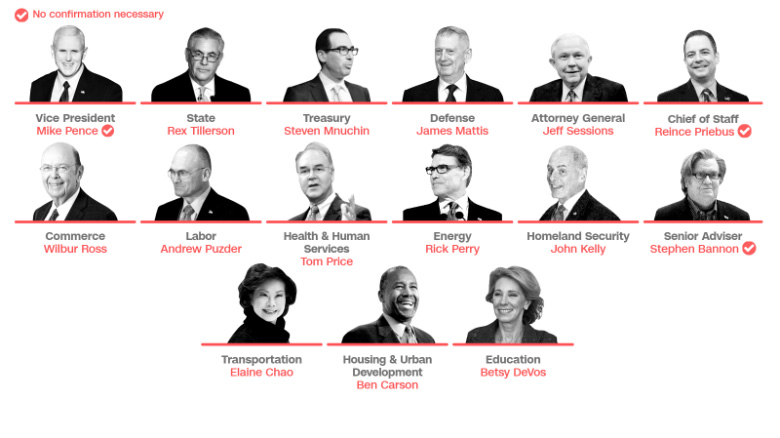
trump-team-dec-15-2016-2Will a group of ultra-wealthy people holding high offices in the Donald Trump administration be a benefit to America?

We will know the answer after January 20, 2017.

Rex Tillerson, CEO of Exxon, holds just over 2.6 million Exxon shares. But he actually only technically owns 611,087 outright, or nearly $57 Million worth. The rest are so-called restricted stock units. How rich is Rex Wayne Tillerson? Rex Wayne Tillerson net worth: $150 Million.

Steven Mnuchin is a former partner at Goldman Sachs, heads up Dune Capital. The investment firm put together a holding company in 2008 — attracting investors like J.C. Flowers, a George Soros investment fund and Paulson & Co. His net worth is around $40 million.

Senator Jeff Sessions has an average net worth of $7.52 Million as of 2014.

Wilber Ross has an estimated wealth estimated at $2.5 Billion as of December 2016 according to Forbes magazine.

Andrew Puzder, chief executive of CKE Restaurants, the parent company of Hardee’s and Carl’s Jr. is worth at least $25.6 Million.

Congressman Tom Price’ net worth is $13.0 Million.

Rick Perry, former Texas governor, total net worth is often estimated to be about $3 Million.

Steven Bannon net worth is $10 Million.

Elaine Chao, wife of Senator Mitch McConnell, net worth is at least $3 Million.

Dr. Ben Carson has a reported net worth of $10 Million.

Betsy DeVos is married to Dick DeVos and is the daughter-in-law of Richard DeVos, the founder of Amway with an estimated net worth of $5.1 Billion.

Katrina Pierson seeking role in Trump administration

Katrina Pierson was a regular on CNN.  Her ability to say things that are utterly incorrect was her outstanding ability.  That might be exactly the kind of person Donald Trump wants as press secretary.  After all that job is all about spin.  The following report provides some of Pierson’s best lines.

by Dylan Byers and Jim Acosta   @CNNMoney December 13, 2016: 6:14 PM ET 

katrina-pierson-a-spokesperson-for-donald-trump

Katrina Pierson, a spokesperson for Donald Trump and fixture on cable news, is seeking a role in his administration, according to two sources with knowledge of the matter.

Pierson visited Trump Tower on Tuesday for meetings with members of Trump’s transition team. One source said she was there to make her pitch for the role of White House press secretary, while another said she was “looking at a lot of opportunities.”

 Loyalists who were with the Trump campaign since its early days have been frustrated that they have been shut out of top posts in the new administration. Pierson, too, feels she deserves more consideration, according to one of the sources.

“I’m at Trump Tower because I work here,” Pierson said in an email. “I’m a Senior Advisor for the Trump Transition team. Our meetings are confidential.”

Pierson was one of the most frequently seen faces on cable news throughout the 2016 campaign, and often drew controversy for making false and inaccurate statements.

On CNN, she blamed the U.S. invasion of Afghanistan, which took place in 2001, on President Barack Obama. She also blamed the death of Capt. Humayun Khan, in 2004, on Obama and Hillary Clinton, his Secretary of State. Obama and Clinton did not assume those roles until 2009.

Pierson also defended Trump’s suggestions that Ted Cruz and Marco Rubio might not be eligible to run for president, and said reporters had “literally beat Trump supporters into submission — into supporting policies they don’t agree with.”

 CNNMoney (San Francisco) First published December 13, 2016: 6:04 PM ET