US green card holders, student visa holders can be deported

Can a green card holder be deported from the United States? The recent arrest of Mahmoud Khalil, a Palestinian activist involved in organising campus protests over the Israel-Hamas conflict at Columbia University in New York City, has raised questions about the protections foreign students and green card holders have against deportation from the US.

A green holder and student visa holders have been given a privilege. They have no rights

A green card holder has lawful permanent resident status, allowing them to live and work in the US indefinitely. However, this status is not absolute, and deportation remains a possibility under certain circumstances. 

Rights and responsibilities of green card holders 

According to US Citizenship and Immigration Services (USCIS), green card holders have the right to:

< Work in any legal job they qualify for, except some roles restricted to US citizens for security reasons

< Be protected by all US laws, including state and local regulations 

They are also subject to specific responsibilities: 

< Obey all US and local laws

< File income tax returns and report income to the Internal Revenue Service and state tax authorities

< Support the democratic form of government (without voting in elections)

< Register with the Selective Service if they are male and between 18 and 25 years old

< Work in any legal job they qualify for, except some roles restricted to US citizens for security reasons

< Be protected by all US laws, including state and local regulations 

 Can green card holders be deported? 

Yes, they can. 

“Generally, green card holders have the same First Amendment rights as US citizens. Constitutionally protected speech, including peaceful protest, would not normally be grounds for cancelling a green card. Green cards are typically revoked for serious crimes or other obvious violations,” Russell A Stamets, partner at Circle of Counsels told Business Standard. 

“While they have strong legal protections, such as the right to a hearing before an immigration judge and the ability to appeal deportation orders, they can still be removed for reasons like aggravated felonies, fraud, national security threats, or abandoning their residency by staying outside the US for too long,” Aurelia Menezes, partner at King Stubb & Kasiva, Advocates and Attorneys, explained to Business Standard.

As protests over the Gaza conflict ignited rancor and division at Columbia University last year, one student stood out for his role as a negotiator representing activists in talks with the school officials who were desperate to achieve peace on campus.

Mahmoud Khalil, 30, emerged as a public face of students opposed to the war, leading demonstrations and granting interviews. He delivered a message that his side viewed as measured and responsible but that has been branded by some, including the Trump administration, as antisemitic.

Mr. Khalil has been involved in demonstrations as recently as January, when four masked demonstrators entered a class on the history of Israel taught by an Israeli professor at Columbia to accuse the school of “normalizing genocide.” Videos of an unmasked Mr. Khalil at a related sit-in were soon circulated on social media among critics of Columbia’s protest movement, with some calling for him to be deported.

Over the weekend, Mr. Khalil was at the center of the news again. He was arrested by federal immigration officials in a drastic escalation of President Trump’s crackdown against what he has called antisemitic campus activity. Mr. Khalil, a permanent resident of the United States, had been living in Columbia’s student housing when he was detained and then transferred to the Central Louisiana ICE Processing Center in Jena, La.

A green card holder and student visa holders have been given a privilege. They have no rights. Deportation for bad behavior by ICE is a consequence of that behavior. Deporting Mr. Khalil and others who are guests in this country is the right thing to do.
Aesop fable Live

“The Boy Who Cried Wolf” is an Aesop fable about a shepherd boy who tricks villagers into thinking a wolf is attacking his sheep. But there was no wolf. The story teaches that people who lie will not be believed, even when they are telling the truth. 

President Donald Trump has threatened new tariffs on Canadian lumber and dairy products, potentially as soon as Friday, just one day after providing Canada a one-month reprieve from 25% tariffs. The tariff on dairy products and lumber Trump threatens is 250%. 

Is Trump serious or is it just noise?

Trump’s repeated threats of tariffs applied to Mexico and Canada are getting tiresome because he seems to change his mind daily.

Canada, Mexico, and other countries will soon tire of his threats.

Because of his power as president of the United States we all need to be concerned.

A new report from ABC News concludes that many Americans who voted for Donald Trump do not necessarily support most of his policies. The study, which analyzed 300 poll questions from publicly available surveys conducted since Trump took office on Jan. 20, reveals that while voters largely support his immigration policies, they disapprove of several other aspects of his agenda.​

Trump and the Courts

Many of the things Trump is doing are illegal or unconstitutional. His attempt to undo birthright citizenship is a blatant contradiction of the 14th Amendment. His refusal to spend money already appropriated by Congress violates both the Constitution’s assignment of spending power to Congress and the Impoundment Act of 1974. He has no authority to disband agencies created by Congress, like USAID or the Consumer Financial Protection Bureau. His treatment of federal employees violates the laws establishing the civil service, as well as union contracts signed by previous administrations.

But laws do not enforce themselves if lawbreakers are determined to ignore them. Victims of the law-breaking have to go to court. Judges have to rule in accordance with the law in spite of executive pressure against them. Court orders can be appealed, so the process can take a long time.

So far, the lower courts are following the law and the Constitution, so Trump is losing most of the cases.

This is all leading up to two questions:

  • Will the Supreme Court invent new interpretations of our laws to back Trump up, essentially ending the rule of law as we have known it?
  • If the Court does rule against Trump, will he defy the Court’s orders?

Jane Fonda

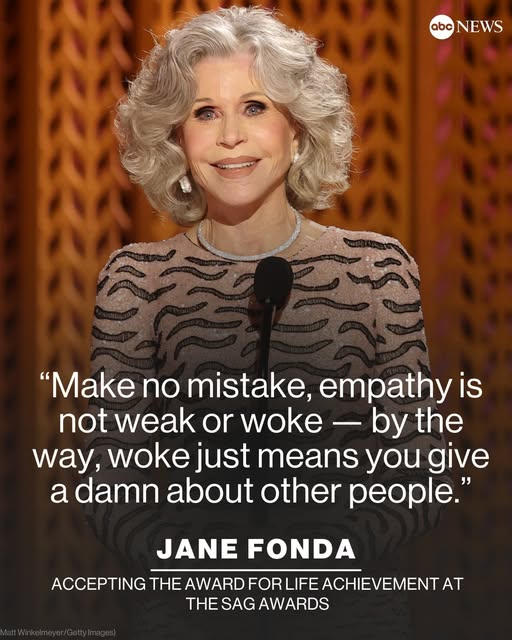
In her acceptance speech for Lifetime Achievement at the SAG Awards on Sunday night, Jane Fonda spoke about the current political state.

“What we actors create is empathy,” she said. “Our job is to understand another human being so profoundly that we can touch their souls. And make no mistake, empathy is not weak or woke — by the way, woke just means you give a damn about other people.”

Read more: https://abcnews.visitlink.me/LoZxf3

Appease Russia in the name of “Peace”

It appears that President Trump’s peace talks with Russian leader Vladimir Putin may take place without the full participation of Ukraine.

If so, there is a possibility of a sellout similar to what took place in 1938, when Great Britain and France approved of Adolf Hitler’s demand that the large German-speaking parts of Czechoslovakia be annexed by Nazi Germany. The Czech government was not present at negotiations.

Upon his return to Britain, Prime Minister Neville Chamberlain proclaimed that he had secured “peace in our time.” Winston Churchill, then a member of the House of Commons, harshly condemned this agreement as appeasement, as have historians since then.

In March 1939, Hitler seized all of Czechoslovakia. It was then that Chamberlain recognized the unlimited imperial greed of the German tyrant. What followed was the British and French guarantee of Poland’s security. In September 1939, when Hitler invaded Poland, Britain and France declared war on Germany, and World War II began.

In 2014, Putin occupied Crimea and backed separatists in the eastern provinces of Ukraine, areas in which Russian speakers make up a large proportion of the population. After the 2022 invasion of Ukraine, he annexed these provinces.

The U.S. government stance has been highly ambiguous. The current secretary of Defense has declared that those parts of Ukraine annexed by Russia would probably not be returned to Ukraine.

At the peace talks, will the U.S. appease Russia in the name of “peace”?

Thomas P. Bernstein, Irvine, California

The writer is a professor emeritus of political science at Columbia University. This was posted in the Los Angeles Times on February 19, 2025.

America has Surrendered to a Madman

This column and introductory commentary was forwarded to me. Mike Greenberg of Texas wrote the opening comments. This is exhausting.

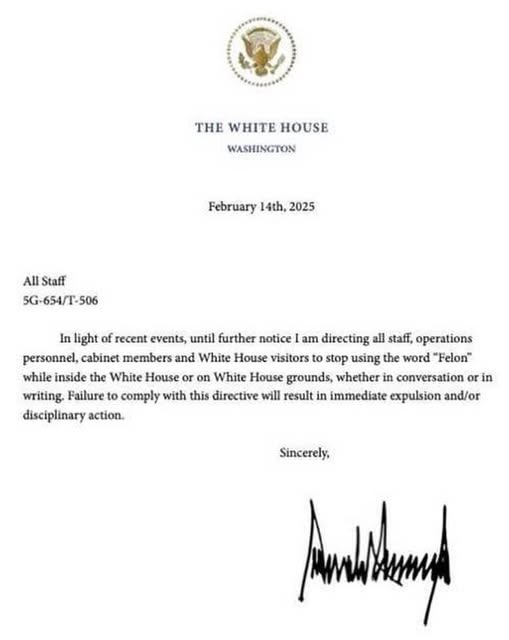
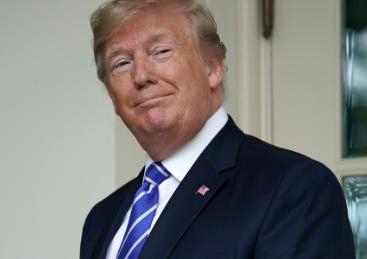
I don’t think any US journalist has written as tough (and spot-on) a portrayal of the threat facing us as this Canadian, Andrew Coyne of the Toronto Globe and Mail. If you read to the end, you will be rewarded with the most flattering photograph yet of the convicted-felon-in-chief:

“Nothing mattered, in the end. Not the probable dementia, the unfathomable ignorance, the emotional incontinence; not, certainly, the shambling, hate-filled campaign, or the ludicrously unworkable anti-policies.

The candidate out on bail in four jurisdictions, the convicted fraud artist, the adjudicated rapist and serial sexual predator, the habitual bankrupt, the stooge of Vladimir Putin, the man who tried to overturn the last election and all of his creepy retinue of crooks, ideologues and lunatics: Americans took a long look at all this and said, yes please.

There is no sense in understating the depth of the disaster. This is a crisis like no other in our lifetimes. The government of the United States has been delivered into the hands of a gangster, whose sole purpose in running, besides staying out of jail, is to seek revenge on his enemies. The damage Donald Trump and his nihilist cronies can do – to America, but also to its democratic allies, and to the peace and security of the world – is incalculable. We are living in the time of Nero.

The first six months will be a time of maximum peril. NATO must from this moment be considered effectively obsolete, without the American security guarantee that has always been its bedrock. We may see new incursions by Russia into Europe – the poor Ukrainians are probably done for, but now it is the Baltics and the Poles who must worry – before the Europeans have time to organize an alternative. China may also accelerate its Taiwanese ambitions.

At home, Mr. Trump will be moving swiftly to consolidate his power. Some of this will be institutional – the replacement of tens of thousands of career civil servants with Trumpian loyalists. But some of it will be … atmospheric.

At some point someone – a company whose chief executive has displeased him, a media critic who has gotten under his skin – will find themselves the subject of unwanted attention from the Trump administration. It might not be so crude as a police arrest. It might just be a little regulatory matter, a tax audit, something like that. They will seek the protection of the courts, and find it is not there.

The judges are also Trump loyalists, perhaps, or too scared to confront him. Or they might issue a ruling, and find it has no effect – that the administration has called the basic bluff of liberal democracy: the idea that, in the crunch, people in power agree to be bound by the law, and by its instruments the courts, the same as everyone else. Then everyone will take their cue. Executives will line up to court him. Media organizations, the large ones anyway, will find reasons to be cheerful.

Of course, in reality things will start to fall apart fairly quickly. The huge across-the-board tariffs he imposes will tank the world economy. The massive deficits, fueled by his ill-judged tax policies – he won’t replace the income tax, as he promised, but will fill it with holes – and monetized, at his direction, by the Federal Reserve, will ignite a new round of inflation.

Most of all, the insane project of deporting 12 million undocumented immigrants – finding them, rounding them up and detaining them in hundreds of internment camps around the country, probably for years, before doing so – will consume his administration. But by then it will be too late.

We should not count upon the majority of Americans coming to their senses in any event. They were not able to see Mr. Trump for what he was before: why should that change? Would they not, rather, be further coarsened by the experience of seeing their neighbours dragged off by the police, or the military, further steeled to the necessity of doing “tough things” to “restore order?”

Some won’t, of course. But they will find in time that the democratic levers they might once have pulled to demand change are no longer attached to anything. There are still elections, but the rules have been altered: there are certain obstacles, certain disadvantages if you are not with the party of power. It will seem easier at first to try to change things from within. Then it will be easier not to change things.

All of this will wash over Canada in various ways – some predictable, like the flood of refugees seeking escape from the camps; some less so, like the coarsening of our own politics, the debasement of morals and norms by politicians who have discovered there is no political price to be paid for it. And who will have the backing of their patron in Washington.

All my life I have been an admirer of the United States and its people. But I am frightened of it now, and I am even more frightened of them.”

Destruction of the Free Press in America

Amid all the noise, an eerie hush is spreading across America. Companies, scientific researchers and Trump critics are clamming up as the MAGA movement ushers in a new era of government censorship.

On Day 1, President Donald Trump signed an executive order titled “Restoring Freedom of Speech and Ending Federal Censorship.” This might have sounded like banal lip service, reaffirming commitment to the First Amendment. In reality, it was the start of an Orwellian effort to root out wrongthink from government ranks and the private sector.

CBS says it will turn over an unedited transcript of its October interview with Kamala Harris to the Federal Communications Commission, part of President Donald Trump’s ongoing fight with the network over how it handled a story about his opponent.

President Donald Trump’s newly appointed chairman of the Federal Communications Commission has ordered an investigation into NPR and PBS over their alleged “airing of commercials,” and suggested that the public broadcasters could be at risk of losing their federal funding.

Last week, the administration ordered a blackout on public communications from government health agencies — in the middle of flu season.

For the first time since 1952, the Centers for Disease Control and Prevention withheld its weekly report on morbidity and mortality data updates.

Other federal departments, such as the Energy Department, were also ordered to cease public communications unless they had explicit approval of the acting secretary.

The president and his allies have also leaned on private firms to disavow politically incorrect values. For example, a group of 19 Republican state attorneys general sent a letter to Costco demanding the retailer drop its diversity commitments, citing a Trump executive order. 

Other Trump allies have engaged in speech- and thought-policing, the kinds of actions for which they once condemned progressives (sometimes rightfully!). Last week, for instance, Rep. Dan Crenshaw (R-Texas) obliquely threatened Apple’s CEO for not yet renaming the Gulf of Mexico as the Trump-blessed “Gulf of America” in Apple Maps. (Google Maps has caved, however.)

Washington Post’s “Democracy Dies in Darkness” is heading for the trash can.

George Orwell ‘s Nineteen Eighty-Four (also published as 1984) is a dystopian novel and cautionary tale by English writer George Orwell. It was published on 8 June 1949 by Secker & Warburg as Orwell’s ninth and final book completed in his lifetime. Thematically, it centres on the consequences of totalitarianismmass surveillance, and repressive regimentation of people and behaviours within society. Orwell, a staunch believer in democratic socialism and member of the anti-Stalinist Left, modelled the Britain under authoritarian socialism in the novel on the Soviet Union in the era of Stalinism and on the very similar practices of both censorship and propaganda in Nazi Germany. More broadly, the novel examines the role of truth and facts within societies and the ways in which they can be manipulated.