In just six days New Zealand banned military-style semiautomatic weapons” and assault rifles

This all happened after the killing of 50 people at two mosques in New Zealand.  New Zealand is a country that holds the right to bear arms a very important freedom.

Compare that action with the United States which has the right to bear arms included in its constitution.

The following chart from the Los Angeles Times.

There has been no ban on ownership of assault weapons in the United States. 


Is the American Democracy Doomed?

Democracy is under threat globally, a new report from the Economist Intelligence Unit warns.


Top 10 most democratic countries in the world:

  • 1 Norway
  • 2 Iceland
  • 3 Sweden
  • 4 New Zealand
  • 5 Denmark
  • =6 Canada
  • =6 Ireland
  • 8 Australia 
  • =9 Switzerland
  • =9 Finland

The United States remained in the ‘flawed democracy’ threshold, to which it dropped in 2016 after a serious decline in public trust, the Economist said.

Link to map showing the level of democracy of all countries in the world.

https://www.indy100.com/article/democracy-index-economist-intelligence-unit-map-data-report-norway-democratic-united-states-8191501

Half of Americans think the United States is in “real danger of becoming a nondemocratic, authoritarian country.” A majority, 55 percent, see democracy as “weak” – and 68 percent believe it is “getting weaker.” Eight in 10 Americans say they are either “very” or “somewhat” concerned about the condition of democracy here.  I am one of those people.


These are among the sobering results of a major bipartisan poll published Tuesday that was commissioned by the George W. Bush Institute, the University of Pennsylvania’s Biden Center and Freedom House, which tracks the vitality of democracies around the world. The three groups have partnered to create the Democracy Project, with the goal of monitoring the health of the American system.


“We hope this work can be a step toward restoring faith in democracy and democratic institutions,” Bush said in a statement.


The concern about the condition of democracy inside the United States transcends the tribal divide between Republicans and Democrats, with majorities across races, genders, age groups, levels of education and income brackets expressing fear.


Sadly I see current president as the person who could bring an end to this republic.  His constant attacks on the media (the press), the courts, and the Republican Party’s willingness to support everything that Trump says and does should be a signal that our nation is in jeopardy.


Are Americans really willing to accept a dictatorship?  If the GOP retains control of the congress after the November election I expect even more attacks on the constitution and the laws that have governed this nation since 1789.


I will not live under a dictatorship.  Happily there are still some nations that do honor democratic principals.

Lowering the Cost of Living

The average Social Security check is only $1,413.08 in 2018, making it hard to get by in the United States. Some retirees look to other countries, where living expenses can be lower, to make their Social Security checks stretch further.

A recent GOBankingRates survey found that more than half of people ages 55 and older have less than $10,000 saved for retirement — and a whopping 34 percent have nothing saved at all.

As the tough economic times continue in the U.S., many people are looking to cut down on their expenses by moving to more affordable cities and towns.

Or is the answer moving to another country where the cost of living is far less than the United States.

southamericaliving.com lists workable budget of $1000 – $1200 USD and up, affording more luxuries such as eating out regularily, shopping excursions, larger apartment or house. The following countries have the lowest cost of living: Bolivia, Colombia, Ecuador and Peru. Chihuahua, Mexico and Guadalajara, Mexico are two of the lowest cost cities in Latin America.

Inexpensive healthcare is often touted as a reason to retire abroad. You become eligible for Medicare at age 65. However, you can’t use this government health coverage overseas.

The annual cost to own and operate a sedan in the U.S. is $8,588, according to AAA. When you retire abroad, you might not need a car because public transit is more common and reliable.

Rent in Mexico is 4.33% lower than in United States. In Santa Ana, Costa Rica a 3-bedroom single family home currently costs about US$212,000.  The cost in other Costa Rican cities housing costs are similar to Santa Ana.  Consider those housing costs in your destination city.  The cost per square meter of a home in Jakarta, Indonesia is $2,120 USD. The cost per square meter of a home in Richmond, Virginia is $2,128 USD.

If you think you’ll lower your tax bill by retiring overseas, think again. You still have to pay U.S. taxes. Even if you move your assets to accounts in your new country, you will be required to file an annual tax return, according to the U.S. Department of State.

If you retire abroad, you still can collect Social Security benefits, said Sally Hurme, author of “Get the Most Out of Retirement: Checklist for Happiness, Health, Purpose, and Financial Security.” In many countries, you can even have your check directly deposited into an account, she said. The Social Security Administration has a Payments Abroad Screening Tool you can use to see in which countries you can live and still receive your check.

You might also have to pay taxes in your new country, Hurme said. The U.S. does have treaties with some countries — including Canada and Mexico — that prevent double taxation. But the country you want to retire to might not.

If you own property or have assets in your new country, you’ll likely need to hire an attorney in that country to help draft an estate plan, Hurme said. That’s because any documents that you had drafted in the U.S. — such as a will, trust or power of attorney — might not have any effect overseas.

The alternative to moving to a“low cost” country is considering moving to a low cost city in the United States.

I found a survey of those low cost cities. Actually they are mostly towns that you are not likely to visit let alone move to. Excluding those small towns (less than 100,000 population) the least expensive small city is Brownsville, Texas with a Population of 180,000 and a Cost of Living 14.9% below U.S. average. Indianapolis, Indiana has a population of over 800,000 people and a Cost of Living 13% below U.S. average.

How comfortable will you feel living in another country? Your family and friends will be thousands of miles away. Visiting San Jose, Costa Rica may be fun but living there should at least cause you to wonder about the downsides.  Think through the entire process before moving to another country rather than living in a country where you were born and feels like home.


Is Age a Criteria for Holding Public Office?

U.S. Sen. Dianne Feinstein ended months of speculation Monday when she said she was running for re-election in 2018. “I’m all in!” she tweeted and wrote in a Facebook post. At age 84, is Feinstein too old to run again? (If she won, her term would extend past her 91st birthday.)

My question is why should she be denied another term in office because of her age? I have seen her on many Sunday morning news shows and she is obviously able to hold her own against those that question her on the topic of the day. Her big issue is gun control and her responses to Chuck Todd on Meet the Press and Chris Wallace on Fox News Sunday are always very well spoken.

Robert Byrd was the longest-serving Senator in United States history. In addition, he was, at the time of his death, the longest-serving member in the history of the United States Congress. That record was later surpassed by Representative John Dingell of Michigan. Byrd died at 92 still holding the office of senator from West Virginia.

Age should not be a criteria for holding public office. Donald Trump is now 71. If he holds office for eight years he will be 79 when he departs Washington. Ronald Reagan was 69 when he was inaugurated.

Don’t Need A Will? Think Again!


by Jane Bryant Quinn in the May 2017 AARP Bulletin

Just do it. Your heirs will thank you.

Does everybody need a Will? The straight answer is yes. That’s true even for people who think they don’t have a dime to leave to anyone. What if you were in an accident and died later of injuries, and your estate won a $l million settlement? Who gets the money?

Admittedly, that’s a little far out. You might get away without having a will if, say, you’re a renter living on Social Security with no savings. If you have savings, a pay-on-death account will pass that money to named beneficiaries when you die.
But there are hitches to any no-will scheme, says attorney Patrick Lamon of Bilzin Sumberg in Miami. To begin with, a random financ.al asset almost always turns up. Examples might be a rental deposit that’s returned or a medical reimbursement. Those checks will be made out to the deceased. How do your heirs get them cashed?

If you had a will, you’d have named an executor to cash checks, pay off creditors and distribute any money or property to your beneficiaries. Without one, your heirs will have to ask a court to appoint a personal administrator. Usually, it will appoint your surviving spouse or a child. But you risk a family fight over who should be in charge.

Some couples try to go will- free by putting everything into joint names. Joint assets pass to the other owner automatically. So do assets with beneficiary forms, such as individual retirement accounts. But something is inevitably left out typically, a car, Lannon says. Heirs would need an administrator to transfer title. Even if the joint-asset strategy works for the first death, what happens when the other spouse dies? He or she should make a will, which you both could have done from the start.

When there’s no will, state law dictates who gets the house, car, savings and other assets. Those laws vary widely. A surviving spouse might get everything in one state but only one-third in another, with the rest going to your children. If you have no children, half might go to a spouse and half to your parents.

Lawyers are the best source for reliable wills. Your lawyer will also remind you that you need a durable power of attorney and a health care proxy, so someone can manage your finances and make medical choices if you’re unable to do so yourself.

If you’re allergic to lawyers, you can find free, state-specific will forms online. In most states (not all), handwritten wills are also accepted, provided that they were witnessed properly. DIY should be better than nothing. But be careful.

Jane Bryant Quinn is a personal finance expert and the author of “How to Make Your Money Last” She writes regularly for the AARP Bulletin.

How about a Trip to Europe Before You are Too Old!

Look! You cannot take all you have saved with you to the next dimension. I know, you want to leave your children and grandchildren an inheritance. Unless your children are seniors themselves, they are more likely to spend that inheritance than save it for a rainy day.

Consider just one or two splurges before your time to check out has come. I am not suggesting you spend your money at a casino. I know, Las Vegas makes an enticing place to spend a few days. There is more than that spending trap.

You can still walk, although slowly. You can still appreciate beautiful art and architecture.

Trafalgar offers some easy walking tours of London and Paris. Actually they take you to the door of many of the most famous places in those cities. Seven day cruises on the Mediterranean Sea can take you to some of Europe’s most famous cities.

Careful planning will not break the bank on those tours.

Bring you camera or smartphone and capture the memories.

Some of the Best Photo Spots in the world are in Europe.

y
              London Eye from nearby bridge

1107r-8-28-claude-monets-home-and-garden

Claude Monet’s Garden near Paris

Taking some of the most iconic shots is a snap when you book your one trip.
• London Eye, London
• Eiffel Tower, Paris
• Trevi Fountain, Rome
• Lagagrada Familia, Barcelona
• Santorini, Greece
• Tower of Pisa, Pisa

5 Tips for Taking the Best Vacation Photos
With a few tricks up your sleeve, the kids will be fighting over who gets to see your photos first.
1. Aim for natural light and try to avoid using flash
2. Don’t pose every shot – make candid photos of people having fun your aim
3. Capture the atmosphere by photographing food, street scenes, and the locals
4. Don’t be self-conscious – these are your memories!
5. Get a good photo editing app for your smartphone and lose the bulky camera bag

We took the Trafalgar tour in 2012 and now we are planning the cruise this coming summer.

This Is When You’re Going To Die

arnold-palmer

Arnold Palmer, the King of Golf,  just died at age 87.  Apparently he really was on Xarelto.  As I have grown older I have become concerned with how long I will live.  My father died at age 86.  It appears to me that many men die in their mid 80s.  The statistics listed below confirm that fact.

Everyone will die someday, and it is only a question of when.

Business Insider provided the following charts and remarks about when we will die.

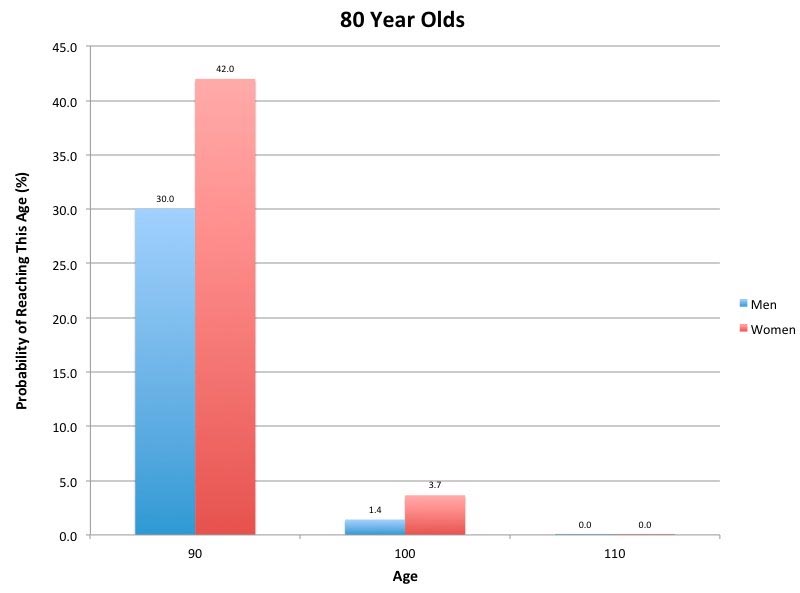
Through the power of actuarial estimates, it is possible to figure out approximately how long you are likely to live. We made a set of charts, based on data from the Social Security Administration’s cohort life tables, that show, given your gender and current age, the probability that you will reach some particular later age.

Naturally, these are based on averages for a particular age group — health conditions and lifestyle choices like diet, exercise, and smoking can vastly alter one’s life expectancy.

Regardless, this is important information for anyone who has to think about things like retirement and estate planning.

Here are the charts, in descending order by present age:

80-year-old-probability-of-reaching-90

Business Insider/Andy Kiersz, data from Social Security Administration

If you are an 80 year old man, your long-term odds are not great. There is a 30% chance of making it to your 90th birthday, and only about 14 in 1,000 will see 100.  The average life expectancy for 90 year old females of all races is 0.83 years greater than that of males.

70-year-old-probability-of-reaching-80

Business Insider/Andy Kiersz, data from Social Security Administration

70 year olds have a somewhat better prognosis. Almost 2/3 of 70 year old men and almost 3/4 of 70 year old women will live at least another ten years, and over 1/5 of men will make it to 90, as will 1/3 of women.

For 60 year olds, we see some of the benefits of modern medicine kicking in. The overwhelming majority of 60 year olds will live until at least 70, and majorities will get to at least 80.

Similarly, very few people who make it to 50 die before they turn 60. As we look at younger and younger cohorts, we see better and better long-term odds as well.

Why We Need Universal Health Care

Health care insurance is too expensive.

The stated goals of health care reform in 2009 (Obamacare) in the USA were

  1. lower costs
  2. cover all Americans
  3. drive quality
  4. and be paid for (without impacting the federal budget)

Premiums for Californians’ Obamacare health coverage will rise by an average of 13.2% next year, according to the Los Angeles Times, more than three times the increase of the last two years. Premiums in the insurance program rose just 4% in 2016, after rising 4.2% in 2015 – the first year that exchange officials negotiated with insurers.

An analysis by the nonpartisan Kaiser Family Foundation of 14 metro areas that have already announced their 2017 premiums found an average jump of 11%. The changes ranged from a decrease of 14% in Providence, R.I., to an increase of 26% in Portland, Oregon.

Ouch! What happened to objective 1 – lower costs?

While Obama Care has provided insurance coverage to 11.7 million people there are still 12.9 million people without any coverage as reported in a Gallup Poll. In other words about 4% of the population is uninsured.

 Obama’s intentions were good but his goal have not been met. Single payer health care like Medicare would cover everyone without exception. That would put for profit insurance companies out of business. Putting companies out of business is the stumbling block to genuine health care reform.

Despite Senator Bernie Sanders this is not likely to happen in the U.S. A. that considers free enterprise one of its basic tenants.

Buy-Outs, Forced Retirement and Age Discrimination

Your employer is in financial difficulty and needs to find a way of saving cash until there is a recovery.

If you work for a newspaper or magazine you are in an industry that is in serious decline then recovery is in doubt. The Washington Post seems to have recovered thanks to a purchase by Jeff Bezos, founder of Amazon. BusinessWeek magazine was bought by Michael Bloomberg and is thriving. Newsweek and U.S. News and World Report are gone. Tribune Publishing Company that owns the Chicago Tribune, the Los Angeles Times and other newspapers is in dire straits.  The Los Angeles Times is currently attempting to offer buy-outs to their staff.  Sports writer Bill Dwyre, a gray-haired man with years of experience and probably high pay just announced his retirement.  Other outstanding columnists with that paper are probably also going to take their leave.

General Motors and Ford Motor Company both went through some very difficult economic times as have   many other companies.

In every instance they all followed the same path. Cut the high cost employees and reduce the pay to the remaining employees. I know people who were part of the buy-out, those who faced the reduced pay, and those who were simply laid-off. I was party to that situation more than once.

The issue for those losing their jobs is their age. Once you are older, 55 or older, obtaining another job at the same pay as was previously received is difficult and in most cases impossible.

Age discrimination is rampant and impossible to prove. “Age discrimination involves treating someone (an applicant or employee) less favorably because of his or her age. The Age Discrimination in Employment Act (ADEA) only forbids age discrimination against people who are age 40 or older.” That is the statement posted on the EEOC on their web site.

From Forbes magazine dated January 31, 2014

The Ugly Truth About Age Discrimination (abridged)

“So then the headhunter said something that took my breath away,” said my caller, Philip.

“He told me that his client looked at my resume and said it looked great, but then he found my LinkedIn profile and decided I’m a little long in the tooth for the job.”

I was silent. That took my breath away, too.

“Long in the tooth?” I asked. “As in old?”

“Exactly,” said Philip. “The headhunter actually told me that the client said I was too old for the job. I asked him if that was illegal – I’m pretty sure it is – and he said that the client’s view is that if they don’t interview me, I’m not a candidate, so it’s not discrimination.”

“That’s false,” I said, but even as I said it, I knew that it doesn’t make any difference.

What is Philip going to do – sue the employer he never met because a third-party recruiter told him that one hiring manager made an inappropriate comment? So-called Failure to Hire cases are notoriously hard to bring and even harder to prove. As long as the organization ends up hiring someone who is qualified for the job, how could Phil ever prove that he was rejected because of his age? It’s not as though the organization is going to publish the new hire’s age for all the other candidates to see.

Age discrimination is everywhere. I hear more examples of age discrimination than I hear about sex discrimination, racial discrimination and every other kind put together. I expect that’s because some employers believe that older workers aren’t as nimble or perhaps aren’t as easy to train. Some of them undoubtedly worry that an older person is necessarily overqualified, and thus likely to bolt the minute a better job comes along.

I was there too. At the age of 60 in an interview the president of the company, he asked me if I was a grandfather. My answer was no and that was accurate. The thought running through my head was I would not be obtaining this job. To my surprise I did receive the job offer. I went on to two promotions proving that older employees can thrive.  Could I have brought a successful suit against that employer? There was no proof that the question was asked.

I know of no solution. Businesses thrive, businesses shrivel, life goes on. As the population ages the issue of age discrimination will fade away.