The former vice president’s comments mark a stunning repudiation of his ex-boss and the president he served with.
Pence did not reveal who he’ll vote for in the 2024 general election, saying that he’ll keep “my vote to myself.” He, however, said he will “never vote” for President Joe Biden. Pence also suggested that he would not back a third-party candidate.
It is a good bet that he will vote for Trump. Pence showed he has no spine and couldn’t even stand up for his conservative principals.
District attorneys in Sacramento, Fresno, San Joaquin, San Bernardino and San Diego counties are using similar blueprints: going after alleged fentanyl dealers for homicide rather than drug sales, in hopes that the threat of harsher criminal penalties will ease an opioid crisis that killed more than 7,300 Californians in 2022.
The Los Angeles County District Attorney says nothing about fentanyl dealers or the rash of smash and burglaries.
Democratic strategist James Carville said President Biden not sitting for an interview before the Super Bowl is a “sign” of his administration having little confidence in him.
“It’s the biggest television audience, not even close, and you get a chance to do a 20, 25-minute interview on that day, and you don’t do it, that’s a kind of sign that the staff or yourself doesn’t have much confidence in you, there’s no other way to read this,” Carville said in a February 10 interview on CNN’s “Smerconish.”
This will be the second year in a row that the president has not sat for an interview before the big game. Biden’s decision not to participate comes as he’s been facing bad press in the wake of the release of a special counsel report on his handling of classified documents.
On that same program Michael Smerconish asked viewers his weekly survey question “Should Jill Biden suggest to her husband that he should not seek re-election?” Two thirds of almost 36,000 viewers voted Yes.
This is not the first time a sitting president has not run for re-election. LBJ (Lyndon Johnson) announced in March of the year he was heading to election that he chose not to run. By 1968, Lyndon B. Johnson knew he was unlikely to win another presidential election; his increase of American involvement in the Vietnam War, as well as rising American casualties in Vietnam, had made him deeply unpopular. After Senator Eugene McCarthy and Robert Kennedy declared their candidacies for the Democratic presidential nomination, Johnson announced that he would not seek another term and would, instead, retire.
The United States may have been founded on the idea that all men are created equal, but during the late 18th and early 19th centuries, slaveholding was common among the statesmen who served as president.
Slavery was legal in the United States from its beginning as a nation. During the late 18th and early 19th centuries, slaveholding was common among the statesmen who served as president. In all, 12 chief executives enslaved people during their lifetime; of these, eight owned slaves while in office. The Thirteenth Amendment to the United States Constitution formally abolished slavery in 1865, but the history of the American presidency’s relationship to slavery remains an uncomfortable one. So, who are these White House incumbents that were also enslavers?
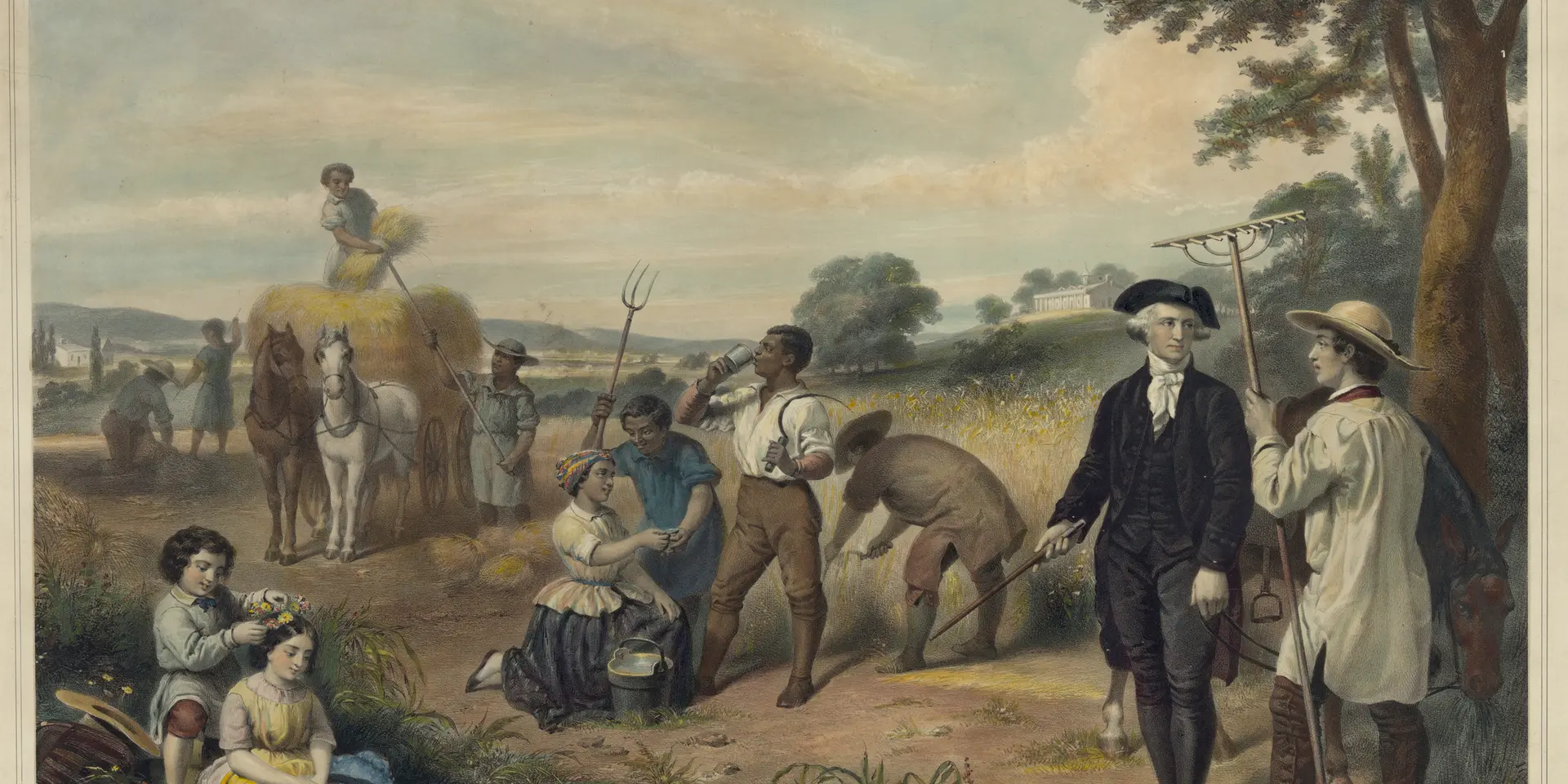
Picture from history.com
President George Washington
A Founding Father of the United States and the country’s first president, George Washington kept over 300 enslaved people at his Mount Vernon plantation.
As president of the United States, Washington oversaw the implementation of the 1787 Northwest Ordinance, which banned slavery north of the Ohio River. But in 1793 he signed the Fugitive Slave Law, which empowered a slaveowner or his agent to seize or arrest any enslaved person on the run. His views on slavery took another turn the following year, when he wrote into law the Slave Trade Act of 1794, which prohibited the export of slaves from the United States to any foreign place or country.
President Thomas Jefferson
Thomas Jefferson, the third president of the United States, owned more than 600 slaves during his adult life. Jefferson’s slaves were held captive at his main residence, Monticello, near Charlottesville, Virginia. It was here that he fathered several children with an enslaved woman called Sally Hemmings.
President James Madison
James Madison kept several enslaved people—he came from a large slaveholding family. By 1801, Madison’s slave population at Montpelier, his plantation estate, was slightly over 100. That figure eventually numbered over 300.
Like Thomas Jefferson, James Monroe outwardly condemned the institution of slavery as evil, and advocated its gradual end. But he, too, still owned many slaves.
President Andrew Jackson
Like most planters in the South, Andrew Jackson used forced labor. Over his lifetime, he owned a total of 300 slaves, most of whom were put to work in the cotton fields of his plantation, The Hermitage, near Nashville, Tennessee.
President Martin Van Buren
Martin Van Buren was ensconced in the White House during the Amistad Case, a freedom suit that resulted from the successful rebellion of African slaves on board the Spanish schooner La Amistad in 1839. Van Buren viewed abolitionism as the greatest threat to the nation’s unity, and he resisted the slightest interference with slavery in the states where it existed. Later in life, Van Buren belonged to the Free Soil Party, which opposed the expansion of slavery into the Western territories, but not immediate abolition.
President John Tyler
William Henry Harrison owned several inherited enslaved people before becoming president in 1841.
John Tyler owned as many as 50 slaves throughout his lifetime, including during his tenure as White House incumbent. In 1845, Tyler oversaw the annexation of Texas as a slave state.
President James K. Polk
President James K. Polk was generally tolerant of slavery. He owned several plantations and even purchased enslaved people during his term in office. His will provided for the freeing of his slaves after the passing of his wife, Sarah Childress, though the Emancipation Proclamation and the Thirteenth Amendment to the United States Constitution ended up freeing them long before her death in 1891.
President Zachary Taylor
Zachary Taylor owned slaves throughout his life. In fact, of the other presidents who owned slaves, Taylor benefited the most from slave labor.
Taylor had enslaved servants in the White House, and it was in Washington where he also supervised his Mississippi plantation’s operations. As president, however, he generally resisted attempts to expand slavery in the territories, and he vowed to veto the Compromise of 1850, which granted enslavers greater authority to seize supposed fugitive slaves in Northern states, as well as other extremely controversial measures.
President Andrew Johnson
Assuming the presidency following the assassination of Abraham Lincoln, Andrew Johnson was one of the last US presidents to personally own slaves. Despite being an enslaver, Johnson had been chosen as vice president by Lincoln as a gesture of unification, with Johnson supporting many of Lincoln’s policies, although he did lobby for Lincoln to exclude Tennessee from the Emancipation Proclamation. But as President Johnson, his Reconstruction goals were to reunify the Union by readmitting former Confederates as citizens of the United States and to limit emancipated people’s civil rights.
President Ulysses S. Grant
The last president to personally own enslaved people was Ulysses S. Grant. As the former commanding general of the Union Army, Grant had kept one enslaved black man named William Jones. He was freed in 1859.
Today in History: January 30, 1933 Hitler becomes German chancellor
Image shows the front page of the German national newspaper “Vorwärts” (Ahead) from Monday, January 30, 1933, reporting on the formation of the new German Cabinet with Hitler as Chancellor and von Hindenburg as president, with a photo of Nazis and citizens at the Lustgarten yesterday in Berlin January 29, 1933. (AP Photo)
In a March 1, 2016 Vanity Fair article it reported that “Trump Kept a Volume of Hitler’s Speeches By His Bedside.”
This is the practice of taking someone else’s work or ideas and passing them off as one’s own.
Copying large pieces of text from a source without citing that source. Taking passages from multiple sources, piecing them together, and turning in the work as your own. Copying from a source but changing a few words and phrases to disguise plagiarism.
As a boy in high school I lacked the knowledge to write anything consequential and copied from books. It was plagiarism and I knew it. The teacher of that class knew it too but at least she knew I had done the research and I was given a passing grade on my report.
As an adult I give credit to the author of what I have copied.
Claudine Gay is stepping down as the president of Harvard University. Her decision was the result of her plagiarism. As Tom Nichols writes in The Atlantic Daily: “Despite the results of an investigation commissioned by the Harvard Corporation last month that found cases only of “inadequate” citation, new charges about her work include episodes of what most scholars would recognize as academic misconduct, including plagiarism. Experts consulted by CNN consider the recent excerpts to be plagiarism.” Why Ms. Gay did not provide citation for other’s work we will never know.
We have all had a lesson in stealing the works of others.
Harvard University President Claudine Gay resigned Tuesday January 2, 2024 amid plagiarism accusations and criticism over testimony at a congressional hearing where she was unable to say unequivocally that calls on campus for the genocide of Jews would violate the school’s conduct policy.
Obviously she was pressured to resign after many well off Jewish alumni demanded her removal.
More than 1,600 alumni of Harvard Universitysay that they will withhold donations to the school until Harvard takes urgent action to address antisemitism on campus, part of a wave of challenges to colleges across the county in addressing hate speech sparked by the Israel-Hamas war.
High-profile billionaire alumni like Pershing Square founder Bill Ackman and former Victoria’s Secret CEO Leslie Wexner have already said that if Harvard doesn’t take steps to fix the problem they could face a donor exodus, but now the largest group yetof alumni — most of whom do not have billionaire status — are threatening to withdraw their donations.
Addtionally more than 70 U.S. lawmakers demanded the governing boards of three of the country’s top universities remove their presidents, citing dissatisfaction with their testimony at a hearing about antisemitism on campuses, according to a letter seen by Reuters.
In the letter, Republican Representative Elise Stefanik and Democratic Representative Jared Moskowitz demanded that the board of governors at Harvard University, the University of Pennsylvania, and the Massachusetts Institute of Technology oust their presidents or risk committing “an act of complicity in their antisemitic posture.”
Almost 160 years after the Civil War — Nikki Haley, a leading contender for the GOP presidential nomination and former governor of South Carolina couldn’t answer the simple question “What was the cause of the Civil War?” Her disjointed response was “basically how government was going to run — the freedoms and what people could and couldn’t do.”
The Constitution Center provides this history. “The victory of Republican presidential candidate Abraham Lincoln in the 1860 elections convinced South Carolina legislators that it was no longer in their state’s interest to remain in the Union. South Carolina declared its secession from the United States. Citing “an increasing hostility on the part of the non-slaveholding states to the institution of slavery,”
Sadly in my own experience in the South is that Southerners are still in denial. That is the reason they still fly the Confederate flag in many places. Haley is not alone.
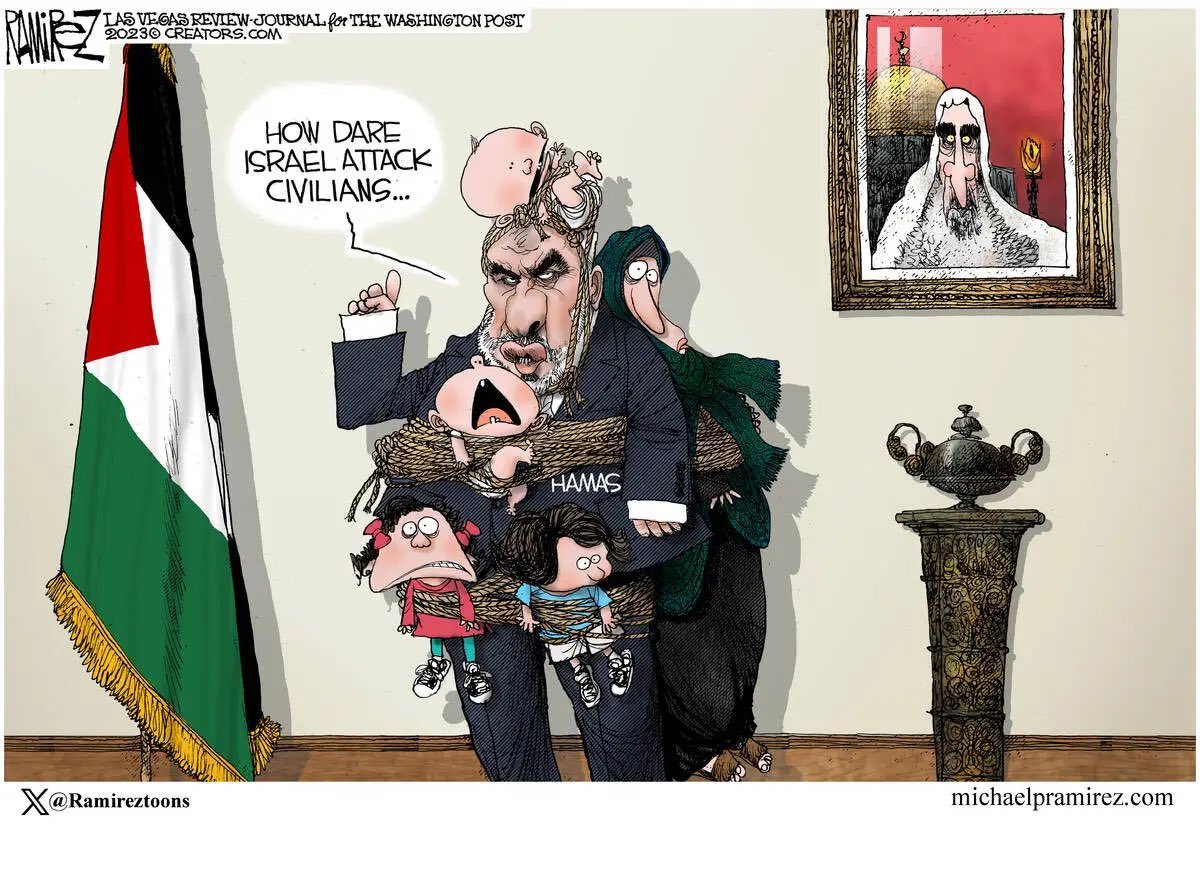
This editorial cartoon, titled “Human Shields” by Michael Ramirez, was removed by the Washington Post. The Las Vegas Journal-Review also ran the same cartoon but did not delete it. 84% of Michael Smerconish’s CNN viewers voted that the Washington Post should not have deleted the cartoon.
By Michael R. Bloomberg, owner of Bloomberg Businessweek
Another mass shooting. Another group of innocents slaughtered. Another public gathering place terrorized. Another community devastated. And another occasion for the gun lobby to say: Oh, well, move along, nothing to see here.
Not this time. We can’t let it happen again. We can’t let the gun lobby get away with it. Not when your community-your bowling alley, your bar, your house of worship, your movie theater, your supermarket, your shopping mall, your work-place and, yes, your child’s school-could be next. Unless we take action to adopt smart and commonsense gun laws, the question isn’t whether another massacre will occur-only how soon. And sadly, we know the answer: Very soon.
In 2023 alone, there have been more than 565 incidents in which someone shot four or more people-that’s almost two mass shootings a day. The US is the only country in the world where this happens. We are not the only country with mentally ill people, of course, just the only country that makes it easy for nearly anyone, no matter how dangerous, to buy guns, including guns that were designed to be used by soldiers.
There is no reason any civilian needs to carry a military-grade rifle. It’s not a hunting weapon. It’s a weapon designed to kill as many people as quickly as possible. The continued sale of these weapons, as well as high-capacity magazines, not only places all Americans at risk but also endangers our police officers, including those who must track down and apprehend people who have shown no compunction about mass killings.
The definition of insanity, it’s often said, is doing the same thing over and over and expecting a different result. That’s what the gun Iobby wants us to keep doing-offering “thoughts and prayers” but doing nothing. But there are some encouraging signs that more people are refusing to go along.
Faced with the enormity of the catastrophe, Jared Golden, the Democratic congressman who represents most of rural Maine, has reversed his opposition to a ban on assault weapons. In announcing his change of heart, Golden, a Marine Corps veteran who knows the deadly capacity of these weapons firsthand, used words the public rarely hears from elected officials: “The time has now come for me to take responsibility for this failure,” he said to his great credit, asking Maine’s residents “for forgiveness and support.” Senator Susan Collins, too, has begun to reevaluate her positions. Collins was among the Republicans who helped kill an assault-weapons ban in 2013, after the massacre at Sandy Hook Elementary School. She now says that she supports a ban on high-capacity magazines.
Golden can also help bring along Maine’s state lawmakers and its Democratic governor, Janet Mills. Mills has previously failed to lend her support to red-flag laws that are designed to prevent the kind of tragedy the state has just suffered: stopping a person with a history of mental illness from being able to buy and possess guns. She has also opposed stronger background checks and limits on magazines. Her support now is crucial to reviving and passing such laws.
It’s not just in Maine where the politics of gun safety are changing. Last year, after nearly three decades of inaction, 15 Republican senators joined Democrats to pass the Bipartisan Safer Communities Act following mass shootings in Buffalo and Uvalde, Texas. And this year, Vermont, which like Maine has a strong tradition of gun ownership, adopted new gun safety policies under a Republican governor.
In the days and weeks ahead, it’s crucial for all of us to make our voices heard and demand that elected officials who have opposed sensible gun regulations follow Representative Golden in reversing course. The gun lobby wants the massacre in Maine to pass from the news quickly. We can’t let them win-not when so many innocent people are dying so many families are grieving and so many Americans are facing danger in their own communities.
The moment is now. Speak out. Get involved. And when politicians offer only thoughts and prayers, counter with deeds and votes. It’s the only way out of this insanity.


 Coast Contact