Three and a half years to go!

President Theodore Roosevelt said “To announce that there must be no criticism of the president, or that we are to stand by the president, right or wrong, is not only unpatriotic and servile, but is morally treasonable to the American public.”

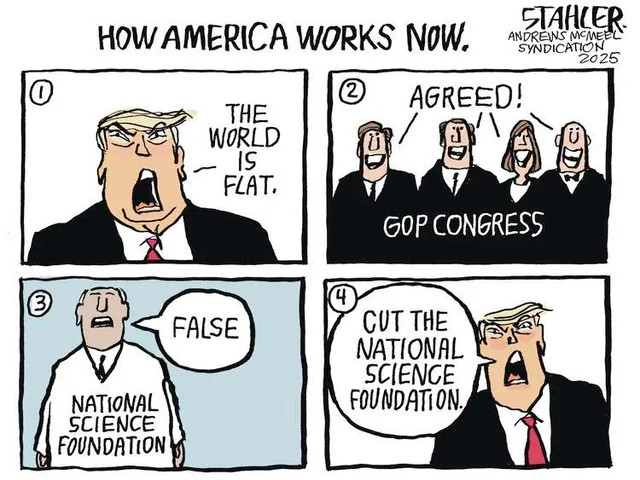
In merely four months Donald Trump has turned the United States from a functioning democracy into a country on the edge of a fascist dictatorship.

The following reports I found on the internet from reliable news sources confirm what my beliefs.                    

The courts including the Supreme Court have given the power for Donald Trump to do as he wishes. The Supreme Court has ruled that President Trump is at least presumptively immune from criminal liability for his official acts, and is absolutely immune for some “core” of them — including his attempts to use the Justice Department to obstruct the results of an election.

Since late February, President Trump has used the power of the presidency to punish law firms that he accuses of weaponizing the justice system and undermining the national interest, part of his promised campaign of vengeance against his perceived political enemies.

Donald Trump expanded on his threats to the media suggesting actions of the press should be deemed illegal and subject to investigation.

“I believe that CNN and MS-DNC, who literally write 97.6% bad about me, are political arms of the Democrat [sic] party and in my opinion, they’re really corrupt and they’re illegal, what do they do is illegal,” the president said during a contentious speech at the Department of Justice.

The Trump administration is seeking to exert extraordinary influence over American universities by withholding the kind of federal financial support that has flowed to campuses for decades. His claim it’s all about anti-semitism. His initial attack is on Harvard, a private university. But it has been expanded.

So far, seven universities have been singled out for punitive funding cuts or have been explicitly notified that their funding is in serious jeopardy. They are:

Now Trump is planning attacks on California universities who chose not to follow his directions.

Now Trump is planning to stop California’s environmental regulations.

What will Trump do next? I do not know. With more than 3 1/2 (three and a half years of his term to go it will be a bumpy ride.

Civil Rights Act of 1964 passed on this Day

Today in History:

On June 19, 1964, the Civil Rights Act of 1964 was approved by the U.S. Senate, 73-27, after surviving a lengthy filibuster.

The act banned discrimination in employment and public accommodations based on race, color, religion, sex, or national origin. This included prohibiting discrimination in hiring, promoting, and firing.

The Civil Rights Act of 1964 sought to undo the damage of Jim Crow policies.

This act, signed into law by President Lyndon Johnson on July 2, 1964.

Columnist reflects the specter of losing his landline

By DENNIS MCCARTHY, Los Angeles Daily News

PUBLISHED: February 16, 2024 at 4:33 p.m. | UPDATED: February 16, 2024 at 4:34 p.m.

When they came for my typewriter and replaced it with a word processor, I grumbled but said nothing.

When they took away my vinyl LPs and replaced them with CDs, I begrudgingly put my Sinatra albums in storage and bought his discs.

When bookstores began closing, I built more shelves in my home and started my own bookstore.

Now, AT&T wants to take away my landline, and I say enough, already! Keep your hands off Ma Bell.

Her rotary phones were our lifelines — our memories of when you could stay in touch with the world with a phone, a newspaper and Walter Cronkite.

Today, I’m paying AT&T and Verizon nearly $400 a month to stay in touch, and I don’t have a clue of what’s going on.

In case you missed it, AT&T wants out of the old copper wire business that delivers landline access to around 25% of the households in California that still have landlines and a cell phone. It drops to around 15% with landlines only.

With the speed and technology AT&T possesses, you’d think they’d have texted me with the news, but they chose good, old, reliable snail mail to let me know. How’s that for a shot of irony?

It’s asking the California Public Utilities Commission for a release from its obligation to provide landline phone service in a large portion if its service territory in the state. My portion.

If approved, AT&T will give us land liners six months before it cuts the copper wires and we have to move to a private, unregulated carrier to keep our landline. If no alternative voice services are available, it will hang on until there are.

Not so fast, though. I kind of like the government keeping an eye on my phone bills. It keeps an eye on everything else for me.

I still have an old rotary phone I keep at the end of my desk for personal therapy. The number’s University 6-3230.

Whenever I’m feeling down or stressed out, I stick my forefinger in one of the 10 holes — digits 1 through 9, and zero — on the rotary dial, and give her a whirl, cradling the receiver between my chin and shoulder, like I used to.

That familiar clicking noise when you turn the rotary dial is a glass of chocolate milk and Oreo cookies to me. I’m back in the old neighborhood calling my high school buddies and old girlfriends in my mind.

Ma Bell hung from our kitchen wall and sat on a side table in the living room in the 1950s when two-thirds of American households had at least one rotary phone, thanks to that old copper wiring it now wants to cut.

Ma couldn’t fit in our pocket or do all the things smart phones can do now, but somehow we made do.

Calendars told us what day it was and watches told us the time. Newspapers, TV and radio news kept us in the loop.

Ma couldn’t check our messages or text our friends for lunch, but she gave us great reception and that’s all we were asking for. She never died in the middle of a call.

By the 1970s, push buttons began replacing rotary dials, and that therapeutic clicking sound was gone forever. By the 80s, most rotary phones were being phased out as Ma Bell sang her swan song in 1984.

Today, when my cell phone rings in my house, it’s a mad dash to the window in my den where I get the only good reception in the place and don’t lose the call.

When my landline rings, I take my time walking over to answer it. It never loses a call.

Before the California Public Utilities Commission makes a decision in April on AT&T’s request, it’s asking for public comments.

Comments may be posted on a CPUC link: tinyurl.com/yvp6fb7n

Also, the California Public Utilities Commission is holding two in-person public forms — Feb. 22 in Ukiah, and March 14 in Indio.

One virtual meeting to be held at 2 and 6 p.m. March 19. Information about these meetings and other information on the issue on the CPUC page here: tinyurl.com/yx9sv9zw

For more information on the issue of AT&T’s request to be relieved of its “Carrier of Last Resort” obligations in certain areas of California go online to: https://www.cpuc.ca.gov/attcolr

Or, better yet, give them a call on your landline at 866-849-8390.

For Ma Bell.

Why all the Rain in a La Niña winter?

The forecast in October by the Climate Prediction Center, a division of the National Weather Service, indicated the odds were stacked against the Golden State: a rare third year of La Niña was expected. And California had already recorded its three driest years in the historical record.

The center’s seasonal forecast for December, January and February said there were equal chances of a dry or wet season in Northern California. But for Southern California, the agency reported there was a 33% to 50% chance of below-normal precipitation.

Every California state water agency and every local water agency were preparing for another winter of drought.

Then the surprise started at the beginning of December 2022. Rain storm after rain storm hit Southen California.

How could that happen when this season was a predicted La Niña winter?

The meteorologists (climate scientists) provide us with an exclamation. One meteorologist who has warned against putting too many eggs in the La Niña basket is Jan Null, a former lead forecaster for the National Weather Service. In late 2020, as La Niña was developing, he tweeted of the phenomenon: “What does it mean for California and U.S. rainfall? Almost anything!”

So while La Niña and El Niño do factor into Southern California weather, another phenomenon known as the Madden-Julian Oscillation can affect whether storms hit. And instead of being forecast months in advance, they can be predicted only weeks ahead of time.

The Madden-Julian Oscillation — or MJO — is separate from La Niña and El Niño. It’s another way of predicting rain and it provides an excuse for incorrect forecasting.

1997-1998 was a year when the El Niño was accurately predicted (48.3 inches) and that started my collection of rain at my home. What I learned is that the average amount to rain is not a guide to how much rain will fall in any given year. Last year the total rain was just of 6 inches. This year the rainy season is only half completed and the rain received is approaching 16 inches.

Aston Martin Executive Says Electric Cars Aren’t Viable

Finally at least one auto executive agrees with me!

Aston Martin Creative Officer Marek Reichman had some interesting things to say about electric cars and the future of the auto industry lately. In an interview with Drive, the automotive executive opined that electrification is “not the answer” for a zero-emissions future. Normally, such concerns are just dismissed by EV fanboys as “anti-progress” or “technophobia” but Reichman and his comments aren’t so easily dismissed.

Instead of completely writing off EVs, Reichman views them as a bridge to something that’s actually viable. In the interview he pointed out some of the obvious limits of electrification, such as ridiculously long charge times (anything above 5 minutes counts as too long) and the rare nature of minerals used to manufacture batteries. Considering millions of cars are made every year and EVs constitute a small drop in the bucket, he has a point.

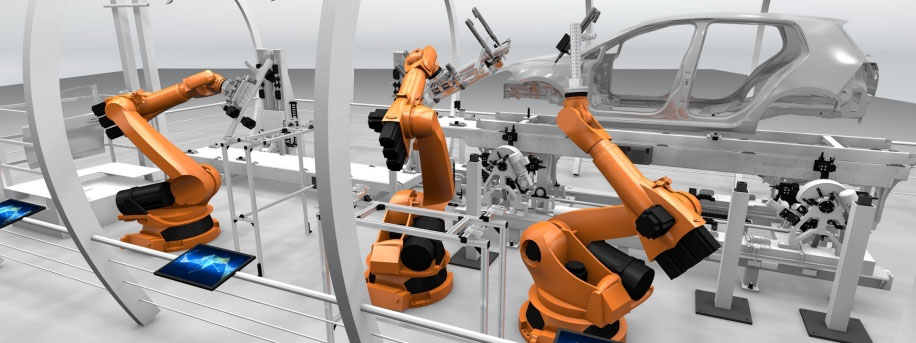
Robots are coming. A quarter US workers at risk!


As reported in USA Today one man is sitting “alone atop a tractor with a specialized mechanical attachment” that now performs the work of 30 people.

The Los Angeles Daily News reported “Members of the longshoremen and warehouse workers union picketed outside a meeting of the L.A. Board of Harbor Commissioners Thursday morning, Jan. 24, protesting the approval of a permit that will allow a major terminal operator to increase automation at the Port of Los Angeles.”

According to a new Brookings Institution report one fourth of all jobs in this country are at risk due to automation.

Without a job what will those people who lack the capacity to learn complex job functions do?  This will most likely be a world wide problem.  We as a nation will not let them starve.  Most likely more people will be on a welfare program.

This won’t happen in 2019 but the structure of our society will be changing before this century is over.

Is there a march to autonomous cars?

My guess is there will be autonomous trucks and self driving Uber cars but the autos that most of us drive will still require operation by the owner.  There are at least two reasons.

1) There is a question of liability.  Who is responsible when accidents occur?

2) Many of us like to drive our cars.  We like to be in control.  It is the fun of accelerating, speeding, and for many we still like to shift the gears.

I predict the consequence will be cars with an abundance of safety features.  Many of them are on some but not all 2018 vehicles.
Look at the 2018 Toyota Camry and Honda Accord

-Pre-Collision System with Pedestrian Detection

If the system determines that a collision is likely and you do not brake in time to prevent an accident the system will apply the brakes to slow the car.

-Lane Departure Alert and Assist (LDW and LKA)
The system will warn you of a departure by issuing a beeping noise and will make minor correction to keep your car centered in your lane.

-Automatic High Beams

The car will turn on high beams when there the area is dark and there are no oncoming lights

-Adaptive Cruise Control

You have set your cruise control at 65 mph.  The traffic slows to a lower speed. The system slows the car to an appropriate speed and subsequently increases the speed when traffic resumes to a faster speed.

-Blind Spot Detection
Blinking lights on outside rear view mirrors and inside mirrors to aid in knowing there is someone or something that could cause an accident

-Rear cross-traffic alert
A beeping noise and flashing warnings on interior screen

I have an early 2018 Camry that includes most of these features.  The Adaptive Cruise Control that they call Radar Cruise Control is my favorite feature.  All of these safety features should be reason enough to buy a new car rather than spending more money on an old clunker.

Self-driving Car Timeline for 11 top Automakers

As I drive a 2001 Nissan Maxima that has gone about 118,000 miles and is still a smooth operating car with dirty upholstery and cruise control that has stopped functioning, I believe it is time for something new.

Aren’t self driving cars about to be the next big thing in just a year or two?

I found the following summary of when this is likely to happen.  Abridged article from venturebeat.com dated June 4, 2017

Should I wait another few years?  After all the car still runs quite well.

A company by company examination of public investments by leading car makers and statements from their top executives makes it clear that most car companies are betting self-driving technology is inevitable, and they’re all jumping in with investment and initiatives.

Defining “self-driving” by level

Level 1 automation: some small steering or acceleration tasks are performed by the car without human intervention, but everything else is fully under human control

Level 2 automation: like advance cruise control or original autopilot systems on some Tesla vehicles, the car can automatically take safety actions but the driver needs to stay alert at the wheel

Level 3 automation: still requires a human driver, but the human is able to hand some “safety-critical functions” off to the vehicle under certain traffic or environmental conditions. This poses some potential dangers as the major tasks of driving are transferred to or from the car itself, which is why some car companies (Ford included) are interested in jumping directly to level 4

Level 4 automation: a car that can drive itself almost all the time without any human input but might be programmed not to drive in unmapped areas or during severe weather. This is a car you could sleep in.

Level 5 automation: full automation in all conditions


GM: Rumors of self-driving vehicles by 2018

Unlike other big car makers, GM has not laid out a specific timeline for its self-driving cars, but the company has made it clear it’s moving aggressively in that direction. In December, GM CEO Marry Barra wrote, “We expect to be the first high-volume auto manufacturer to build fully autonomous vehicles in a mass-production assembly plant.” The focus will be on ride-sharing, rather than the individual buyer.


Ford: Truly self-driving vehicles by 2021

Ford Motor CEO Mark Fields told CNBC that Ford plans to have a “Level 4 vehicle in 2021, no gas pedal, no steering wheel, and the passenger will never need to take control of the vehicle in a predefined area.” Ford actually plans to skip right over Level 3 automation and go straight to Level 4. In the company’s tests, chief technology officer Raj Nair found that Level 3 automation would lead to engineers dozing off and not being situationally ready to take over when called on. CEO Mark Fields claims that Ford will have cars with no gas pedal and no steering wheel driving people around in select cities by 2021.


Honda: Self-driving on the highway by 2020

At the end of last year, Honda announced it was in discussions with Waymo, an independent company of Alphabet, to include Waymo self-driving technology in Honda’s vehicles.


Toyota: Self-driving on the highway by 2020

Toyota has been one of the most skeptical car companies when it comes to autonomous vehicles, but in 2015 it made a big investment to catch up. Toyota is investing $1 billion over five years in the Toyota Research Institute to develop robotics and AI technology. The company hopes to launch products based on its Highway Teammate programs in 2020, which would also be just in time for the Tokyo Olympics.


Renault-Nissan: 2020 for autonomous cars in urban conditions, 2025 for truly driverless cars

Renault-Nissan is counting on its new partnership with Microsoft to help advance the company’s autonomous car efforts. Renault-Nissan plans to release 10 different self-driving cars by 2020.


Volvo: Self-driving on the highway by 2021

Volvo CEO Hakan Samuelsson said in an interview, “It’s our ambition to have a car that can drive fully autonomously on the highway by 2021.” He envisions that full autopilot would be a highly enticing option on a premium vehicle and will initially be priced at $10,000.


Hyundai: Highway by 2020, urban driving by 2030

Hyundai is working on self-driving vehicles but with more of a focus on affordability. In an announcement, Hyundai claims it is “developing its own autonomous vehicle operating system with the goal of using a lot less computing power. This will result in a low-cost platform, which can be installed in future Hyundai models the average consumer can afford.”


Daimler: Nearly fully autonomous by early 2020s

Daimler announced this month a high-profile development agreement with Bosch, one of the largest parts suppliers. The goal is to bring both Level 4 and Level 5 autonomous vehicles to urban environments “by the beginning of the next decade.” This announcement came less than a month after Bosch announced its own collaboration with chip maker Nvidia to develop self-driving systems.


Fiat-Chrysler: CEO expects there to be some self driving vehicles on the road by 2021

Fiat-Chrysler also teamed up with Waymo last year to test some self-driving Chrysler Pacifica Hybrid minivans.


BMW: Fully self-driving vehicles possible by 2021

Last year, BMW announced a high-profile collaboration with Intel and Mobileye to develop autonomous cars. Officially, the goal is to get “highly and fully automated driving into series production by 2021.”


Tesla: End of 2017

As a smaller startup car maker, Tesla has always focused on pushing the edge of technology. Last year, Tesla began making sure all its cars had the hardware needed for full self-driving capabilities, even before the software/data was ready. Tesla constantly updates its car’s software to improve safety.

I have no car payments now and  the car still runs quite well.  Maybe some new tires and I will ask the mechanic what is the cost of fixing the cruise control.