What’s Wrong with California?

To answer the title question: Nothing!

The talk at some discussion groups that I attend revolves around the argument that California and especially Los Angeles is on the verge of collapse due to high taxes, high public debt, and a significant loss of private enterprises moving to other states. That perception is not in keeping with reality.

For the most part Californians accept the multi-ethnic makeup of the society. Thus we find large populations of Asians and Hispanics throughout the state. The Los Angeles LGBT Center is one of the largest and most experienced providers of LGBT health and mental healthcare, supported by a research team working to advance the care and treatment of lesbian, gay, bisexual, and transgender people.

California alone as a nation would economically be the 6th largest economy in the world. The five ahead of us are the U.S., China, Japan, Germany and the United Kingdom. The U.S. Bureau of Economic Analysis reported that California’s GDP was $2.5 trillion in 2015, up 4.1 percent from a year earlier.

California is the largest producer of Pima cotton in the United States. The California cotton industry provides more than 20,000 jobs in the state and generates revenues in excess of $3.5 billion annually.

California is largest producer of fresh vegetables in the United States says the US Department of Agriculture. California strawberries are found in the markets of Toronto Canada.

Industry Week lists the 500 largest U.S. companies each year. Last year California surged ahead of Texas, 64 companies to 55. By revenue, the biggest manufacturers in California together contributed $881 billion to the state’s coffers, while the biggest in Texas contributed $847 billion. There is not one other state that employs over 1 million people in manufacturing. Texas at 750,000 is in second place. This is US Census data.

40% of all imports and exports of the U.S.A. are moved through the Los Angeles/Long Beach harbor facilities. This figure does not include goods that are shipped by air cargo.

Speaking of air traffic, Los Angeles International Airport (LAX) is the third busiest in the United States.  That makes Los Angeles a major tourist destination. Santa Monica, Beverly Hills, Hollywood, and the amusement parks draw millions of people and that means thousands of jobs.

San Francisco and San Diego are major tourist destinations for the entire world.  Last year we stayed at the Fisherman’s Wharf Sheraton Hotel.  The desk informed me that their primary of guests comes from other countries.   

Los Angeles is a world leader in architecture. The Los Angeles Times this past Sunday (May 21, 2017) published a catalogue of 186 pages showing the works of major architect in this city. Titled DesignLA, it pictured the work of those talented people who include Frank Gehry.

As to education, California has some of the most highly regarded universities in the world. UCLA, USC, UC Berkley, Stanford, and CSUN are just the top of an outstanding educational system that draw thousands of students from around the world.

Silicon Valley and San Francisco are the heart of high tech for the entire world.  Facebook, Google, Apple, Tesla are the four most famous of those companies but there are many others as well.

Los Angeles is still home to important aerospace companies including JPL, Rocketdyne, and Space X. 

Los Angeles is the entertainment capital of the world. All the major movie studios are based in metropolitan Los Angeles. All television networks have large studios in Los Angeles.

New Jersey has the highest effective property tax rate at 2.38% and is followed closely by Illinois (2.32%), New Hampshire (2.15%), and Connecticut (1.98%). California is happily in 34th place with an effective rate of .81%. My source: https://taxfoundation.org/

California gasoline tax will be the highest in the nation thanks to the latest increase in that tax that will take effect November 1, 2017. This is clearly a serious mistake.

California state government bonds are rated AA- by both Fitch and Standard and Poor’s, Aa3 by Moody’s.

I have not even discussed the weather that is the most obvious reason there was a mass migration to California after WW2 and is still a major drawing point for so many in the rest of the United States. We moved from Philadelphia where you can rely on rain if you plan a picnic in the park and that is in the summer. Winters can best be described as miserable at best.

This is not actress Scarlett Johansson

A 42-year-old product and graphic designer in Hong Kong spent a year and a half and more than $50,000 to build a female robot that’s meant to resemble a Hollywood actress whom he doesn’t want to name. (It’s Scarlett Johansson.) The crop-topped humanoid responds to a set of verbal commands and makes facial expressions.

Ricky Ma built the full-size robot, dubbed “Mark 1,” from scratch on his balcony, thus fulfilling a childhood dream, according to Reuters. “During this process, a lot of people would say things like, ‘Are you stupid? This takes a lot of money. Do you even know how to do it? It’s really hard,’” Ma said.

Have you seen the television program Humans? It is an UK series all about robots that appear to be human.  It can be seen in the USA on AMC.

After overcoming challenges like burnt-out electric motors and his inexperience with electromechanics and programming, Ma has created Mark 1, which can move its limbs, turn its head, bow, smirk, and wink. It can also respond to a set of commands with responses or movements.

Evolution of American Industry

Valued at nearly $20 trillion, the U.S. economy is the largest in the world. Maintaining a competitive edge necessitates remaining diversified and dynamic. While this means that some U.S. industries thrive, others inevitably decline or are rendered obsolete.

As certain industries fade, so do hundreds of thousands of American jobs. 24/7 Wall St. analyzed employment figures from 2006 to 2015 from the Bureau of Labor Statistics to determine the 25 fastest dying industries. Employment in each industry on this list declined by at least 43%, and in the top two by at least 80%.

At least one of three broad factors is behind the decline in each of the fastest dying industries. The first factor is cost reduction. Cheaper labor abroad has caused many American companies to outsource manufacturing operations. In China, for example, the minimum monthly wage in the garment industry is less than $150 a month. Perhaps not surprisingly, the bulk of clothing Americans import was made in China.

Click here to see America’s 25 dying industries.

Click here to see America’s 25 thriving industries.

In addition to outsourcing, robotic automation in U.S. factories have hurt employment in manufacturing. The sector has shed nearly 2 million jobs in the past decade, a 12.8% decline. Of the 25 fastest dying industries, 10 are in the manufacturing sector, and seven of those are related to clothing and other textiles.

The second cause for massive employment declines in certain industries is the wide adoption and exponential growth of new technologies. Online streaming services and on-demand programming are largely responsible for the 61% employment decline in DVD and video tape manufacturing and the 89% decline in the video rental industry. Similarly, the proliferation of cellphones and smartphones has greatly reduced employment in both telephone manufacturing and photofinishing, industries where employment has declined by 51% and 60%, respectively.

Finally, broad macroeconomic conditions have also contributed to lower employment in many industries. Most notably, within the last 10 years, the subprime mortgage crisis and resulting recession have contributed to a considerable drag on construction. Since 2006, new home construction has declined by 51%. Over the same time period, the broad construction sector has shed over a million jobs, or 15.3% of total employment. The land subdivision and framing industries were hit especially hard, with employment declining by 57% and 55%, respectively.

To identify the dying industries, 24/7 Wall St. reviewed employment growth from 2006 through last year for 704 U.S. industries in the fourth level of detail in The North American Industry Classification System (NAICS) by the U.S. Census Bureau. All data, including the number of establishments within each industry, average weekly and annual wages, as well as breakouts of these data over government, private, and local levels were retrieved from the U.S. Bureau of Labor Statistics’ (BLS) Quarterly Census of Employment and Wages (QCEW). The BLS tracks industry employment by tallying the number of workers in establishments whose primary sources of revenue fall within a given industry. As a result, a given establishment along with all of its employees may be reclassified depending on business decisions and market performance. For the finance and insurance industry, where the primary source of revenue for a fund, trust, or financial vehicle can change from a single trading decision, industry employee counts may not be comparable from one year to the next. To help ensure that 10-year employment changes reflected natural growth, all industries related to the management of funds, trusts, and other financial vehicles were excluded.

This is not the kind of data Donald Trump wants to see.  He, along with millions of people who have lost their jobs, does not want to face the realities of a world economy.  Instead of working to retain outdated technologies the US government should be spending its time training the population in technologies of the 21st century.  We have the money to change but we lack the will.

Trump just signed off on killing your Internet privacy protections

The article on CNN reads, “Trump signed into law a resolution that repealed protections requiring Internet service providers to get your permission before collecting and sharing data. These protections — which had not yet gone into effect — were approved by the Federal Communications Commission in the final days of the Obama administration.”

It is panic over absolutely nothing.

This resolution changes nothing. It only reinforces an existing reality. Here is the reality.

– I apply for life insurance and the carrier does an investigation of my past life. I am not qualified for their lowest quotation because they learn something about my life that they consider to be concerning. Where did they get that information?

– I do a search on-line for information about the 2017 Chevrolet Cruze and immediately every car maker offering competitive models has advertising in the header of my screen.

– The internet constantly bombards me with advertising that an algorithm has concluded will interest me.

– My bank has studied my buying habits and concluded I should have a new credit or debit card. They send the card to me without my request.

You think this resolution will change anything? No it won’t because almost every company knows almost everything about you now.

Are robots about to replace humans?

Last week, Treasury Secretary Steven Mnuchin said he wasn’t worried at all about advancing artificial intelligence taking over jobs anytime soon. In fact, he said, he wouldn’t be worried about it for another 50 to 100 years.

That was a surprising commentary considering the advance of AI (artificial intelligence) and the advances in robotics. New York developer Rockefeller Group is building two warehouses in Riverside County, California that will span 1.45 million square feet. The purpose of those warehouses is to be a distribution point for goods received at the ports of Long Beach/Los Angeles.

Giant cranes unload those cargo container ships far faster than the longshoreman directed activities of the past. Thanks to bar code technology the location of every widget in a warehouse can be identified and fetched by robots that can lift and move 3,000 pounds with ease. That means fewer jobs for operators of large fork lifts.

Recent studies from McKinsey and the economists Carl Benedikt Frey and Michael A. Osborne estimate that around 45 percent of workers currently perform tasks that could be automated in the near future. And the World Bank estimates that around 57 percent of jobs could be automated within the next 20 years.

Robots install rivets on a 2015 Ford F-150

Automobile welding as car move down assembly lines have become so common that photos of the action no longer attract too much attention.

Sellafield, on the coast of the Irish Sea, more than 300 miles north (and a bit west) of London, at the dawn of the Cold War; the U.K. chose this site as the place to begin enriching uranium for its first nuclear weapon. But in the country’s haste to build a bomb, little thought was given to disposing of the waste. The U.K. government is spending about £2 billion ($2.5 billion) a year at Sellafield to contend with the nuclear waste. A new model of a cleanup robot “will make its own decisions” in dealing with the waste.

The technology already exists to make long haul trucks self-driving. There are 8.7 million trucking-related jobs in the United States. It is easy to understand why the changeover to those autonomous trucks will take time. It is not going to take 50 to 100 years.

This Robotic Sex Doll Isn’t Just Looking For A One Night Stand, She Wants To Meet Your Parents.

The Greatest Concept Cars of the 1950s

In the 1950s, the American economy was booming, the suburbs were sprawling, and automobiles took on newfound importance. At the same time, inventions, pop culture, and technological innovations touched our lives in new ways, from the Space Race and the credit card to the Barbie doll and beyond. With jet planes and research rockets soaring above us, not even the sky was the limit anymore.
Few objects of any sort embodied the spirit, the extravagance, and the confidence of 1950s America as well as the concept, or “idea,” cars displayed at the country’s auto shows and, in some cases, on its roads. Designers and engineers experimented with wild styling, clever features, and new solutions to old problems, some of which worked and some of which didn’t. The Jet Age was upon us, and the carmakers were not about to let us forget it. And so you don’t forget them, here is a collection of what we consider to be the greatest concept cars of the decade.

1951-gm-lesabre

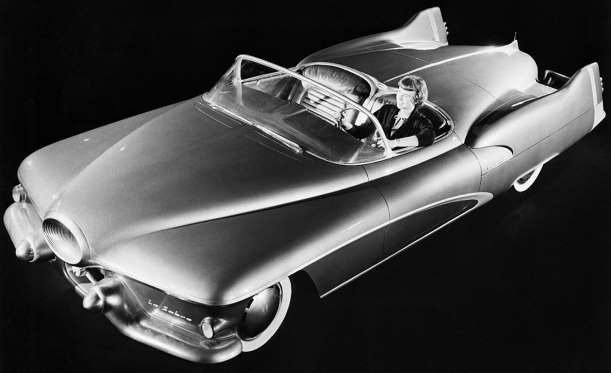
1951 GM LeSabre

No company put out more captivating concept cars in the 1950s than General Motors, in large part thanks to GM design boss Harley Earl, who dazzled the world in 1951 with the GM LeSabre. The LeSabre (a name not yet associated with Buick) captured the dawning Jet Age from every angle, starting with the protuberant center grille that concealed twin headlamps. Its distinct, fuselage-like upper body contours flowed all the way to its afterburner-like center taillamp, all flanked by low and wide fenders and tailfins sprouting from its outboard flanks. The latter theme continued to define the era. The LeSabre was a runner, too, powered by a 335-hp aluminum supercharged V-8 with a rear-mounted automatic transaxle. But unlike most concept cars that followed, the LeSabre was no trailer queen: Earl used it as his everyday ride for a few years, ultimately putting 45,000 miles on it. Strong public reaction to the LeSabre helped convince GM to include concept cars in its famous Motorama traveling car shows of the 1950s.

1956-oldsmobile-golden-rocket 
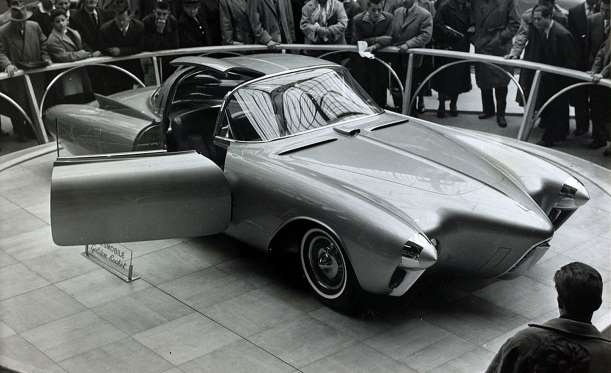
1956 Oldsmobile Golden Rocket

Oldsmobile was a powerhouse in the 1950s, and its shark-nosed Golden Rocket concept, which made the rounds as part of 1956’s General Motors Motorama, showed how ambitious the brand was. Decidedly sporty, if a little strange-looking with its round headlamps tucked between the skinny grille and high-set, missile-like fenders, the fiberglass-bodied Golden Rocket could have outaccelerated a Corvette at the time, thanks to its 275-hp V-8 and lithe 2500-pound curb weight. Sadly, few of its nifty styling features made production, save for the wraparound split-rear-window treatment, which appeared on the 1963 Corvette. As fast as it was, its luxury features were equally interesting, including a power-tilting steering column, seats that automatically raised and swiveled out when the doors opened, and twin roof panels that tilted upward to facilitate ingress and egress, adding even more drama to arrival.

 1954-lincoln-futura
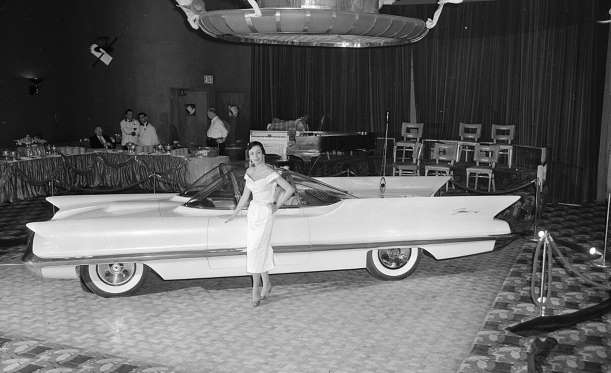
1954 Lincoln Futura

Italian coachbuilder Ghia kept busy in the 1950s and built the gorgeous Lincoln Futura in 1954 for display at the 1955 Chicago auto show. The Futura’s furrowed brow was the most consequential styling element as far as Lincoln was concerned, but the car itself became a cultural icon more than a decade later when, in 1966, it was given a batlike face, fluted fins, and black-and-orange paint, becoming—you guessed it—the Batmobile for the Batman series. Fifty years later, it remains one of the most famous and beloved automobiles in history, selling at auction in 2013 for $4.6 million.

 1953-1954-and-1955-alfa-roneo-b-a-t-cars
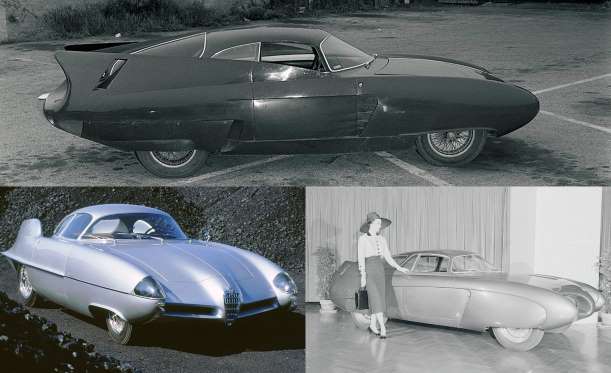
1953, 1954, and 1955 Alfa Romeo B.A.T. Cars

Concept cars weren’t just an American thing. In the early 1950s, Alfa Romeo commissioned its fellow Italians at the Bertone design house to assist its aerodynamic research efforts. The collaboration resulted in three amazing B.A.T. (Berlinetta Aerodinamica Tecnica) concept cars: B.A.T. 5, B.A.T. 7, and B.A.T. 9. No relation to Bruce Wayne’s favored ride, Alfa’s trio appeared in successive order at the 1953, 1954, and 1955 Turin auto shows brandishing tapered greenhouses, curved fins, and fenders that were covered in smooth bodywork. Each car looked more producible than the one before it, but they were never built for customers. They did, however, help Alfa Romeo gain a better understanding of aerodynamics, with the best one claiming a heroically low 0.19 drag coefficient, a figure achieved only by the GM EV1 and the Volkswagen XL1 in modern times.

 1955-ford-mystere
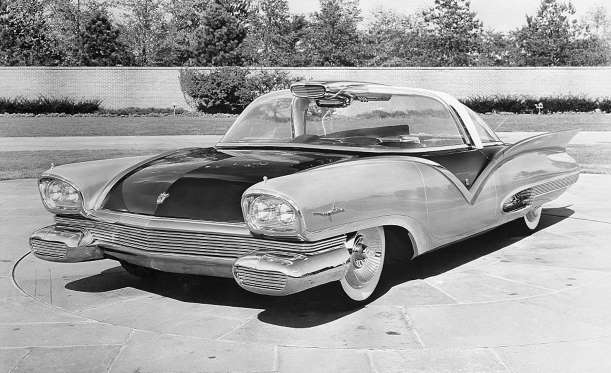
1955 Ford Mystere

With its one-piece glass roof, forward-thrusting front fenders, and dual afterburner taillamps, the Ford Mystere could hail from no other time than the 1950s. The Mystere’s four passengers would enter and exit through the rear-hinged swing-up canopy, with the overhead scoop providing much-needed ventilation considering how much sunshine the cabin would get (and that there was no way to open the glass). Intended for a gas-turbine engine mounted in the back, the Mystere is said to have arrived at the 1956 Chicago auto show unable to move under its own power. It also supposedly had a radio telephone between the front seats and an aircraft-like “throw over” steering system that could be moved for operation from either front seat.

 1956-1957-chrysler-dart-diablo

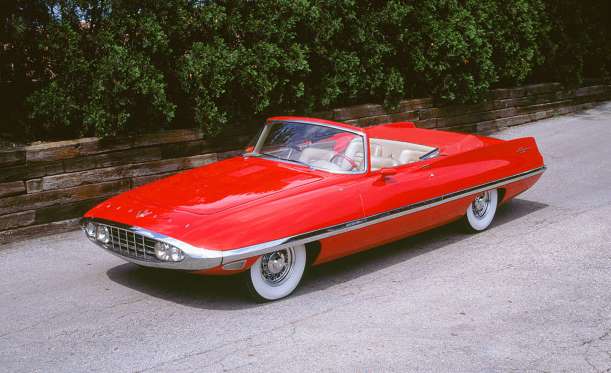
1956–1957 Chrysler Dart/Diablo

Of the numerous Chrysler/Ghia collaborations of the 1950s, the 1956 Dart/Diablo was arguably the greatest. This concept was built on the chassis of a 1956 Chrysler 300 and was originally dubbed the Dart, featuring a low, ovoid, horizontal grille rendered in chrome that streaked all the way down its clean, unadorned body sides. With its smooth body and inset wheels, the Dart was extremely aerodynamic, so gigantic fins were used for stability as well as style. It originally featured a trick, if unreliable, retractable hardtop that slid back in three positions—sunroof, landau, and fully retracted—but in 1957 it was sent back to Ghia, where the elaborate roof was swapped for a more conventional ragtop and the tailfins were shaved down to more relatable proportions. Thus equipped and renamed the Dart Diablo, the nearly 21-foot-long show car was shown to the public at the 1958 Chicago auto show. In 2013, it sold at auction for a cool $1.4 million.

Los Angeles booms as a startup hub

From The Economist, Nov 5th 2016

surfing-at-venice-beach
Surfing at Venice Beach

HOLLYWOOD has produced plenty of films about underdogs rising to claim the limelight. Now Los Angeles is experiencing its own real-life Cinderella story, as the area’s technology scene has been transformed from backwater to boomtown in just a few years. Hordes of venture capitalists from northern California, once long dismissive of their southern neighbour, now regularly commute in search of deals in a less heavily hunted spot than the Bay Area. In 2016 the city’s startups received around $3bn in funding, around six times more than in 2012, according to CB Insights, a research firm.

Evan Spiegel went to Stanford University in the heart of Silicon Valley, but he wanted to live and work close to the sea. So he based his new company one block from the Pacific in Venice Beach, which is better known in Los Angeles for its silicone-enhanced bodies than the silicon chips that gave the Valley its name. Mr Spiegel’s firm, Snap, is best known for its ephemeral Snapchat social-media messages and is now valued at a whopping $18bn. Other successful technology firms are thriving nearby, including Dollar Shave Club, an e-commerce firm recently sold to Unilever for $1bn; Ring, a “smart” doorbell company, and Riot Games, maker of “League of Legends”, a popular online multiplayer contest.

Los Angeles is now the third-most-prominent outpost for startups in America, after San Francisco and New York. It has several advantages, including good universities, warm weather, a relaxed culture, proximity to San Francisco and much lower costs. Michael Schneider, the boss of Service, a customer-relations startup, reckons he would need to have raised at least 40% more money if based in San Francisco, “just to pay for the same space and people”.

Although Los Angeles has fewer experienced engineers, those that are there tend to be more loyal, not least because there are fewer firms out to poach them. Startups can convince people to move. Ophir Tanz of GumGum, an advertising startup, says he has recruited several employees looking for a more balanced life away from cities like New York and San Francisco.

Los Angeles may at last be getting the attention it deserves. “The original monetisation of the internet was created here, not Silicon Valley,” says Mark Suster, a venture capitalist with Upfront Ventures, referring to pioneers such as Applied Semantics, bought by Google. But for Los Angeles to establish itself as an enduring place for startups, it needs Snapchat to continue to thrive and go public, which could happen as soon as next year.


A Sad Decline for America

I am not happy as I did support Hillary Clinton. However I did not support her because she had anything worthwhile to offer. She was “the lesser of two evils” in my opinion. Trump won because he promised change. That was the Obama promise too. We all know how that turned out. Millions of people believed that Mrs. Clinton was just a continuation of the same gridlock that has kept the same bunch of elected people in office (and that includes Republicans and Democrats).  It’s unlikely Trump will be successful but the public keeps hoping.

Charles Krauthammer in his November 11, 2016 column mostly wrote about how a Republican congress can now cancel Obamacare, end Dodd Frank consumer protection, and impose their solutions for illegal immigration.  One point he made does make sense: “Trump spoke to and for a working class squeezed and ruined by rapid technological and economic transformation.” While Krauthammer was correct in that analysis his solutions make no sense.

The greater question for me is what will Donald Trump actually do as president?  His history of remarks and promises is full of contradictions.  Many of those contradictory statements have been played on CNN and elsewhere. A good example is in 1999, when Trump forcefully argued for universal health care, telling CNN’s Larry King, “If you can’t take care of your sick in the country, forget it, it’s all over. I mean, it’s no good. So I’m very liberal when it comes to health care. I believe in universal health care. I believe in whatever it takes to make people well and better.”

The world has changed dramatically over the last two decades.  Donald Trump cannot roll back the impact of globalization.  Our congress is filled with people with an average age of Members of the House at the beginning of the 114th Congress of 57.0 years; of Senators, 61.0 years.  These are a bunch of older people many of whom do not understand the changing world.  This is not the group likely to lead this nation in a rapidly changing technology world.

Sadly, we are likely to see an America in decline.  Tell me I am wrong and why.

Automation at Work

Where have all the jobs gone? That is the question asked by so many people.  Of course many have gone to low labor cost countries but that is not the entire answer.  The new 2017 Honda Civic Hatchback is being assembled in the U.K.  That is not a country known for its low labor costs.  This model will be sold in the United States, Canada and elsewhere.  The video is a little too long but notice that there are no people in the video for over 4 minutes.  Then the number of workers is small.  The car is welded and painted without  human interaction.  That part is all automated.  Assembly of the parts still requires human activity but if Honda and the other car manufacturers can find a way to do automation they will employ that opportunity.

2017 Honda Civic sedans will go on sale in the U.S. and Canada this month. The sedans are assembled Greensburg, Indiana, and in its Alliston, Ontario, Canada, plant. The Civic Hatchback will be manufactured in Honda’s U.K. Manufacturing plant in Swindon, England, but make no mistake, the 1.5-liter double overhead cam, direct-inject turbocharged, in-line four-cylinder engine is all Japanese.

The Impact of Technology on Blue Collar Workers

We are about to select a new American president in a world that is rapidly becoming more technically advanced than anyone could have imagined in the year 2000. Remember that as the year many of us were concerned that clocks would stop, power grid systems might fail, and commercial aircraft might fall from the sky. Of course none of that happened. What has happened is the rapid advance of technology and a globally connected society. Thomas Friedman’s “The World is Flat” (Published April 5, 2005) was not only a recognition of a changing world economy but the need for America to look forward and plan for the new economy.

Take just one new technology, autonomous (self driving) cars and trucks, that is predicted to be launched by the year 2020 to 2025 and consider the impact and you will understand that no one – no president of the United States – can stop the impact on the public in either the United States or other countries.

Don’t Tell The Teamsters: But Driverless Trucks Are Already Here.  Driverless trucks are operating in an Australian mine. When those trucks arrive in America the Teamsters will fight with everything they have to stop those autonomous trucks. Feather bedding will be a prominent part of their strategy. There are currently 900,000 active working Teamsters in the United States and Canada. There are approximately 3.5 million professional truck drivers in the United States, according to estimates by the American Trucking Association.

What will all those families that rely on those truck driving jobs do when they are replaced by self driving trucks? As a nation we have not looked forward. We have looked back.  Technology’s impact on the trucking industry is simply one example of the changing work environment.

Donald Trump promises to bring back the jobs that have been lost due to out sourcing. It is not clear what will motivate the return of jobs other than tariffs that could start a trade war.

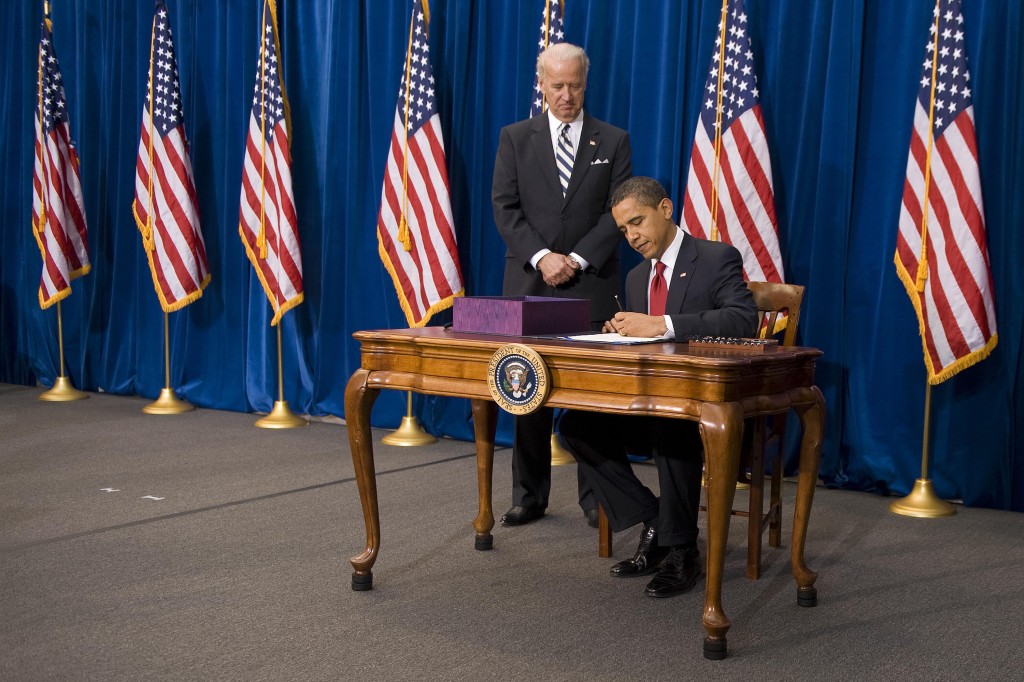
Hillary Clinton says she will propose investing in infrastructure, manufacturing, research and technology, clean energy, and small businesses. The costly $787 billion spending bill that President Barack Obama signed into law soon after taking office had little effect. It was argued that it was insufficient.

obama-signs-the-american-recovery-and-reinvestment-act-of-2009

In all of the Trump and Clinton ideas there is no consideration of the future.