The Downsides Of Turbocharged Automobile Engines

There seems to be a fad among auto manufacturers to build engines that of Direct Injection or Turbocharged engines.  The Honda Civic will offer a turbocharged 1.5-liter four in all models except the basic L model as the standard engine.  Buyers should research the downsides of both of these technologies.
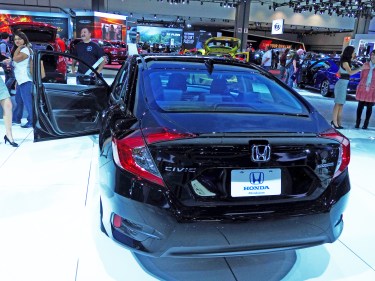
P1000666 edited
  2016 Honda Civic at Los Angeles Auto Show

Increasing concerns for the environment, global supply of oil, CAFÉ standards, and fuel prices have forced many manufacturers to implement new methods of reducing tailpipe emissions and fuel consumption from their cars.

One such method is the use of turbocharged engines. Once exclusively the domain of performance cars, turbocharged engines have exploded in popularity on the mainstream car market. A turbocharger is a component that allows a smaller sized engine to produce power comparable to a much larger sized engine without, in theory, compromising the fuel economy.

Though turbocharging is capable of providing such benefits, there are certain complications with the technology that consumers should be aware of:

1.Turbocharging puts additional strain on the engine due to an increase in heat and pressure properties. The result is that turbocharged engines require more extensive maintenance, such as more frequent oil and spark plug changes, than naturally aspirated engines.

2.Turbocharged engines have low tolerance to short driving trips that don’t allow the parts to warm up to operating temperature. They require regular extended use, ideally highway use, in order to maintain proper performance and reliability. They also require a warm-up/cool-down procedure that involves careful, low rpm driving.

3.Turbocharged engines have more components than naturally aspirated engines, such as turbochargers and intercoolers, which increases the potential for repair expenses over the long-run.

4.Finally, though turbocharged engines are marketed as fuel efficient alternatives to comparably larger, naturally aspirated engines, in real world driving, the actual gains are minimal at best. In some cases, turbocharged cars actually wind up being the gas guzzlers.

You may be wondering why car manufacturers don’t clarify these concerns from the beginning. The answer is that turbocharging used to be more or less exclusive to sports cars and, thus, sports car owners; people who generally could be counted upon to have a certain degree of automotive knowledge. Nowadays, your run-of-the-mill family SUV, complete with a child seat and roof rack, can have a high-powered turbocharged engine. If the dealership told the average car buyer all of this information, few would likely listen to it, and others wouldn’t even buy the car.

Car manufacturers would love to have you believe that turbocharged engines are some kind of ultimate solution to the tug-of-war between power and efficiency, but there’s no question, they don’t work for everyone.

Source for this article primarily from carhelpcanada.com  but Consumers Reports also offered similar advise.
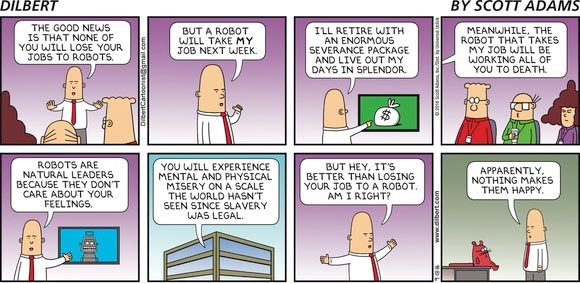
Manufacturers returning to America means jobs for robots, not people

Another article in the Los Angeles Times re-states what I have been writing about for a few years. https://coastcontact.wordpress.com/2013/02/08/impact-of-technology-on-the-u-s-economy/

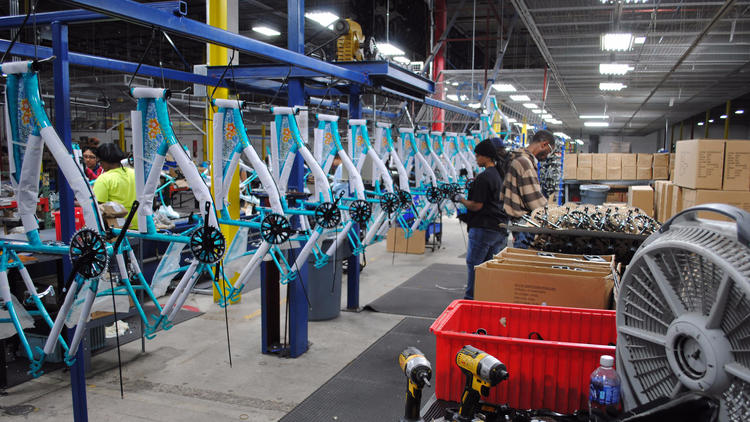
Workers at Bicycle Corporation of America assemble bikes - LA Times 8-14-2016

Workers at Bicycle Corporation of America assemble bikes for Wal-Mart, Target and other retailers. (Bicycle Corporation of America)

Here’s a little reality check on the current presidential campaign and promises by both Donald Trump and Hillary Clinton to bring back jobs from overseas.

It’s about a private Michigan company called Ranir, which makes, among other things, the business end of electric toothbrushes. After spending two years and millions of dollars to reengineer its toothbrush heads, Ranir brought back fully one-fifth of that production from China to its facility in Grand Rapids.

There’s just one catch: Thanks to the new robotic manufacturing process that Ranir adopted, it takes only four workers at the American plant to do the same job that almost certainly required dozens more in China.

The story goes that William Lee, an English minister, grew tired of hearing the incessant clicking of his wife’s knitting needles. Alternate versions of the story say that Lee was trying to win the affections of a lady who was more interested in her knitting than she was in him. In 1589, he modified the looms that were used to create rugs with hooks that would form loops that would be released during each pass of the thread, thereby knitting a whole row at once. Lee left his church work and went to secure the blessing of the queen (Elizabeth I) to ensure that no one else could create such a device and allowing him to make a healthy profit. Elizabeth denied his request and Lee went to France to try the same thing. Henri IV granted Lee the rights that he asked for, but was soon assassinated leaving Lee to die poor in 1610. Lee’s brother, James, took the idea back to England and was assisted by a man named Ashton in Nottingham in creating the first knitting factory. It wasn’t long before it was so cheap to create machine knitted clothing that many local hand-knitters were petitioning the government for limits of the business. (Sound familiar?) Lee’s design remained virtually unchanged until the 1700s when it was modified to include the kitting frame and later to accept other materials like lace and silk or create ribbed materials that could stretch.

Just as hand knitters in 1600 could not stop progress, today American factory workers are asking the United States government to stop progress. They might delay progress but in the end things will not be as they were during the industrial revolution.

Yes! It does hurt!


Technological Unemployment

From Wikipedia: “Perhaps the earliest example of a scholar discussing the phenomena of technological unemployment occurs with Aristotle, who speculated in Book One of Politics that if machines could become sufficiently advanced, there would be no more need for human labour.”

It has been reported repeatedly that Queen Elizabeth I of England refused to grant a patent for a weaving machine because it would put the hand weavers out of work. She was correct. It did.

I was talking with an acquaintance about the effects of AI (artificial intelligence) and IT (information technology) on the work environment and the elimination of many jobs. A touch plate at a fast food ordering counter could replace an order taker. So could many other jobs.

One job I held for 7½ years was a scheduling supervisor in a factory. I had decided to quit after about four years. The work was tedious and very stressful. It took me the next 3½ years to find work that would pay more and appeared to offer a chance of advancement. I was responsible for all the production schedules and work orders in the factory. If something went wrong in the middle of the night, the night foreman called me. Today that job would be done more accurately by a computer generated program that could accomplish my 40 plus hour weekly job in minutes.

My father was a structural engineer. He retired just as computers were beginning to be used to calculate stress analysis. His calculation tool was a slide rule. He was a mathematical genius. Today those calculations can be more accurately accomplished using a computer that would provide the results in minutes not hours. The drafting of the structure can now be provided by a computer driven drafting machine rather than a draftsman.

Perhaps the order taker at the fast food counter will still have a job preparing the order. Perhaps the mathematical genius will be working on a program in Silicon Valley. One thing is certain. All jobs that can be mechanized and/or computer driven will result in fewer jobs.

I rarely take my car to a repair garage because they too have been fitted with longer lasting components. Thanks to a well-made furnace and plumbing in my house the need for service maintenance is reduced. That means there is no growing need for service industry workers.

I have yet to hear anyone, neither politician, corporate leader, nor social engineer, explain how even the brightest people will care for their families when the number of jobs is in decline.

We have a serious societal challenge and no answers. Joel Kotkin and other commentators have observed the issue. Now what?

Robots Are Coming For Our Jobs

This is not an April Fool’s Joke!

Donald Trump and Bernie Sanders may say that they want to help the blue collar, working class, and middle class income Americans but neither has a solution for the oncoming displacement of most laboring and office jobs as wells as many technical jobs.

Japan is number one in the world in operational robots with 310,508 units. There’s even a hotel staffed almost entirely by robots that opened last year in Nagasaki, Japan, according to BAML (Bank of America Merrill Lynch). The United States is in second place (168,623) with Germany in a close third place. This was reported just today on Business Insider.

Coincidentally the Los Angeles Times had an opinion piece in today’s paper that starts with the words “A viral video released in February showed Boston Dynamics’ new bipedal robot, Atlas, performing human-like tasks: opening doors, tromping about in the snow, lifting and stacking boxes.” That article refers to a White House report that says “Most occupations that pay less than $20 an hour are likely to be automated into obsolescence.” Powerhouse consultancies like McKinsey & Co. forecast that 45% of today’s workplace activities could be done by robots, AI or some other already demonstrated technology. Truck drivers and baristas will be replaced too. Some professors argue that we could see 50% unemployment in 30 years.

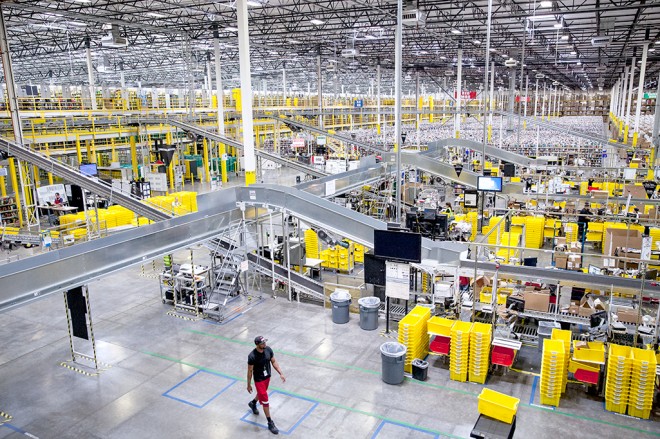
AMAZON-PHOENIX-WAREHOUSE

A rare peak inside Amazon’s massive wish-fulfilling machine

We think we have problems now but a coming so-called Fourth Industrial Revolution will bring changes to society that most of us have yet to imagine.

Elected to Office but Unaware and Really Don’t Care

Inside the beltway: Is your representative aware of happenings in the world?

As reported in the Los Angeles Times

A bipartisan group of senators is seeking a federal investigation into alleged abuses in a popular visa program that has been linked to layoffs of U.S. workers in favor of cheaper foreign labor, the Los Angeles Times has learned.

“We are concerned about recent information that has come to light regarding the abuse of the H-1B visa program by Southern California Edison (SCE) and other employers to replace large numbers of American workers,” wrote Sen. Richard J. Durbin of Illinois, the Democratic whip, and Sen. Jeff Sessions (R-Ala.), who led the bipartisan group.

All of these senators are in league because they all know they must show concern for their constituents. This is a case of crocodile tears for those who are have lost their job or about to experience the same fate as Edison employees. Our free enterprise system says employers have every right to lower all their costs no matter who is impacted. Bank and technology companies are two of the most obvious adopters of the programs to cut labor costs. The shock is that it has taken this long for our senators to become aware of the outsourcing of American jobs. Maybe it’s not such a shock. After all some senators deny having ever used e-mail.

One must ask, where have these senators been? Haven’t they had at least one situation when they needed telephone help from a company and been transferred to a help line in India or the Philippines? Wait perhaps it is accurate to say they have been unaware. Senator Lindsey Graham, Republican of South Carolina, said on NBC’s “Meet the Press” on Sunday March 8 said has never, ever sent an email.

As reported in the New York Times

Nor does Senator Charles E. Schumer, Democrat of New York. “Maybe once every four months, I do one email,” he said, with evident relish. “I like to communicate by talking directly to people. I find it’s an important part of humanity to understand not just the words that are said, but how they’re said, the tone they’re said in, the speed they’re said with.”

Jim Manley, a Democratic strategist and longtime former Hill staff member, recalled that one of his bosses, Senator Edward M. Kennedy, Democrat of Massachusetts, could not use his BlackBerry “if his life depended on it.”

Luddite: One who fears technology (or new technology, as they seem pleased with how things currently are…why can’t everything just be the same?)

Technology is Impacting our Buying Habits

Say Goodbye to Shopping Malls

America, no the entire world, is experiencing a dramatic change in the retail industry. It is very apparent in the United States. Americans are not shopping at malls as much as they have in past years. Macy’s department stores is planning to close 14 of their 800 locations in 2015. That is a company that has been a success. JC Penney plans another 40 closings in 2015. Wet Seal has announced it is closing 2/3 of their stores in 2015.

BloombergBusinessweek says “While malls stumble, mobile shopping is expected to grow 800% through 2015.”

In 2014 a long list of stores were closed. That includes 339 Sears, 170 Staples, 150 Office Depot, and 33 JC Penney. Not the only reason but a major cause has been on line sales. Many of the stores themselves have opened sales web sites.

Amazon has played a prominent role in the structural shift away from brick-and-mortar retail, and it may lay waste to several other retailers in the years to come. Without the cost burden of physical stores, Amazon can price below traditional rivals and drive recurring traffic online. But it is not the only on line business that has changed the retail climate. eBay, Etsy, are just the two other on-line businesses that I know. Want to buy anything from Hewlett Packard? They sell all of their computers, printers, and supplies on line. Meanwhile Alibaba (the Amazon knockoff) is booming in China.

While I still shop at Costco and they have seen their sales increase, they too sell many of their products on line.

Sorry old timers, this is all part of the 21st century.

The Gap Between the Wealthy and the Middle Class

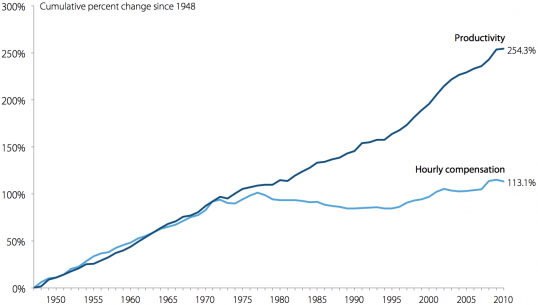
The political parties have missed the primary message of the November 4 election. There was a poor turnout because neither party addressed the issue that most Americans care about. My opinion: A growing economy ought to be the primary target for both parties.   The graph below developed by the Economic Policy Institute shows increased productivity without increased remuneration but the EPI discussion does not offer any evaluation as to cause. They leave the evaluation to others. Those others are the commentators and economists who just might have a political agenda.

Real Hourly Growth

My take: Higher productivity is not the outcome of employees working harder or smarter. It is the result of new technologies. Those technologies are the consequence of new tools and new software. Those technologies lower the needed manpower. A good example is the elimination of ticket takers/payment clerks as you leave a parking structure. They are now being replaced with automated systems. Those same systems will eliminate order takers at McDonald’s, etc. Those technologies enable machine shops to complete projects faster with less scrap and higher quality.

What will we do with all the people who no longer have jobs? That is the question that politicians can’t answer. Those illegal aliens? Their jobs are on the line too. Capitalism in a free enterprise society translates to hiring the least expensive labor. Of course politicians don’t want to talk to the electorate about this issue.

Is the solution more subsidies and aid for the “middle class”? That appears to be the only solution today. Neither political party wants to admit we have a problem with no apparent solution.

Do not expect anyone running for president in 2016 to say anything about this issue. You will hear discussion on illegal immigration, Russian threats to Eastern Europe, the challenges in Middle Eastern Islamic nations (no boots on the ground), and of course Obama Care. No one will be talking about the gap between the wealthy and the middle class. I hope I am wrong.

Cancer Research, Cures, and Making Money

AbigailNabbyAdams Smith (July 14, 1765 – August 15, 1813) was the firstborn of Abigail and John Adams, founding father and second President of the United States.

In 1810, Nabby was diagnosed with breast cancer, followed by a mastectomy in 1811. … The cancer continued to spread throughout her body, and she died, aged 48. That was 200 years ago.

ABCNews.com says that $415 Million is spent annually by Medicare for the treatment of breast cancer.

Total average Medicare spending per patient for initial phase care of breast cancer (2 months prediagnosis–365 days postdiagnosis) was $21,000 (2002 US$) in 2002 (Figure 2).4 Surgery and radiation cost little on a per-patient basis: $5700 and $4500 (2002 US$), respectively, and were used in 91% and 51% of patients, respectively. In contrast, chemotherapy and other inpatient services were used in about 25% of patients, but at a higher per patient cost ($12,800 [2002 US$]). If the data used for this analysis were expanded to include continuing care and end-of-life care, there would be a marked difference in spending patterns. The United States spent an estimated $62,900 to $94,300 per person for end-of-life breast cancer care during 2010 – See more at: http://www.ajmc.com/publications/evidence-based-oncology/2012/2012-2-vol18-n1/the-economics-of-cancer-care-in-the-united-states-how-much-do-we-spend-and-how-can-we-spend-it-better#sthash.BSrLsaip.dpuf.

So millions of dollars are spent treating people with this horrible disease. Billions more are spent on research for a cure. The National Cancer Institute’s (NCI) budget for FY 2013 was approximately $4.8 billion. Overall, NCI’s budget has been relatively flat in recent years. During the period from 2005 through 2013, the NCI budget averaged $4.9 billion per year.

Lots of people making lots of money.   

How dare I suggest this thought? Isn’t cancer cures and cancer research an industry that makes large amounts of money? Lesley Stahl on 60 Minutes discovers the shock and anxiety of a cancer diagnosis can be followed by a second jolt: the astronomical price of cancer drugs.


If you had a cure for just one of those cancers, breast cancer, how many people would need to find another job?  How many companies would be earning less money?

Women Shouldn’t Ask for Raises?

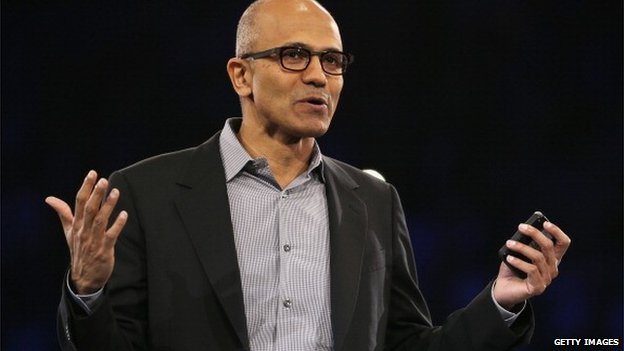
Satya Nadella, CEO of Microsoft

The boss of Microsoft, Satya Nadella, has apologised for remarks he made advising women not to ask for a pay rise but to have “faith in the system”.

Could you imagine Bill Gates, founder of Microsoft, saying these things?

Microsoft Chief Executive Satya Nadella issued an apology Thursday evening to all company employees following the backlash he received for comments he made about women asking for raises.

Nadella was a featured speaker at a Phoenix conference for thousands of women professionals in computing when he was asked what advice he would give to women who aren’t comfortable asking for a raise.

“It’s not really about asking for the raise, but knowing and having faith that this system will actually give you the right raises as you go along,” Nadella told the moderator, Maria Klawe, in front of the gathering of women engineers. Nadella went on to say that women who don’t ask for raises have an “additional superpower … because that’s good karma, it’ll come back.”

Klawe, a computer scientist and Microsoft board member, immediately shot back, “This is one of the very few things I disagree with you on,” and was applauded by audience members.

The CEO’s response received blowback almost immediately. “Does this mean Microsoft is developing karma currency to pay your bills?” Twitter user Jame Ervin wrote. “Waiting for karma to solve wage gap.”

“I sort of doubt that Satya Nadella got to be CEO by trusting in karmic ‘super powers,’” Twitter user Scott Starr wrote.

Shortly after his speech, Nadella tweeted that he “was inarticulate” about how women should ask for raises. He added that the tech industry needs to close the gender pay gap “so a raise is not needed because of bias.”

Thursday night, he issued a formal apology via email: “I answered that question completely wrong,” Nadella wrote. “I believe men and women should get equal pay for equal work. And when it comes to career advice on getting a raise when you think it’s deserved, Maria’s advice was the right advice. If you think you deserve a raise, you should just ask.”

Copyright © 2014, Los Angeles Times

Erin Burnett on her CCN Out Front program interviewed Susie Orman about the outspoken Nadella.  Obviously Orman condemned the Nadella statement.  Others that could be interviewed would be Meg Whitman, Sarah Palin, and Hillary Clinton.  Do you suppose any of them would be talking about karma ‘super powers?’

Nadella seemed to recognize his mistake, later walking back his comments through Twitter:

Satya Nadella         @satyanadella

Was inarticulate re how women should ask for raise. Our industry must close gender pay gap so a raise is not needed because of a bias


What can you expect from a man who comes from a country where rape is common place and mistreatment of women is the norm?