I was the Shabbes Goy of Sterling Place and Utica Ave.

by Joe Velarde

(Joe Velarde became the fencing coach of Columbia University in the 1940’s-50s and was an early advocate of civil rights in sports, eventually retiring to California.)

Snow came early in the winter of 1933 when our extended Cuban family moved into the Williamsburg section of Brooklyn . I was ten years old. We were the first Spanish speakers to arrive, yet we fit more or less easily into that crowded, multicultural neighborhood. Soon we began learning a little Italian, a few Greek and Polish words, lots of Yiddish and some heavily accented English.

I first heard the expression ‘Shabbes is falling’ when Mr. Rosenthal refused to open the door of his dry goods store on Bedford Avenue . My mother had sent me with a dime to buy a pair of black socks for my father. In those days, men wore mostly black and Navy blue. Brown and gray were somehow special and cost more. Mr. Rosenthal stood inside the locked door, arms folded, glaring at me through the thick glass while a heavy snow and darkness began to fall on a Friday evening. “We’re closed, already”, Mr.Rosenthal had said, shaking his head, “can’t you see that Shabbes is falling? Don’t be a nudnik! Go home.” I could feel the cold wetness covering my head and thought that Shabbes was the Jewish word for snow.

My misperception of Shabbes didn’t last long, however, as the area’s dominant culture soon became apparent; Gentiles were the minority. From then on, as Shabbes fell with its immutable regularity and Jewish lore took over the life of the neighborhood, I came to realize that so many human activities, ordinarily mundane at any other time, ceased, and a palpable silence, a pleasant tranquility, fell over all of us. It was then that a family with an urgent need would dispatch a youngster to “get the Spanish boy, and hurry.”

That was me. In time, I stopped being nameless and became Yussel, sometimes Yuss or Yusseleh. And so began my life as a Shabbes Goy, voluntarily doing chores for my neighbors on Friday nights and Saturdays: lighting stoves, running errands, getting a prescription for an old tante, stoking coal furnaces, putting lights on or out, clearing snow and ice from slippery sidewalks and stoops. Doing just about anything that was forbidden to the devout by their religious code.

Friday afternoons were special. I’d walk home from school assailed by the rich aroma emanating from Jewish kitchens preparing that evening’s special menu. By now, I had developed a list of steady “clients,” Jewish families who depended on me. Furnaces, in particular, demanded frequent tending during Brooklyn ‘s many freezing winters. I shudder remembering brutally cold winds blowing off the East River . Anticipation ran high as I thought of the warm home-baked treats I’d bring home that night after my Shabbes rounds were over. Thanks to me, my entire family had become Jewish pastry junkies. Moi? I’m still addicted to checkerboard cake, halvah and Egg Creams (made only with Fox’s Ubet chocolate syrup).

I remember as if it were yesterday how I discovered that Jews were the smartest people in the world. You see, in our Cuban household we all loved the ends of bread loaves and, to keep peace, my father always decided who would get them. One harsh winter night I was rewarded for my Shabbes ministrations with a loaf of warm challah (we pronounced it “holly”) and I knew I was witnessing genius! Who else could have invented a bread that had wonderfully crusted ends all over it — enough for everyone in a large family?

There was an “International” aspect to my teen years in Williamsburg . The Sternberg family had two sons who had fought with the Abraham Lincoln Brigade in Spain . Whenever we kids could get their attention, they’d spellbind us with tales also introduced us to a novel way of thinking, one that embraced such humane ideas as ‘From each according to his means and to each according to his needs’. In retrospect, this innocent exposure to a different philosophy was the starting point of a journey that would also incorporate the concept of Tzedakah in my personal guide to the world.

In what historians would later call The Great Depression, a nickel was a lot of mazuma and its economic power could buy a brand new Spaldeen, our local name for the pink-colored rubber ball then produced by the Spalding Company. The famous Spaldeen was central to our endless street games: stickball and punchball or the simpler stoop ball. On balmy summer evenings our youthful fantasies converted South Tenth Street into Ebbets Field with the Dodgers’ Dolph Camilli swinging a broom handle at a viciously curving Spaldeen thrown by the Giants’ great lefty, Carl Hubbell. We really thought it curved, I swear.

Our neighbors, magically transformed into spectators kibitzing from their brownstone stoops and windows, were treated to a unique version of major league baseball. My tenure as the resident Shabbes Goy came to an abrupt end after Pearl Harbor Day, December 7, 1941. I withdrew from Brooklyn College the following day and joined the U.S. Army. In June of 1944, the Army Air Corps shipped me home after flying sixty combat missions over Italy and the Balkans. I was overwhelmed to find that several of my Jewish friends and neighbors had set a place for me at their supper tables every Shabbes throughout my absence, including me in their prayers. What mitzvoth! My homecoming was highlighted by wonderful invitations to dinner. Can you imagine the effect after twenty-two months of Army field rations?

As my post-World War II life developed, the nature of the association I’d had with Jewish families during my formative years became clearer. I had learned the meaning of friendship, of loyalty, and of honor and respect. I discovered obedience without subservience. And caring about all living things had become as natural as breathing. The worth of a strong work ethic and of purposeful dedication was manifest. Love of learning blossomed and I began to set higher standards for my developing skills, and loftier goals for future activities and dreams. Mind, none of this was the result of any sort of formal instruction; my yeshiva had been the neighborhood. I learned these things, absorbed them actually says it better, by association and role modeling, by pursuing curious inquiry, and by what educators called “incidental learning” in the crucible that was pre-World War II Williamsburg. It seems many of life’s most elemental lessons are learned this way.

While my parents’ Cuban home sheltered me with warm, intimate affection and provided for my well-being and self esteem, the group of Jewish families I came to know and help in the Williamsburg of the 1930s was a surrogate tribe that abetted my teenage rite of passage to adulthood. One might even say we had experienced a special kind of Bar Mitzvah. I couldn’t explain then the concept of tikkun olam, but I realized as I matured how well I had been oriented by the Jewish experience to live it and to apply it. What a truly uplifting outlook on life it is to be genuinely motivated “to repair the world.”

In these twilight years when my good wife is occasionally told, “Your husband is a funny man,” I’m aware that my humor has its roots in the shticks of Second Avenue Yiddish Theater, entertainers at Catskill summer resorts, and their many imitators. And, when I argue issues of human or civil rights and am cautioned about showing too much zeal, I recall how chutzpah first flourished on Williamsburg sidewalks, competing for filberts (hazelnuts) with tough kids wearing payess and yarmulkes. Along the way I played chess and one-wall handball, learned to fence, listened to Rimsky-Korsakov, ate roasted chestnuts, and read Maimonides .

I am ever grateful for having had the opportunity to be a Shabbes Goy.


Mario Cuomo, Colin Powell & Pete Hamill were also shabbos goyim
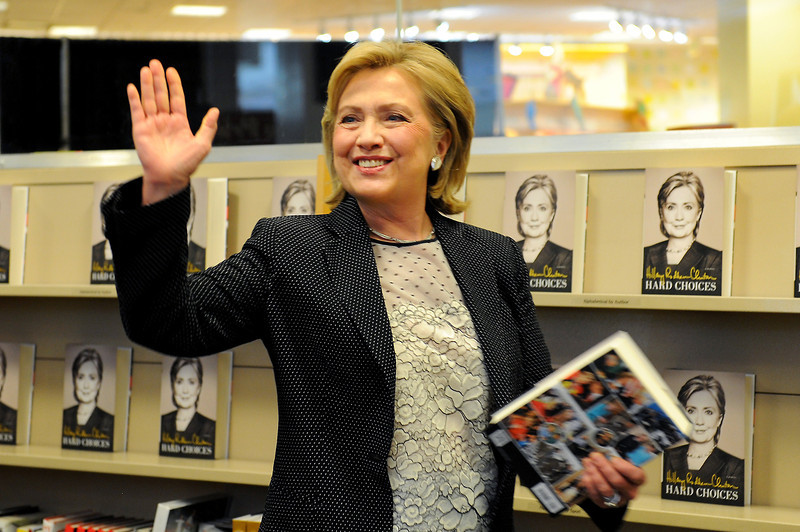
 

Hillary Clinton is Unwilling to Accept Her Defeat

“Hillary Rodham Clinton enters the Barnes & Noble to sign her book “Hard Choices” at The Grove, Thursday, June 19, 2014. (Photo by Michael Owen Baker/Los Angeles Daily News)”

The American election for president was November 8, 2016. That is more than six months ago. Everyone who loses an election for president probably goes through an emotional conflict for some period of time. Mrs. Clinton still seems to be in a state of denial.

Even worse for her is that she has blamed everyone for her loss but appears to believe that she is not to blame.

First Mrs. Clinton was a poor campaigner. During the last weeks before the election Donald Trump was appearing somewhere every day at a campaign rally. Clinton did not campaign every day.  Prior to the debates Donald Trump was appearing at rallies every day while we citizens were told that Mrs. Clinton was preparing for the debates. Despite her preparation Donald Trump at least did a credible job.

Those debates were not the turning point for her campaign. The truth is her campaign was flawed from the very beginning. In fact her entire effort lacked a theme. I remember her appearance at The Grove shopping center in Los Angeles well before she announced her candidacy. There were long lines of people waiting to see her for the announcement and sale of her new book, “Hard Choices”, Thursday, June 19, 2014. Most people in that line wanting her signature inside the cover all carried signs saying “I’m with her.” That was her campaign slogan. Most of us understood that the new book was a kickoff of her campaign. I did not stand in line. I was there merely to see how many people would be willing to stand in line for that signature. The number was in the hundreds.

Donald Trump took the primary theme that has been the backbone of every Democratic Party candidate since FDR. That was the claim that the Democratic Party was the party for the working man. What does “I’m with her.” Mean?

When Businessweek told stories of people who had lost their jobs and looking for help it was Donald Trump who promised to bring back those jobs. Where was Hillary Clinton then? Nowhere to be seen. Donald Trump promised to revitalize coal mining and bring back miner’s jobs. Clinton promised to shut down the coal industry.

Mrs. Clinton offered no plans or ideas for reinvigorating the blue collar and middle class work force that historically supported Democratic candidates.

The fault for Mrs. Clinton’s loss in the election of November 8, 2016 lies with her.

Americans Seem to Believe they are Immune from Bad Things when Traveling

Do Americans think they are immune to the acts of foreign governments when they travel? Apparently the answer is YES. The State Department warns U.S. citizens to stay away from North Korea but hundreds go anyway every year. Otto Warmbier was an American university student who, while visiting North Korea as a tourist in January 2016 tore a wall poster down as a souvenir. He paid with his life.

North Korea is not the only country that the State Department has warned not to visit. The State Department web site has a Travel Warnings list. The site is headed with the following warning statement.

“We issue a Travel Warning when we want you to consider very carefully whether you should go to a country at all. Examples of reasons for issuing a Travel Warning might include unstable government, civil war, ongoing intense crime or violence, or frequent terrorist attacks. We want you to know the risks of traveling to these places and to strongly consider not going to them at all. Travel Warnings remain in place until the situation changes; some have been in effect for years.”

There are 44 countries listed. Of those nine are from 2016. Surprisingly none in Europe which is on a Travel Alert list due to threat of terrorist attacks.

The Travel Warnings list includes Mexico. The Mexico specific statement says: “The U.S. Department of State warns U.S. citizens about the risk of traveling to certain parts of Mexico due to the activities of criminal organizations in those areas. U.S. citizens have been the victims of violent crimes, including homicide, kidnapping, carjacking, and robbery in various Mexican states. This Travel Warning replaces the Travel Warning for Mexico, issued April 15, 2016.” The site then identifies the cities and states that are particularly dangerous including Mexico City. Despite the warning a total 7.86 million Americans visited the country from January to October 2016, an increase of 12% from the same period in 2015.

Have you visited America’s national parks? My favorites are Yellowstone and Grand Teton. Have you visited Washington D.C.? Both Boston and Philadelphia offer interesting historic sites that I believe everyone should visit. The best part is that you are far safer and you might see a really great show on Broadway in New York City.

Trump has a dangerous disability

By George F. Will, conservative columnist in The Washington Post, May 3, 2017

It is urgent for Americans to think and speak clearly about President Trump’s inability to do either. This seems to be not a mere disinclination but a disability. It is not merely the result of intellectual sloth but of an untrained mind bereft of information and married to stratospheric self-confidence.

In February, acknowledging Black History Month, Trump said that “Frederick Douglass is an example of somebody who’s done an amazing job and is getting recognized more and more, I notice.” Because Trump is syntactically challenged, it was possible and tempting to see this not as a historical howler about a man who died 122 years ago, but as just another of Trump’s verbal fender benders, this one involving verb tenses.

Now, however, he has instructed us that Andrew Jackson was angry about the Civil War that began 16 years after Jackson’s death. Having, let us fancifully imagine, considered and found unconvincing William Seward’s 1858 judgment that the approaching Civil War was “an irrepressible conflict,” Trump says:

“People don’t realize, you know, the Civil War, if you think about it, why? People don’t ask that question, but why was there the Civil War? Why could that one not have been worked out?”

Library shelves groan beneath the weight of books asking questions about that war’s origins, so who, one wonders, are these “people” who don’t ask the questions that Trump evidently thinks have occurred to him uniquely? Presumably they are not the astute “lot of,” or at least “some,” people Trump referred to when speaking about his February address to a joint session of Congress: “A lot of people have said that, some people said it was the single best speech ever made in that chamber.” Which demotes Winston Churchill, among many others.

What is most alarming (and mortifying to the University of Pennsylvania, from which he graduated) is not that Trump has entered his eighth decade unscathed by even elementary knowledge about the nation’s history. As this column has said before, the problem isn’t that he does not know this or that, or that he does not know that he does not know this or that. Rather, the dangerous thing is that he does not know what it is to know something.

The United States is rightly worried that a strange and callow leader controls North Korea’s nuclear arsenal. North Korea should reciprocate this worry. Yes, a 70-year-old can be callow if he speaks as sophomorically as Trump did when explaining his solution to Middle Eastern terrorism: “I would bomb the s— out of them. . . . I’d blow up the pipes, I’d blow up the refineries, I’d blow up every single inch, there would be nothing left.”

As a candidate, Trump did not know what the nuclear triad is. Asked about it, he said: “We have to be extremely vigilant and extremely careful when it comes to nuclear. Nuclear changes the whole ballgame.” Invited to elaborate, he said: “I think — I think, for me, nuclear is just the power, the devastation is very important to me.” Someone Trump deemed fit to be a spokesman for him appeared on television to put a tasty dressing on her employer’s word salad: “What good does it do to have a good nuclear triad if you’re afraid to use it?” To which a retired Army colonel appearing on the same program replied with amazed asperity: “The point of the nuclear triad is to be afraid to use the damn thing.”

As president-elect, Trump did not know the pedigree and importance of the one-China policy. About such things he can be, if he is willing to be, tutored. It is, however, too late to rectify this defect: He lacks what T.S. Eliot called a sense “not only of the pastness of the past, but of its presence.” His fathomless lack of interest in America’s path to the present and his limitless gullibility leave him susceptible to being blown about by gusts of factoids that cling like lint to a disorderly mind.

Americans have placed vast military power at the discretion of this mind, a presidential discretion that is largely immune to restraint by the Madisonian system of institutional checks and balances. So, it is up to the public to quarantine this presidency by insistently communicating to its elected representatives a steady, rational fear of this man whose combination of impulsivity and credulity render him uniquely unfit to take the nation into a military conflict.

James Comey and the Russia Trump Connection

The firing of James Comey explanation is simply not creditable.

Donald Trump did not even have the decency to face James Comey when he fired him. Unlike his Apprentice program where he fired the contestants, in real life Mr. Trump lacked the courage of his convictions. Perhaps that is because Trump knows that Comey is closing in on the Trump Russia connection. Is there any other reasonable explanation? Politico and The New York Times seem concur with my explanation that I reached within minutes of the announced firing.

 [Trump] had grown enraged by the Russia investigation, two advisers said, frustrated by his inability to control the mushrooming narrative around Russia. He repeatedly asked aides why the Russia investigation wouldn’t disappear and demanded they speak out for him. He would sometimes scream at television clips about the probe, one adviser said. [Politico]

 Mr. Trump explained the firing by citing Mr. Comey’s handling of the investigation into Hillary Clinton’s use of a private email server, even though the president was widely seen to have benefited politically from that inquiry and had once praised Mr. Comey for his “guts” in his pursuit of Mrs. Clinton during the campaign.
But in his letter to Mr. Comey, released to reporters by the White House, the president betrayed his focus on the continuing inquiry into Russia and his aides. [New York Times]

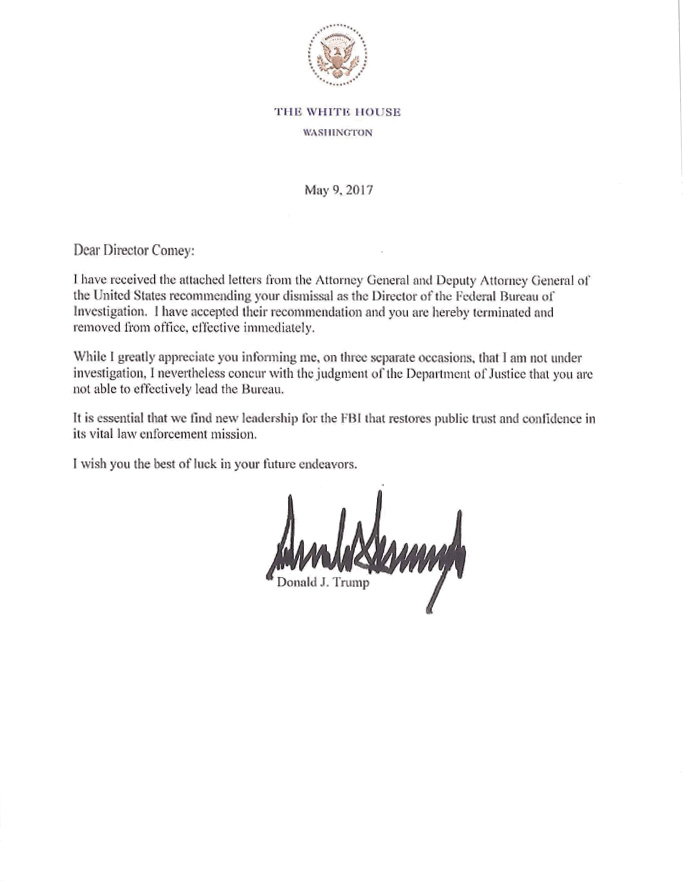
James Comey was the Director of the FBI since September 4, 2013.  Mr. Comey learned of his dismissal while in Los Angeles. Here is the letter that informed Comey of his immediate dismissal.

‘new chapter of American greatness’

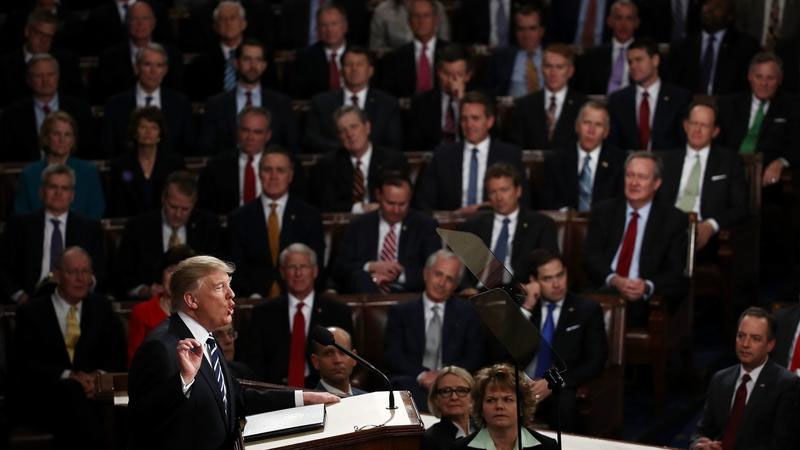
The Washington Post offered the following on line article summarizing President Donald Trump’s address to a joint session of the Congress of the United States.  The summary was a strictly non-partisan report.  It is not “fake news.”

president-trump-addresses-a-joint-session-of-congress-on-tuesday-2-28-17

Trump lays out plan for ‘new chapter of American greatness’ in speech to Congress

by Philip Rucker, Sean Sullivan, Abby Phillip

President Trump sought to repackage his hard-line campaign promises with a moderate sheen in his first joint address to Congress Tuesday night, ushering in what he termed “a new chapter of American greatness” of economic renewal and military might.

Seeking to steady his presidency after a tumultuous first 40 days, Trump had an air of seriousness and revealed flashes of compassion as he broadly outlined a sweeping agenda to rebuild a country he described as ravaged by crime and drugs, deteriorating infrastructure and failing bureaucracies.

Trump’s speech touched on his plans to overhaul the nation’s health-care system and tax code, but was short on specifics. Struggling to steer a bitterly divided nation with his job approval ratings at historic lows, Trump effectively pleaded with the American people to give him a chance and to imagine what could be achieved during his presidency.

“We are one people, with one destiny,” Trump said quietly near the end. “The time for small thinking is over. The time for trivial fights is behind us. We just need the courage to share the dreams that fill our hearts.”

Trump extended olive branches to his opponents. He called on Congress to pass paid family leave, a reference to a long-held Democratic Party priority that brought liberal lawmakers to their feet to applaud. And he pledged to work with Muslim allies to extinguish Islamic State terrorists, going so far as to acknowledge the killings of Muslims as well as Christians in the Middle East.

Still, Trump did not back away from his most controversial policies. He used typically bellicose language to describe the fight against the Islamic State, calling it “a network of lawless savages that have slaughtered Muslims and Christians, and men, women and children of all faiths and all beliefs.”

The president forcefully defended his travel ban — an executive order that was halted in federal court — as necessary to prevent the entry of foreigners who do not share America’s values.

“We cannot allow a beachhead of terrorism to form inside America,” Trump said. “We cannot allow our nation to become a sanctuary for extremists.”

Pulling from his campaign speeches and others since taking office, the president ran off a list of accomplishments since taking office and issued promises for the year ahead.

“Above all else, we will keep our promises to the American people,” he said.

He touted “billions” in new investments by American companies in the weeks since his inauguration, seeking to highlight the actions his administration has taken to keep his campaign promises.

He vowed to usher in “historic” tax reform, as he appeared to nod to a House Republican “border adjustment” plan, but did not explicitly endorse it.

“Currently, when we ship products out of America, many other countries make us pay very high tariffs and taxes — but when foreign companies ship their products into America, we charge them nothing or almost nothing,” said Trump.

The “border adjustment” is shorthand for a House GOP proposal to tax imports, which some Republicans oppose. Trump didn’t use those words in his address. But his remarks could be seen as a hopeful sign for those Republicans hoping he will back it unequivocally.

Trump’s comments were received with some bipartisan applause and some jeers from Democrats, especially during his mention of a lobbying restriction that some feel does not go far enough.

While his speech pulled upon many of his earlier themes, the president seemed more subdued in his delivery, sticking more to the teleprompter and avoiding the bombastic rhetoric of the campaign.

Reiterating a much-repeated campaign promise, Trump vowed midway thorough his speech to “repeal and replace” the Affordable Care Act but stopped short of resolving disagreements among Republicans about how to do that.

While Trump did not explicitly endorse a specific step-by-step approach to repealing and replacing the federal health-care law, he did say that a replacement plan must utilize “tax credits,” which is a victory for House Republicans leaders who have looked at replacing the Obamacare subsidies with such credits.

“We should help Americans purchase their own coverage, through the use of tax credits and expanded Health Savings Accounts — but it must be the plan they want, not the plan forced on them by our government,” said Trump.

Some House and Senate conservatives oppose the idea of creating tax credits. But supporters of it can now turn to Trump’s words as they seek to build support for the idea.

In one of the speech’s tenser moments, House Minority Leader Nancy Pelosi (D-Calif.) who was seated in the audience, looked on, shaking her head as Trump criticized the law. Pelosi helped then-President Barack Obama pass the law and has sharply criticized Republicans for trying to undo it. Trump appeared to be pointing someone out in the crowd when he called the law a “disaster.” It was not immediately clear whether he was singling out Pelosi or someone else.

Trump told a series of stories to highlight his calls for reforms to the Food and Drug Administration and public education.

He pointed to two women who sat in the gallery as a guest of first lady Melania Trump. One who was diagnosed with a rare disease and treated with a new drug. A second who was able to attend a private school and become the first person in her family to graduate from high school and college.

Both anecdotes drew bipartisan applause from members of Congress in the audience.

He also pressed his policies on immigration, including his controversial proposal to build a wall along the U.S.-Mexico border.

“We want all Americans to succeed —- but that can’t happen in an environment of lawless chaos. We must restore integrity and the rule of law at our borders,” said Trump. “For that reason, we will soon begin the construction of a great wall along our southern border. It will be started ahead of schedule and, when finished, it will be a very effective weapon against drugs and crime.”

Trump challenged members of Congress who disagree with him: “I would ask you this question: what would you say to the American family that loses their jobs, their income, or a loved one, because America refused to uphold its laws and defend its borders?”

He did call for Republicans and Democrats to work toward reforming the immigration system into a merit-based program focused on the “well-being of American citizens.”

Trump argued that the country’s current focus on low-skilled immigration hurts American workers and strains the country’s finances.

The comments come hours after Trump said in a meeting with journalists that he would support comprehensive immigration reform efforts with a pathway to legalization for law abiding immigrants.

At his remarks before Congress, Trump did not specify the parameters of a compromise he would be willing to accept. But he outlined a preference for a system that favors immigrants who are able to support themselves financially.

“I believe that real and positive immigration reform is possible, as long as we focus on the following goals: to improve jobs and wages for Americans, to strengthen our nation’s security, and to restore respect for our laws,” Trump said.

Trump also vowed to take on “radical Islamic terrorism,” a divisive term that many have taken issue, arguing it unfairly singles out the Muslim religion.

He also pledged to announce new steps to bolster national security and “keep out those who would do us harm,” weeks after his executive order barring immigration from seven predominantly Muslim countries was halted by a federal judge.

Pointing to statistics on terror convictions by foreigners from the Department of Justice, Trump said that it was “reckless” to allow foreigners into the country who could then perpetrate attacks on Americans.

“We cannot allow a beachhead of terrorism to form inside America — we cannot allow our Nation to become a sanctuary for extremists,” Trump said.

The comments drew mixed reaction from the gathered lawmakers.

Though Trump did not specifically mention the travel ban, he suggested that new efforts to put in place “improved vetting procedures” would be forthcoming.

Later in his speech, there were some audible groans in the crowd as Trump announced that he has ordered the Department of Homeland Security to create on office to address victims of crimes committed by undocumented immigrants. The office is called “VOICE” — which stands for “Victims of Immigration Crime Engagement.”

As he often did on the campaign trail, Trump mentioned Jamiel Shaw, whose teenage son was killed by an undocumented immigrant.

Central to Trump’s promise to strengthen the nation’s security is a proposal to massively infuse the military with new spending, including eliminating the defense sequester, which had put caps on military spending.

Trump this week announced that his budget would include a request for a $54 million increase in military spending accompanied by corresponding cuts in other parts of government.

“To keep America safe we must provide the men and women of the United States military with the tools they need to prevent war and —- if they must —- they have to fight and they only have to win,” Trump said.

In a highly emotional moment, President Trump lead an extended tribute to a U.S. Navy SEAL William “Ryan” Owens, the first U.S. service member to die in the line of duty during Trump’s administration.

With Owens’s widow, Carryn, sitting in the audience, Trump called him “a warrior and a hero” who gave his life for his nation.

“Ryan’s legacy is etched into eternity,” Trump said. “For as the Bible teaches us, there is no greater act of love than to lay down one’s life for one’s friends.

“Ryan laid down his life for his friends, for his country, and for our freedom — we will never forget Ryan,” Trump added.

The comments, which were received with protracted applause, come in the midst of a tense time for Trump. Owens died during a raid in Yemen that left him and civilians dead, prompting a series of investigations by the Defense Department.

Owens’s father, William Owens, has also spoken out against the raid, questioning why it was authorized so quickly after Trump came into office.

Trump defended the raid on Tuesday, saying that his Defense Secretary Jim Mattis recently told him that it was a “highly successful raid that generated large amounts of vital intelligence that will lead to many more victories in the future against our enemies.”

As Trump spoke, Owens’ widow stood and wept openly as the room applauded her.

While not delving too much into foreign policy during his speech, the president said the United States was willing to “find new friends” and noted that the U.S. has forged relationships with former enemies.

The comment came as growing intrigue rises about possible ties his campaign had to Russia and its efforts to influence the election.

While he did not mention Russia explicitly, the comments were reminiscent of what Trump often said on the campaign trail — that it would be a good thing for the United States to have a productive relationship with Russia, even as many U.S. lawmakers in both parties remain deeply skeptical of the Russian government’s intentions.

Trump began the night by strongly denouncing recent threats to Jewish community centers across the country and condemned a recent attack on Indian immigrants in Kansas.

“We are a country that stands united in condemning hate and evil in all its forms,” Trump said.

His speech quickly turned, however, as he declared that the “earth shifted beneath our feet” in 2016 as he took a victory lap over his election victory and nodded to his signature campaign themes.

“The chorus became an earthquake — and the people turned out by the tens of millions, and they were all united by one very simple, but crucial demand, that America must put its own citizens first,” said Trump.

The president closed his speech with a call for unity and an end to “trivial fights,” a comment that, coming from a president known for carrying out small feuds with his detractors on social media, elicited groans from some lawmakers.

Trump seemed to indicate that his speech represented a dawning of a new phase for the country and for his presidency.

“We will look back on tonight as when this new chapter of American Greatness began,” Trump said. “I am asking all citizens to embrace this Renewal of the American Spirit. I am asking all members of Congress to join me in dreaming big, and bold and daring things for our country.

“And I am asking everyone watching tonight to seize this moment,” Trump concluded.

Mike DeBonis and Kelsey Snell contributed to this report.

Which is better: Will or living trust?

As a Legal Document Assistant in California, I could not ignore these words from Liz Weston in today’s LA Times.

Liz Weston, financial advice columnist Los Angeles Times

Feb 19, 2017

Which is better: Will or living trust?


Dear Liz: I am 48 and my wife is 45. Should we set up a will or a living trust? Which is better?


Answer: One of the major differences between wills and Irving trusts is whether the estate has to go through probate, which is the court process that typically follows death. Living trusts avoid probate while wills do not.

Probate isn’t a big problem in many states, but in some – including California -it can be protracted, expensive and often worth avoiding. Another advantage of living trusts is privacy. While wills are entered into the public record, living trusts aren’t.

Living trusts can help you avoid another court supervised process called conservancy. If you’re incapacitated, the person you’ve named as your “successor trustee” can take over management of your finances without going to court. To avoid the court process without a living trust, you’d need separate documents called powers of attorney. If you have minor children, your living trust trustee can manage their money for them. If you have a will, you would need to include language setting up a trust and naming a trustee.

One big disadvantage of living trusts is the cost. Although price tags vary, a lawyer typically charges a few hundred dollars for a will, while a living trust may cost a few thousand. Also, there’s some hassle involved, since property has to be transferred into the trust to avoid probate.

There are do-it-yourself options, including Nolo software and LegalZoom, that can save you money if your situation isn’t complicated and you’re willing to invest some time in learning about estate planning. If your situation is at all complicated, though -‘if you’re wealthy or have contentious relatives who are likely to challenge your documents – an experienced attorney’s help can be invaluable.

Whichever you decide, make sure you have one or the other before too much longer. Otherwise when you die, state law will determine who gets your stuff and who gets your kids.

More Rain than We can Handle

Southern Californians are unaccustomed to rainy days.  It rained yesterday from about 7 a.m. to about 7 a.m. today. I have a rain gauge in the backyard.  4.2 inches of rain was not a record but was one of the rainiest days we have had since 1997 when I started collecting data.

The Mojave Desert and adjoining mountain areas are more susceptible to significant rainfall.  A local television station was on Highway 138 just a few miles west of Interstate 15 reporting on the blocked two lane roadway.  As the reporter is giving an update from inside the vehicle a wave of water rolled across the desert surface that looked like a wave at the beach.

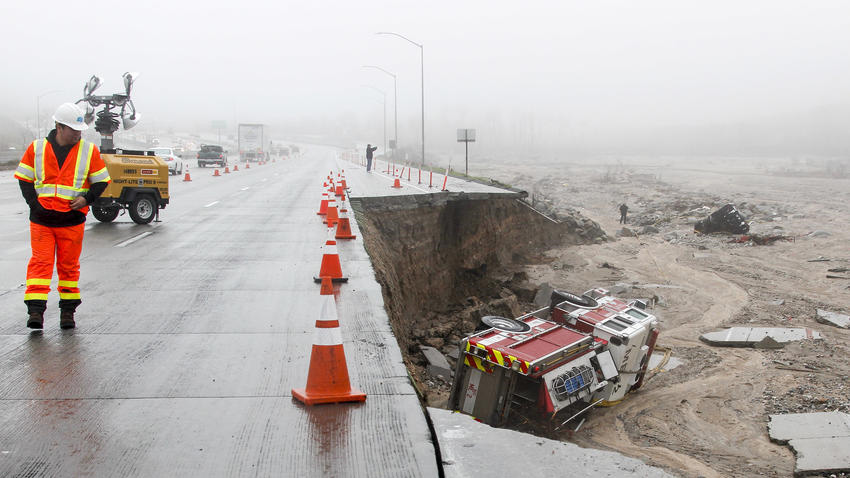
Nearby a few hours later, on Interstate 15 in El Cajon pass a fire truck was helping people evacuate from their cars, when the freeway itself collapsed sending the truck into a ditch.  That same local television station was there when that happened and you actually saw the truck quickly fall.  No one was injured as the crew was helping motorists.

fire-truck-falls-due-to-rain

With more than 22.5 inches of rain to date this season is one of the rainiest I have recorded.  The rainiest I have recorded was 48.3 inches in the 1997-98 El Nino year.  Long range forecasters had predicted this season would be a La Nina dry year.  So much for long range forecasting.

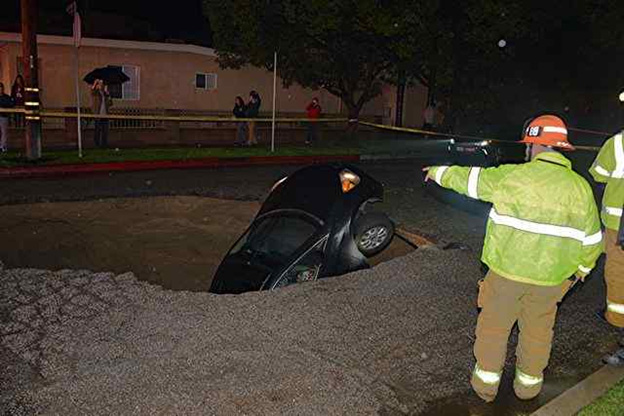
The following photo taken by a Daily News reporter in Studio City, that is near Universal Studios. That area is in the city of Los Angeles.

rainy-day-in-san-fernando-valley

Two vehicles fell into the 20-foot sinkhole in Studio City Friday and firefighters had to rescue one woman who escaped her car. (Photo by Rick McClure for SCNG)