What is it like in Nigeria and other West African nations?
A Studio City, California film company shows you some of their way of life. Maybe they are showing some of the worst. Still their worst makes America’s worst look rather good.
What is it like in Nigeria and other West African nations?
A Studio City, California film company shows you some of their way of life. Maybe they are showing some of the worst. Still their worst makes America’s worst look rather good.
 By Fareed Zakaria Opinion writer , 2014 in The Washington Post
From the start, President Obama’s Syria policy has foundered because of a gap between words and deeds. And he’s done it again. Having declared that the aim of U.S. policy is to “degrade and ultimately destroy” the Islamic State, Obama now finds himself pressured to escalate military action in Syria. This is a path destined for failure. In fact, the administration should abandon its lofty rhetoric and make clear that it is focused on a strategy against the Islamic State that is actually achievable: containment.
Escalation in Syria cannot meet American objectives and is almost certain to produce chaos and unintended consequences. The central reality is that Washington has no serious local partners on the ground. It is important to understand that the Free Syrian Army doesn’t actually exist. A Congressional Research Service report points out that the name does not refer to any “organized command and control structure with national reach.” The director of national intelligence has testified that the opposition to the Bashar al-Assad regime is composed of 1,500 separate militias. We call a bunch of these militias — which are anti-Assad and also anti-Islamist (we hope) — the Free Syrian Army.
Scholar Joshua Landis — whose blog Syria Comment is an essential source — estimates that the Assad regime controls about half of Syrian territory, though much more of the population. The Islamic State controls about one-third of the country, and the other militias control a little less than 20 percent. But the largest and most effective of these non-Islamic State groups are al-Qaeda-affiliated and also deadly enemies of the United States. The non-jihadi groups collectively control less than 5 percent of Syria. Landis writes that, according to opposition leaders, Washington is supporting about 75 of these groups.
A U.S. strategy of escalating airstrikes in Syria — even if coupled with ground forces — would wish that the weakest and most disorganized forces in the country somehow become the strongest, first defeating the Islamic State, then the Assad regime, all while fighting off Jabhat al-Nusra and Khorasan. The chance that all this will happen is remote. Far more likely, heavy bombings in Syria will produce chaos and instability on the ground, further destroying Syria and promoting the free-for-all in which jihadi groups thrive.
Critics are sure this policy would have been easy three years ago, when the opposition to Assad was more secular and democratic. This is a fantasy. It’s true that the demonstrations against the Assad regime in the initial months seemed to be carried out by more secular and liberal people. This was also true in Libya and Egypt. But over time, more organized, passionate and religious forces triumphed. This is a familiar pattern in revolutions — including the French, Russian and Iranian. They are begun by liberals and taken over by radicals.
For any strategy to work in Syria, it needs both a military and a political component. The military element is weak. The political one is nonexistent.
The crucial, underlying reason for the violence in Iraq and Syria is a Sunni revolt against governments in Baghdad and Damascus that they view as hostile, apostate regimes. That revolt, in turn, has been fueled by Saudi Arabia, the United Arab Emirates and Qatar, each supporting its own favorite Sunni groups, which has only added to the complexity. On the other side, Iran has supported the Shiite and Alawite regimes, ensuring that this sectarian struggle is also regional.
The political solution, presumably, is some kind of power-sharing arrangement in those two capitals. But this is not something that the United States can engineer in Syria. It tried in Iraq, but despite 170,000 troops, tens of billions of dollars and David Petraeus’s skillful leadership, the deals Petraeus brokered started unraveling within months of his departure, well before American troops had left. This is not a part of the world where power-sharing and pluralism have worked — with the exception of Lebanon, and that happened after a bloody 15-year civil war in which one out of every 20 people in the country was slaughtered.
The only strategy against the Islamic State that has any chance of working is containment — bolstering the neighbors (who are threatened far more than the United States) that are willing to fight militarily and politically. They include, most importantly, Iraq, Jordan, Lebanon, Turkey and the Gulf states. The greatest challenge is to get the Iraqi government to make serious concessions to Sunnis so that they are recruited into the fight, something that has not happened so far. All of this should be coupled with counterterrorism, which means strikes at key Islamic State targets, as well as measures to track foreign fighters, stop their movements, intercept their funds, and protect the neighbors and the West from a jihadi infiltration spilling over.
The Obama administration is pursuing many elements of this strategy. It should be forthright about its objectives and abandon its grander rhetoric, which is setting itself up for escalation and failure.
A well done effort to understand the Tea Party.
The popularity and inadequacy of the First Edition led its readers to submit many terms which had unfortunately been overlooked. While still far from complete, the Second Edition (I hope) will make far more Conservative speech comprehensible to non-residents of the conservative echo chamber.
But before listing the terms new to the Second Edition, other comments motivate me to say a few words about the origin and intentions of the Lexicon.
Origin of the Lexicon. While researching “Not a Tea Party, a Confederate Party“, I discovered many examples of language drift among conservatives. The great majority of the new usages are transparent, and can be easily understood by readers without my help. (When, for example, Paul Ryan says “inner city” he means “black”.) But confusion became likely when the drifting terms began to interact.
One example in particular required unpacking, because it was…
View original post 2,285 more words
Are there any poor members of congress? How do you define rich?
The Washington Post listed the top 50 members. The poorest in the group has assets totaling over $6 million.
This data was complied by Roll Call (http://www.rollcall.com) based on reports that members must file.
The ten richest:
The ten poorest:
While these members appear to be in the most dire straits on paper, an alternative calculation would peg the seven members who report having no assets as the poorest. These seven members are: Democrats Kyrsten Sinema of Arizona, Gwen Moore of Wisconsin, John Conyers Jr. of Michigan and Gregory W. Meeks of New York, and Republicans Rick Crawford of Arkansas, Duncan Hunter of California and Louie Gohmert of Texas. These members do not have enough liabilities to drop into the 10 poorest, but their net worths range from -$15,000 (Sinema) to -$610,000 (Gohmert).
Democrat Debbie Stabenow of Michigan is the poorest member of the Senate, with a net worth of -$585,000. Fellow Democrat Mark Pryor of Arkansas is the senator with the smallest amount of assets; he has a bank account worth $1,000 to $15,000 and one for his children worth less than $1,000.
An Israeli Sense of Humor at United Nations set the record straight.
An ingenious example of speech and politics occurred recently in the United Nations Assembly and made the world community smile.
A representative from Israel began:
‘Before beginning my talk I want to tell you something about Moses:
When he struck the rock and it brought forth water, he thought,
“What a good opportunity to have a bath!”
Moses removed his clothes, put them aside on the rock and entered the water.
When he got out and wanted to dress, his clothes had vanished.
A Palestinian had stolen them!
The Palestinian representative at the UN jumped up furiously and
shouted, “What are you talking about? The Palestinians weren’t there then.”
The Israeli representative smiled and said,
“And now that we have made that clear, I will begin my speech.”
Author of this piece is unknown
DAVID BANCROFT
It appears that many Americans have given up on the electoral system. Grid lock in Washington makes us all wonder “what’s the use?” I too am reaching that point. We just don’t have an alternate.
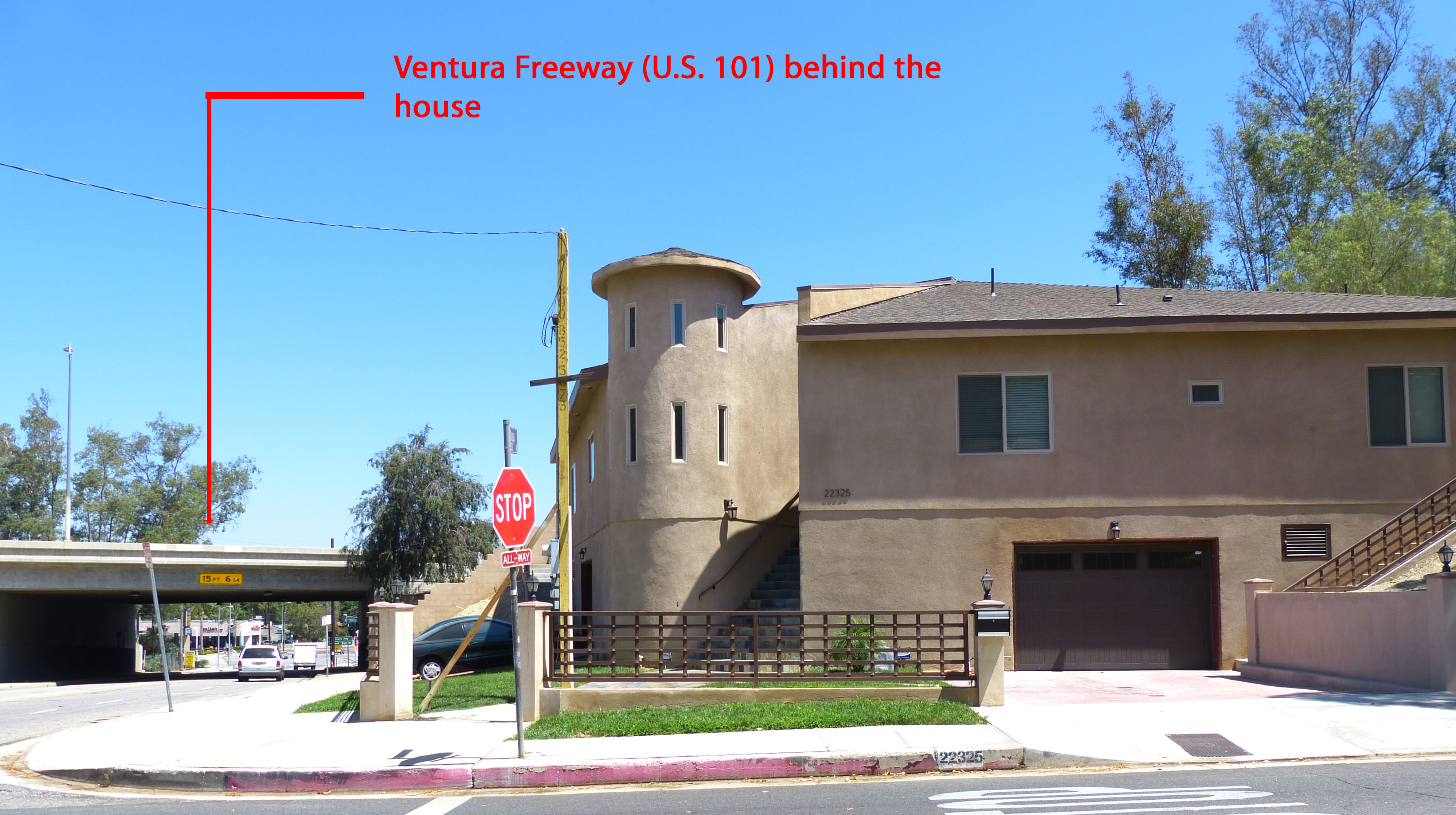
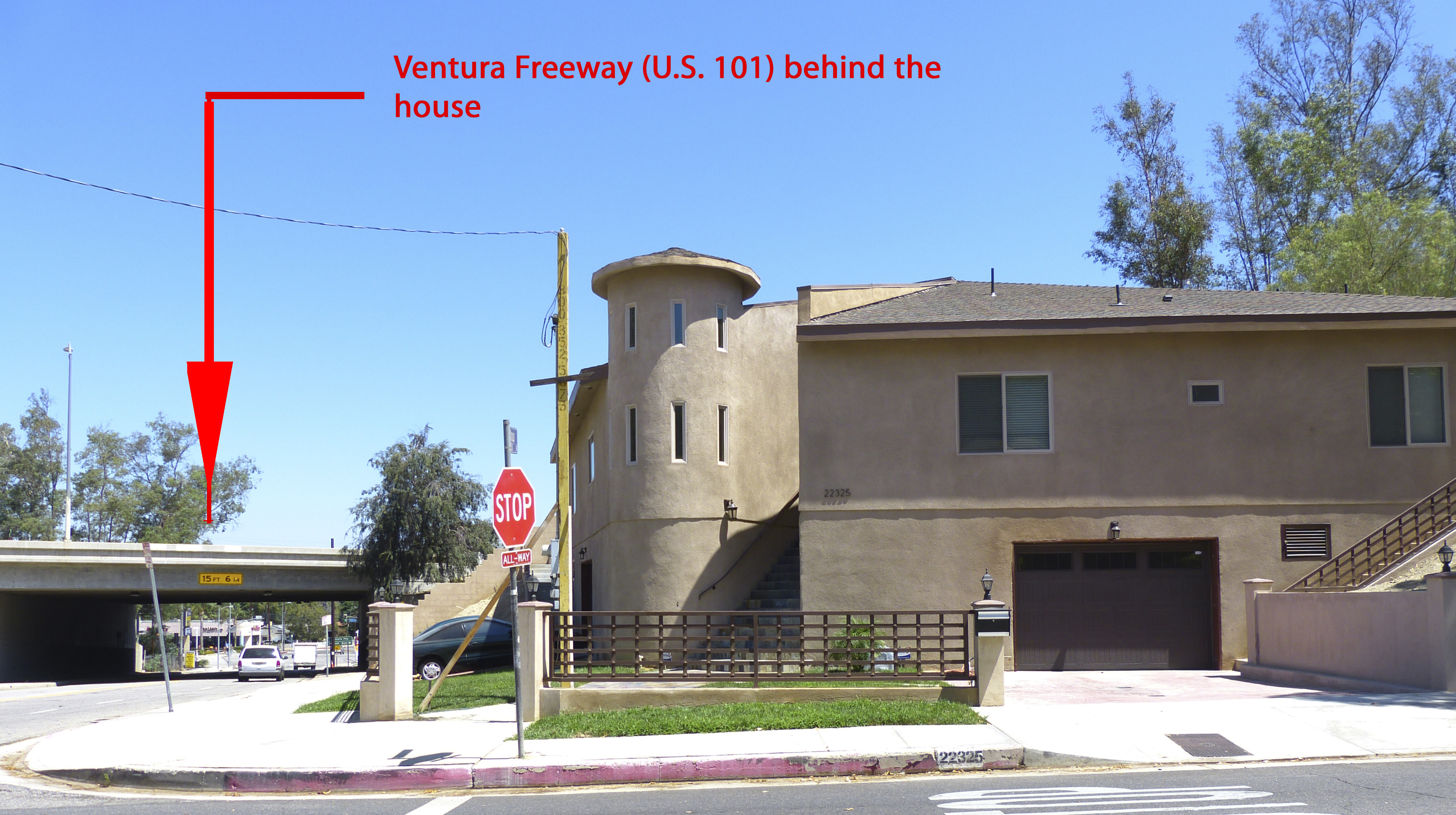
This is a very unusual situation. A piece of land, a lot of about 10,000 square feet sat unused immediately adjoining the freeway in Woodland Hills, California. Most of the property was a steep hill. We have driven by the lot every two or three weeks for many years. I said someone with lots of money and a love of auto and truck noise will ultimately buy the lot and build an unusual structure.
I was correct. The house has two garage entrances and is built into the hill.
A turret tower on the corner makes for an unusual design. The owner had the house built for his 72 year old mother. However, he cannot obtain an electrical connection to Los Angeles Department of Water and Power. It seems there is no easement to the property to string the power line.
The electric line used during construction was a temporary line that was OK’d during construction only. So he called the Los Angeles Times to tell them of his plight. The item made the newspaper both in print and on-line. Others have picked up the story.
How a building permit could be issued before confirming that all utility connections were available has not been explained. The city has also issued an occupancy approval certificate.
This is my photo taken with a Panasonic FZ150 camera.

From The Week magazine
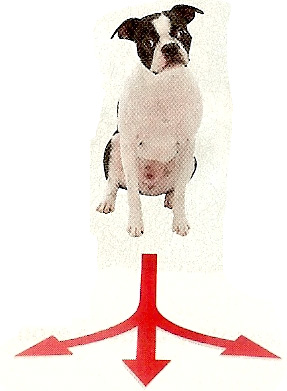 Why do dogs tend to circle around before getting down to business? Because they like to be aligned with the earth’s magnetic field before they poop. Researchers finally figured out this great mystery after watching 70 dogs engage in 1,893 defections and 5,582 urinations over a two-year period, and recording the time, place, and body orientation for each one. They found that dogs’ preference for the north-south axis was most pronounced during the roughly 20 percent of the day when the magnetic field was calm and steady. When the field was in flux-due to solar flares, solar wind, and sunspot activity-the canines had real trouble finding a suitable place to go. “We found that dogs are magnetosensitive, and they are predictably disturbed by even small changes of the magnetic field,” zoologist Sabine Begall of the University of Duisburg-Esser in Germany tells HuffingtonPost.com. Previous studies have shown that cattle and deer graze in a north-south direction, and that birds and fish use the magnetic field to guide their seasonal migrations.
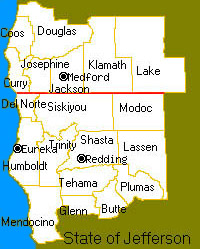
Secession in the United States typically refers to state secession, which is the withdrawal of one or more states from the Union that constitutes the United States—but may refer to cleaving a state or territory to form a separate territory or new state, or to the severing of an area from a city or county within a state.
The people within the California / Oregon border region and surrounding rural counties are joining to form the State of Jefferson. In a unanimous vote on Tuesday, Glenn County Supervisors began the process of seceding from California and joining the State of Jefferson. Last September, Siskiyou County was the first to pursue withdrawal from California with Modoc County following their lead shortly after.
None of the southern Oregon counties have been reported tp have held similar votes. The Oregonian has given this idea a boost.

 Coast Contact