‘Moron’ Donald Trump Blasted for Announcing WWII Victory Day on Wrong Date and for Trying to Rename Veterans Day

Donald Trump said he was ‘renaming May 8th as Victory Day for World War II’ in America.

The president was scolded since WWII didn’t officially end for the United States until September 1945.

By: Rebecca Friedman, full-time Writer/Editor for OK!

Donald Trump is quite literally trying to rewrite history.

The president was mocked on Thursday, May 1, after taking to Truth Social with a bizarre rant about World War II, as he called for Americans to celebrate the end of the war on May 8 — which marked the official surrender of all German military operations in 1945 — despite the United States’ battles continuing until September 2 of that year, when Japan officially surrendered.

“Many of our allies and friends are celebrating May 8th as Victory Day, but we did more than any other country, by far, in producing a victorious result on World War II. I am hereby renaming May 8th as Victory Day for World War II and November 11th as Victory Day for World War I,” Trump wrote via his social media platform, ignoring the fact that November 11 is Veterans Day — which honors those who served in the United States Armed Forces.

In his post, the POTUS added: “We won both Wars, nobody was close to us in terms of strength, bravery, or military brilliance, but we never celebrate anything — That’s because we don’t have leaders anymore, that know how to do so! We are going to start celebrating our victories again!”

Buy Canadian movement starts to take a sizable bite out of U.S. business

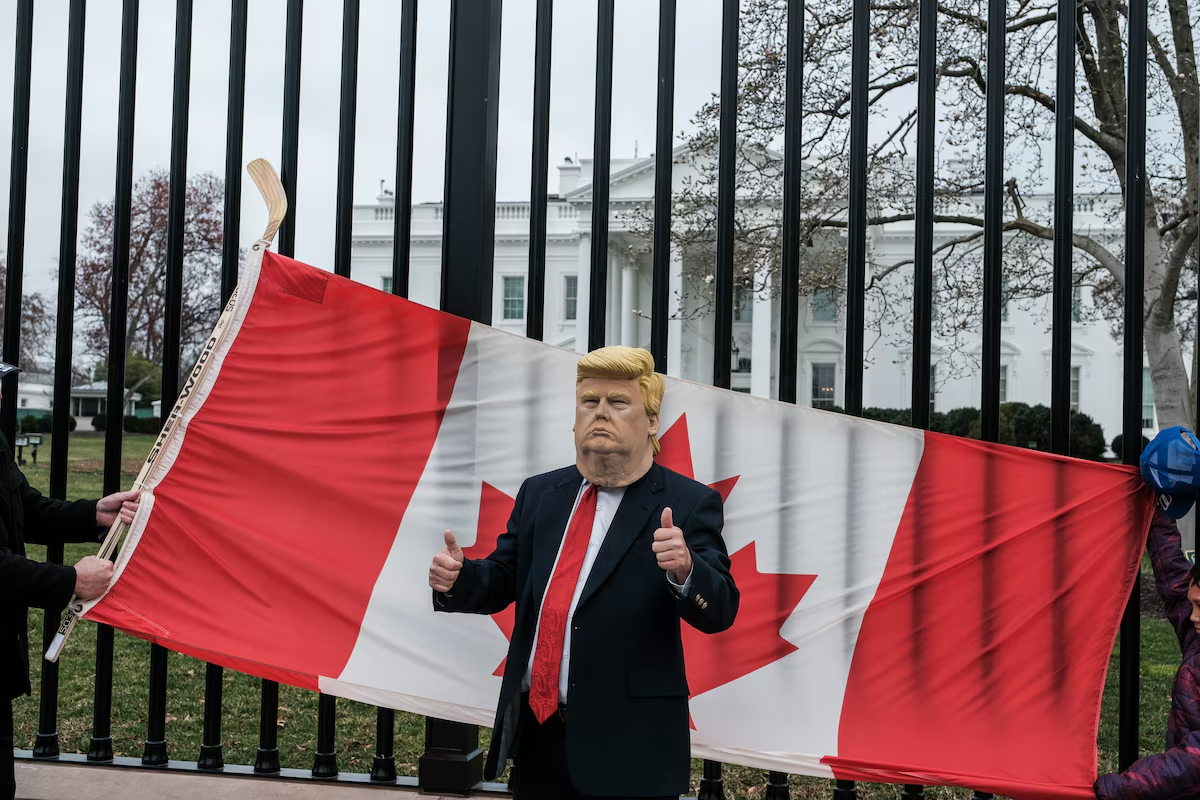
A man dressed as U.S. President Donald Trump poses for a photo near the White House in Washington on March 13. MICHAEL A. MCCOY/The New York Times News Service

The surge in patriotism among Canadian shoppers, fuelled by trade tensions with the United States, is already leaving a sizable mark on American business, early data from a variety of industries suggests.

U.S. tour operators are reporting booking declines of as much as 85 per cent, while American distilleries are losing major deals. Meanwhile, Canadian grocers are posting a bump in domestic product sales of up to 10 per cent.

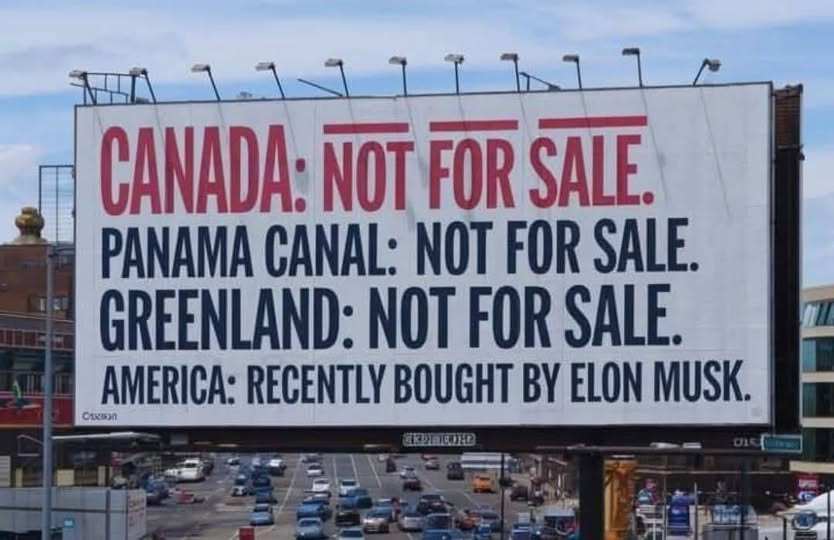
Donald Trump’s jabs about annexation, along with a 25-per-cent levy on steel and aluminum from Canada and the U.S. President’s threats of a 25-per-cent tariff on most Canadian imports have prompted a rallying cry to “Buy Canadian” across this country.

While consumer boycotts – combined with government policy actions – are causing trouble south of the border, concerns are bubbling up about the toll on Canadian businesses, too.

“To use some of the words I hear from tour company members of the National Tour Association, the drop-off is ‘astronomical’ when speaking about Canadians booking group travel to the United States,” said Catherine Prather, president of the Kentucky-based organization, which specializes in group tours.

The exchange rate and fluctuating trade policies have had a “resounding effect” on Canadians’ travel cancellations, she said. But tour operators shared that the rhetoric about making Canada the 51st state is “perhaps even worse,” and in many cases, has been the “deciding factor” for customers.

Traffic across some major border crossings in tourism states such as New York has dropped by 12 per cent in the first two weeks of February alone, said Corey Fram, director at the Thousand Islands International Tourism Council. He cited data provided to him by the Bridge and Tunnel Operators Association for border crossings on the Thousand Islands Bridge between Alexandria Bay, N.Y., and southeastern Ontario.

Statistics Canada data also show that Canadian automobile trips to the U.S. are plummeting. About 1.2 million return trips were made into Canada by Canadians in February – a 23-per-cent drop from that period a year ago.

The U.S. Travel Association warned in February that even a 10 per cent drop in Canadian visitors would lead to more than $2.1-billion in spending losses and a threat to 14,000 jobs.

The Buy Canadian movement is also hitting the grocery aisles. Per Bank, CEO of Canada’s largest food retailer, Loblaw Cos. Ltd., said in February that the company saw about a 10-per-cent uptick in sales for Canadian products in preceding weeks.

Pierre Cléroux, vice-president of research and chief economist at the Business Development Bank of Canada, told The Globe and Mail that if every Canadian household redirected $25 a week from foreign products to Canadian ones, it would boost GDP by 0.7 per cent and create 60,000 jobs.

According to his modelling, if Canadians also cut international travel by 10 per cent and spent that money domestically, the combined effect would raise GDP by 1 per cent and create 74,000 jobs.

Another U.S. industry reeling from the “Buy Canadian” movement and its manifestation in public policy – including provincial moves to take American booze off the shelves – is American distilling.

Canada is a critical market for U.S. spirits, making up “a little over 31 per cent of all U.S. exports” of distilled spirits in 2024, said Stephen Gould, a Colorado-based alcohol trade consultant at Consulting Alchemist Ltd and former distillery owner.

In addition to bourbon, Canada is a crucial market for U.S. whisky and other spirits as well as wine and beer. Bartenders, waitstaff and retail clerks in the U.S. are among those who will face significant layoffs if trade tensions continue, said Mr. Gould.

“The American industry is suffering,” he said.

Victor Yarbrough, co-founder of Brough Brothers,Kentucky’s first Black-owned distillery, said his company was “deeply disappointed” after losing a lucrative deal to sell its bourbon to New Brunswick Liquor due to trade tensions. The deal was projected to increase company sales by 2.55 per cent in 2025.

“Canada’s a large export market for us,” said Mr. Yarbrough. “Let’s figure out ways to move forward and amicably.”

Abridged article from the Canadian Globe and Mail.

Canada and Greenland

Yes, I was born in Canada. My parents moved to the United States when I was 6 months old. As a boy I visited Winnipeg every summer until I was 10 years old to see my grandparents. I have cousins in Winnipeg, Vancouver, and other cities in Canada. I have visited Canada many times as an adult. Toronto and Vancouver are fun places to tour.

That being said, I am concerned about Canada’s future.

It appears Donald Trump is serious about annexing Canada and Greenland. The difference between Donald Trump and Vladimir Putin is that Trump wants to accomplish his goals without a war.

Earlier this month, Canadian Prime Minister Justin Trudeau publicly said of President Donald Trump, “What he wants is to see a total collapse of the Canadian economy because that’ll make it easier to annex us.”

Trudeau’s accusation was extraordinary and unprecedented. Here was the leader of Canada, one of America’s closest and longest-standing allies, accusing the U.S. president of engaging in economic warfare. More and more, however, it seems Trudeau wasn’t making this argument up. The evidence is piling up that Trump has declared economic war on Canada for the express purpose of making our Northern neighbor the 51st state.

Trump first referred to Canada as the 51st state in a December 2024 meeting with Trudeau. At the time, the Canadian Prime Minister assumed Trump was joking. But then, in January, he said it again publicly, this time threatening the use of “economic force” to pursue annexation. In addition, he began referring to Trudeau as “Governor” rather than “Prime Minister.”

By this point, one could easily chalk this up to Trumpian bluster. He couldn’t possibly be serious about annexing Canada? Could he?

But, two weeks after Trump’s inauguration, a private call between him and Trudeau, which was supposed to be about tariffs, took an odd turn. According to The New York Times, Trump told “Trudeau that he did not believe that the treaty that demarcates the border between the two countries was valid and that he wants to revise the boundary.” He also mentioned revisiting long-standing treaties between the U.S. and Canada regarding the sharing of lakes and rivers.

Even the Canadians were taken aback by Trump’s statement — and it slowly began to dawn on them that perhaps the president was serious (or as serious as one can be about an insane notion like the U.S. annexing Canada).

Publicly, Trump wouldn’t let the matter die. In an interview broadcast before the Super Bowl, on February 9, Trump told Fox News’ Bret Baier his plans to annex Canada were a “real thing.” And to magnify Canada’s economic vulnerability, Trump told reporters that Canada was “not viable as a country” without U.S. trade. 

The problem for Canada is that Trump isn’t wrong on this front. Canada is so dependent on cross-border trade that if the U.S. were to turn the screws on The Great White North it could crater Canada’s economy. 

In the current context of the emerging trade war between the U.S. and Canada, it seems more than reasonable to believe that this is precisely Trump’s intention. 

Consider for a moment how this trade war has unfolded. When Trump first declared his intention to slap tariffs on Canada, he used the smuggling of fentanyl across the Canadian border as a justification (never mind that 19 kilograms of fentanyl came across the Canadian border last year, compared to 9,600 kilograms that crossed the U.S.-Mexico border). After Trudeau reminded Trump of Canada’s plan for slowing the smuggling of fentanyl, which was introduced late last year, he backed down.

But then last week, Trump returned to the trade spat with Canada, but this time blamed Canada because of its protectionist trade policies on dairy, lumber and banking. After Ontario’s premier, Doug Ford, announced a 25% surcharge on electricity exports to Michigan, Minnesota and New York, in response, Trump upped the ante announcing a new 25% tariff on Canada’s exports of steel and aluminum (which is in addition to already planned tariffs on steel and aluminum).

In announcing the new tariffs, Trump didn’t mention fentanyl as a justification, but instead wrote on TruthSocial that “the only thing that makes sense is for Canada to become our cherished Fifty First State. This would make all Tariffs, and everything else, totally disappear.” In a follow-up post, he wondered why the U.S. “allow(s) another Country to supply us with electricity, even for a small area?”

Trump’s zigzagging has left markets and the business community flummoxed. For Canadians, the confusion is even worse. How can they end these trade tensions if the reason Trump is slapping tariffs on their country keeps changing?

But perhaps the obvious answer is staring us in the face, and we’re all too dumbfounded to acknowledge it. Trump has been remarkably consistent in stating that Canada should become America’s 51st state — he has said this repeatedly for months now. Moreover, he has openly espoused using U.S. economic power to achieve that goal — and is doing precisely that. 

Just so we’re clear, this is not a Trump-only phenomenon. Yesterday, when asked if the U.S. still considers Canada a “close ally,” White House press secretary Katherine Leavitt said that Canada would “benefit greatly” from joining the United States and pointed to its high cost of living as a reason for surrendering sovereignty.  

Commerce Secretary Howard Lutnick sounded a similar theme, noting that “Canada is gonna have to work with us to really integrate their economy, and as the president said, they should consider the amazing advantages of being the 51st state.”

In recent days, the Trump administration has further imposed its will on Canada by requiring Canadians who visit the country for more than 30 days to register with the U.S. government. 

The first 51 days of Trump’s presidency have been, for lack of a better word, an odyssey. Crazy has been dropped on top of more crazy. But  in the year 2025, an American president, with no pushback from his Cabinet or Congress, has declared economic war on our closest neighbor to annex its land (which is larger than America’s) and wants to make its 40 million citizens part of the United States. This is the craziest notion of all.

The first three paragraphs of this posting are my words. The rest of this article was originally published on MSNBC.com
545 vs. 300,000,000 People

Charlie Reese  (January 29, 1937 – May 21, 2013) was a former columnist of the Orlando Sentinel Newspaper. This is his final column.

545 vs. 300,000,000 People

-By Charlie Reese

Politicians are the only people in the world who create problems and then campaign against them.

Have you ever wondered, if both the Democrats and the Republicans are against deficits, WHY do we have deficits?

Have you ever wondered, if all the politicians are against inflation and high taxes, WHY do we have inflation and high taxes?

You and I don’t propose a federal budget. The President does.

You and I don’t have the Constitutional authority to vote on appropriations. The House of Representatives does.

You and I don’t write the tax code, Congress does.

You and I don’t set fiscal policy, Congress does.

You and I don’t control monetary policy, the Federal Reserve Bank does.

One hundred senators, 435 congressmen, one President, and nine Supreme Court justices equates to 545 human beings out of the 300 million are directly, legally, morally, and individually responsible for the domestic problems that plague this country.

I excluded the members of the Federal Reserve Board because that problem was created by the Congress. In 1913, Congress delegated its Constitutional duty to provide a sound currency to a federally chartered, but private, central bank.

I excluded all the special interests and lobbyists for a sound reason. They have no legal authority. They have no ability to coerce a senator, a congressman, or a President to do one cotton-picking thing. I don’t care if they offer a politician $1 million dollars in cash. The politician has the power to accept or reject it. No matter what the lobbyist promises, it is the legislator’s responsibility to determine how he votes.

Those 545 human beings spend much of their energy convincing you that what they did is not their fault. They cooperate in this common con regardless of party.

What separates a politician from a normal human being is an excessive amount of gall. No normal human being would have the gall of a Speaker, who stood up and criticized the President for creating deficits.. ( The President can only propose a budget. He cannot force the Congress to accept it.)

The Constitution, which is the supreme law of the land, gives sole responsibility to the House of Representatives for originating and approving appropriations and taxes. Who is the speaker of the House?( John Boehner. He is the leader of the majority party. He and fellow House members, not the President, can approve any budget they want. ) If the President vetoes it, they can pass it over his veto if they agree to. [The House has passed a budget but the Senate has not approved a budget in over three years. The President’s proposed budgets have gotten almost unanimous rejections in the Senate in that time. ]

It seems inconceivable to me that a nation of 300 million cannot replace 545 people who stand convicted — by present facts — of incompetence and irresponsibility. I can’t think of a single domestic problem that is not traceable directly to those 545 people. When you fully grasp the plain truth that 545 people exercise the power of the federal government, then it must follow that what exists is what they want to exist.

If the tax code is unfair, it’s because they want it unfair.

If the budget is in the red, it’s because they want it in the red.

If the Army & Marines are in Iraq and Afghanistan it’s because they want them in Iraq and Afghanistan ..

If they do not receive social security but are on an elite retirement plan not available to the people, it’s because they want it that way.

There are no insoluble government problems.

Do not let these 545 people shift the blame to bureaucrats, whom they hire and whose jobs they can abolish; to lobbyists, whose gifts and advice they can reject; to regulators, to whom they give the power to regulate and from whom they can take this power.

Above all, do not let them con you into the belief that there exists disembodied mystical forces like “the economy,” “inflation,” or “politics” that prevent them from doing what they take an oath to do.

Those 545 people, and they alone, are responsible. They, and they alone, have the power.

They, and they alone, should be held accountable by the people who are their bosses. Provided the voters have the gumption to manage their own employees… We should vote all of them out of office and clean up their mess!

Destruction of the Free Press in America

Amid all the noise, an eerie hush is spreading across America. Companies, scientific researchers and Trump critics are clamming up as the MAGA movement ushers in a new era of government censorship.

On Day 1, President Donald Trump signed an executive order titled “Restoring Freedom of Speech and Ending Federal Censorship.” This might have sounded like banal lip service, reaffirming commitment to the First Amendment. In reality, it was the start of an Orwellian effort to root out wrongthink from government ranks and the private sector.

CBS says it will turn over an unedited transcript of its October interview with Kamala Harris to the Federal Communications Commission, part of President Donald Trump’s ongoing fight with the network over how it handled a story about his opponent.

President Donald Trump’s newly appointed chairman of the Federal Communications Commission has ordered an investigation into NPR and PBS over their alleged “airing of commercials,” and suggested that the public broadcasters could be at risk of losing their federal funding.

Last week, the administration ordered a blackout on public communications from government health agencies — in the middle of flu season.

For the first time since 1952, the Centers for Disease Control and Prevention withheld its weekly report on morbidity and mortality data updates.

Other federal departments, such as the Energy Department, were also ordered to cease public communications unless they had explicit approval of the acting secretary.

The president and his allies have also leaned on private firms to disavow politically incorrect values. For example, a group of 19 Republican state attorneys general sent a letter to Costco demanding the retailer drop its diversity commitments, citing a Trump executive order. 

Other Trump allies have engaged in speech- and thought-policing, the kinds of actions for which they once condemned progressives (sometimes rightfully!). Last week, for instance, Rep. Dan Crenshaw (R-Texas) obliquely threatened Apple’s CEO for not yet renaming the Gulf of Mexico as the Trump-blessed “Gulf of America” in Apple Maps. (Google Maps has caved, however.)

Washington Post’s “Democracy Dies in Darkness” is heading for the trash can.

George Orwell ‘s Nineteen Eighty-Four (also published as 1984) is a dystopian novel and cautionary tale by English writer George Orwell. It was published on 8 June 1949 by Secker & Warburg as Orwell’s ninth and final book completed in his lifetime. Thematically, it centres on the consequences of totalitarianismmass surveillance, and repressive regimentation of people and behaviours within society. Orwell, a staunch believer in democratic socialism and member of the anti-Stalinist Left, modelled the Britain under authoritarian socialism in the novel on the Soviet Union in the era of Stalinism and on the very similar practices of both censorship and propaganda in Nazi Germany. More broadly, the novel examines the role of truth and facts within societies and the ways in which they can be manipulated.