A Too Happy Hillary Clinton

My opinion is that Donald Trump is not a Republican.  Too many of his views match the Democratic Party views and many of Bernie Sanders’ views.

Hillary Clinton looking happy

By Damon Linker in The Week magazine, May 11, 2016

The Clinton campaign seems almost giddy at the prospect of facing Donald Trump on November. That’s a mistake.

Dear Hillary,

I have to admit, you have me worried. And for more than just the usual reasons.

In the week since it became clear you would be facing Donald Trump in the general election, I’ve sensed giddy delight coming from your camp.

Believe me, I get it.

Trump has incredibly high unfavorable ratings. Women hate him, as do Hispanic voters. The very things that made him attractive to the Republican base — the anger, the fear-mongering, the misogyny — could drive millions of undecided voters into your outstretched, welcoming arms.

And all of this comes on top of fundamentals that give a substantial edge to the Democrat in any presidential contest these days. From 1992 to 2012, the Democratic nominee always won 18 states, plus the District of Columbia, that are worth a combined 242 electoral votes — just 28 short of the 270 needed to win the presidency. Over the same six elections, Republicans have consistently won 13 states with a total of 102 electoral votes. That means a generic GOP candidate has a much narrower path to victory than a generic Democrat. Add in The Donald’s distinctive negatives, and it probably looks like you’ll be facing a cakewalk in the fall.

Don’t believe it.

For starters, I hate to break it to you, but you’re not especially popular either. Sure, Trump’s unfavorables are higher than yours — but yours are pretty damn high! And it’s not like those numbers are likely to move very much. You’ve been a fixture on the political scene for close to a quarter century now. And those young people who know the least about you have been Bernie Sanders’ most passionate supporters in the primaries. That might not prove fatal in the general election, but it’s not exactly good either.

And then there’s Trump.

With 10 contests left to go in the primaries, Trump has already surpassed Mitt Romney’s vote total for the entire 2012 primary season by roughly 700,000 votes. And he did it against a more sharply divided field, and while winning a smaller portion of overall votes cast (though that number will narrow between now and the end of the primary season on June 7). Republicans are energized, with turnout up sharply from four years ago. This means that the baseline assumptions that have held since 1992 may not pertain this time around.

In every single one of those elections, the Republican candidate has run on pretty much the same cluster of issues: tax cuts, especially for the wealthy; muscular internationalism; social conservatism; free trade. That’s also the matrix of positions Democrats of your generation are conditioned to respond to and attack.

But Trump is different. He will hit you from the populist far right on immigration and free trade. He will hit you from the far left on the Iraq war, Libya, and Syria. He will directly challenge you on economic policy by supporting an increase in the minimum wage and higher taxes for the wealthy.

And he will relentlessly, mercilessly attack you (and your husband) personally.

How will you respond to the onslaught? I sure hope the answer is that you have no idea yet. Because if you think the answer is obvious or simple, you’re deluding yourself.

It’s certainly going to take more than selling merchandise emblazoned with utterly lame slogans like “Dangerous Donald” and “America Is Already Great.” Isn’t it a tenet of progressivism that America isn’t already great? That our national greatness is always a work in progress, a goal achieved only in the fullness of time? If conservatives are prone to nostalgia, the left is inspired by eschatological hopes for the future. Barack Obama, with his frequent references to the arc of history bending toward justice, certainly knows this, and I’m sure you do, too. After these feeble gestures, I can’t say the same about DNC chair Debbie Wasserman Schultz. You might need to have a talk with her.

No Democrat has ever run against a candidate like Trump. He overturns every settled ideological and temperamental expectation of normal politics. He will go after you with a ferocity we’ve never seen before, and the assault will be unremitting — yes, on the stump, in TV and radio ads, and in the debates, but also in 24/7 cable news coverage and an endless stream of infectiously quotable tweets, half of them capped by what’s become this election cycle’s all-purpose three-letter dismissal: Sad!

So don’t be cocky. Fire anyone on your staff who tells you this is going to be easy.

Then tell the staffers who remain that they need to be nimble, thinking on their feet and outside of the proverbial box. Yes, the Democrats have very real demographic advantages, and that will help — but not as much as the usual consultants and data crunchers want to assume.

Don’t try to define Trump, whether by labeling him “dangerous” or anything else. He’s a master of rhetorical jujitsu, instantly turning criticisms and insults into honorifics. Let Trump define himself. Of course he’ll try to define you, too — as “Crooked Hillary,” among other things — but your self-definition needs to prevail over the one he tries to pin on you. If it doesn’t, you’ll lose.

Most crucially, you need to show voters by your words and actions that you’re everything Trump is not: sober, smart, informed, sensible, level-headed, presidential. Yes, a lot of Americans at all points on the spectrum are angry these days. But are they so angry that when presented with a clear and obvious choice a plurality of them will actually opt for the candidate who is manifestly less sober, less smart, less informed, less sensible, less level-headed, and less presidential?

I don’t think they will.

If I’m wrong, your bid for the presidency is doomed — and so, perhaps, is the country.

Sincerely yours, A concerned anti-Republican

President Donald J. Trump—It Could Happen

The following article was posted by The Nation magazine on February 23, 2016.  That is well before Donald Trump became the presumptive nominee of the Republican Party.  It now appears even more likely that Mr. Trump will be the next president of the United States.

His promise to protect jobs and change trade policies could win over blue-collar workers, especially in the industrialized swing states.

by John Nichols, in The Nation

February 23, 2016


Donald_Trump_2016_rtr_imgIn the middle of the political food fight that was the ninth Republican presidential debate, the front-runner suddenly abandoned the petty politics of the moment and delivered a message that mattered less to the scramble for South Carolina primary votes and more to the November fight for the battleground states that ring the Great Lakes.

“This country is dying. And our workers are losing their jobs,” Donald Trump declared. Noting the announcement of plans by the air-conditioner company Carrier to transfer production (and 1,400 union jobs) from Indianapolis to Mexico, the billionaire said, “Carrier is moving. And if you saw the [workers]…. They were crying.” Promising a no-more-tears presidency, Trump said he’d renegotiate “trade pacts that are no good for us and no good for our workers” and tell corporations to keep production in the United States or “we’re going to tax you.”

The pundits and political insiders who have missed every other warning sign from the 2016 race missed that one as well. But Trump’s recognition of shuttered plants and crying workers struck Ohio Congresswoman Marcy Kaptur. “I heard him. I heard exactly what he was saying, and so did the people of Indianapolis and Indiana,” Kaptur said. “So did everyone else who has lost a job to offshoring and outsourcing, or who knows they are just one more trade deal away from losing a job.”

Kaptur, a Democrat who represents a multiethnic, multiracial district stretching from Toledo to Cleveland, has decried Trump’s divisive remarks as shameful deviations from the American promise of “unity, not hatred.” But she cautions Democrats against assuming that the revulsion to Trump’s hateful language and crude politics will immediately disqualify him in the eyes of scared and angry voters in states that have been essential building blocks for Democratic wins in presidential races of recent decades. Kaptur’s not alone in this view.

Service Employees International Union president Mary Kay Henry warns that Trump could win a good many union votes—and perhaps the presidency—if he secures the Republican nod. “I think this is a very dangerous political moment in our country,” said the head of the SEIU, which has endorsed Hillary Clinton for the Democratic nomination, during a January discussion of Trump’s appeal. “I think he’s touching this vein of terrible anxiety that working-class people feel about their current status, but more importantly, how terrified they are for their kids not being able to do as well as they have, never mind doing better.” Henry noted that internal polls of union members across the country reveal a “broken sense of the future” and raise the prospect of an emotion-driven election in which it is “easier [to] appeal to fear than to what’s possible.”

“I don’t think the Democrats are ready for this,” adds Ralph Nader, the consumer activist and former presidential candidate. “Once he gets these wildcats off his back, once he gets the Republican nomination, then Trump becomes the builder again. He’s already said he’s going to be the greatest jobs president in history. He hasn’t pushed that line too hard in the primaries because he doesn’t want to come off as something other than a conservative. But if he’s the nominee, watch out.”

“Watch out”? Really? Isn’t Trump supposed to be unelectable? Isn’t he too bigoted, too crude, to be taken seriously? That’s what Republicans told themselves for most of 2015. But since his big wins in the New Hampshire and South Carolina primaries, the GOP establishment has begun to adjust to the prospect of a billionaire nominee with a flair for grabbing media attention, shaping the debate, and shredding opponents.

Yes—watch out. “This is an unprecedented election in so many ways that we don’t know what electability is,” cautions Ilyse Hogue, president of NARAL Pro-Choice America, which has backed Clinton. “What we do know is that Trump is better positioned to pivot, to Etch-A-Sketch his message, than the other Republicans. That constitutes a threat.”

Trump has already proved to be competitive with Clinton and her insurgent challenger, Vermont Senator Bernie Sanders, in the polls from battleground states like Florida, North Carolina, and Colorado. Measures of hypothetical match-ups should always be considered with skepticism when the parties are in the midst of nomination fights—and when potential independent candidacies are being explored. But poll numbers and interviews with Democrats in key states like Ohio, Pennsylvania, and Wisconsin indicate that the 2016 Democratic nominee could face a fight for industrial states that provided vital support for Barack Obama in 2008 and 2012. And Trump has yet to make his play for those states.

Right now, Trump is still peddling the snake-oil blend of xenophobia and bigotry that plays well in Republican primaries (one recent survey in South Carolina found that 38 percent of his backers believe the Confederacy should have won the Civil War). If he’s the Republican nominee, however, he’ll be confident about South Carolina. And Trump is all but certain to have what Hogue refers to as his “Etch-A-Sketch” moment, pivoting toward economic-populist themes that, while still crudely nationalistic, might attract independents and Democrats in key states. Republican pollster Frank Luntz says that in the focus groups he’s conducted, he has regularly found people who voted for Obama twice but now say “they would consider Trump.” Why? Because Trump is speaking to the fears of Americans who have lost faith not just in establishment politics, but in establishment economics. And he is likely to do a lot more of that.

It’s in the industrialized swing states where Trump’s promise to protect jobs and change trade policies could resonate among blue-collar workers. AFL-CIO president Richard Trumka acknowledges that workers are “talking to me about Donald Trump.” Union leaders fret about internal surveys that show the billionaire is attracting greater support than is usually afforded Republicans. While much of it comes from white male voters, these union leaders say they’ve seen some evidence of a broader openness to Trump’s message. Luntz claims that his candidacy “would get the highest percentage of black votes since Ronald Reagan in 1980.” That’s not a high bar—exit polls gave Reagan 14 percent—but the prospect of losing any working-class votes in states like Wisconsin, Indiana, Michigan, Ohio, and Pennsylvania should be a wake-up call for Democrats.

“The two major parties will have to change, or they are likely to be changed by voters who have had enough,” argues the Rev. Jesse Jackson. But what if one party changes—however cynically or crudely—to address the fears of the moment, while the other does not? What if Trump turns up the volume on a populist message while the Democrats run a more cautious campaign?

Sanders supporters point to polls in some battleground states that show him faring better than Clinton in matchups with Trump. “Bernie’s where the Democrats need to be,” says RoseAnn DeMoro, executive director of the National Nurses United union, regarding Sanders, a longtime critic of corporate-friendly trade pacts. “He’s speaking to fears that working families have about the future, but he’s not dividing people the way Trump is.”

Kaptur, who has not endorsed a candidate in the Democratic race, made a similar point on a drive from Toledo to Lorain, where the steel mills are cutting production and in some cases shutting down. “These people have been hit over and over and over again. They’ve retrained. They’ve done everything they can to survive—but the plants keep closing. They’ve been battered, and they’re sick of it. They want security, and this country is not delivering security. When Bernie talks about this, I think it touches people. Clinton says a lot of the same things, but I don’t hear the same passion.”

That’s a fair critique. But the counter to Trump’s appeal can’t merely be to debate on his terms. “It won’t work to go ‘My populism is bigger than your populism,’” Hogue says. A smart challenge must involve a full-spectrum response to the billionaire’s appeal as “a builder and a doer,” Nader says. “He reaches millions of people by making them comfortable with their prejudices. The press sometimes goes after him on that, which is good. But the press never gets to his vulnerabilities—his tax returns. There’s so much there, but Trump has diverted attention from a real examination of his financial dealings. Progressives can’t get distracted the way conservatives have. They have to expose him.”

Exposing the billionaire as a crony capitalist means pursuing the question of whether a candidate who opposes a minimum-wage hike would really take on multinational corporations in order to save jobs in Flint and Youngstown. In addition to challenging Trump himself, savvy observers say, it is vital to challenge Trumpism—the politics of division that scapegoats, stereotypes, and appeals to bigotry. Trumka says that “a campaign fueled by contempt and exclusion is bad for working families,” and labor unions are preparing to make that point with an aggressive campaign similar to their 2008 push to get union members behind Obama’s candidacy.

The challenge to Trump must address economic anxiety while also emphasizing pluralism, says Hogue. “Where Trump’s weakness is, and where his opponent will have an advantage, is that the way this country genuinely experiences economic inequality has everything to do with your race, your gender, your treatment as an immigrant—all these issues.” Clinton has begun speaking to this. Even if Wall Street is reined in and economic challenges are addressed, she warned in the Democratic debate in Milwaukee, “we would still have racism holding people back. We would still have sexism preventing women from getting equal pay. We would still have LGBT people who get married on Saturday and get fired on Monday.” That’s smart—as was Sanders’s call in the same debate for “a political revolution in which millions of Americans stand up, come together, [and] not let the Trumps not let the Trumps of the world divide us.”

Clinton and Sanders are both evolving—and improving—as candidates. This is important, because if Trump is the GOP nominee, he will not be beaten with old talking points or a cautiously calculated message. “The Democrats have to get much better at making the connections between the water crisis in Flint and the closing of factories in Flint,” Kaptur says. “They have to make all the connections between trade and poverty, between deindustrialization and hollowed-out cities. People are hurting for a lot of reasons. Democrats have to recognize that hurt, and they have to explain that a politics of division is never going to address it.

“Dividing people doesn’t make positive change possible,” Kaptur adds. “Dividing people makes the changes that are necessary impossible.”

40 million and counting

I admit to being a numbers wonk.

Twelve percent of the United States population lives in California. It was that way in the last national census. So we are not growing faster than the national population. California’s major cities have run out of space so they must either build taller apartment houses or simply resign to the fact that they have reached to maximum population limit. The consequence is the ever increasing price for rental apartments and individual homes.

California is within earshot now of 40 million residents — 39,256,000 — based on analysis of housing data and other measures. The way these surveys rely on slightly old data, in reality California is possibly already over 40 million.

The state Department of Finance’s estimate also pegs the city of Los Angeles at over four million population for the first time since the state has done this report. Or not quite triple the population of California’s second-largest city, San Diego. Here is the top 10:

  1. Los Angeles   4,030,904
  2. San Diego     1,391,676
  3. San Jose       1,042,094
  4. San Francisco  866,583
  5. Fresno             520,453
  6. Sacramento     485,683
  7. Long Beach     484,958
  8. Oakland          422,856
  9. Bakersfield      379,110
  10. Anaheim          358,136

Here is the full report if you like to peruse the stats.

California’s population was 10.7 million people in 1950. In 1960 at 15.8 million people it was behind Canada that had a population approaching 18 million. Today Canada’s population is lagging behind at 36 million and NYC has grown by about 1 million people since 1990.

We all ought to understand the reasons. They are the weather, arts and entertainment, high technology, outstanding colleges and universities.

The Nominees

The Nominees

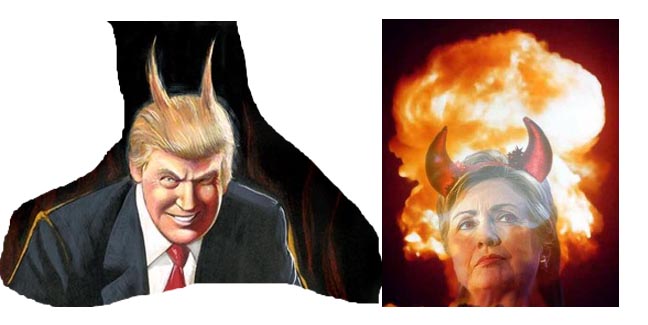
Neither of these candidates are good for America. I see two Twilight Zone Devils.

In other words they appear reasonable until the until the last moment when they will do their nasty acts.  Of course we won’t know that until it has happened.

Hillary Clinton is an insider who has too many donors that will have the final say on her actions as president. She is most likely to follow the philosophy of her husband (former President Bill Clinton). Recall that he signed the law revoking the Glass-Steagall act of 1933 that prohibited commercial banks from engaging in the investment business. He also signed into law NAFTA, a law proposed by Republicans and pushed by President George H.W. Bush that resulted in numerous companies relocating to Mexico.

Donald Trump has no experience in public office and does not appear to understand the workings of the federal government. He clearly does not understand the total significance of the Bill of Rights. “One of the things I’m going to do if I win… I’m going to open up our libel laws so when they write purposely negative and horrible and false articles, we can sue them and win lots of money,” Trump said during a rally in Fort Worth, Texas. He has limited understanding of the relations the United States has with other countries and like most of us does not know a great deal about our military capabilities. He is a scholar of business.

Let’s start with Hillary Clinton.

  1. There is no explanation to be found where she tells where she was and what she was doing when Benghazi, Libya was attacked.
  2. The use of her private e-mail server does not appear to have compromised anything. However, her use of that device calls into question her judgement.
  3. There is no theme to her campaign for president. Her entire theme seems to be she will continue the Obama administration and the banners saying “She’s with Us” and “Fighting for us.” The number one reason Hillary should be our next president according to her web site is “As a former secretary of state, U.S. senator, first lady, and a lifelong advocate for women and families, no one is more qualified to be president than Hillary.”

Let’s look at Donald Trump.

  1. He has never held any elected office.
  2. People might ask “How is Donald Trump able to file for bankruptcy so many times?” The answer is “He didn’t.” Trump himself has never filed for bankruptcy. His corporations have filed for Chapter 11 bankruptcy four times. This information from http://thelawdictionary.org/.
  3. Is he a buffoon? A genius? An exploration of the man, his brand, and his chronic bluster at The Atlantic offers a perspective.
  4. Foreign trade is a big part of the Trump campaign. Donald Trump’s trade war could kill millions of U.S. jobs contends Jim Tankersley in The Washington Post.

Go ahead and choose your devil. Just understand that in four years you will be ready for another unacceptable president. Ugh!!

Foolishly Passed Laws and the Unintended Consequences

A Tale of Two Nafta Towns

This is a story about NAFTA. The theory must have been that lower tariffs between Mexico, Canada, and the United States would benefit businesses in all three countries. Who would have thought that American companies would move to Mexico? But that is precisely what happened.

The latest that received attention from Donald Trump are Oreo Cookies and Carrier Air Conditioning. There have been many others that come to mind for me personally.

Bloomberg Businessweek reported on the case of A. O. Smith, an electric motor manufacturer in the small southern Kentucky town of Scottsville (population 4,226). The factory employed 1,100 people. Randall Williams and his wife Brenda each earned $16.10 per hour. The factory closed and moved to Acuña, Mexico. The workers in Mexico earn $1.75 per hour. The Williams have new jobs that pay minimum wage. She works in the high school cafeteria and he fills orders in a local farm store.

Brenda and Randall Williams plan to vote for Donald Trump in November.

A Tale of the Consequence of Minimum Wage Laws

Florida’s governor is fishing for California jobs now that the minimum wage will be $10.50 per hour in January 2017 and $15.00 per hour in 2022.

Laws are passed by government without adequate consideration of possible unintended consequences.

President Trump Good for California?

Oh, he’ll be great, just like his border wall

by Steve Lopez Contact Reporter and commentator for the Los Angeles Times

This is a really funny, witty column.

We have a very beautiful state here.

Absolutely beautiful.

And people are always saying to me, whether they live in California or they’re visiting from somewhere else in the country or the world, hey, this is fantastic. That’s what they say about California. They’ve never seen anything like it.

Did I mention that it’s huge?

This state is very huge, with lots of mountains, gorgeous mountains. We have the best mountains. And of course — I don’t need to tell you — we have the most wonderful beaches in the world.

I don’t care where you’ve been. The French Riviera. Hawaii. The Caribbean.

Our beaches are the best.

Believe me.

We have top-notch people here, too, with terrific ability, some of them. Very intelligent. They’re making rockets; that’s how smart they are.

And the women — many of the women — are beautiful, the most beautiful women in the world. Best of all, they don’t go around playing the woman card like somebody we know.

Now comes the big question, this being the middle of a presidential campaign:

What’s in store for our great state of California if Donald Trump is elected president of the United States?

I get asked this by readers, some of the best readers, and some of them are speed readers. Brilliant people. Some of them follow me on Twitter — I have great power on Twitter, by the way. I tweet, I get re-tweeted, and my enemies weep. Or call me an idiot, but that’s the way it goes.

California company, Twitter. Not Texas, home of lying Ted, who is hated by everybody.

Everybody hates him! That I can tell you, OK?

Anyhow, getting back to the readers, they want to know what a Trump presidency looks like for the country, but more specifically, they want to know what’s in it for California.

In some respects it’s hard to know, because Trump hasn’t spelled out many policy details, but look at the man’s record of success.

He is rich. Filthy rich.

I rest my case.

You think he got that way not knowing how to run things? His IQ is one of the highest, according to a Tweet he sent out.

The highest! I guarantee it.

So when Trump says he will eliminate the EPA — “What they do is a disgrace” — you have to trust that he has a plan to keep California’s water drinkable and our air somewhat breathable without regulatory oversight.

A vote for Trump is a vote for fresh air.

Some experts argue that his tax cut would blow a $10-trillion hole in the federal budget, and California — with its disintegrating bridges and cratered roads — would suffer a big hit.

But let me tell you something about these so-called experts.

They are low-energy people. They have a lower pulse than this guy Jeb Bush, and they know less than he does. They’re scavengers, really. Worse than the media people, some of whom have blood coming out of their eyes. That’s how horrible they are.

Some analysts will tell you that California, with its terrific amounts of international trade — we’ve got stupendous trade here in God’s country — could be bushwhacked under Trump’s policies. They say his proposed tariff on imported goods could actually cost jobs and lead to higher prices on Asian imports, amounting to a crippling tax on consumers.

Here’s what these haters don’t know, if I can use Trump’s own words:

“I just sold an apartment for $15 million to somebody from China. Am I supposed to dislike them?”

Trump loves China, you know? That’s my point. He loves China — it’s a beautiful thing to watch, people — at least as much as he loves the poorly educated.

And let’s not forget what he said about African Americans.

“I’ve always had a great relationship with the blacks.”

A state as diverse as California couldn’t go wrong under the leadership of an enlightened man like Trump, which is why true believers turned out in Costa Mesa on Thursday to cheer their guy.

Sure, there were some rabble-rousers there who don’t like what Trump has said about Latinos or Muslims or women, and police arrested 17 people who got a little out of hand.

But let’s look at the numbers, OK?

Eight thousand rabid supporters.

Seventeen party-poopers.

You don’t have to take my word for it, even though math is one of my strengths — everybody says this about me — but that’s a landslide victory for Donald J. Trump.

The supporters in Costa Mesa could be heard in Tijuana when they roared after Trump’s promises to torture terrorism suspects and make Mexico pay for a border wall, a beautiful wall, and believe me, this man can build tremendous walls.

You know what he’s going to do? I bet he’s going to build walls under the ground to block the tunnels.

That’s what this man is capable of, and as Trump stumps for California votes, I think you’re going to be seeing a lot more of what we saw in Costa Mesa.

These were high-energy supporters who would probably gladly help build the wall themselves. For pesos. Since Mexico’s paying for it.

And then what happens, once the great wall is built?

Deportations, that’s what. By the millions. With President Trump driving the bus himself if Pete Wilson is busy.

A few sniveling softies will argue that it’s inhumane and un-Christian to send dirt-poor families back to countries with even greater poverty and unimaginable levels of violence.

A few mushy-headed economists will argue that California’s huge agriculture industry, to name one of many, would be devastated, with ripple effects throughout the state’s economy.

But these naysayers don’t know what Donald Trump is capable of, and they don’t understand California’s resilience.

We have great resilience in this state. Everybody talks about it.

Costa Mesans can move to Palos Verdes to mow the lawns at Trump’s golf course — these are the greatest links in the world, by the way. Or they can move to Delano to pick lettuce or Oxnard to pluck mushrooms out of the manure.

They would do great in the manure. We have the best manure.

Donald Trump will be president, and we’ll have a sequel to “A Day Without a Mexican,” but this time it’ll be a documentary.

And California will be great again.

America First by Donald Trump

Donald Trump on Foreign Affairs 4-27-16

Donald Trump’s foreign policy speech was well written and well presented. However it lacked any detail. Lots of vague generalities was the order of the day. The New York Times commentators offered some interesting and worthwhile observations.

The only thing that can be understood is that, as president, Mr. Trump would put America first in all of his decisions. Which president and which candidate for president would to otherwise?

Mr. Trump is a master of generalities. Read the speech slowly and carefully and you will see glaring contradictions. Compare these two statements in his speech. “Our allies must contribute toward the financial, political and human costs of our tremendous security burden. But many of them are simply not doing so. They look at the United States as weak and forgiving and feel no obligation to honor their agreements with us.” “America is going to be a reliable friend and ally again.”  So which is it?

Trump repeatedly said that the United States under his administration would be a “reliable” power. But he also said U.S. policy would have to be “unpredictable” to keep the world guessing, a formula rarely used in high-stakes diplomacy.

Being president of the United States carries a major responsibility. Do you really want a reality show star to lead this country?

Manufacturing and Minimum Wage Jobs in the 21st Century

Lower taxes might help domestic manufacturers but when the cost of labor in other countries is one-tenth the cost in the United States lost jobs will not be returned to this country.

Individuals assembling Apple’s iPhones in China allegedly work long hours for low pay. They work 11-hour shifts at a rate of $1.50 per hour. During each shift they are docked 20 minutes of pay (I assume for a lunch break). There earnings are $268 per month before overtime. This information is from a report in Business Insider.

GM, Ford Boost Mexico Output With $26-a-Day Workers.  Mexico’s share of North American auto production may rise at a quicker pace as General Motors Co., Ford Motor Co. and Chrysler Group LLC seek out workers making less than 10 percent of what their U.S. counterparts earn. This information is from a report in Bloomberg Businessweek.

For example crib maker Stanley Furniture Co. misjudged the willingness of Americans to pay more for domestically produced goods when cheaper imports are available. Meanwhile, the husband-and-wife entrepreneurs who founded 20-year-old Chesapeake Bay Candle have struggled to find workers who can do basic math. This information is from a report in The Wall Street Journal.

 Los Angeles, once the epicenter of apparel manufacturing has seen the outsourcing of jobs to China and Southeast Asia due to lower labor costs.

Do you really believe that Donald Trump will bring those assembly jobs back to the United States? Donald Trump does not agree with the idea of a $15 per hour minimum wage. I heard him say that. Los Angeles was once the epicenter of apparel manufacturing Los Angeles was once the epicenter of apparel manufacturing, attracting buyers from across the world to its clothing factories, sample rooms and design studios. But over the years, cheap overseas labor lured many apparel makers to outsource to foreign competitors in far-flung places such as China Los Angeles was once the epicenter of apparel manufacturing, attracting buyers from across the world to its clothing factories, sample rooms and design studios. But over the years, cheap overseas labor lured many apparel makers to outsource to foreign competitors in far-flung places such as China

Just to add to the difficulty in keeping jobs in America paid family leave regulations have been passed in New York and California.

Most web sites contend that government regulations are a significant cost to business in the USA. The problem is that every regulation has its supporters.

Unless Donald Trump intends to drive up the cost of clothing, cars, and electronic devices there is no way he can bring those jobs back to the United States. His ideas will spark a trade war.

The solution is retraining in areas short of workers. CNN posted an article listing 30 jobs needing most workers in next decade. How many people will take the opportunity by at least investigating the opportunities?

I am Drinking Bottled Water

We started using bottled water immediately after the 1994 Northridge Earthquake. An article in a local newspaper warned that there was a concern about contaminated drinking water in the San Fernando Valley.

To this day we are still buying Arrowhead bottled water in 2½ gallon containers. Friends and acquaintances believe I am wasting money.

Then came the Flint Michigan lead polluted water. There have been articles in newspapers about other towns that may also have lead polluted water. Now Des Moines, Iowa’s water utility is suing to stop nitrate pollution from upstate.

 Nitrogen (it’s part of fertilizer) pollution of waterways is a problem that extends well beyond Iowa. In Lake Erie in 2014, a toxic algae bloom—caused by runoff from farms and septic systems plus warmer temperatures, among other factors—contaminated Toledo’s water supply.

The main line pipes in my neighborhood are over 50 years old and many pipes in my city are almost 100 years old. Many pipes have burst due to corrosion. Still the Los Angeles Department of Water and Power (DWP) insists that the water is safe to drink. They issue semi-annual reports on water quality to reassure the residents.

From WebMD:
Occasionally, your tap water can become contaminated as a result of breaks in the water line, although one of the biggest problems is lead getting into the water from pipes. Even ”lead-free” pipes can contain as much as 8% lead.

The best way to avoid consuming lead from tap water is to only use water from the cold tap for drinking, cooking, and making baby formula and to let the water run for a minute before using it.

This is not reassuring. I will continue using bottled water.