Why Ben Carson has no business near the Oval Office

by Los Angeles Times commentator Doyle McManus, on line and in print November 11, 2015
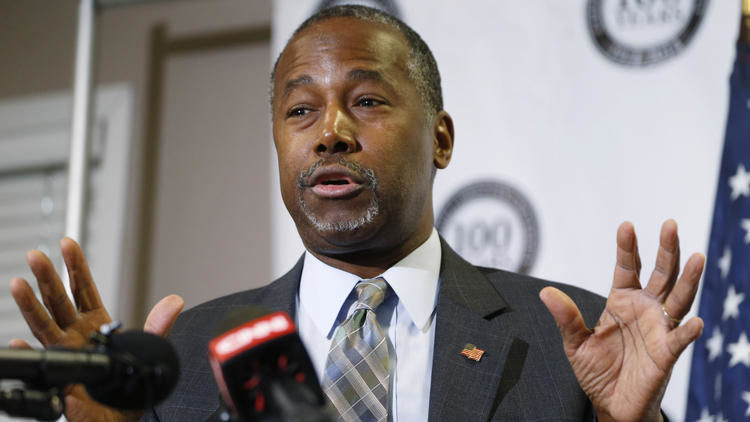
Ben Carson #2

I don’t really mind that Ben Carson thinks the pyramids in Egypt were used to store grain; that’s a folk belief that’s been around since the Middle Ages. At least he dismisses the theory that the pyramids were built by space aliens.

And I don’t really mind that Carson’s autobiography, by his own admission, isn’t precisely accurate on every detail. He still insists that he tried to kill a classmate with a knife, an unusual claim for a presidential candidate. But even if that story was an exaggeration, it’s harmless myth-making — a dramatization of how low the teenage Carson had sunk before God intervened to shape him up. Barack Obama’s autobiography used creative license to make him sound like a juvenile delinquent, too.

Here’s what I do mind: Even though Carson considers himself brilliant, he doesn’t seem to care much about the actual duties of a president. His speeches, interviews and books betray a shaky grasp of economic and foreign policy, to put it kindly. And when a candidate is tied for first place for the Republican nomination in most polls, that’s no laughing matter.

Case in point: His comments about the federal budget.

Carson has proposed turning the income tax into a 15% flat tax on rich and poor alike — a massive tax cut for the wealthy (and tax increase for the poor) that would reduce federal revenue by more than half a trillion dollars, according to most estimates.

But more than a year after he began running for president, the good doctor still hasn’t explained how he would fill the yawning budget gap his tax cut would produce.

Indeed, this week he appeared to make the problem worse. Previously, Carson said he would cut federal spending by 3% to 4% across the board (except for the military, which he would grow). Now he says the cuts would amount to only 2% or 3% — a more realistic target, but one that would only widen the deficit.

Where are the details? There aren’t any available; none of these plans has been reduced to paper. A Carson spokesman told me that the campaign hopes to release specific proposals by the end of the year.

I don’t envy Carson’s aides; the candidate often sounds confused.

“The lion’s share of the gross domestic output is consumed by the federal government,” he complains in his latest book, “A More Perfect Union.” Actually, no: Federal spending consumes about 20% of GDP while consumer spending takes the true lion’s share: almost 70%.

On the public radio show “Marketplace” last month, Carson was asked whether he would block an increase in the federal debt ceiling. “I would not sign an increased budget,” he replied. No, his interviewer clarified, the question was about debts already incurred, not future spending. Carson still seemed to think they were the same thing. “We’re not raising any spending limits, period,” he said.

His vagueness and apparent lack of understanding on those counts isn’t comical; it’s troubling. Next to Carson, Ronald Reagan was a detail-oriented policy wonk.

Economics isn’t his only blind spot.

In his book, Carson argues that federal judges shouldn’t be allowed to rule on the constitutionality of state ballot initiatives like California’s Proposition 8, which the Supreme Court overturned in 2013.

“Having a ballot referendum on an important issue is a farce if a federal judge can throw out the results,” he writes. He suggests, as a remedy to this problem, that Congress simply impeach any judge who “ignores the will of the people.” So much for the Constitution.

Carson thinks the U.S. military should be taking the lead in ground combat against Islamic State in Syria and Iraq. “I would commit everything to eliminating them [Islamic State] right now,” he said. That’s a controversial position, but a defensible one. Here’s where Carson goes off course: He argues that U.S. forces shouldn’t be bound by the laws of war.

“There is no such thing as a politically correct war,” he told Fox News. “If you’re going to have rules for war, you should just have a rule that says ‘no war.’ Other than that, we have to win.”

Carson is, by all accounts, a brilliant surgeon. He’s a splendid motivational speaker and an admirable philanthropist. But he’s not ready to be chief executive of the United States.

In his books, he often mentions incidents in which God intervened in his life. When he neglected to study at Yale, God showed him the answers on a chemistry exam. When he fell asleep while driving home one night, God spared his life. When he used new surgical techniques on children’s brains, God saved some of his patients. And when he was on a safari in Africa, God answered his prayer for plenty of photogenic wildlife.

Now that he’s running for president, Carson sounds as if he’s counting on divine intervention to pull him through again. There can be no doubt about the sincerity of Carson’s Christian faith or his belief in the power of prayer. But voters — even the most devout — deserve more earthly evidence that he’s up to the job.

doyle.mcmanus@latimes.com

“Six Amendments: How and Why We Should Change the Constitution.”

By John Paul Stevens April 11, 2014

John Paul Stevens served as an associate justice of the Supreme Court from 1975 to 2010. Following is a part of his essay is excerpted from his new book, “Six Amendments: How and Why We Should Change the Constitution.”

The Second Amendment expressly endorsed the substantive common-law rule that protected the citizen’s right (and duty) to keep and bear arms when serving in a state militia. In its decision in Heller, however, the majority interpreted the amendment as though its draftsmen were primarily motivated by an interest in protecting the common-law right of self-defense. But that common-law right is a procedural right that has always been available to the defendant in criminal proceedings in every state. The notion that the states were concerned about possible infringement of that right by the federal government is really quite absurd.

As a result of the rulings in Heller and McDonald, the Second Amendment, which was adopted to protect the states from federal interference with their power to ensure that their militias were “well regulated,” has given federal judges the ultimate power to determine the validity of state regulations of both civilian and militia-related uses of arms. That anomalous result can be avoided by adding five words to the text of the Second Amendment to make it unambiguously conform to the original intent of its draftsmen. As so amended, it would read:

“A well regulated Militia, being necessary to the security of a free State, the right of the people to keep and bear Arms when serving in the Militia shall not be infringed.”

Emotional claims that the right to possess deadly weapons is so important that it is protected by the federal Constitution distort intelligent debate about the wisdom of particular aspects of proposed legislation designed to minimize the slaughter caused by the prevalence of guns in private hands. Those emotional arguments would be nullified by the adoption of my proposed amendment. The amendment certainly would not silence the powerful voice of the gun lobby; it would merely eliminate its ability to advance one mistaken argument.

What’s Wrong with the TPP?

What is wrong with NAFTA, TPP, and other free trade agreements that lower tariffs?

The United States is the dream country for capitalists. The limits on corporations are minimal. Very big companies buy each other out (called a merger) with few government efforts to control the likely outcome of near monopoly. The latest example in Walgreens drug company’s plan to buy Rite-Aid drug company.

Those same companies are now referred to as multi-nationals. General Electric is a creation of Thomas Edison but consider that the company now has facilities in 130 countries. GE has invested over $200 million in a flexible new “brilliant factory” in Pune, India. This information is from GE websites.

Heinz Ketchup sits on the tables of restaurants in Paris. It is not packaged in the United States.

The United States currently imposes low tariffs on most of the goods imported into this country. The TPP will eliminate those tariffs on the other 11 countries. That probably won’t impact the amount of goods being imported. The agreement also lowers the tariffs that other countries impose on imported American goods and that appears to be a good thing.

However when those goods are shipped overseas that are in limited supply in the United States that will drive up the prices in America. An example is chicken. Tyson Foods processes 41 million chickens a year. If they can sell some of those chickens in other countries that will reduce the number of chickens available for sale in America. Less supply translates to higher prices. That means higher profits for Tyson.

If you manufacture something in the United States where $15 to $25 per hour is a common pay rate, why not manufacture your goods in Vietnam, Peru or Malaysia where pay rates are significantly lower and import the products to America?

John Deere and Caterpillar are two companies that will benefit from lower tariffs in other countries. The problem is there are too few companies that are in the category of big machines.

The United States has lost millions of jobs to lower pay rate countries. The benefit to company shareholders is obvious.   The loss of jobs in America is obvious. The rich typically get their way. I predict capitalism will prevail. I also predict the end of the middle class in America.

A Demonstrated Benefit of Free Press

In less than one day the impact of America’s free press was demonstrated in Los Angeles County by the Los Angeles Times newspaper. In the morning edition of the paper there was a front page center article titled FAIR GROUP’S TAX STATUS AT ISSUE.

Here us the gist of the article.

The Los Angeles County Fair Association formed in 1940 to promote agriculture in an area that then had a booming agricultural industry. The non-profit organization’s annual fair was created to promote the industry and teach children for the next generation. The problem is that Los Angeles County is now an urban/suburban area of over 10 million people who are, for the most part, not part of agriculture.

The front page story includes a photo of portable spas that were on sale at the fair. When you walk through the fair buildings there are sales people hawking spas, motor homes, and vegetable blenders.

Experts say the high-paying L.A. County association’s businesses push the boundaries of its agricultural exemption. The president of the association receives a salary of almost $900,000 a year. His four vice presidents each receive pay of well over $300,000 per year. Other counties in California with fairs pay their fair manager less than $300,000 per year and San Diego’s manager receives less than $200,000 per year. In 2013 the fair lost over $3million.  The pay to those top executives almost makes up the loss.

This afternoon the Los Angeles Times reported that the county supervisors have called for an audit and possible renegotiation with the Los Angeles County Fair Association.

Obviously the supervisors read the Los Angeles Times.

Buy-Outs, Forced Retirement and Age Discrimination

Your employer is in financial difficulty and needs to find a way of saving cash until there is a recovery.

If you work for a newspaper or magazine you are in an industry that is in serious decline then recovery is in doubt. The Washington Post seems to have recovered thanks to a purchase by Jeff Bezos, founder of Amazon. BusinessWeek magazine was bought by Michael Bloomberg and is thriving. Newsweek and U.S. News and World Report are gone. Tribune Publishing Company that owns the Chicago Tribune, the Los Angeles Times and other newspapers is in dire straits.  The Los Angeles Times is currently attempting to offer buy-outs to their staff.  Sports writer Bill Dwyre, a gray-haired man with years of experience and probably high pay just announced his retirement.  Other outstanding columnists with that paper are probably also going to take their leave.

General Motors and Ford Motor Company both went through some very difficult economic times as have   many other companies.

In every instance they all followed the same path. Cut the high cost employees and reduce the pay to the remaining employees. I know people who were part of the buy-out, those who faced the reduced pay, and those who were simply laid-off. I was party to that situation more than once.

The issue for those losing their jobs is their age. Once you are older, 55 or older, obtaining another job at the same pay as was previously received is difficult and in most cases impossible.

Age discrimination is rampant and impossible to prove. “Age discrimination involves treating someone (an applicant or employee) less favorably because of his or her age. The Age Discrimination in Employment Act (ADEA) only forbids age discrimination against people who are age 40 or older.” That is the statement posted on the EEOC on their web site.

From Forbes magazine dated January 31, 2014

The Ugly Truth About Age Discrimination (abridged)

“So then the headhunter said something that took my breath away,” said my caller, Philip.

“He told me that his client looked at my resume and said it looked great, but then he found my LinkedIn profile and decided I’m a little long in the tooth for the job.”

I was silent. That took my breath away, too.

“Long in the tooth?” I asked. “As in old?”

“Exactly,” said Philip. “The headhunter actually told me that the client said I was too old for the job. I asked him if that was illegal – I’m pretty sure it is – and he said that the client’s view is that if they don’t interview me, I’m not a candidate, so it’s not discrimination.”

“That’s false,” I said, but even as I said it, I knew that it doesn’t make any difference.

What is Philip going to do – sue the employer he never met because a third-party recruiter told him that one hiring manager made an inappropriate comment? So-called Failure to Hire cases are notoriously hard to bring and even harder to prove. As long as the organization ends up hiring someone who is qualified for the job, how could Phil ever prove that he was rejected because of his age? It’s not as though the organization is going to publish the new hire’s age for all the other candidates to see.

Age discrimination is everywhere. I hear more examples of age discrimination than I hear about sex discrimination, racial discrimination and every other kind put together. I expect that’s because some employers believe that older workers aren’t as nimble or perhaps aren’t as easy to train. Some of them undoubtedly worry that an older person is necessarily overqualified, and thus likely to bolt the minute a better job comes along.

I was there too. At the age of 60 in an interview the president of the company, he asked me if I was a grandfather. My answer was no and that was accurate. The thought running through my head was I would not be obtaining this job. To my surprise I did receive the job offer. I went on to two promotions proving that older employees can thrive.  Could I have brought a successful suit against that employer? There was no proof that the question was asked.

I know of no solution. Businesses thrive, businesses shrivel, life goes on. As the population ages the issue of age discrimination will fade away.

Southern California Doomed in Zombie Apocalypse

Zombies made me post this article.

By Beau Yarbrough, Inland Valley Daily Bulletin

Zombie with family A new report says that Southern Californians are pretty much doomed in the event of a zombie uprising.

CareerBuilder and Economic Modeling Specialists International have published the ZombieApocalypse/FinalRankings”> Zombie Apocalypse Index, ranking the United States’ 53 largest metropolitan areas on eight factors, including the region’s ability to defend itself against a virus that causes people to turn into zombies.

Other factors tallied were the ability to contain the virus, ability to find a cure, ability to outlast a zombie virus epidemic and food supply.

The Los Angeles, Long Beach and Anaheim region would fall to the zombies almost immediately, according to the index, coming in 51st out of the 53 largest metropolitan areas. The region scored poorly for everything but the ability to find a cure, where it scored in the middle of the pack.

(This is not news to anyone who watched the Los Angeles-based “ Fear the Walking Dead” earlier this year.)

According to the ZAI, the Los Angeles region comes in 51st out of 53 metro areas on containment (a network of highways means keeping zombies in one place would be difficult at best), 25th out of 53 for finding a cure, 40th for defense and 39th for food.

The only metro areas that will fall faster, according to the index, are Tampa and — the worst place of all to be during the zombie apocalypse — New York City.

Angelenos might want to embrace the oncoming apocalypse, according to Logan Crow, the founder of the zombies-walk-this-weekend-at-rainbow-lagoon-park/article_e9fa6c60-7786-11e5-ba94-6740ee86ab72.html”>Long Beach Zombie Walk.

“Some may find Long Beach/L.A.’s third-to-last ranking a matter of great concern, but let me propose a re-frame of thought: given the compounding strains and pressures of everyday life, wouldn’t life as a zombie prove quite liberating?” Crow wrote in an email Wednesday.

Undeath is the ultimate vacation, according to Crow.

“Imagine a world free of the pressure of making sure your hair is styled right, that there’s enough money in your account to cover the auto-payment on your car, that your shirt stays tucked in during your Monday morning presentation. Imagine a world without Monday morning presentations,” he wrote. “Imagine a world free of party lines — no Left, no Right — just one common interest: landing the next meal.”

In his vision of things, the Los Angeles, Long Beach and Anaheim area’s poor ability to contain the zombie outbreak is actually a net positive — you know, assuming you end up joining the zombie horde.

“And here’s what’s great about Long Beach — you’ve got the Port of Long Beach to keep pumping in human resources to satisfy the cravings of Long Beach’s undead,” he wrote. “What zombie wouldn’t want the world’s biggest port in their backyard? Plus, Long Beach is renowned for being a city that sets trends — why shouldn’t Long Beach be the epicenter for an eventual worldwide zombie apocalypse? History would suggest that one day zombies will develop a language, learn to educate themselves, and begin to share and preserve their history, and when that day happens, they will always say: It started in Long Beach.”

(Crow is kidding about all of this…. Probably.)

The Riverside, San Bernardino and Ontario area would fair only slightly better, coming in one slot better than L.A. County on the ZAI. The region ranks 12th in food supply, likely owing in part to the region being home to multiple logistics centers and all the canned food awaiting shipment therein, along with Stater Bros. Markets 2.1 million-square-foot distribution center at the former Norton Air Force Base in San Bernardino. Not to mention Redlands’ seemingly infinite supply of oranges. But it ranks more poorly for the ability to contain an outbreak (44/53), finding a cure (52/53) and defense (50/53).

High Desert author Amy Hernandez, who wrote “Jack and the Zombie Attack,” scoffs at San Bernardino County’s low ranking in the ZAI.

“No matter what movie, show, graphic novel, the first thing that people do when the zombies show up is get out of the major cities,” she said. “People forget that San Bernardino County has lots of rural areas and farmland.”

Apparently thinking along the same lines, the survivors in the first season of “Fear the Walking Dead” repeatedly tried to escape to Barstow.

Hernandez, who keeps an earthquake preparation kit stocked and ready, said that San Bernardino County has a lot of things to offer those escaping the undead.

“My first thought, if I were a survivalist, would be to go to a school,’ she said. “They have survival kits, kitchens, not to mention the fences.”

Despite being a desert, there are sources of fresh water accessible, if need be, to ordinary people in San Bernardino County, Hernandez said.

“I don’t know where in Boston you can go digging for fresh water, but I know where I can go digging for water” in the High Desert, she said.

And, of course, many residents of San Bernardino County, especially in rural areas, hunt and participate in outdoor sports and activities, giving them both the skills and equipment needed when the dead rise.

“Most households out here in the desert have that kind of protection within their home, within their grasp,” she said. “In a city, how many places can you go where someone has a bow and arrow or a crossbow?”

Not everyone in Southern California is dead meat in the event of a zombie apocalypse, however: The apocalypse index ranks San Diego as the metropolitan area seventh most prepared to handle a zombie uprising, with high scores in being able to defend against the virus and its shambling carriers as well as being able to research a cure.

The 10 metropolitan areas most likely to survive a zombie apocalypse, according to the ZAI, are Boston, Salt Lake City, Columbus, Baltimore, Virginia Beach, Seattle, San Diego, Kansas City, Denver and Indianapolis. Atlanta, the initial setting of “The Walking Dead,” is the 18th best metropolitan area to weather the zombie apocalypse, which may give an idea of how tough things will be for Los Angeles and the Inland Empire.

A final note: In 2011, the Centers for Disease Control published a blog post on how to prepare for the zombie apocalypse. (You’ll want water, food, medication and hygiene articles — the CDC says nothing about the practicality of chainsaws as replacement hands.) You can find it online at zombie-apocalypse/”>blogs.cdc.gov/publichealthmatters/2011/05/preparedness-101- zombie-apocalypse.

JOBS HELD BY ZOMBIES

The CareerBuilder/EMSI Zombie Apocalypse Index looks, in part, at the job skills needed in the event of a zombie apocalypse, but it ignores the job skills of zombies themselves. Since very few zombies have come out of the coffin, we only have fictional depictions to go by, but here’s a short list of what job skills zombies might bring to the table:

iZombie

The CW show, now in its second season, features Rose McIver playing Seattle medical examiner Liv Moore. The 2010 DC Comics series of the same name on which the show is somewhat loosely based featured the much less-punningly-named Gwen Dylan as a Eugene, Oregon, gravedigger.

In the Flesh

This two-season BBC Three series (aired in the United States on BBC America) centered on Kieren Walker , a former student turned manual laborer under a community “give back scheme” for zombies receiving drug treatment to curb their aggressive impulses.

Fido

In this 2007 film, a corporation captures and “tames” zombies, who are then sold as manual laborers and even pets in post-zombie apocalypse society.

Re: Your Brains

This 2006 Jonathan Coulton song, which can be listened to on a jukebox in the zombie-slaying videogame Left 4 Dead 2 as well as on innumerable YouTube music videos, is sung from the perspective of a zombie office worker who uses his white-collar skills to get human survivors to surrender to the zombie horde.

Return of the Living Dead III

In this 1993 film, the U.S. Army uses “2-4-5 Trioxin” gas in an attempt to turn corpses into zombie soldiers. (Spoiler: It doesn’t go well.)

GOP Debate #3 – No Clear Winner

A GOP effort to avoid offering solutions to issues.

The debates are becoming somewhat boring. We have all heard the positions of the candidates. For the most part we know who wants to create a flat tax and who wants to protect Social Security. That made the moderator’s job more difficult.

The candidates were asked some questions that were obviously meant to start arguments among them. For the most part that strategy failed. Jeb Bush’s attacks on Marco Rubio were induced by the moderator. The attacks were fended off fairly well by Rubio.

The one significant continuing problem for me was the lack of answers to reasonable questions. The candidates all spoke about the lagging income of the middle class but not one offered even an outline of a solution. There were some who acknowledged the growing college student debt but not one had any solution.

Remarks about the Federal Reserve by Ted Cruze and Rand Paul might have rung a bell with the No-Nothings but seemed obtuse and irrelevant. Inserting politics into the management of our monetary system would likely result in endless Benghazi like hearings conducted by people who have an agenda beyond the management of the nation’s banking system. Somewhat bizarrely, Cruz also appeared to call for a return to the gold standard.

Ted Cruze was a master at avoiding answering the questions put to him.  He attacked the moderators and pointedly guessed that none would be voting in the Republican primaries.  When asked his view on the fact that women on average earn 77% of the pay of men for the same job he went on a spiel about helping the middle class.

I could not identify a winner of this event. Neither Donald Trump nor Ben Carson offered any impressive position or statement that would keep them in the lead in the polling. Jeb Bush, considered the early favorite of the establishment made no statement that pushed him ahead. Carly Fiorina’s idea of a three page tax code was a good sound bite, remember Herman Caine’s 2012 9-9-9 plan, but is obviously an unlikely outcome. The Herman Caine plan was 9 percent “individual flat tax,” a 9 percent “business flat tax,” and a 9 percent sales tax.

I do not anticipate anyone dropping out of the race as a consequence of this debate.

How Big Business Continues to Take More from Everyday Americans

Walgreens Drug company, officially named Walgreens Boots Alliance Inc., on Tuesday agreed to buy Rite Aid Corp. for about $9.4 billion, combining two of the nation’s largest drugstore chains as they bulk up to increase their profits. The claim is that they are doing this to better compete in the rapidly changing health care industry.

The two companies didn’t say whether they would shutter stores or lay off workers after the deal closes. But they did say that “decisions will be made over time regarding the integration of the two companies” and that Walgreens “plans to further transform Rite Aid’s stores to better meet consumer needs.”  A Rite Aid is about 3/4 mile from my house and a Walgreens is about one mile from my house.  Do you think both will remain open after this consolidation?

Soon when you say “I am going to the drug store” no one will ask which one because there will be only one. That is also likely to happen in the retail food market business as Kroger continues its march to own all the general purpose food stores no matter what the brand name is on the front of the building. In Los Angeles both Ralphs and Food 4 Less are owned by Kroger.

The dismaying part of this march to consolidation is the reduced competition and the ensuing price hikes. No matter what those companies say, when there is reduced competition there are price increases.

The saddest part of this situation is that our congress sits on its hands and does nothing to stop the consolidations. This is the reason that Donald Trump, Ben Carson, and Bernie Sanders are all doing well in the presidential polling. They say that they will stop the control of our society by the wealthy.

Can we believe those outsiders? The insiders certainly have not done the job.

Benghazi Attack will be Part of Republican Play for the White House

The Benghazi investigation committee hearing was a waste of time.

I am no fan of Hillary Clinton. I am also no fan of congressional committees that have a political agenda. Mrs. Clinton was in front of the Benghazi investigation committee but the committee was obviously not ready to hear her testimony. What is the purpose of the committee? We all know that mistakes were made. Democratic Congresswoman Loretta Sanchez attempted to learn what was going on at the State Department when the attack occurred but she was timed out and did not obtain a complete statement from Mrs. Clinton.

At the end of this hearing I predict Mrs. Clinton will go on to be a stronger candidate for president. Republican commentators will be flummoxed over the outcome and will try to blame Mrs. Clinton for a lack of detail on the Benghazi attack and how it was poorly handled by the State Department. It was poorly handled. The subsequent lies to the public were stupid and shows that Mrs. Clinton did not know how to explain away the deaths. No one foresaw the loss of life and no one is happy about the outcome.

The Benghazi hearing dragged on for 11 hours. Much of that time was a discussion of Mrs. Clinton’s e-mail and Sydney Blumenthal. Mr. Blumenthal was not a member of any government agency but was/is a private adviser and perhaps a friend of Mrs. Clinton. His connection to the Benghazi attack is nonexistent.

Republicans will use the Benghazi attack as evidence that Mrs. Clinton is not up to the job of president.

The Countries with the Most Millionaires

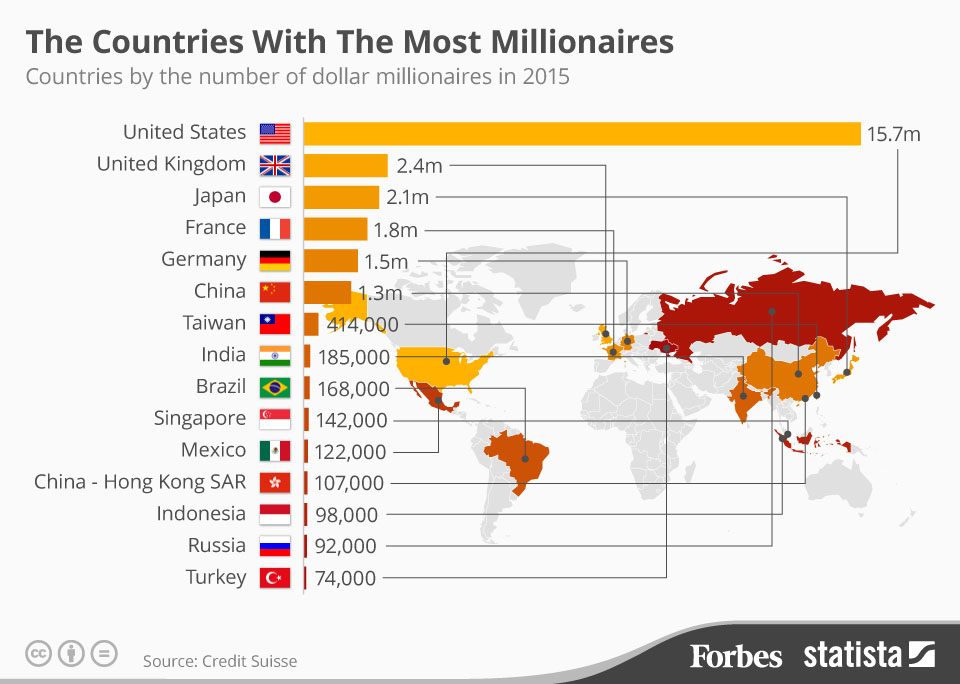
Senator Bernie Sanders is correct when he says that 1% of our citizens control more wealth than the bottom 90%. A new report posted on cnn.com references an English company named Oxfam estimates that the richest 1% will have as much wealth as the other 99% combined by next year. Just Google these words: “does 1% of Americans own 90% of the wealth” and you will find numerous web sites that confirm the Sanders contention. The United States is the overwhelming home of millionaires.

From Forbes Magazine date October 15, 2015

“The United States has the world’s biggest millionaires club by a huge distance. No other country comes even close to matching it. According to Credit Suisse Global Wealth Report, the U.S. was home was home to 41% of the world’s millionaires in 2014, and its share grew by 46% in 2015.”

“Wealth has risen has risen in the U.S. for the seventh year in succession and the U.S. millionaire population now stands at 15/7 million, according to the report. The United Kingdom comes a distant second at 2.4 million, while Japan rounds of top three countries with a population of 2.1 million.”

Countries with the most millionaires

This situation probably explains the ever higher costs of living in NYC, San Francisco, and Los Angeles.

So should we vote for Mr. Sanders based upon these facts? My response: 1) what would he do to change this reality? 2) Is this situation a bad thing?