Paraprosdokians

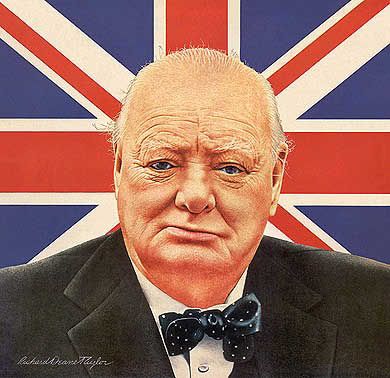
Winston ChurchillWinston Churchill loved paraprosdokians, figures of speech in which the latter part of a sentence or phrase is surprising or unexpected.

1 . Where there’s a will, I want to be in it.

2. The last thing I want to do is hurt you, but it’s still on my list.

3. Since light travels faster than sound, some people appear bright until you hear them speak.

4. If I agreed with you, we’d both be wrong.

5. War does not determine who is right – only who is left.

6. Knowledge is knowing a tomato is a fruit.  Wisdom is not putting it in a fruit salad.

7. They begin the evening news with ‘Good Evening,’ then proceed to tell you why it isn’t.

8. To steal ideas from one person is plagiarism.  To steal from many is research.

9. I thought I wanted a career. Turns out, I just wanted pay checks.

10. In filling out an application, where it says, ‘In case of emergency, notify:’ I put ‘DOCTOR.”

11. I didn’t say it was your fault, I said I was blaming you.

12. Women will never be equal to men until they can walk down the street with a bald head and a beer gut, and still think they are sexy.

13. Behind every successful man is his woman. Behind the fall of a successful man is usually another woman.

14. A clear conscience is the sign of a fuzzy memory.

15. You do not need a parachute to skydive. You only need a parachute to skydive twice.

16. Money can’t buy happiness, but it sure makes misery easier to live with.

17. There’s a fine line between cuddling and holding someone down so they can’t get away.

18. I used to be indecisive. Now I’m not so sure.

19. You’re never too old to learn something stupid.

20. To be sure of hitting the target, shoot first and call whatever you hit the target.

21. Nostalgia isn’t what it used to be.

22. Change is inevitable, except from a vending machine.

23. Going to church doesn’t make you a Christian any more than standing in a garage makes you a car.

Finally:

I’m supposed to respect my elders, but now a days it’s getting harder and harder for me to find one.

Erin Burnett Gives Birth to a Baby Boy

Erin-BurnettA favorite anchor of mine on CNN, Erin Burnett, welcomed her first child – a boy – with husband David Rubulotta on Friday.

“Dave and I welcomed a healthy, happy baby boy at 9:47 p.m. Friday November 29th,” the Erin Burnett OutFront host tells PEOPLE. “He weighed in at 8 lbs., 10 oz.”

The 37-year-old – who married Rubulotta, a managing director at Citigroup, in December – announced that she was expecting in June.

More

US Mutual Defense Treaties

From the Los Angeles Times (abridged)

U.S. bombers defy China restrictions

Two fly through a newly declared (Chinese) air defense zone.

Defense Secre­tary Chuck Hagel reaffirmed the United States’ commitment to the mutual defense treaty with Japan and said the U.S. considered the Senkaku is­lands to fall under that treaty.

Are we to believe that the United States would go to war if the unpopulated Senkaku Is­lands (China calls them the Diaoyu Islands) are attacked?  Would we fight to defend Japan proper if it were attacked over a dispute for control of the unpopulated islands?

An even more important question is will the United States honor the list of mutual defense treaties that have been negotiated, signed, and approved by the United States Senate?  The list is long.

Japan

NATO

  • At present, NATO has 28 members. In 1949, there were 12 founding members of the Alliance: Belgium, Canada, Denmark, France, Iceland, Italy, Luxembourg, the Netherlands, Norway, Portugal, the United Kingdom and the United States. The other member countries are: Greece and Turkey (1952), Germany (1955), Spain (1982), the Czech Republic, Hungary and Poland (1999), Bulgaria, Estonia, Latvia, Lithuania, Romania, Slovakia, Slovenia (2004), and Albania and Croatia (2009).

Philippines

ANZUS military alliance

  • Australia
  • New Zealand

South Korea

Taiwan

So let’s imagine that China decides to take control of Taiwan by force.  Is the United   States prepared to face war with China to defend the freedom of Taiwan?  China seems to be taking an evermore controlling position in the East China Sea and the South China Sea.

Is the United States prepared to confront China?  Apparently the USA did defend its rights this time with a flyover.   If the situation becomes more heated will congress honor America’s commitments?

Enjoying the Stock Market Rise? Now might be the Time to Sell!

Revised December 2, 2013

The marvelous thing about the stock market is you can find someone, an expert, who will say the words you want to hear.  Thus if you believe the stock market will continue to go up there are plenty of stock market advisers who will tell you that the end of the rise is no where in sight.  However, if you are skeptical about the continued rise in stock market shares then you will listen to those who say now is the time to sell.

After all, buy low sell high demands you get out now!  Frankly it looks like a bubble to me.

Economist Caution: Prepare For ‘Massive Wealth Destruction’

Starts with these two paragraphs.

Take immediate steps to protect your wealth . . . NOW!

That’s exactly what many well-respected economists, billionaires, and noted authors are telling you to do — experts such as Marc Faber, Peter Schiff, Donald Trump, and Robert Wiedemer. According to them, we are on the verge of another recession, and this one will be far worse than what we experienced during the last financial crisis.

Most of the above group are known bear market advisers.  How about Oaktree Chairman, Howard Marks?  He has a bundle of funds to manage.  He posted this article on Morningstar.  Not a bear market web site.

The Race is On

. . . there’s a race
to the bottom going on, reflecting a widespread reduction in the level of
prudence on the part of investors and capital providers.  No one can prove at
this point that those who participate will be punished, or that their long-run
performance won’t exceed that of the naysayers.  But that is the usual
pattern.

I know, you want to squeeze every last drop out of the unbelievable rise in the stock market.  After all the S&P 500 is up over 25% this year alone.  The problem is that when it drops, the falls seem to come fast and furious.  Just remember, mutual fund trades occur at the end of the day.  In just one day the market lost 777.68 or 6.98%. That was not in 1929.  That was September 29, 2008.

Oh well that was 2008 you are saying.  That was the start of the Great Recession.  What about the 15% drop in August 2011?  That occurred between August 4 and August 10.

Don’t be greedy!

There is NO PROOF We Can Trust Iran

The agreement with Iran over its right to a nuclear program that is for peaceful purposes must be viewed with significant skepticism.  There should be no agreement without a complete and verifiable elimination of all their facilities that could develop a nuclear weapon.  A new president was selected in Iran and suddenly that country has turned a page and is willingly agreeing with demands of the world.  It is too incredible to be taken seriously.

I don’t have to be an expert on nuclear and missile diplomacy to be suspicious of Iran’s ultimate intent.  I only have to look at the time line of events that ultimately led to a North Korea with the ability to shoot nuclear armed missiles at the United   States, Japan, South Korea and most of the nations rimming the Pacific Ocean.

Iran is using the North Korean template to further its development of nuclear weapons that will threaten the world.

The Arms Control Association has posted on its web site Chronology of U.S.-North Korean Nuclear and Missile Diplomacy along with some extra details from Wikipedia.

Here are the highlights of the sequence of events dealing with North Korea.

December 12, 1985:North Korea accedes to the nuclear Nonproliferation Treaty (NPT) but does not complete a safeguards agreement with the International Atomic Energy Agency (IAEA). Under Article III of the NPT, North Korea has 18 months to conclude such an arrangement. In coming years, North Korea links adherence to this provision of the treaty to the withdrawal of U.S. nuclear weapons from South Korea.

September 27, 1991: President George Bush announces the unilateral withdrawal of all naval and land-based tactical nuclear weapons deployed abroad. Approximately 100 U.S. nuclear weapons had been based in South Korea. Eight days later, Soviet President Mikhail Gorbachev reciprocates.

January 30, 1992: More than six years after signing the NPT, North Korea concludes a comprehensive safeguards agreement with the IAEA.

February 9, 1993: The IAEA demands special inspections of two sites that are believed to store nuclear waste. The request is based on strong evidence that North Korea has been cheating on its commitments under the NPT. North Korea refuses the IAEA’s request.

Late 1993: The Central Intelligence Agency (CIA) and the Defense Intelligence Agency estimate that North Korea had separated about 12 kilograms of plutonium. This amount is enough for at least one or two nuclear weapons.

January 1994: The director of the CIA estimates that North Korea may have produced one or two nuclear weapons.

June 15, 1994: Former U.S. President Jimmy Carter negotiates a deal with North Korea in which Pyongyang confirms its willingness to “freeze” its nuclear weapons program and resume high-level talks with the United States. Bilateral talks are expected to begin, provided that North Korea allows the IAEA safeguards to remain in place, does not refuel its 5-megawatt nuclear reactor, and does not reprocess any spent nuclear fuel.

October 16, 1996: After detecting North Korean preparations for a test of its medium-range Nodong missile, the United States deploys a reconnaissance ship and aircraft to Japan. Following several meetings in New York between U.S. and North Korean diplomats, the State Department confirms on November 8 that the missile test has been canceled.

July 15, 1998: The bipartisan Rumsfeld Commission concludes that the United States may have “little or no warning” before facing a long-range ballistic missile threat from “rogue states,” such as North Korea and Iran.

September 9, 1999: A U.S. National Intelligence Estimate reports that North Korea will “most likely” develop an ICBM capable of delivering a 200-kilogram warhead to the U.S. mainland by 2015.

January 14, 2005: North Korea says it is willing to restart stalled talks on its nuclear programme, according to the official KCNA news agency. The statement says North Korea “would not stand against the US but respect and treat it as a friend unless the latter slanders the former’s system and interferes in its internal affairs”.

January 24, 2013: The North Korean National Defense Commission announces its intentions to conduct another nuclear test and continue rocket launches.

March 13, 2013: North Korea confirmed it ended the 1953 Korean Armistice Agreement, declaring that North Korea “is not restrained by the North-South declaration on non-aggression” and warned that the next step was an act of “merciless” military retaliation against its enemies.

March 26, 2013: The U.S. again dispatched B-52 bombers from Guam to overfly South Korean territory as part of the ongoing Foal Eagle exercise. These flights were, according to US Department of Defense sources, routine flights intended to demonstrate America’s capability of maintaining a “continuous bomber presence” in the region.

March 30,2013: North Korea declared a ‘state of war’ against South Korea. A North Korean statement promised “stern physical actions” against “any provocative act”. North Korean leader Kim Jong-un declared that rockets were ready to be fired at American bases in the Pacific. This was in response to two nuclear-capable American B-2 stealth bombers flying over the Korean peninsula on March 28.

Majority Should Rule

Although the rule allowing a filibuster in the United States Senate was created in 1789, the first Senate filibuster occurred in 1837.  Clearly the intent is to stop the Senate from conducting its business.  Since 1917, the minority has enjoyed the right to unlimited debate on legislation and nominations until the majority can amass a super-majority. In recent years, that has meant 60 votes.

One senator can impact the wishes of the majority.  It is clearly an undemocratic procedure.

There continues to be a debate about the rights of the minority in a democracy.  It revolves around the argument that even minorities have rights.  While that may have some validity, the opportunity to vote should not be denied.  The results of any election, whether in an elected body or the total electorate should determine a course of action.  Flibusters deny that opportunity.

I celebrate the Senate’s vote (52-48) to change the filibuster rule to change proceedings so that only a simple majority was required to clear the way for a final vote on all appointments except Supreme Court nominations.

In California there are regulations that require a two-thirds majority to change tax laws.  That too is undemocratic.  Thus we have tax laws that are almost impossible to change.

This rule change should not only apply to all senate business, it should apply to all elections and all representative bodies.  “Majority rule” is what democracy is all about.

No Defining Issue

Does Every Vote Count?

Why should I vote?  It’s the favorite question for everyone who fails to vote.  After many non-voters say that no matter who wins nothing changes.

In my own state assembly district there was a special election to replace the assemblyman who now holds a Los Angeles city council seat.  The results separate the Democrat, Now leading, from the Republican by 173 votes. It wasn’t immediately known how many provisional ballots remained to be counted.  So results are not final.  This situation has occurred in a district that has historically been Democratic.

Neither candidate has held elected office.  The candidates had a difficult time defining their differences.  Neither offered a clear message answering the question, why should I vote for you?

Perhaps that is the reason elections are close.  There was no defining issue.

Democrats are Celebrating

The Republican Party seems to be living in another time when White conservative Americans were a majority and their beliefs dominated all others.

Their reference is the world of Richard Nixon, Ronald Reagan, William F. Buckley and Barry Goldwater.

Today is a totally different time.  Large numbers of immigrants from non-White countries along with a more successful Black American society are the growing population.  The population of Hispanics has become equal to the population of Whites in the most heavily populated state in the union.

The Huffington Post reports Former Republican presidential candidate Mitt Romney, speaking more than a year after he lost to President Barack Obama, acknowledged Friday that his campaign failed to attract minority voters.

“The place that my campaign and I fell short was probably in being able to speak openly and effectively to minority populations. We didn’t get as many African-American voters as we should have, didn’t get as many Hispanic voters as we should have,” he said on “CBS This Morning.” “Across the board, we need to do a better job explaining why it is that our policies will lead to higher wages, better health care, better schools.”

Perhaps Mitt Romney does understand the need to change now.  However his comments about the 47% will dog him for the rest of his life.

The Tea Party agenda is in opposition to the changes the GOP needs to make in order to win elections in the multi-cultural society of 2013 and beyond.

Democrats are celebrating.