Status of Same Sex Marriage in the United States

My opinion: If two people love each other they should be permitted to marry.  There should not be any exceptions no matter where they live.

The U.S. 9th Circuit Court of Appeals today cleared the way for gay marriages to resume in California.  CNN reports that Kamala Harris, California’s State Attorney General, is attending two same sex marriage ceremonies in San   Francisco this afternoon.

What is the status of the states on same-sex marriage?  This is a summary posted today by the Associated Press.  The AP calls the laws a hodgepodge of laws.  The Supreme Court is to blame.

CALIFORNIA: The Supreme Court cleared the way for gay marriages to resume in California for the first time since 2008, ruling that sponsors of the state’s voter-approved same-sex marriage ban lack authority to defend it in court. State officials say counties will start issuing marriage licenses once the court finalizes its decision.

 CONNECTICUT: The state Supreme Court legalized same-sex marriage in October 2008; marriages started the next month.

 DELAWARE: A same-sex marriage bill was signed into law in May. A Democratic state senator and her partner will be the first couple in the state to have their civil union converted to marriage when the bill takes effect July 1.

 DISTRICT   OF  COLUMBIA: The D.C. Council approved same-sex marriage in 2009; marriages began in March 2010.

 IOWA: The state Supreme Court legalized same-sex marriage in 2009. Conservative lawmakers have sought to change state law to define marriage as between a man and a woman. Those efforts have failed so far because Democrats controlling the state Senate have blocked any legislation from coming up for a vote. That’s unlikely to change unless the GOP takes control of both chambers in 2014.

MAINE: Voters approved same-sex marriage last November, reversing results of a 2009 referendum that quashed a gay-marriage bill.

 MARYLAND: The Legislature approved same-sex marriage in February 2012; the issue then won voter approval in a referendum last November.

 MASSACHUSETTS: It was the first state to allow same-sex marriage. The state’s Supreme   Judicial Court ordered it legalized in 2003; marriages started in May 2004.

 MINNESOTA: A same-sex marriage bill was signed into law in May. It takes effect Aug. 1.

 NEW   HAMPSHIRE: The Legislature approved same-sex marriage June 2009.

NEW YORK: The Legislature approved same-sex marriage in June 2011.

 RHODE ISLAND: A same-sex marriage bill was signed into law in May. It takes effect Aug. 1.

 VERMONT: The Legislature legalized same-sex marriage in 2009. Earlier, Vermont was the first state to offer civil unions to gay and lesbian couples.

WASHINGTON: The Legislature approved same-sex marriage in February 2012. It then won voter approval in referendum on Nov. 6, 2012.

___

CIVIL UNION STATES:

 COLORADO: Gay-rights advocates were pleased that Colorado lawmakers approved a civil-union law this year that extends marriage-like rights to same-sex couples. But they still plan to push for the full status of marriage. That would entail either a lawsuit or a voter initiative to overturn a gay-marriage ban approved by voters in 2006.

 HAWAII: Lawmakers passed a civil union law in 2011. It’s being challenged in the 9th U.S. Circuit Court of Appeals by two women who want to marry rather than enter into a civil union. Democratic Gov. Neil Abercrombie supports same-sex marriage and says the U.S. Supreme Court rulings bolster his argument that the Constitution requires it.

 ILLNOIS: Lawmakers approved civil unions in 2011, but an effort this year to legalize gay marriage fell short despite a push from Gov. Pat Quinn and Chicago Mayor Rahm Emanuel. The bill’s sponsor, Democratic Rep. Greg Harris, says the Supreme Court rulings improve the chances in the next legislative session. Meanwhile, a right-to-marry lawsuit filed by more than two dozen gay couples is pending.

NEW  JERSEY: Acting under an order from the state Supreme Court, the Legislature legalized civil unions in 2006. However, a pending lawsuit contends that civil unions do not fulfill the court’s mandate that gay couples receive equal treatment. A hearing is scheduled for August. The Democratic-led Legislature passed a bill last to recognize gay marriage, but it was vetoed by Republican Gov. Chris Christie.

___

STATES WITH CONSTITUTIONAL BANS:

 ALABAMA: Voters overwhelming approved a constitutional amendment in 2006 limiting marriage to one-man, one-woman unions. Democratic Rep. Patricia Todd, the only openly gay member of the Legislature, says she and her partner plan to file suit challenging the ban. “The state only moves forward on civil rights issues when forced by the federal courts,” she says.

 ALASKA: Voters approved a ban in 1998. Changing the constitution would require that voters approve a constitutional convention — but they opted not to do so in 2012. The Legislature also could propose a constitutional amendment, but Republicans control both chambers, and there is no apparent rush to act. Alaska’s U.S. senators, Democrat Mark Begich and Republican Lisa Murkowski, support same-sex marriage. But the state’s lone U.S. House member, Republican Don Young, and its GOP governor, Sean Parnell, do not.

 ARIZONA: Gay-rights activists are gathering signatures in hopes of placing a measure on next year’s ballot that would overturn a 2008 ban. Republican Gov. Jan Brewer predicts voters will reject any such effort. One city, Bisbee, recently legalized local-level civil unions for same-sex couples. Tempe and several other cities are considering similar ordinances.

 ARKANSAS: The gay-rights group Arkansans for Equality is asking the state attorney general’s office to approve language for a ballot measure next year that would repeal the 2004 ban on gay marriage. The attorney general must certify the language before the group can begin collecting the 78,133 signatures from registered voters needed to place it on the 2014 ballot.

 COLORADO: As noted above, gay marriage is banned under a constitutional amendment approved by voters in 2006. But Democrats now control the Legislature and passed the bill this year establishing civil unions. Gay-rights supporters are deliberating on how to challenge the ban — it could be through a lawsuit or a voter initiative.

FLORIDA: Voters approved a constitutional amendment banning same-sex marriages in 2008. It would take approval from 60 percent of voters to overturn it if the issue gets on the ballot again. That would require either action by the Legislature — which seems unlikely anytime soon — or a petition drive that would require the signatures of more than 683,000 registered voters.

 GEORGIA: A gay-marriage ban was approved in 2004 with support from 76 percent of the voters. No group has mounted a serious attempt to overturn that prohibition. Most politicians in Georgia publicly embrace positions opposing gay-rights measures, although Atlanta Mayor Kasim Reed announced in December that he supports gay marriage.

 IDAHO: Voters approved a ban in 2006 with 63 percent support. The Republican dominated Legislature is not expected to make any changes in the near future. GOP lawmakers have resisted appeals from gays to amend the Idaho Human Rights Act to include discrimination protections for gays and lesbians in regard to employment and housing.

 KANSAS: Voters overwhelmingly approved a gay-marriage ban in 2005. With conservative Republicans in charge of both the House and Senate, no move to modify or repeal the amendment is expected.

 KENTUCKY: Voters approved a ban in 2004; there’s no serious talk of any imminent challenge. Chris Hartman, director of the Louisville-based Fairness Campaign, said the Supreme Court rulings may add momentum to the push for a state law protecting gays from discrimination in employment, housing and public accommodations.

 LOUISIANA: A ban was approved by voters in 2004 with 78 percent support. Gay rights leaders say they will study the possibility of a challenge, but none is currently foreseen. Meanwhile, they will continue to lobby the Legislature for adoption rights and job protections.

 MICHIGAN: A lawsuit to overturn a 2004 ban on same-sex marriage is pending in federal court. Detroit-area nurses April DeBoer and Jayne Rowse are suing to try to win the right to jointly adopt each other’s children, and a judge suggested the case be stretched to include a challenge to the ban on gay marriage. Separately, gay-rights activists say they will try to get a measure on the ballot in 2016 to overturn the ban.

 MISSISSIPPI: A ban was approved in 2004 with support from 86 percent of the voters, the highest percent among all the voter-approved bans in the U.S. There’s no expectation it will be repealed except under a mandate from Congress or the U.S. Supreme Court.

 MISSOURI: A ban was approved in 2004 with more than 70 percent support; there’s been no effort to repeal it. The state Supreme Court is currently considering a legal challenge to a law that limits survivor benefits for deceased public safety officers to spouses who were in a “marriage between a man and a woman.” The case was brought by the same-sex partner of a former Highway Patrol officer killed by a vehicle while investigating an accident.

MONTANA: Voters approved a ban in 2004; it’s not under immediate threat. But gay-rights advocates believe that parts of the Supreme Court rulings could bolster their arguments in a case seeking domestic partnership recognition. In that lawsuit, gay couples are seeking inheritance, joint tax and other legal benefits.

 NEBRASKA: Voters approved a constitutional gay-marriage ban in 2000. In light of the Supreme Court rulings, gay-rights activists are now looking at ways to challenge it. Doing so would likely require a citizen initiative and another statewide vote, though supporters aren’t ruling out a lawsuit to challenge the amendment in federal court.

NEVADA: Although Nevada is among the 29 states with a constitutional ban, it also has a domestic partnership law providing extensive rights to same-sex couples. Legislators approved a resolution this year aimed at changing the constitution to allow same-sex marriage; it will need a second round of legislative approval in two years before going to a popular vote. Meanwhile, there’s a case pending in federal court challenging the constitutionality of the ban.

NORTH   CAROLINA: The most recent of the nation’s gay-marriage bans was approved by North Carolina voters in May 2012. Gay-rights activists are looking at whether the Supreme Court rulings provide an opening to challenge it.

 NORTH   DAKOTA: A ban was approved by voters in 2004 with 73 percent support. The GOP-dominated Legislature also has voted repeatedly against gay-rights measures, including a bill in the last session to prohibit discrimination based on sexual orientation in housing, public services and the workplace.

 OHIO: Voters approved a ban in November 2004 after an expensive ballot campaign that some analysts say boosted turnout among supporters of Republican President George W. Bush’s re-election in the battleground state. The new Supreme Court rulings fueled the hopes of FreedomOhio, a coalition of gay marriage supporters that’s working to overturn the ban in 2014.

 OKLAHOMA: More than 75 percent of voters approved a gay-marriage ban in 2004. Repealing it would almost certainly have to be done through court challenges, since there appears to be little appetite in the Republican-led Legislature to embrace gay rights. Last session, the House voted 84-0 for a resolution to reaffirm marriage as a union between a man and a woman,

 OREGON: Voters in this relatively liberal state approved a constitutional ban on same-sex marriage in 2004 with 57 percent support. It’s now viewed as perhaps the most likely state to overturn such a ban; gay-rights activists and Democratic politicians are gearing up to place a repeal measure on the 2014 ballot.

SOUTH   CAROLINA: In 2006, 78 percent of voters approved a constitutional ban. Little has changed since then. There were no bills introduced in the Legislature dealing with gay rights in 2013, and legislative leaders don’t expect it to be an issue any time soon.

 SOUTH   DAKOTA: Gay marriage has been banned since the Legislature passed a law in 1996, and the prohibition was strengthened with a constitutional ban approved by voters in 2006. Activists say there are no current plans to ask voters to overturn it.

 TENNESSEE: Voters approved a ban in 2006 with 81 percent support. It appears under no immediate threat.

TEXAS: Voters overwhelmingly approved a ban in 2005; there’s been no organized drive to repeal it. However, gay-rights activism has increased in Texas in recent years, and Houston last year re-elected its openly lesbian mayor.

 UTAH: Three same-sex couples have filed a legal challenge against Utah’s gay-marriage ban, which was approved by voters in 2004. The case had been put on hold pending the Supreme Court rulings.

 VIRGINIA: Voters approved a ban in 2006; it’s unlikely that the Legislature dominated by conservative Republicans would take steps to repeal the ban. Gay-rights supporters haven’t ruled out a lawsuit.

 WISCONSIN: Voters approved a Republican-backed ban in 2006; repealing it would require votes in two consecutive legislative sessions, followed by a statewide referendum. In 2009, with Democrats in control, lawmakers passed statutes creating a domestic partner registry for same-sex couples. That registry is now under legal attack by a conservative group which argues that it violates the gay-marriage ban.

___

OTHER STATES:

 INDIANA: There’s a state law prohibiting same-sex marriage but as yet no constitutional ban. Leaders of the Republican majority in the Legislature hope the Supreme Court rulings will provide motivation to get the ban passed so it can be put before voters in 2014. GOP Gov. Mike Pence says he supports a stronger ban.

 PENNSYLVANIA: It’s the only state in the Northeast that doesn’t extend legal recognition to same-sex couples. An openly gay Democrat, state Rep. Brian Sims, plans to introduce a bill that would legalize same-sex marriage. It may not get far in the GOP-controlled Legislature, but it could be an issue in the 2014 gubernatorial campaign. Incumbent GOP Gov. Tom Corbett opposes gay marriage; the three Democratic challengers support it.

NEW   MEXICO: Its statutes contain no law that specifically prohibits or legalizes same-sex marriage. Democratic Attorney General Gary King’s office released a legal analysis in early June concluding that same-sex marriage is not authorized at this point. But lawyers for two gay men from Santa Fe are trying to expedite a lawsuit seeking a ruling that gay marriage is legal.


You Said What?

According to famenetworth.com Paula Deen’s net worth is $15 Million. So even if she lost all of her television shows and all of her contractual deals with Wal-Mart, Walgreen’s, etc. she does not have to work another day of her life.

However, if she values her reputation she has a long way to retrieve her image.

It appears that some other famous people also have issues that are not quickly repaired. Tiger Woods, Bill Clinton, Eliot Spitzer, Arnold Schwarzenegger and Mel Gibson are five who come to mind.

Of that list only Bill Clinton can be identified as someone who has mostly retrieved his reputation. However, would you leave your daughter in the same room with him?

U.S. Companies with Foreign Ownership

Do you really care?

This item all started when Tesco PLC, a British company, announced it is planning to close its Fresh and Easy convenience markets located in many cities throughout the United   States.  One of the potential buyers is Trader Joe’s.  As it happens Trader Joe’s is owned by another foreign company, ALDI Einkauf GmbH & Co. oHG, a German company.

Everyone wants a piece of the American pie.  Bayer Aspirin is German.  Nestle is a Swiss company selling chocolate to water.  Royal Dutch Shell is the owner of Shell Oil, Philips Lighting (various light bulbs found in Lowe’s and Home Depot) is owned by Koninklijke Philips NV, a Dutch company, and Westfield shopping malls are owned by The Westfield Group an Australian conglomoerate.

Henan Shuanghui Investment & Development Co., China’s largest meat processing enterprise, will now be the parent company of brands like Armour, Farmland and Healthy Ones all thanks to the purchase of Smithfield Ham.

Others:

BEN & JERRY’S Unilever, the British/Dutch   company
GERBER Novartis, Swiss pharmaceutical   company
PURINA Nestle, a Swiss company
ALKA-SELTZER Bayer, a German pharmaceutical   company
JOHN HANCOCK LIFE INSURANCE Manulife Financial, a Canadian   insurance company
IBM THINKPAD Lenovo, a Chinese company
TD AMERITRADE Toronto Dominion Bank, a   Canadian company
BUDWEISER InBev, a   Belgian company


Learn more by reading the packages of the products you buy!

“Taper” and “Sequester” both Wall of Strength?

“Taper” may be easier to define (and spell) than “sequester” but both caused the same headache for financial markets.

“Taper” is the latest buzzword that describes the Federal Reserve’s pledge to gradually drawdown the ultra-loose borrowing conditions fueled by its bond buying (the Fed’s demand drives up bond prices and drives down borrowing rates pinned to those bonds). “Sequester” you’ll remember was the S-word that emerged from federal budget-balancing attempts. It had investors bracing, however briefly, for an expensive and inconvenient government service disruption. Words can be potent once they’ve entered the investing vernacular. We get it. It’s noise that can be hard to tune out. And who wants to turn a deaf ear when our portfolios are at stake? Frankly, the negative use of the word “tapering” has muddled the fact that the Fed is simply readying for actions that most investors have expected for some time—which ironically, are tailored responses to an improving economy.

Stock Market Jitters in 2013

The formidable line here is an uptrend. The S&P 500 closed at an all-time high 1,669.16 on May 21, 2013, up over 130% from its financial-crisis low of 676.53 reached March 9, 2009, but it wasn’t a straight path to that high. From election uncertainty to fiscal-cliff vertigo to rumblings from Europe, and now, intense focus on the Fed–we’ve been here before. Data source: TD Ameritrade/Standard & Poors.

Of course there are no guarantees.  Today panic seems to be in the air.

George Zimmerman has a Jury of Six

July 13, 2013

George Zimmerman found innocent!

Six women were selected yesterday to serve on the Florida jury that will decide if George Zimmerman is guilty of second-degree murder in the shooting death of Trayvon Martin.

I was surprised to learn that the Zimmerman murder trial in Florida consists of only six people on the jury.  I had always believed a jury must consist of 12 people.

From Exploring Constitutional Conflicts I have learned the following:

The Court (Supreme Court) had long taken the position that a jury in a criminal case must have 12 members. In 1898, the Court said, “a jury comprised of 12 persons, neither more or less” was a constitutional requirement. In 1970, in Williams v Florida, they Court reconsidered its earlier statements on jury size in a case that affirmed the conviction of a robber convicted by a six-member Florida jury. The Court noted that the Sixth Amendment says nothing at all about jury size, even though 12 person-juries had been traditionally used in America. The expectation that a jury consists of 12 members dated back to the 1300s, but the Court found that to be a “historical accident.” Concluding that a six-person jury could fulfill the framers’ expectations concerning a jury’s functions just as well as a 12-person jury, the Court rejected its prior words on the subject and held that six-person juries satisfy the requirements of the Sixth and Fourteenth Amendments. Justice Harlan harshly criticized the majority’s reasoning, asking where and how the Court might draw the line on jury size. Would a three-person jury be okay, he wondered?

California does use the 12 person jury.  Criminal cases must have a unanimous verdict.  Civil cases require a nine person majority.  Nowhere does the United States Constitution say that a jury has to consist of 12 people.

For thousands of years, though, civilizations have given great mystical prominence to an even dozen. The 12 days of Christmas. The 12 hours on the clock. The 12 tribes of Israel. Twelve months of the year, 12 houses of an astrological chart. A baker’s dozen.

And 12 jurors. That’s the tradition and the law in most states. An ancient Welsh king, Morgan of Gla-Morgan, who established trial by jury in A.D. 725, is said to have declared, “For as Christ and his 12 apostles were finally to judge the world, so human tribunals should be composed of the king and 12 wise men.”

Convincing six people of anything is defintiely easier than convincing twelve.  It seems to me that erring on the side of a person is innocent until proven guilty the Supreme Court would have upheld the 12 person requirement.

City Mismanagement

Chicago, IL

In 1950, Chicago’s population peaked at about 3.6 million people. Since then, the city has lost nearly 1 million residents. Corruption, government bureaucracy, high taxes and a lack of a significant wealth-generating industry have all been cited as factors.

The city’s fastest growing industry is Business Products & Services according to a study conducted by city government.  Seaton Companies, a headhunter firm is their largest fast growing company.  While head hunting companies do create jobs, the numbers would be small compared to the more likely industries like finance and manufacturing.

P1000968

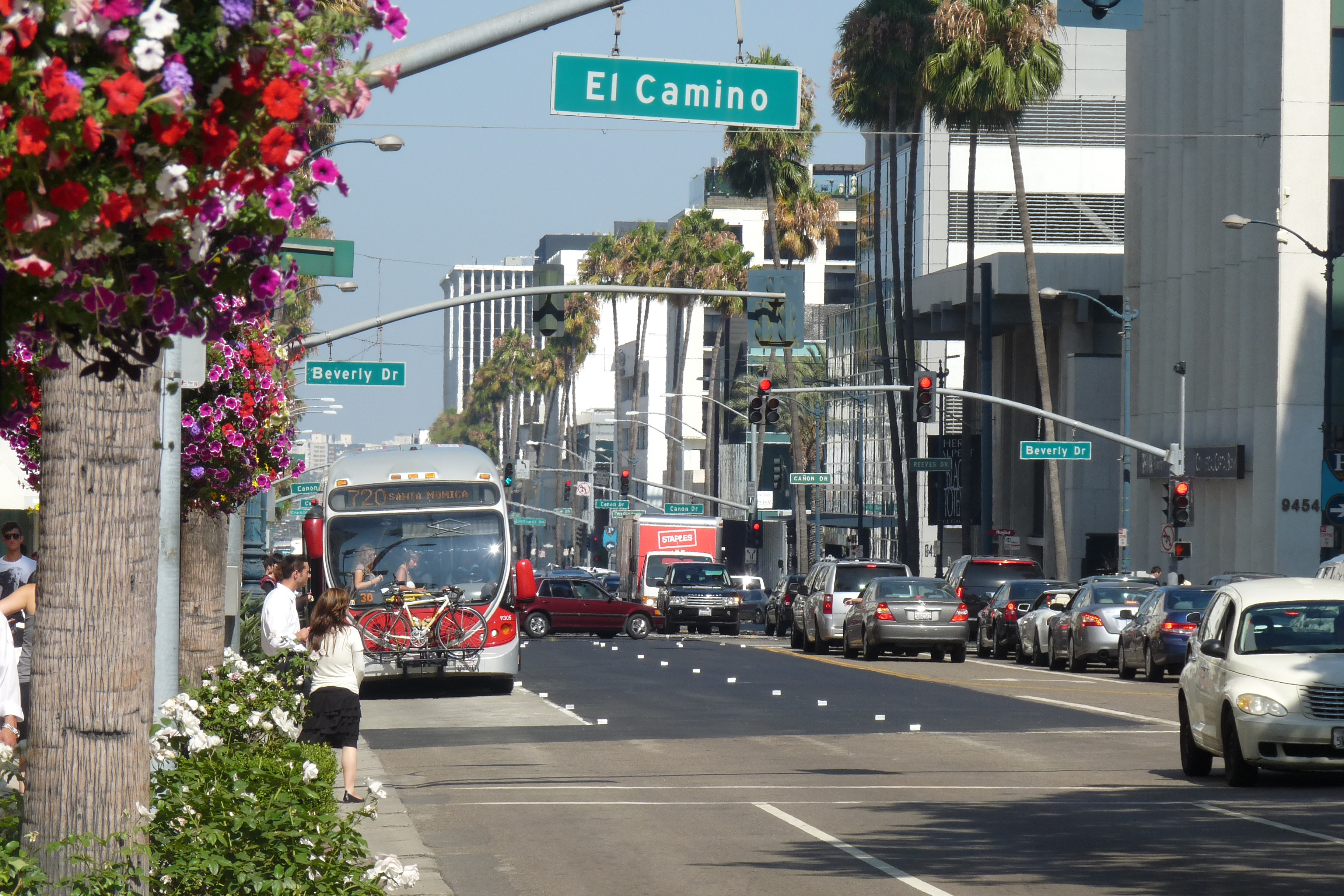
 On Wilshire Blvd. Beverly Hills – Panasonic DMC FZ28, f/5.6, 1/500 sec., ISO 100, hand held 

Los   Angeles seems to be taking a page from the Chicago playbook.  Added taxes, added fines, and potential lost jobs are the consequence of surrendering to environmentalists.  The latest decision by the Los Angeles city council is to ban plastic shopping bags at all stores and require stores to charge 10¢ for every paper shopping bag.   

The Los Angeles County unemployment rate is 9.3%.  To drive that number even higher the city council should consider new taxes at restaurants, hotels, and amusement parks.  The reason would be we need more money to clean the streets or hire more police.

Of course this makes no sense.  But who said City Hall is sensible?

There is the issue.  The city councils of Chicago, Los Angeles, and many other cities are responding to pressure groups rather than doing the right thing.  Of course they say they are doing the right thing.  With high unemployment in Los Angeles and a falling population in Chicago, are they doing the right things?

The Joy of Sarah Palin

Sarah_Palin

Former GOP vice presidential candidate Sarah Palin is rejoining Fox News.  It’s a time to rejoice for liberal commentators.

The crew over at MSNBC has been in a funk.  After all their major targets for ridicule have been Michele Bachmann and Sarah Palin.  The mockery has been well deserved.

Bachmann is famous for her accusations.  She suggested that the HPV vaccine known as Gardasil had caused mental retardation in the child of one of her supporters. After a swift public outcry, Bachmann cautioned that she was not a doctor but still stood by her story.  The there was the time that Bachmann told Chris Matthews on “Hardball” that the media should probe Congress for “anti-America” views.

Then there were the Katie Couric (when Couric was the CBS Evening News anchor) interviews with Sarah Palin.  They were not meant to be disrespectful and the questions were what most would consider “softball.”

Couric asked Palin her opinion on the emergency economic bailout the Bush administration was proposing:

COURIC: Why isn’t it better, Governor Palin, to spend $700 billion helping middle-class families, who are struggling with healthcare, housing, gas and groceries, allow them to spend more and put more money into the economy instead of helping these big financial institutions that played a role in creating this mess?

PALIN: That’s why I say, I, like every American I’m speaking with, we’re ill about this position that we have been put in where it is the tax payers looking to bail out, but ultimately, what the bailout does is help those who are concerned about the healthcare reform that is needed to help shore up our economy, helping tho— it’s got to be all about job creation too, shoring up our economy, and putting it back on the right track, so healthcare reform and reducing taxes and reining in spending has got to accompany tax reductions and tax relief for Americans. And trade, we’ve got to see trade as opportunity, not as— competitive— scary thing, but one in five jobs being created in the trade sector today, we’ve got to look at that as more opportunity. All those things under the umbrella of job creation. This bailout is a part of that.

In another segment aired on September 30, 2008, Couric asked Palin about her taste in periodicals:

COURIC: And when it comes to establishing your world view, I was curious, what newspapers and magazines did you regularly read before you were tapped for this — to stay informed and to understand the world?

PALIN: I’ve read most of them again with a great appreciation for the press, for the media, coming f—

COURIC: But like which ones specifically? I’m curious that you—

PALIN: Um, all of ’em, any of ’em that, um, have, have been in front of me over all these years. Um, I have a va—

COURIC: Can you name a few?

PALIN: I have a vast variety of sources where we get our news too. Alaska isn’t a foreign country, where, it’s kind of suggested and it seems like, ‘Wow, how could you keep in touch with what the rest of Washington, D.C. may be thinking and doing when you live up there in Alaska?’ Believe me, Alaska is like a microcosm of America.

And who could forget Palin’s comment that the difference between a hockey mom and a Pit Bull? Lipstick. You can put lipstick on a pig, but it’s still a pig.

Chris Matthews can hardly wait for Palin’s return to Fox News.

Clean Tap Water Fails to Reach Faucets Nationwide

June 17, 2013:  The Los Angeles Times has caught up with KPCC and the New York Times in today’s from page article titled “Funding to improve drinking water has come at a slow drip.”  What will it take to motivate California government?

KPCC, an NPR station in Los Angeles,  had an item this past Friday about Springfield California that does not have drinkable water.  Nitrates from fertilizer have poisoned the well that is the source of their piped water.  The residences of the community must drive five miles to buy bottled water.  The people are all too poor to move from the community.  The community is unincorporated and does not qualify for any grant programs.

Springfield lies along a single dusty road near Watsonville in Monterey County. Strawberry fields surround the road. The town is so small you cannot find it on a map. In the middle of one of those fields is the source of the community’s frustration.

Upon research I have learned that this situation is not at all uncommon throughout the nation.

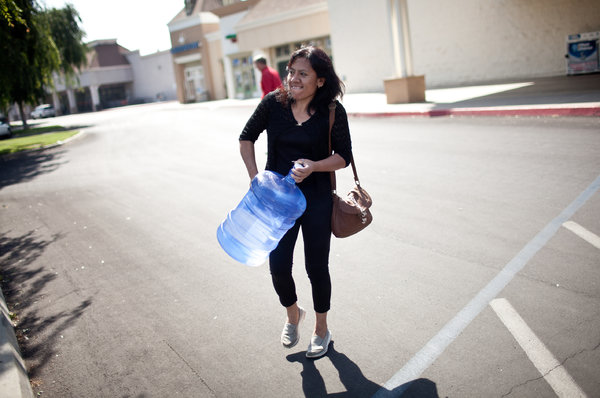
Laura Garcia in Monson CA carries a water bottle

Laura Garcia, whose well water is laced with excessive nitrates, had to use bottled water until the recent installation of a filtration system in her sink.

MONSON, Calif. — I did find it on the map north of Visalia California.  Laura Garcia was halfway through the breakfast dishes when the spigot went dry. The small white tank beneath the sink that purified her undrinkable water had run out. Still, as annoying as that was, it was an improvement over the days before Ms. Garcia got her water filter, when she had to do her dishes using water from five-gallon containers she bought at a local store.

Environmental Protection Agency distributes funds to state agencies that are supposed to identify problems and underwrite solutions. By the E.P.A.’s calculations, no state has been as inept in distributing the money as California.

According to Jared Blumenfeld, the regional administrator of the E.P.A., nearly a quarter of all small water systems in California are in the Central Valley.  To fix the problems, however, requires access to engineering and financial management resources beyond the reach of the needy communities, Mr. Blumenfeld said. “We require the state to be sure the people they fund have managerial, financial and administrative capacity to deal” with their water issues.

Meanwhile there are people retiring in California from government jobs with annual pensions of more than $100K.

Additional source for this article from the New York Times.

Does the Federal Government know too much about you?

June 10, 2013 news report:

“Orwell’s ‘1984’ Soars on Amazon After NSA Surveillance Reports”

The 4th Amendment to the Constitution says:

“The right of the people to be secure in their persons, houses, papers, and effects, against unreasonable searches and seizures, shall not be violated, and no warrants shall issue, but upon probable cause, supported by oath or affirmation, and particularly describing the place to be searched, and the persons or things to be seized.”

Despite those words the NSA (National Security Agency) has  programs that monitors who is talking, texting and e-mailing  to whom.  The programs are both domestic and international.  The NSA has used FISA court approvals that give their investigations legitimacy.

Senate Intelligence Committee lead members Dianne Feinstein and Mike Rogers both say that the NSA is acting legally and both contend that their have been real benefits to the agency’s actions.

CNN pointed out one example. This was also reported in the New York Magazine and on CBS News.  The email monitoring program called PRISM stopped Najibullah Zazi from blowing up backpacks in the New York City subway.  The CNN report showed the email where Zazi sent an email asking for instructions on bomb building.  He included his phone number in the email.

When I applied for Social Security my monthly payout was increased by $100 because I am married.  The Social Security worker not only named my wife, she gave me her birth date.  I merely confirmed the information.

Writing me a check for $10,000 or more?  The banks are required to report those transactions to the Treasury Department.

Try not filing your income tax form one year and see if anyone notices.

It’s all in the name of security.  To put it another way, has Orwell’s “1984” finally arrived?

The Reasoning of Corporate Executives

jeep-cherokee-fireA fatal fire involving a 1999 Jeep Grand Cherokee that was struck by a pick-up truck, according to NHTSA

It is always a wonder to me how the reasoning of corporate executives works.  Those brilliant minds seem to ignore the obvious so many times.

An outstanding example was the decision by Sav-on Drugs in Los Angeles (a retail chain of drug stores) to change their name to Osco.  The new name was mistake because “Osco” having the same pronunciation as the Spanish word “asco” (oss-ko) which means “nausea” or “disgust”, a considerable factor within southern California’s heavily Hispanic market.  After spending millions of dollars on those new signs (Osco Drugs) they spent more millions changing the name back to Sav-on Drugs. 

Then there was the issue of auto safety.  Toyota Camry’s were reported to accelerate even as the drivers were applying the brakes.  Toyota’s sterling reputation was seriously damaged.  Consumer’s Reports removed their recommendation to buy that car and warned their subscribers that the car was not safe.  Stories about lax quality abounded.  Camry sales plummeted.  Apparently Toyota has overcome the issue after a massive recall.  It most definitely impacted my decision in purchasing a new car in 2012.  We bought a Nissan Altima.

So why is Chrysler saying “No” to NHTSA when asked to recall their 1993 to 2004 Jeep Grand Cherokees and 2002 to 2007 Jeep Libertys?  What could be Chrysler reasoning?  After all, they have finally seen a rebound in their sales.  Is it worth saying “No” to NHTSA?  Chrysler’s cars are still poorly rated by Consumers Reports but the public has been supportive of their brands.  Why chance another sales nose dive?