Amid all the noise, an eerie hush is spreading across America. Companies, scientific researchers and Trump critics are clamming up as the MAGA movement ushers in a new era of government censorship.
On Day 1, President Donald Trump signed an executive order titled “Restoring Freedom of Speech and Ending Federal Censorship.” This might have sounded like banal lip service, reaffirming commitment to the First Amendment. In reality, it was the start of an Orwellian effort to root out wrongthink from government ranks and the private sector.
CBS says it will turn over an unedited transcript of its October interview with Kamala Harris to the Federal Communications Commission, part of President Donald Trump’s ongoing fight with the network over how it handled a story about his opponent.
President Donald Trump’s newly appointed chairman of the Federal Communications Commission has ordered an investigation into NPR and PBS over their alleged “airing of commercials,” and suggested that the public broadcasters could be at risk of losing their federal funding.
Last week, the administration ordered a blackout on public communications from government health agencies — in the middle of flu season.
For the first time since 1952, the Centers for Disease Control and Prevention withheld its weekly report on morbidity and mortality data updates.
Other federal departments, such as the Energy Department, were also ordered to cease public communications unless they had explicit approval of the acting secretary.
The president and his allies have also leaned on private firms to disavow politically incorrect values. For example, a group of 19 Republican state attorneys general sent a letter to Costco demanding the retailer drop its diversity commitments, citing a Trump executive order.
Other Trump allies have engaged in speech- and thought-policing, the kinds of actions for which they once condemned progressives (sometimes rightfully!). Last week, for instance, Rep. Dan Crenshaw (R-Texas) obliquely threatened Apple’s CEO for not yet renaming the Gulf of Mexico as the Trump-blessed “Gulf of America” in Apple Maps. (Google Maps has caved, however.)
Washington Post’s “Democracy Dies in Darkness” is heading for the trash can.
It is rare when someone holding public attention stands up for their views even though they may suffer economic impact. Jim Acosta is one of those people.
The ripple effect of Jeff Bezos’s decision to block The Washington Post from endorsing a presidential candidate continues to reverberate through the newspaper, as a tidal wave of readers cancel their subscriptions and nearly one-third of the Post’s editorial board stepped down in protest. Pulitzer prize winner Ann Telnaes had drawn a cartoon of the paper’s owner kneeling before Donald Trump.
Veteran journalists Robert Greene and Karin Klein announced their resignations at the Los Angeles Times a day after the editorial page editor Mariel Garza left in protest.
"Don't give into the Lies"
As today marks Jim Acosta’s @acosta final day with @cnn after 18 years I speak on behalf of millions and millions of people here in the U.S. and worldwide who thank you for being amongst the very, very best in the business and setting the gold standard… pic.twitter.com/jEZiRBPY9C
First they came for the Communists And I did not speak out Because I was not a Communist Then they came for the Socialists And I did not speak out Because I was not a Socialist Then they came for the trade unionists And I did not speak out Because I was not a trade unionist Then they came for the Jews And I did not speak out Because I was not a Jew Then they came for me And there was no one left To speak out for me
BREAKING: Democratic star Congressman Jamie Raskin delivers a show-stopping takedown of Donald Trump’s lawless mass pardon of violent January 6th insurrectionists.
This is exactly what all of us are thinking right now…
“The chairman began by saying that the point here is to restore the rule of law… restore the rule of law… Can you even pretend to do that if you stand by and support Donald Trump who on day one — as the chairman of the committee just said — day one of his presidency, pardoned fifteen hundred insurrectionists including hundreds of people who violently assaulted and attacked American police officers?” said Raskin during a hearing of the Judiciary Committee’s Subcommittee on Immigration Integrity, Security, and Enforcement.
“Let’s just take one person who is free today, Julian Khater, who had been convicted after having every due process protection, the right to counsel, the right to cross-examine witnesses, the right to introduce evidence, but they had him completely,” said Raskin.
“They knew exactly what happened. Most of this was videotaped so the whole world could see it,” he continued. “Well, Julian Khater repeatedly violently assaulted our officer protecting us in Congress, Officer Brian Sicknick, who then proceeded to have several strokes and died on January the 7th, 2021, the next day.”
“The family of Officer Sicknick is absolutely devastated and demolished by what’s just happened,” Raskin went on. “I invite any of my colleagues, including the members new to this committee who maybe weren’t here on January 6th and didn’t experience the trauma of that violent insurrection when we saw a mob marauding through here yelling ‘Hang Mike Pence! Hang Mike Pence!’ and looking to assassinate Nancy Pelosi.”
“And now you have the temerity to come forward and say this is about public safety? How much safer are we now with these fifteen hundred criminals at large in Washington D.C. and going out into the country?” asked Raskin.
“Are you vouching that these people are not going to be attacking any other police officers?” he added. “Are you vouching that they’re no longer a threat to public safety? What an outrage! What a scandal!”
The truth is that there is no defending Trump’s pardons on anything other than purely partisan grounds. He released these criminals because they support him. He doesn’t care that they attacked police officers. He doesn’t care that they might do it again. All that matters is that they’re in his MAGA cult.
While I hate comparing anyone’s behavior to Adolph Hitler, this article, while long, should be a cautionary warning to those celebrating the election of Donald Trump.
This article appeared in The Atlantic Monthly
How Hitler Dismantled a Democracy in 53 Days
by Timothy W. Ryback
Ninety-two years ago this month, on Monday morning, January 30, 1933, Adolf Hitler was appointed the 15th chancellor of the Weimar Republic. In one of the most astonishing political transformations in the history of democracy, Hitler set about destroying a constitutional republic through constitutional means. What follows is a step-by-step account of how Hitler systematically disabled and then dismantled his country’s democratic structures and processes in less than two months’ time—specifically, one month, three weeks, two days, eight hours, and 40 minutes. The minutes, as we will see, mattered.
Hans Frank served as Hitler’s private attorney and chief legal strategist in the early years of the Nazi movement. While later awaiting execution at Nuremberg for his complicity in Nazi atrocities, Frank commented on his client’s uncanny capacity for sensing “the potential weakness inherent in every formal form of law” and then ruthlessly exploiting that weakness. Following his failed Beer Hall Putsch of November 1923, Hitler had renounced trying to overthrow the Weimar Republic by violent means but not his commitment to destroying the country’s democratic system, a determination he reiterated in a Legalitätseid—“legality oath”—before the Constitutional Court in September 1930. Invoking Article 1 of the Weimar constitution, which stated that the government was an expression of the will of the people, Hitler informed the court that once he had achieved power through legal means, he intended to mold the government as he saw fit. It was an astonishingly brazen statement.
“So, through constitutional means?” the presiding judge asked.
“Jawohl!” Hitler replied.
By January 1933, the fallibilities of the Weimar Republic—whose 181-article constitution framed the structures and processes for its 18 federated states—were as obvious as they were abundant. Having spent a decade in opposition politics, Hitler knew firsthand how easily an ambitious political agenda could be scuttled. He had been co-opting or crushing right-wing competitors and paralyzing legislative processes for years, and for the previous eight months, he had played obstructionist politics, helping to bring down three chancellors and twice forcing the president to dissolve the Reichstag and call for new elections.
When he became chancellor himself, Hitler wanted to prevent others from doing unto him what he had done unto them. Though the vote share of his National Socialist party had been rising—in the election of September 1930, following the 1929 market crash, they had increased their representation in the Reichstag almost ninefold, from 12 delegates to 107, and in the July 1932 elections, they had more than doubled their mandate to 230 seats—they were still far from a majority. Their seats amounted to only 37 percent of the legislative body, and the larger right-wing coalition that the Nazi Party was a part of controlled barely 51 percent of the Reichstag, but Hitler believed that he should exercise absolute power: “37 percent represents 75 percent of 51 percent,” he argued to one American reporter, by which he meant that possessing the relative majority of a simple majority was enough to grant him absolute authority. But he knew that in a multiparty political system, with shifting coalitions, his political calculus was not so simple. He believed that an Ermächtigungsgesetz (“empowering law”) was crucial to his political survival. But passing such a law—which would dismantle the separation of powers, grant Hitler’s executive branch the authority to make laws without parliamentary approval, and allow Hitler to rule by decree, bypassing democratic institutions and the constitution—required the support of a two-thirds majority in the fractious Reichstag.
The process proved to be even more challenging than anticipated. Hitler found his dictatorial intentions getting thwarted within his first six hours as chancellor. At 11:30 that Monday morning, he swore an oath to uphold the constitution, then went across the street to the Hotel Kaiserhof for lunch, then returned to the Reich Chancellery for a group photo of the “Hitler Cabinet,” which was followed by his first formal meeting with his nine ministers at precisely 5 o’clock.
Hitler opened the meeting by boasting that millions of Germans had welcomed his chancellorship with “jubilation,” then outlined his plans for expunging key government officials and filling their positions with loyalists. At this point he turned to his main agenda item: the empowering law that, he argued, would give him the time (four years, according to the stipulations laid out in the draft of the law) and the authority necessary to make good on his campaign promises to revive the economy, reduce unemployment, increase military spending, withdraw from international treaty obligations, purge the country of foreigners he claimed were “poisoning” the blood of the nation, and exact revenge on political opponents. “Heads will roll in the sand,” Hitler had vowed at one rally.
But given that Social Democrats and Communists collectively commanded 221 seats, or roughly 38 percent, of the 584-seat Reichstag, the two-thirds vote Hitler needed was a mathematical impossibility. “Now if one were to ban the Communist Party and annul their votes,” Hitler proposed, “it would be possible to reach a Reichstag majority.”
The problem, Hitler continued, was that this would almost certainly precipitate a national strike by the 6 million German Communists, which could, in turn, lead to a collapse of the country’s economy. Alternatively, Reichstag percentages could be rebalanced by holding new elections. “What represents a greater danger to the economy?” Hitler asked. “The uncertainties and concerns associated with new elections or a general strike?” Calling for new elections, he concluded, was the safer path.
Economic Minister Alfred Hugenberg disagreed. Ultimately, Hugenberg argued, if one wanted to achieve a two-thirds Reichstag majority, there was no way of getting around banning the Communist Party. Of course, Hugenberg had his own self-interested reasons for opposing new Reichstag elections: In the previous election, Hugenberg had siphoned 14 seats from Hitler’s National Socialists to his own party, the German Nationalists, making Hugenberg an indispensable partner in Hitler’s current coalition government. New elections threatened to lose his party seats and diminish his power.
When Hitler wondered whether the army could be used to crush any public unrest, Defense Minister Werner von Blomberg dismissed the idea out of hand, observing “that a soldier was trained to see an external enemy as his only potential opponent.” As a career officer, Blomberg could not imagine German soldiers being ordered to shoot German citizens on German streets in defense of Hitler’s (or any other German) government.
Hitler had campaigned on the promise of draining the “parliamentarian swamp”—den parlamentarischen Sumpf—only to find himself now foundering in a quagmire of partisan politics and banging up against constitutional guardrails. He responded as he invariably did when confronted with dissenting opinions or inconvenient truths: He ignored them and doubled down.
The next day, Hitler announced new Reichstag elections, to be held in early March, and issued a memorandum to his party leaders. “After a thirteen-year struggle the National Socialist movement has succeeded in breaking through into the government, but the struggle to win the German nation is only beginning,” Hitler proclaimed, and then added venomously: “The National Socialist party knows that the new government is not a National Socialist government, even though it is conscious that it bears the name of its leader, Adolf Hitler.” He was declaring war on his own government.
We have come to perceive Hitler’s appointment as chancellor as part of an inexorable rise to power, an impression resting on generations of postwar scholarship, much of which has necessarily marginalized or disregarded alternatives to the standard narrative of the Nazi seizure of power (Machtergreifung) with its political and social persecutions, its assertion of totalitarian rule (Gleichschaltung) and subsequent aggressions that led to the Second World War and the nightmare of the Holocaust. In researching and writing this piece, I intentionally ignored these ultimate outcomes and instead traced events as they unfolded in real time with their attendant uncertainties and misguided assessments. A case in point: The January 31, 1933, New York Times story on Hitler’s appointment as chancellor was headlined “Hitler Puts Aside Aim to Be Dictator.”
In the late 1980s, as a graduate student at Harvard, where I served as a teaching fellow in a course on Weimar and Nazi Germany, I used to cite a postwar observation, made by Hans Frank in Nuremberg, that underscored the tenuous nature of Hitler’s political career. “The Führer was a man who was possible in Germany only at that very moment,” the Nazi legal strategist recalled. “He came at exactly this terrible transitory period when the monarchy had gone and the republic was not yet secure.” Had Hitler’s predecessor in the chancellery, Kurt von Schleicher, remained in office another six months, or had German President Paul von Hindenburg exercised his constitutional powers more judiciously, or had a faction of moderate conservative Reichstag delegates cast their votes differently, then history may well have taken a very different turn. My most recent book, Takeover: Hitler’s Final Rise to Power, ends at the moment the story this essay tells begins. Both Hitler’s ascendancy to chancellor and his smashing of the constitutional guardrails once he got there, I have come to realize, are stories of political contingency rather than historical inevitability.
Hitler’s appointment as chancellor of the country’s first democratic republic came almost as much as a surprise to Hitler as it did to the rest of the country. After a vertiginous three-year political ascent, Hitler had taken a shellacking in the November 1932 elections, shedding 2 million votes and 34 Reichstag seats, almost half of them to Hugenberg’s German Nationalists. By December 1932, Hitler’s movement was bankrupt financially, politically, ideologically. Hitler told several close associates that he was contemplating suicide.
But a series of backroom deals that included the shock weekend dismissal of Chancellor Schleicher in late January 1933 hurtled Hitler into the chancellery. Schleicher would later remember Hitler telling him that “it was astonishing in his life that he was always rescued just when he himself had given up all hope.”
The eleventh-hour appointment came at a steep political price. Hitler had left several of his most loyal lieutenants as political roadkill on this unexpected fast lane to power. Worse, he found himself with a cabinet handpicked by a political enemy, former Chancellor Franz von Papen, whose government Hitler had helped topple and who now served as Hitler’s vice chancellor. Worst of all, Hitler was hostage to Hugenberg, who commanded 51 Reichstag votes along with the power to make or break Hitler’s chancellorship. He nearly broke it.
As President Hindenburg waited to receive Hitler on that Monday morning in January 1933, Hugenberg clashed with Hitler over the issue of new Reichstag elections. Hugenberg’s position: “Nein! Nein! Nein!” While Hitler and Hugenberg argued in the foyer outside the president’s office, Hindenburg, a military hero of World War I who had served as the German president since 1925, grew impatient. According to Otto Meissner, the president’s chief of staff, had the Hitler-Hugenberg squabble lasted another few minutes, Hindenburg would have left. Had this occurred, the awkward coalition cobbled together by Papen in the previous 48 hours would have collapsed. There would have been no Hitler chancellorship, no Third Reich.
In the event, Hitler was given a paltry two cabinet posts to fill—and none of the most important ones pertaining to the economy, foreign policy, or the military. Hitler chose Wilhelm Frick as minister of the interior and Hermann Göring as minister without portfolio. But with his unerring instinct for detecting the weaknesses in structures and processes, Hitler put his two ministers to work targeting the Weimar Republic’s key democratic pillars: free speech, due process, public referendum, and states’ rights.
Frick had responsibility over the republic’s federated system, as well as over the country’s electoral system and over the press. Frick was the first minister to reveal the plans of Hitler’s government: “We will present an enabling law to the Reichstag that in accordance with the constitution will dissolve the Reich government,” Frick told the press, explaining that Hitler’s ambitious plans for the country required extreme measures, a position Hitler underscored in his first national radio address on February 1. “The national government will therefore regard it as its first and supreme task to restore to the German people unity of mind and will,” Hitler said. “It will preserve and defend the foundations on which the strength of our nation rests.”
Frick was also charged with suppressing the opposition press and centralizing power in Berlin. While Frick was undermining states’ rights and imposing bans on left-wing newspapers—including the Communist daily The Red Banner and the Social Democratic Forward—Hitler also appointed Göring as acting state interior minister of Prussia, the federated state that represented two-thirds of German territory. Göring was tasked with purging the Prussian state police, the largest security force in the country after the army, and a bastion of Social Democratic sentiment.
Rudolf Diels was the head of Prussia’s political police. One day in early February, Diels was sitting in his office, at 76 Unter den Linden, when Göring knocked at his door and told him in no uncertain terms that it was time to clear house. “I want nothing to do with these scoundrels who are sitting around here in this place,” Göring said.
A Schiesserlass, or “shooting decree,” followed. This permitted the state police to shoot on sight without fearing consequences. “I cannot rely on police to go after the red mob if they have to worry about facing disciplinary action when they are simply doing their job,” Göring explained. He accorded them his personal backing to shoot with impunity. “When they shoot, it is me shooting,” Göring said. “When someone is lying there dead, it is I who shot them.”
Göring also designated the Nazi storm troopers as Hilfspolizei, or “deputy police,” compelling the state to provide the brownshirt thugs with sidearms and empowering them with police authority in their street battles. Diels later noted that this—manipulating the law to serve his ends and legitimizing the violence and excesses of tens of thousands of brownshirts—was a “well-tested Hitler tactic.”
As Hitler scrambled to secure power and crush the opposition, rumors circulated of his government’s imminent demise. One rumor held that Schleicher, the most recently deposed chancellor, was planning a military coup. Another said that Hitler was a puppet of Papen and a backwoods Austrian boy in the unwitting service of German aristocrats. Still others alleged that Hitler was merely a brownshirt strawman for Hugenberg and a conspiracy of industrialists who intended to dismantle worker protections for the sake of higher profits. (The industrialist Otto Wolff was said to have “cashed in” on his financing of Hitler’s movement.) Yet another rumor had it that Hitler was merely managing a placeholder government while President Hindenburg, a monarchist at heart, prepared for the return of the Kaiser.
There was little truth to any of this, but Hitler did have to confront the political reality of making good on his campaign promises to frustrated German voters in advance of the March Reichstag elections. The Red Banner published a list of Hitler’s campaign promises to workers, and the Center Party publicly demanded assurances that Hitler would support the agricultural sector, fight inflation, avoid “financial-political experiments,” and adhere to the Weimar constitution. At the same time, the dismay among right-wing supporters who had applauded Hitler’s earlier demand for dictatorial power and refusal to enter into a coalition was distilled in the pithy observation “No Third Reich, not even 2½.”
On February 18, the center-left newspaper Vossische Zeitung wrote that despite Hitler’s campaign promises and political posturing, nothing had changed for the average German. If anything, things had gotten worse. Hitler’s promise of doubling tariffs on grain imports had gotten tangled in complexities and contractual obligations. Hugenberg informed Hitler during a cabinet meeting that the “catastrophic economic conditions” were threatening the very “existence of the country.” “In the end,” Vossische Zeitung predicted, “the survival of the new government will rely not on words but on the economic conditions.” For all Hitler’s talk of a thousand-year Reich, there was no certainty his government would last the month.
Over the eight months before appointing Hitler as chancellor, Hindenberg had dispatched three others—Heinrich Brüning, Papen, and Schleicher—from the role, exercising his constitutional authority embedded in Article 53. And his disdain for Hitler was common knowledge. The previous August, he had declared publicly that, “for the sake of God, my conscience, and the country,” he would never appoint Hitler as chancellor. Privately, Hindenburg had quipped that if he were to appoint Hitler to any position, it would be as postmaster general, “so he can lick me from behind on my stamps.” In January, Hindenburg finally agreed to appoint Hitler, but with great reluctance—and on the condition that he never be left alone in a room with his new chancellor. By late February, the question on everyone’s mind was, as Forward put it, how much longer would the aging field marshal put up with his Bohemian corporal?
That Forward article appeared on Saturday morning, February 25, under the headline “How Long?” Two days later, on Monday evening, shortly before 9 p.m., the Reichstag erupted in flames, sheafs of fire collapsing the glass dome of the plenary hall and illuminating the night sky over Berlin. Witnesses recall seeing the fire from villages 40 miles away. The image of the seat of German parliamentary democracy going up in flames sent a collective shock across the country. The Communists blamed the National Socialists. The National Socialists blamed the Communists. A 23-year-old Dutch Communist, Marinus van der Lubbe, was caught in flagrante, but the Berlin fire chief, Walter Gempp, who supervised the firefighting operation, saw evidence of potential Nazi involvement.
When Hitler convened his cabinet to discuss the crisis the next morning, he declared that the fire was clearly part of a Communist coup attempt. Göring detailed Communist plans for further arson attacks on public buildings, as well as for the poisoning of public kitchens and the kidnapping of the children and wives of prominent officials. Interior Minister Frick presented a draft decree suspending civil liberties, permitting searches and seizures, and curbing states’ rights during a national emergency.
Papen expressed concern that the proposed draft “could meet with resistance,” especially from “southern states,” by which he meant Bavaria, which was second only to Prussia in size and power. Perhaps, Papen suggested, the proposed measures should be discussed with state governments to assure “an amicable agreement,” otherwise the measures could be seen as the usurpation of states’ rights. Ultimately, only one word was added to suggest contingencies for suspending a state’s rights. Hindenburg signed the decree into law that afternoon.’
Put into effect just a week before the March elections, the emergency decree gave Hitler tremendous power to intimidate—and imprison—the political opposition. The Communist Party was banned (as Hitler had wanted since his first cabinet meeting), and members of the opposition press were arrested, their newspapers shut down. Göring had already been doing this for the past month, but the courts had invariably ordered the release of detained people. With the decree in effect, the courts could not intervene. Thousands of Communists and Social Democrats were rounded up.
On Sunday morning, March 5, one week after the Reichstag fire, German voters went to the polls. “No stranger election has perhaps ever been held in a civilized country,” Frederick Birchall wrote that day in The New York Times. Birchall expressed his dismay at the apparent willingness of Germans to submit to authoritarian rule when they had the opportunity for a democratic alternative. “In any American or Anglo-Saxon community the response would be immediate and overwhelming,” he wrote.
More than 40 million Germans went to the polls, which was more than 2 million more than in any previous election, representing nearly 89 percent of the registered voters—a stunning demonstration of democratic engagement. “Not since the German Reichstag was founded in 1871 has there been such a high voter turnout,” Vossische Zeitung reported. Most of those 2 million new votes went to the Nazis. “The enormous voting reserves almost entirely benefited the National Socialists,” Vossische Zeitung reported.
Although the National Socialists fell short of Hitler’s promised 51 percent, managing only 44 percent of the electorate—despite massive suppression, the Social Democrats lost just a single Reichstag seat—the banning of the Communist Party positioned Hitler to form a coalition with the two-thirds Reichstag majority necessary to pass the empowering law.
The next day, the National Socialists stormed state-government offices across the country. Swastika banners were hung from public buildings. Opposition politicians fled for their lives. Otto Wels, the Social Democratic leader, departed for Switzerland. So did Heinrich Held, the minister-president of Bavaria. Tens of thousands of political opponents were taken into Schutzhaft (“protective custody”), a form of detention in which an individual could be held without cause indefinitely.
Hindenburg remained silent. He did not call his new chancellor to account for the violent public excesses against Communists, Social Democrats, and Jews. He did not exercise his Article 53 powers. Instead, he signed a decree permitting the National Socialists’ swastika banner to be flown beside the national colors. He acceded to Hitler’s request to create a new cabinet position, minister of public enlightenment and propaganda, a role promptly filled by Joseph Goebbels. “What good fortune for all of us to know that this towering old man is with us,” Goebbels wrote of Hindenburg in his diary, “and what a change of fate that we are now moving on the same path together.”
A week later, Hindenburg’s embrace of Hitler was on full public display. He appeared in military regalia in the company of his chancellor, who was wearing a dark suit and long overcoat, at a ceremony in Potsdam. The former field marshal and the Bohemian corporal shook hands. Hitler bowed in putative deference. The “Day of Potsdam” signaled the end of any hope for an Article 53 solution to the Hitler chancellorship.
That same Tuesday, March 21, an Article 48 decree was issued amnestying National Socialists convicted of crimes, including murder, perpetrated “in the battle for national renewal.” Men convicted of treason were now national heroes. The first concentration camp was opened that afternoon, in an old brewery near the town center of Oranienburg, just north of Berlin. The following day, the first group of detainees arrived at another concentration camp, in an abandoned munition plant outside the Bavarian town of Dachau.
Plans for legislation excluding Jews from the legal and medical professions, as well as from government offices, were under way, though Hitler’s promise for the mass deportation of the country’s 100,000 Ostjuden, Jewish immigrants from Eastern Europe, was proving to be more complicated. Many had acquired German citizenship and were gainfully employed. As fear of deportation rose, a run on local banks caused other banks and businesses to panic. Accounts of Jewish depositors were frozen until, as one official explained, “they had settled their obligations with German business men.” Hermann Göring, now president of the newly elected Reichstag, sought to calm matters, assuring Germany’s Jewish citizens that they retained the same “protection of law for person and property” as every other German citizen. He then berated the international community: Foreigners were not to interfere with the domestic affairs of the country. Germany would do with its citizens whatever it deemed appropriate.
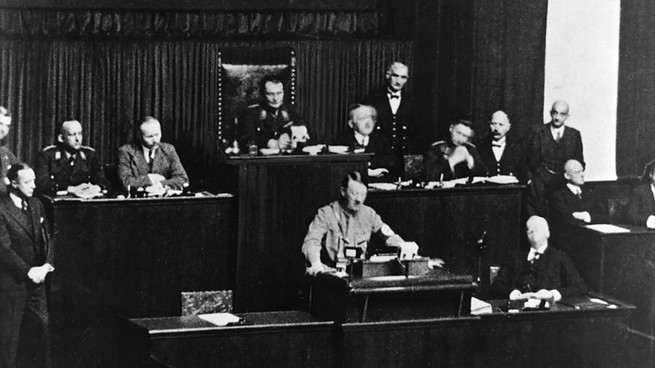
Adolf Hitler’s address to the Reichstag on March 23, 1933, at the Kroll Opera House. On this day, a majority of the delegates voted to eliminate almost all constitutional restraints on Hitler’s government. (Ullstein Bild / Getty)
On Thursday, March 23, the Reichstag delegates assembled in the Kroll Opera House, just opposite the charred ruins of the Reichstag. The following Monday, the traditional Reich eagle had been removed and replaced with an enormous Nazi eagle, dramatically backlit with wings spread wide and a swastika in its talons. Hitler, dressed now in a brown storm trooper uniform with a swastika armband, arrived to pitch his proposed enabling law, now formally titled the “Law to Remedy the Distress of the People and the Reich.” At 4:20 p.m., he stepped up to the podium. Appearing uncharacteristically ill at ease, he shuffled a sheaf of pages before beginning to read haltingly from a prepared text. Only gradually did he assume his usual animated rhetorical style. He enumerated the failings of the Weimar Republic, then outlined his plans for the four-year tenure of his proposed enabling law, which included restoring German dignity and military parity abroad as well as economic and social stability at home. “Treason toward our nation and our people shall in the future be stamped out with ruthless barbarity,” Hitler vowed.
The Reichstag recessed to deliberate on the act. When the delegates reconvened at 6:15 that evening, the floor was given to Otto Wels, the Social Democratic leader, who had returned from his Swiss exile, despite fears for his personal safety, to challenge Hitler in person. As Wels began to speak, Hitler made a move to rise. Papen touched Hitler’s wrist to keep him in check.
“In this historic hour, we German Social Democrats solemnly pledge ourselves to the principles of humanity and justice, of freedom and socialism,” Wels said. He chided Hitler for seeking to undermine the Weimar Republic, and for the hatred and divisiveness he had sowed. Regardless of the evils Hitler intended to visit on the country, Wels declared, the republic’s founding democratic values would endure. “No enabling act gives you the power to destroy ideas that are eternal and indestructible,” he said.
Hitler rose. “The nice theories that you, Herr Delegate, just proclaimed are words that have come a bit too late for world history,” he began. He dismissed allegations that he posed any kind of threat to the German people. He reminded Wels that the Social Democrats had had 13 years to address the issues that really mattered to the German people—employment, stability, dignity. “Where was this battle during the time you had the power in your hand?” Hitler asked. The National Socialist delegates, along with observers in the galleries, cheered. The rest of the delegates remained still. A series of them rose to state both their concerns and positions on the proposed enabling law.
The Centrists, as well as the representatives of the Bavarian People’s Party, said they were willing to vote yes despite reservations “that in normal times could scarcely have been overcome.” Similarly, Reinhold Maier, the leader of the German State Party, expressed concern about what would happen to judicial independence, due process, freedom of the press, and equal rights for all citizens under the law, and stated that he had “serious reservations” about according Hitler dictatorial powers. But then he announced that his party, too, was voting in favor of the law, eliciting laughter from the floor.
Shortly before 8 o’clock that evening, the voting was completed. The 94 Social Democrat delegates who were in attendance cast their votes against the law. (Among the Social Democrats was the former interior minister of Prussia, Carl Severing, who had been arrested earlier in the day as he was about to enter the Reichstag but was released temporarily in order to cast his vote.) The remaining Reichstag delegates, 441 in all, voted in favor of the new law, delivering Hitler a four-fifths majority, more than enough to put the enabling law into effect without amendment or restriction. The next morning, U.S. Ambassador Frederic Sackett sent a telegram to the State Department: “On the basis of this law the Hitler Cabinet can reconstruct the entire system of government as it eliminates practically all constitutional restraints.”
Joseph Goebbels, who was present that day as a National Socialist Reichstag delegate, would later marvel that the National Socialists had succeeded in dismantling a federated constitutional republic entirely through constitutional means. Seven years earlier, in 1926, after being elected to the Reichstag as one of the first 12 National Socialist delegates, Goebbels had been similarly struck: He was surprised to discover that he and these 11 other men (including Hermann Göring and Hans Frank), seated in a single row on the periphery of a plenary hall in their brown uniforms with swastika armbands, had—even as self-declared enemies of the Weimar Republic—been accorded free first-class train travel and subsidized meals, along with the capacity to disrupt, obstruct, and paralyze democratic structures and processes at will. “The big joke on democracy,” he observed, “is that it gives its mortal enemies the means to its own destruction.”
Timothy W. Ryback is a historian and director of the Institute for Historical Justice and Reconciliation in The Hague. He is the author of several books on Hitler’s Germany, most recently Takeover: Hitler’s Final Rise to Power.
We are witnessing the end of freedom of speech in America as Trump has made the press bow to his demands.
CNN’s top boss told his show hosts to show some deference to the most powerful person on earth.
The owners of the Los Angeles Times and the Washington Post have stopped their editorial boards from endorsing Harris. The Times owner, Patrick Soon-Shiong, has taken on the paper’s liberal philosophy and has added known conservatives to its editorial board.
The absolute dictatorship of the United States is going forward. Donald Trump’s family and friends will soon have absolute control. Sadly, the majority of Americans handed the power to make this a reality.
Starting Sunday, most drivers who enter Manhattan south of 60th Street during peak travel times will be charged a $9 fee.
New York’s congestion pricing program will be similar to tolling systems used in London, Stockholm and Singapore to reduce traffic and climate-warming vehicle emissions and to generate revenue. But New York’s program would be the first of its kind in the United States, and it has been the source of at least 10 legal challenges and subjected to repeated delays, most recently by the state’s governor, Kathy Hochul.
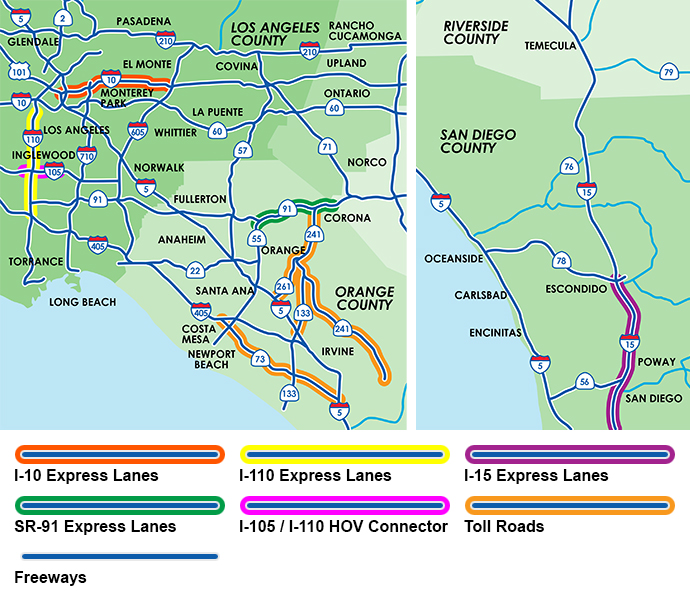
If you have been to any of our largest cities you know that congestion in downtown areas makes driving a nightmare. Downtown Los Angeles traffic is horrifying. Los Angeles freeways provide toll roads to help you avoid the jams.
Metro ExpressLanes are toll roads in Los Angeles County on the I-10 and I-110 freeways. It is a program designed to improve traffic flow and provide enhanced travel options. ExpressLanes provide mobility and offers safe and reliable trip for users. More choices for solo drivers. More rewards for carpoolers. More transit service.
Tolls on the ExpressLanes will be calculated using Congestion Pricing. Congestion pricing provides an opportunity to sell some of the additional capacity on the ExpressLanes to those willing to pay a toll and maximizes efficiency of the entire freeway. It is designed to keep traffic in the ExpressLanes flowing smoothly, resulting in a more reliable travel time. Tolls on the ExpressLanes are based on real-time traffic conditions and vary according to the level of congestion in the ExpressLanes. The toll is higher when there is more traffic in the ExpressLanes, and lower when traffic is lighter.


 Coast Contact