10 Things You Should Know About Social Security

From AARP Money Newsletter

Social Security provides benefits to 55.4 million Americans. Among beneficiaries age 65 and older, 22 percent of married couples and 43 percent of unmarried people rely on Social Security for 90 percent or more of their income. And 54 percent of married couples and 73 percent of unmarried persons in this age group receive 50 percent or more of their income from Social Security.

Sign up for the AARP Money Newsletter.

Is Social Security just for retired workers? No. As of December 2011, 15 percent of beneficiaries were disabled workers; 9 percent were dependents of workers and 11 percent were survivors (such as widows and widowers and children).

At what age can I start collecting Social Security benefits? Workers can begin receiving benefits at age 62, but your benefit will be greater if you wait until your full retirement age (currently 66) or later. Widows, widowers, surviving children, the disabled and children of the disabled can start collecting earlier. Full retirement ages are based on the year of your birth.

How do I sign up for Social Security benefits? Apply for Social Security benefits online, at your local office or by phone at 800-772-1213. To collect your full retirement benefits, apply to the Social Security Administration (SSA) three months before you wish to receive your first payment.

How long do I need to work to become eligible for benefits? If you were born in 1929 or later, you need to work at least 10 years to become eligible for Social Security. The SSA determines eligibility with a system of credits. Basically, you earn up to four credits for every year worked, and you need a total of 40 credits to qualify for Social Security.

Must I stop working to collect Social Security benefits? No, you can receive benefits while working. But, if you are younger than the full retirement age (currently 66) and earn more than a certain amount, your monthly benefits will be temporarily reduced. Once you reach full retirement age, however, your benefits will be increased to make up for what was lost.

If you’re turning 66 in 2012, the amount you can earn without a reduction in benefits is $38,880. If you’re younger than 66 for all of 2012, the amount you can earn without a reduction in benefits is $14,640. After you reach your full retirement age, you keep all of your benefits no matter how much you earn.

What’s the maximum monthly Social Security benefit? For a worker retiring in 2012 at the full retirement age of 66, the highest monthly amount is $2,513. In December 2011, the average monthly Social Security benefit for a retired worker was about $1,229.

Join the Social Security community group.

Can I receive Social Security benefits based on the earnings of a former spouse? Yes, as long as you were married for 10 years and you aren’t remarried. If so, you’re eligible to claim Social Security benefits under your ex-spouse’s earnings if they turn out to be higher than your own.

How can I boost the amount of my Social Security check? Bottom line: The longer you wait to start collecting after you become eligible at 62, the higher the amount you will receive. For each year you delay, your Social Security benefits will increase between 7 percent and 8 percent annually up to age 70, depending on your year of birth. (See for yourself: Try the AARP Social Security Benefits Calculator.)

How should I receive my Social Security payments? Your best bet is to sign up for direct deposit into your bank account. Paper checks can get lost in the mail. The Department of Treasury plans to do away with paper checks altogether by 2013 in favor of direct deposit and debit cards.

When someone dies, how does the Social Security Administration know? The SSA receives reports of beneficiary deaths from family members, funeral homes and other government agencies. You should inform the SSA as soon as possible when a person dies.
Jobs or Political Party – What’s Your Priority?

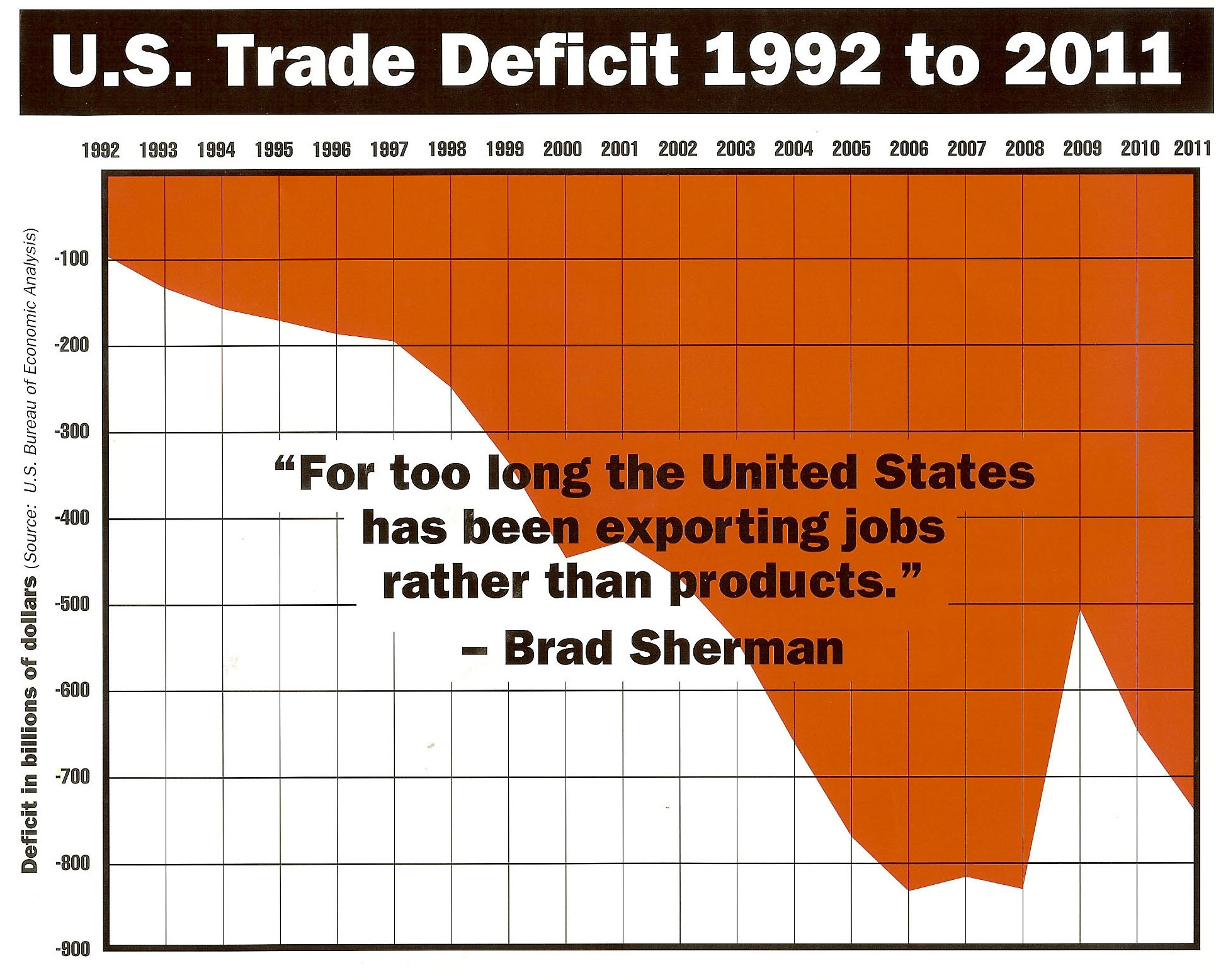
“Huge trade deficits cost millions of jobs, lower wages and place a massive debt burden on future generations.” –Brad   Sherman, United States Congressman

 Democratic Party member are not unified in many ways.  The question of abortion rights is simply the most well known issue.  Gay marriage rights is also another party dividing issue.  However, in this era of job growth, job creation ought to be the focus.  It isn’t.

In my own new California 30th district, redistricting has resulted in two long time Democratic congressman vying for the same seat. Howard Berman versus Brad Sherman.  On most issues they agree. Sherman has taken positions that have been contrary to Democratic Party leadership.  He opposed TARP as it was initially proposed and, I believe, only voted in favor of the final bill when he saw the stock market decline. Sherman has also taken an unusual view of free trade agreements.  He opposes them.

 Brad Sherman opposes NAFTA and CAFTA because they are shipping our jobs overseas.  “For too long the United States has been exporting jobs rather than products.” The latest free trade agreements are with Columbia and South Korea.  His take is supportable when you look at the American trade deficit.  It’s has been at or near the highest level since 2004. The amount has been in excess of $800 Billion Dollars.  This is a number supplied by the U.S. Bureau of Economic Analysis.

His concern for jobs is justified. It’s not just the high unemployment rate.  The employment to population ratio of Americans age 16-54 has barely begun to recover from levels last seen in 1983.  That number was 68.5% in April of this year.  This is a BLS statistic.  Meanwhile Berman is a supporter of free trade agreements.

I have not heard or read any positions taken by Republicans on the issue of free trade.  It should be a deciding factor when voting for a congressman or the president.

Barack Obama’s Failed Recovery

It seems the president’s likeability has remained high even though his success leading the country leaves a lot to be desired.  The number one issue facing him at his inauguration was the growing number of unemployed Americans.

It is accurate to say that the continuing increase in the number of unemployed has been stopped. The worst of the unemployment crises has passed.  However, the number of unemployed Americans has remained basically unchanged.  The apparent improved unemployment picture is the result of people giving up in searching for a job.  Those giving up aren’t counted.  It takes 150,000 new jobs a month to keep up with our growing population.  (The number of new jobs added in April was a horribly disappointing 115,000.)  Once you deduct that leveling number of 150,000 you see that real job growth has been small.

The one significant exception to this situation is the re-employment of people in the manufacture of automobiles.

Every country has something to sell to its own people and the rest of the world.  The United States has one major export, agricultural products.   Brazil has five. Oil, iron ore, soybeans, coffee, and steel. Brazil now holds 45% of the world’s steel production.

Meanwhile the U.S.A.has a $15 trillion economy but only has $1.5 trillion in exports.  Worse we import $2.4 trillion in goods.

Thanks to the ever growing number of free trade agreements most of the things we buy were manufactured in another country.  The auto industry and agricultural products are the only major industries that have not been entirely exported.  Here in Southern California Costco now has a variety of fruits and vegetables imported from Latin America.

Not only are there no plans to change this situation, but Obama has signed free trade agreements with Columbia and South Korea.

Retraining programs for the unemployed?  To do what?

You notice that Barack Obama never talks about the unemployed.  No wonder, his “hope and change” have brought hope there is enough food stamps to buy next week’s food and his change never happened at all unless adding to the federal debt is counted as change.

As bad a Mitt Romney may be is he as bad as four more years of Obama?  Isn’t it time for a change?  Democrats and independents hold your nose.

Mitt Romney Does Not Understand American Life

If you grew up in a poor neighborhood that is the environment you understand.  Likewise if you grew up in a neighborhood of the well to do that is also the world you understand.  I grew up in a very middle class neighborhood and my perceptions are based upon that environment.  I never missed meal and I never went without shoes in that 1250 square foot three bedroom home.

The Associated Press reports: “Mitt Romney says he learns about what it’s like to struggle in a difficult economy by sitting down to chat with regular people. But the Republican presidential candidate doesn’t want anybody to see it — and his campaign won’t say who he meets with or when the meetings occur.”

“Before I begin an event like this, I typically am able to sit down with a few people on an off-the-record kinda basis,” Romney said as he delivered his standard campaign speech Friday in Pittsburgh.

 Mitt Romney’s annual yearly income is over $20 million.  He has off shore accounts to minimize his income tax.  I doubt anyone reading this column has any accounts outside the United States(Unless you live outside the United States).  The Census Bureau says the median household income in the USA from 2006-2010 was $51,914.  Arithmetic Median Definition: Median is the middle value of the given numbers or distribution in their ascending order.

Mitt Romney can hear about the issues of the average American for the rest of his life but he has never had to say “we can’t afford that” or heard your spouse asking if there is enough in the budget to pay for some new curtains or new shoes this month.

Yesterday’s issue for me was getting the lights turned on after an electrical malfunction.  The initial price to do the job right was over $4,000.  The final cost just to get the lights working was $352.  Mr. Romney would have done the $4,000 job.

Mr. Romney’s problem is that he really doesn’t have to face the life of a typical American citizen.  There is no way he can understand. Isn’t he lucky?

Citigroup Stock Holders had Their Say

At Citigroup’s annual meeting, owners of the stock voted 55 to 45 against a $50 million executive pay package, including $15 million for CEO Vikram Pandit.

This is all thanks to the Dodd-Frank financial overhaul law.

Buried in its 2,300 pages is a requirement for public companies to hold “say on pay” votes for executive compensation.

Unfortunately the vote is non-binding (Democrats wanted it to be binding), but the chairman of Citigroup Dick Parsons said he took it seriously, and promised the board would consider it carefully.

Shareholders have every right to be upset with Vikram.

Over the last decade, Citigroup has had the worst stock price performance of the big banks, but consistently had some of the highest executive compensation.

Citi shares are down more than 80% since the financial crisis hit.
They’re down 93% from 2006.

Last year, Pandit got a $1.7 million salary, plus a $5.3 million cash bonus, and he got a $40 million retention package that pays out through 2015.

Getting a bonus should be a piece of cake for these execs, too, since the standard for the payout is an earnings track record half of what it was in 2009 and 2010 when the economy was in the tank.

Whoa! Don’t get too ambitious!

Look, to be fair to Pandit, for 2009 and 2010, he accepted just a buck in salary.

But to be fair to shareholders, Citi’s quarterly dividend is one penny.
Citigroup has announced its first-quarter profit had fallen two percent from a year earlier on a paltry one percent rise in revenue.

The Federal Reserve turned the company down on its request for a share buyback or dividend after Citi flunked the central bank’s stress test in March. And don’t forget the bank was one of many bailed out during the financial crisis.

Some people bridle at anyone earning millions of dollars a year. I am one of them.

If you can grow sales, boost the bottom line, raise the share price, then by all means you’ve earned a fat paycheck.

But what we can’t do is reward mediocrity and failure.

Last year shareholders voted down just two percent of executive pay plans. Maybe this is the start of a new trend.

Read more: http://www.foxbusiness.com/on-air/willis-report/blog/2012/04/18/shareholders-strike-back?link=mktw#ixzz1sXtwnCTx

When You Retire Will the Money be There?

No one cares more about your savings and investments more than you.  You need to become an expert on the kinds of investments that you are comfortable with holding.  Don’t let a financial adviser take control of your funds.  No matter what he/she says, they do not understand your true wishes and needs.  They will not be the one in pain if those savings are lost.

The unpleasant reality is that most of us do not save enough money for our retirement years.  The reason is obvious.  The cost of living takes our paychecks.  It’s not a new situation.  This has been a fact for all of history.  It is the reason that Social Security was created in the 1930s.  That insurance provides sufficient income in retirement years to prevent starvation.  It is only enough to pay for food, housing, and other basic necessities.

The problem is that Social Security has become the only income resource for many retired Americans.  (401(k) plans have not become the outstanding resource that many believed would occur.  The reason is they are not a mandatory savings plan.  It is a voluntary program.  The average balance in all 50 million (401(k) accounts is just over $60,000 according to the Employee Benefit Institute.  Even people within 10 years of retirement have saved an average of only $78,000, and more than a third have less than $25,000.

I still hear financial gurus saying that you should be receiving 10% or more on your savings.  I know such investments do exist but they are not well known.  Those that do pay that level of return are high risk securities that most people are not prepared to take.  Even Vanguard’s High Yield Corporate Bond Fund pays 6.75%.

Even if you savings are small there are magazines you can view in the library and sites that do not charge anything.  My favorite is Morningstar.  You do not have to subscribe to obtain much of their information.

Start today thinking about where your income will come from when that day comes when you want to say “It’s time for me to retire.”

Obama and Romney: Where they stand on the issues

The Associated Press offered a detailed and lengthy run down of where Obama and Romney stand on the issues that we all to consider in the next election. Following is a summary. You can read the detail at http://my.earthlink.net/article/pol?guid=20120430/fe9b4c4c-15ca-43a7-9a4d-2605576b3e73


ABORTION and BIRTH CONTROL:
  

Obama: Supports abortion rights.

Romney: Opposes abortion rights.
  

DEBT:

Obama: Federal spending is estimated at 23.5 percent of gross domestic product this year, up from about 20 percent in previous administration, and is forecast to decline to 21.8 percent by 2016. Calls for tackling the debt with a mix of spending cuts and revenue increases. Central to Obama’s plan is to let Bush-era tax cuts expire for couples making more than $250,000. Debt reduction is based upon a stepped 10 year plan.

Romney: Would cap federal spending at 20 percent of gross domestic product by end of first term. Proposes broad but largely unspecified cuts in federal spending. Among the few details: 10 percent cut in federal workforce, elimination of $1.6 billion in Amtrak subsidies and cuts of $600 million in support for the arts and broadcasting.

ECONOMY:

Obama: Continued implementation of Wall Street and auto industry bailouts begun under George W. Bush. Proposes tax breaks for U.S. manufacturers producing domestically or repatriating jobs from abroad, and tax penalties for U.S. companies outsourcing jobs. Won approval of South Korea, Panama and Colombia free-trade pacts begun under previous administration, completing the biggest round of trade liberalization since the North American Free Trade Agreement and other pacts of that era.

Romney: Lower taxes, less regulation, balanced budget, more trade deals to spur growth. Replace jobless benefits with unemployment savings accounts. Proposes repeal of the (Dodd-Frank) law toughening financial-industry regulations after the meltdown in that sector. Proposes repeal of the (Sarbanes-Oxley) law tightening accounting regulations in response to corporate scandals, and replacing it with less onerous rules to ease the accountability burden on smaller businesses.

EDUCATION:

Obama: Has approved waivers freeing states from the most onerous requirements of the Bush-era No Child Left Behind law with their agreement to improve how they prepare and evaluate students. “Race to the Top” competition has rewarded winning states with billions of dollars for pursuing education policies Obama supports. Won approval for a college tax credit worth up to $10,000 over four years and more money for Pell grants for low-income college students. Wants Congress to agree to reduce federal aid to colleges that go too far in raising tuition.

Romney: Supported the federal accountability standards of No Child Left Behind law. In 2007, said he was wrong earlier in career when he wanted the Education Department shut because he came to see the value of the federal government in “holding down the interests of the teachers’ unions” and putting kids and parents first. Has said the student testing, charter-school incentives and teacher evaluation standards of Obama’s “Race to the Top” competition “make sense” although the federal government should have less control of education.

ENERGY and ENVIRONMENT

Obama: Proposes Congress give oil market regulators more power to control price manipulation by speculators and stiffer fines for doing so. Failed to persuade a Democratic Congress to pass limits he promised on carbon emissions. Shelved plan to toughen health standards on lung-damaging smog. Rejected Keystone XL oil pipeline from Canada but supports fast-track approval of a segment of it. Proposes ending subsidies to oil industry but has failed to persuade Congress to do so.


Romney: Supports opening the Atlantic and Pacific outer continental shelves to drilling, as well as Western lands, the Arctic National Wildlife Refuge and offshore Alaska; and supports exploitation of shale oil deposits. Wants to reduce obstacles to coal, natural gas and nuclear energy development, and accelerate drilling permits in areas where exploration has already been approved for developers with good safety records.


GAY RIGHTS:

Obama: Once opposed federal recognition of same-sex marriage, later said his views were “evolving” and has not taken a position on that since.

Romney: Favors constitutional amendment to ban gay marriage.

HEALTH CARE:

Obama: Achieved landmark legislation and if the Supreme Court upholds the heath care law and its mandate for almost everyone to obtain insurance.

Romney: Promises to work for the repeal of the federal health care law.

IMMIGRATION:

Obama: Failed to deliver on a promised immigration overhaul. . Says he is still committed to it.

Romney: Favors U.S.-Mexico border fence, opposes education benefits to illegal immigrants. Opposes offering legal status to illegal immigrants who attend college, but would do so for those who serve in the armed forces. Proposes more visas for holders of advanced degrees in math, science and engineering who have U.S. job offers, and would award permanent residency to foreign students who graduate from U.S. schools with a degree in those fields.

SOCIAL SECURITY:

Obama: Has not proposed a comprehensive plan to address Social Security’s long-term financial problems.

Romney: Protect the status quo for people 55 and over but, for the next generations of retirees, raise the retirement age for full benefits by one or two years and reduce inflation increases in benefits for wealthier recipients.

TAXES:

Obama: Wants to raise taxes on the wealthy and ensure they pay 30 percent of their income at minimum. Supports extending Bush-era tax cuts for everyone making under $200,000, or $250,000 for couples.

Romney: Drop all tax rates by 20 percent, bringing the top rate, for example, down to 28 percent from 35 percent and the lowest rate to 8 percent instead of 10 percent. Curtail deductions, credits and exemptions for the wealthiest. End Alternative Minimum Tax for individuals, eliminate capital gains tax for families making below $200,000 and cut corporate tax to 25 percent from 35 percent.

TERRORISM:

Obama: Largely carried forward Bush’s key anti-terrorism policies, including detention of suspects at Guantanamo Bay despite promise to close the prison. Also has continued with military commissions instead of civilian courts for detainees and invocation of state secrets privilege in court. Expanded use of unmanned drone strikes against terrorist targets in Pakistan and Yemen.

Romney: No constitutional rights for foreign terrorism suspects. He does not consider waterboarding to be torture.

WAR:

Obama: Declined to repeat the Libya air power commitment for Syrian opposition. Opposes a near-term military strike on Iran, either by the U.S. or by Israel, to sabotage nuclear facilities that could be misused to produce a nuclear weapon. Says the U.S. will never tolerate a nuclear-armed Iran but negotiation and pressure through sanctions are the right way to prevent that outcome. Reserves the right to one day conclude that only a military strike can stop Iran from getting the bomb.


Romney: Has not specified the troop numbers behind his pledge to ensure the “force level necessary to secure our gains and complete our mission successfully” in Afghanistan. Would increase strength of armed forces, including number of troops andwarships, adding almost $100 billion to the Pentagon budget in 2016.

Economy is Job One!

May 4, 2012 Addendum.  The April jobs report confirmed my worst fears.  The U.S. economy added just 115,000 jobs and yet the unemployment rate is down another tenth of a percent to 8.1%.  In other words more people have given up the search.  This is another great day for Mitt  Romney.  Everything I wrote on April 28 remains valid.  The difference  is it has just been reinforced.    

Is the recession over? Not if you are unemployed. Over 12 million Americans are in that status. Most of those people have families that have been impacted. The impact is more likely on three to four times that number. Worse is that the number is not the real number because many more people are no longer counted as unemployed. Most economists add about 50% to the official numbers to reach that real number.

The Obama administration failed to address the primary issue facing the nation. That is the condition of our economy.

Where is the plan to change our course of outsourced jobs? It does not exist.

The latest pieces of economic data support the feeling that the economy is struggling to recover from the Great Recession. New claims for unemployment benefits dropped to 351,000 in the week ending February 11 of this year but have been increasing every week since then with one exception. Gross Domestic Product (GDP) for the first quarter of 2012 grew 2.2% versus a growth of 3% in the last quarter of 2011. The president can’t be held responsible for everything in our economy but there is little he has done or proposed to improve the situation.

 The problem is that Mitt Romney has not enunciated any actions he would take that would change our desperate employment situation. The number of unemployed reached over 14 million people and has now dropped to under 13 million. However the number of long term unemployed has not been significantly reduced and still remains over 5 million people. Obama’s policies did save the country’s auto manufacturers but too many products and services are now provided in other countries.

Americans are the employer of the president. We have the right to expect results. Barack Obama’s four year contract is almost up. Unfortunately the alternate candidate for the job has not told us what he would do to change our economic situation.

Israel’s Nuclear Deception – A Perfect Hoax

Remember the Trojan Horse and the inflatable tanks on the shores of England at the end of WWII. Israel’s nuclear war heads are in the same anthology.

Do a Google search and you will find that there is the perception that Israel has nuclear weapons. France did provide cooperation for some kind of nuclear development in the 1950s. There is a secret facility in a location called Dimona but United States officials have never actually seen what is located there. Apparently no one outside Israel has seen the inner workings of the site. One Googled site speculates “Israel could have thus produced enough plutonium for at least 100 nuclear weapons, but probably not significantly more than 200 weapons.”

However, the next time you read an article quoting an Israeli official or listen to an interview you will notice that they never claim to have any nuclear weapons. I just saw an interview by Erin Burnett of Benjamin Netanyahu and he avoided responding to her inquiries about Israel’s nuclear capabilities. In the April 2, 2012 issue of Time magazine “10 Questions” column the author asks President Simon Peres “Remind me, does Israel have nuclear weapons? ‘Look, Israel doesn’t intend to introduce nuclear weapons, but if people are afraid that we have them, why not? It’s a deterrent. I want to tell you a small story. Amr Moussa was the Foreign Minister of Egypt. One day he came to me and said, ‘Simon, we are such good friends. Take me to Dimona. Let me see what’s going on.’ I said, ‘Amr, are you crazy? I shall take you, and you’ll see there’s nothing there. You’ll stop being frightened, and then I should be out of my job.’ ”

Obviously Israel has perpetuated the perfect hoax. Most Jews even believe it!