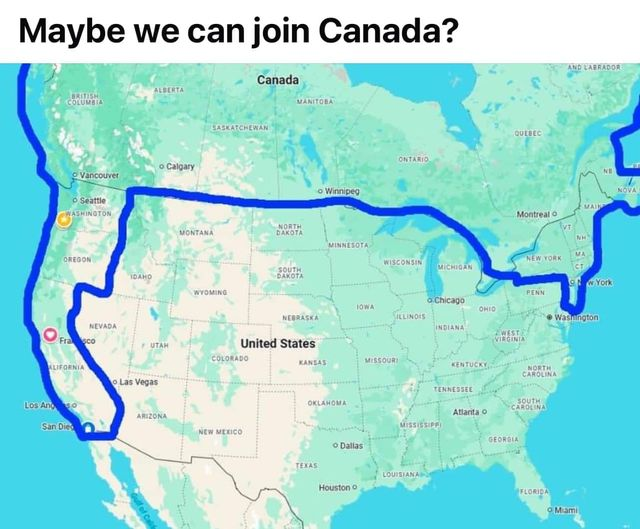
A fun fantasy. Secession was decided in the U.S. Civil War. It can’t be done.
My question is would Canada accept parts of the United States? The only reason would be adding warmer Pacific Coast states.
It’s fun to fantasize.
An Independent view of law, politics and social issues confronting Angelinos, Californians, and Americans
A fun fantasy. Secession was decided in the U.S. Civil War. It can’t be done.
My question is would Canada accept parts of the United States? The only reason would be adding warmer Pacific Coast states.
It’s fun to fantasize.

America fell for gaslighting.
Like so many of you I am gagging.
Nine days before Election Day, Donald Trump delivered his closing argument at a Madison Square Garden rally that drew comparisons to a 1939 pro-Nazi rally in the same arena and characterized by similar anti-democratic themes: demonization of immigrants and political enemies, invocation of strongman leadership, threats of violent retribution, denunciations of the press.
Responding to criticism of this self-evident hate-fest, Trump characterized it as “a lovefest.” He wasn’t just lying. That’s too simple an explanation of how Trump behaves in general, and what he’s doing here. Lying is deceiving people about the state of the world, and Trump routinely does that too. But simply tallying up the lies gives no insight into their purpose. Bulls***ting is deceiving people about one’s motives — using true or false claims indiscriminately — and is a more accurate description of his routine behavior. But calling that rally calls a “lovefest,” is doing something more: That’s gaslighting, an effort to undermine people’s entire sense of reality and impose an invented reality in its place.
Trump was saying, in effect: The hate you saw was really love, and if you can’t see that, you’re the hateful one. It’s the kind of upside-down logic commonly found in abusive relationships, whenever the abuser is challenged. They may lie all the time, but when the chips are down, they gaslight.
“I’m not perfect” = Your expectations I behave like a human being are unreasonable
“I’ve never pretended to be someone I’m not” = You fell in love with me so it’s your fault
“This more than decade old video” = It was a long time ago, why the fuss? You’re so unreasonable.
“These words do not reflect who I am” = The reality you just experienced didn’t actually happen.
“I said it … I apologize” = Get over it already — I said I’m sorry, you’re being hysterical.
I am thinking about leaving before I am deported. Since I was born in Canada and I say “eh” frequently perhaps it’s time to say goodby.
I had a nightmare last night where I dreamed that Donald Trump won the election. Then I woke up and found out and realized it was more than a dream. He won the election 277 to 224 electoral votes.
Even worse the GOP now will have control of both house of Congress. U.S. Senate 42 Democrats 52 Republicans. U.S. House 181 Democrat 201 Republicans
I anticipate that Donald Trump will implement all the things he promised during the campaign. That includes deportation of millions of undocumented people, outrageous tariffs, lowered taxes for corporations and the wealthy, withdrawal from NATO, refusal to aid Ukraine, refusal to aid South Korea, refusal to provide protection for Taiwan, national anti-abortion law, no LGBT protection.
The GESTAPO is coming after you if you resist his directions.
Fed up with U.S. politics, some Californians are making plans to move abroad was a headline in today’s print edition Los Angeles Times. I am in that category.
The editorial board of The New York Times just eviscerated Donald Trump in a single paragraph.
Here it is in full, with its original hyperlinks to other Times’ coverage of Trump preserved:
“You already know Donald Trump. He is unfit to lead. Watch him. Listen to those who know him best. He tried to subvert an election and remains a threat to democracy. He helped overturn Roe, with terrible consequences. Mr. Trump’s corruption and lawlessness go beyond elections: It’s his whole ethos. He lies without limit. If he’s re-elected, the G.O.P. won’t restrain him. Mr. Trump will use the government to go after opponents. He will pursue a cruel policy of mass deportations. He will wreak havoc on the poor, the middle class and employers. Another Trump term will damage the climate, shatter alliances and strengthen autocrats. Americans should demand better. Vote.”
The owners of the Washington Post and the Los Angeles Times fear the retribution of a Trump presidency and refuse to endorse Kamala Harris. The NYT has no fear as it has been owned by the same family for more than 100 years.
Democratic nominee Kamala Harris will be the next president of the United States and beat Republican rival Donald Trump on Election Day, or so historian and election forecaster Allan Lichtman still predicts.
Known for correctly predicted the results of the last nine out of 10 presidential elections, Lichtman said on his YouTube channel Tuesday night that his prediction has not changed, despite Democratic nominee Harris’ leads in battleground states shrinking and polls being nail-bitingly close.
Lichtman has come under fire for his predictions, notably with political pollster Nate Silver last month calling the American University modern history professor’s keys “totally arbitrary” in a post on X.
He emphasized Tuesday the 13 keys he uses to make his predictions have not changed and criticized the prevalence of polling in the media, saying that governing, rather than campaigning, is indicative of who will win the 2024 race for the White House.
“I don’t have a crystal ball, I’m not Speaker Mike Johnson who thinks he has a pipeline to the Almighty, my system is based on history, it’s very robust, but it’s always possible, you can’t know it in advance that that there’d be something so cataclysmic and so unprecedented to break the pattern of history,” Lichtman said, but that “doesn’t mean my prediction is invalidated.”
Lichtman’s son Sam interviewed his father during the 90-minute live video, where the election prognosticator argued that democracy itself is at stake in this year’s White House race.
Before every election, Lichtman said he gets butterflies, but this year is different.
“I have a flock of crows in my stomach,” he said.

by Ruben Bolling


Then-President Donald Trump holds a roundtable with tech executives at the White House in 2017. From left, Apple CEO Tim Cook; Trump; Microsoft CEO Satya Nadella; and then-Amazon CEO Jeff Bezos, who also owns The Washington Post. (Jabin Botsford/The Washington Post)
Many billionaires watching the polls fear that Donald Trump, if elected to a second term as President, will identify them as the “enemy within.”
In a conversation with CNN‘s Jake Tapper on Sunday morning before the Madison Square Garden rally, Trump’s VP running mate J.D. Vance denied that Trump’s “enemy within” rhetoric was referring to the Democratic Party. “He did not say that, Jake,” Vance responded when Tapper asked about Trump’s words. “He said that he was going to send the military after the American people? Show me the quote where he said that.” (During a Fox News town hall earlier this month, Trump specifically pledged to use either the National Guard or the military against “the enemy within,” whom he described as “radical left lunatics.”)
The Democratic Party is not the only “enemy” for Trump. As he’s said many times previously, he also places the press in that camp — a profession whose freedom is protected by the Constitution’s First Amendment, in case Trump needs reminding. While in the midst of calling Harris a liar, saying she lied about working at McDonald’s, without any evidence, and claiming she’s said he doesn’t want fracking, without evidence, he went after the press.
Is it any wonder that Patrick Soon-Shiong, owner of the Los Angeles Times, and Jeff Bezos, owner of the Washington Post, stopped endorsements of Kamala Harris?

What happened to Ronald McDonald? It’s very sad. Well, this was supposed to remain a secret, but yes. You see, Ronald had an affair with the Dairy Queen and Wendy was born. The Burger King was very displeased. I saw him walking near my local McDonald’s and this is what he looked like. Homeless near Roscoe and Topanga in the San Fernando Valley.
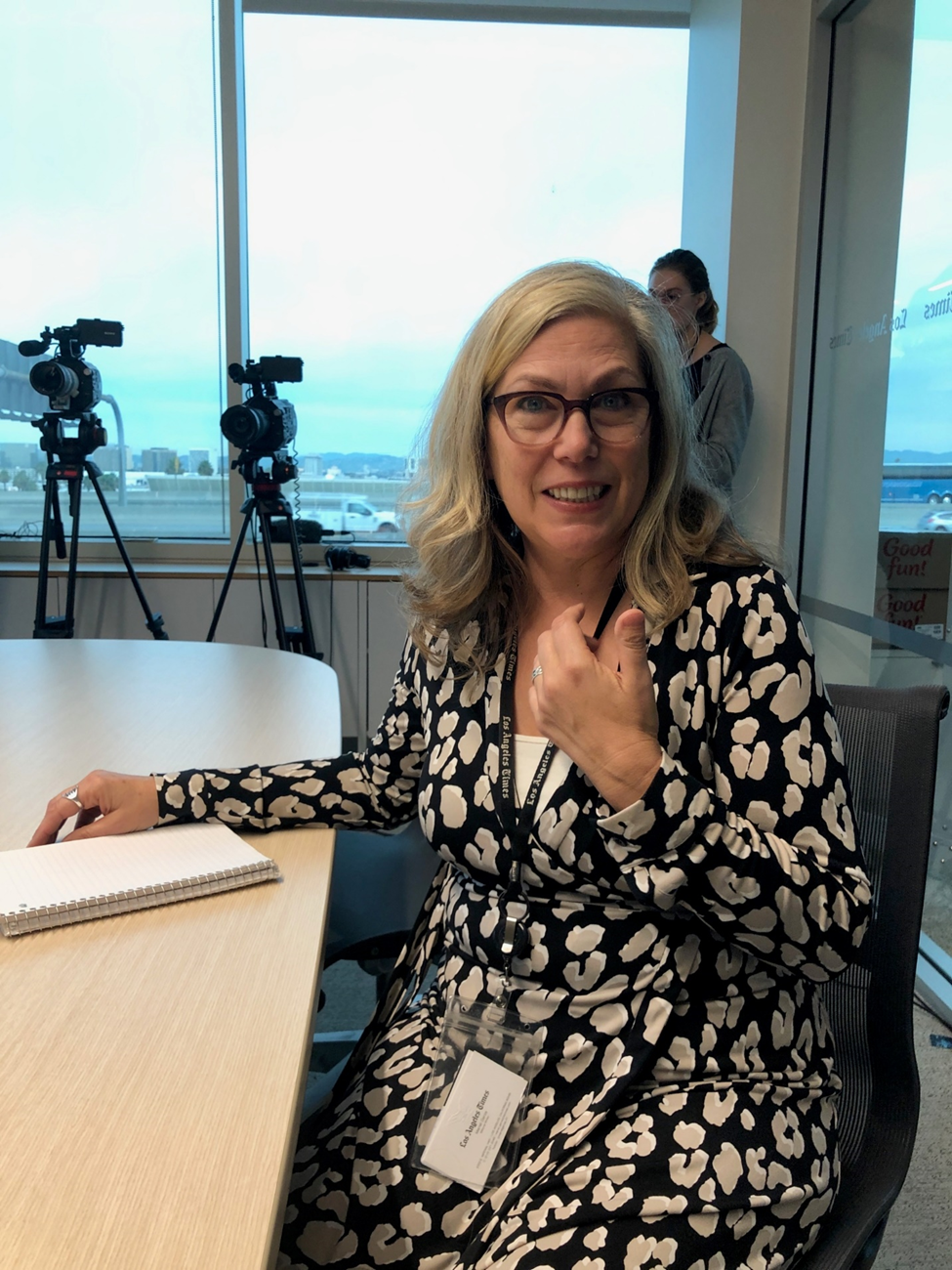
Mariel Garza, the editorials editor of the Los Angeles Times, resigned on Wednesday after the newspaper’s owner blocked the editorial board’s plans to endorse Vice President Kamala Harris for president.
“I am resigning because I want to make it clear that I am not okay with us being silent,” Garza in a conversation with Columbia University School of Journalism. “In dangerous times, honest people need to stand up. This is how I’m standing up.”
Terry Tang is Executive Editor, Los Angeles Times.
Terry,
Ever since Dr. Soon-Shiong vetoed the editorial board’s plan to endorse Kamala Harris for president, I have been struggling with my feelings about the implications of our silence.
I told myself that presidential endorsements don’t really matter; that California was not ever going to vote for Trump; that no one would even notice; that we had written so many “Trump is unfit” editorials that it was as if we had endorsed her.
But the reality hit me like cold water Tuesday when the news rippled out about the decision not to endorse without so much as a comment from the LAT management, and Donald Trump turned it into an anti-Harris rip.
Of course it matters that the largest newspaper in the state—and one of the largest in the nation still—declined to endorse in a race this important. And it matters that we won’t even be straight with people about it.
It makes us look craven and hypocritical, maybe even a bit sexist and racist. How could we spend eight years railing against Trump and the danger his leadership poses to the country and then fail to endorse the perfectly decent Democrat challenger—who we previously endorsed for the US Senate?
The non-endorsement undermines the integrity of the editorial board and every single endorsement we make, down to school board races. People will justifiably wonder if each endorsement was a decision made by a group of journalists after extensive research and discussion, or through decree by the owner.
Seven years ago, the editorial board wrote this in its series about Donald Trump “Our Dishonest President”: “Men and women of conscience can no longer withhold judgment. Trump’s erratic nature and his impulsive, demagogic style endanger us all.”
I still believe that’s true.
In these dangerous times, staying silent isn’t just indifference, it is complicity. I’m standing up by stepping down from the editorial board. Please accept this as my formal resignation, effective immediately.
Mariel
 Coast Contact