View this but be prepared to become ill.
http://irritableliberal.blogspot.com/2011/04/i-have-friends-who-are-black.html

An Independent view of law, politics and social issues confronting Angelinos, Californians, and Americans
View this but be prepared to become ill.
http://irritableliberal.blogspot.com/2011/04/i-have-friends-who-are-black.html
The question was posed by the Los Angeles Daily News.
Here are some of the answers the newspaper printed.
Ten presidents were defeated for re-election including John Adams, Jimmy Carter and George H.W. Bush. Thus we know that even good presidents can be beaten. President Barack Obama did not bring us “change you can believe in.” The problem for the Republicans is that they do not yet have a strong candidate. Look who replaced the three I identified: Thomas Jefferson, Ronald Reagan and Bill Clinton. All three were great leaders. Mediocre or good enough will not bring a win for the GOP.
There is not one Republican candidate qualified to run for president against President Barack Obama, who seems to be going out of his way to cross the aisle to avoid an assassination threat. President Obama will have my vote and be re-elected in 2012, after cleaning up most of the mess left by the Bush/Cheney administration.
I suggest they find a normal, working-class man. A person with brains and common sense, with at least a high school or some college education who can realize that another four years of President Obama will never ever get us out of debt.
.
Other letters supported New Jersey Gov. Chris Christie, Comedy Central’s Stephen Colbert, Herman Cain (he used to be the CEO of Godfather’s Pizza), and former Massachusetts Governor Mitt Romney.
Although there was no supporters for Donald Trump among the letter writers, he is at least the most well-known and certainly one of the smartest people in the GOP. Then again California had Arnold Schwarzenegger as governor and that didn’t turn out too well.
Whether you’re on the other side of the world or wandering your own neighbourhood, you’ll soon realise that the sights that have you reaching for your camera are fleeting photo opportunities.
With this in mind, you really need to be prepared to capture such moments. Here are the six most common mistakes that can leave you with an ordinary image – instead of the masterpiece it should have been.
The very first thing to consider is the subject – what is it and why are you taking a photo of it? Successful images have a point of interest: the key element around which the composition is based. It’s probably the thing that caught your eye in the first place and should be able to draw and holds the viewer’s attention.

Good compositions leave no doubt as to the subject of the photograph. How do you make sure this is clear? A good way to start is to fill the frame with your subject. This helps to eliminate unnecessary or unwanted elements and overcomes the common mistake of making the subject too small and insignificant, which leaves the viewer wondering what the photo is supposed to be of. Often just taking a few steps towards your subject or zooming in slightly will make an enormous difference.

The sharpest part of the image should be the point of interest, so take care when focusing. If something other than the main subject is the sharpest part of the composition the viewer’s eye will rest in the wrong place.
Most compact cameras and all SLRs have a focus-lock facility, activated by depressing the shutter release button halfway, which you should be confident using. It allows you to produce more creative and technically better pictures by locking the focus on the main subject then recomposing without the camera automatically refocusing.

Centering the subject often contributes to a static composition so you should aim to place the point of interest away from the centre of the frame. As you’re thinking about where to place the point of interest, keep in mind the ‘rule of thirds’ that has traditionally been the starting point for successful composition. As you look through your viewfinder or study the LCD screen, imagine two vertical and two horizontal lines spaced evenly, creating a grid of nine rectangular boxes.
Try placing the point of interest, or other important elements, on or near the points where the lines intersect. For example, if you’re taking a portrait, the subject is the person’s face and the point of interest would be their eyes. In a landscape the point of interest may be a boat floating on a lake; place the boat on one of the intersections and also position the horizon near one of the horizontal lines.

Avoid including other elements that conflict with the main subject. Look at the space around and behind your subject and make sure nothing overpowers it in colour, shape or size. What you leave out of the frame is just as important as what you leave in.
Do you really want power lines running across the facade of the most beautiful building in the city? It’s fine if you do, but not if you didn’t notice them in the first place! Scan the frame before pressing the shutter release, looking for distractions and unnecessary elements.

The direction of the light and how it is illuminating your subject, whether it’s the natural light of the sun, incandescent lighting indoors or at night or flashlight, can make or break a photograph. That’s why it’s vital to observe the light. If you are aware that it’s striking your subject in the wrong place – for example, if the facade of a beautiful monument is in shade, or if someone’s hat is casting a shadow over half their face – then you can take action.
Either move the subject, move yourself or, if the subject isn’t going to disappear, wait a while or return at the appropriate time of day. Once you’re in the habit of considering how the light is falling on your subject you can select a viewpoint and time of day so that the light enhances your subject, rather than detracts from it.
Happy photographing!
What a shame that a certifiable nut job like Glenn Beck understands the difference between Israelis and Arabs but many “normal” people don’t. It proves my off-stated view that even crazy people have something valuable to say.
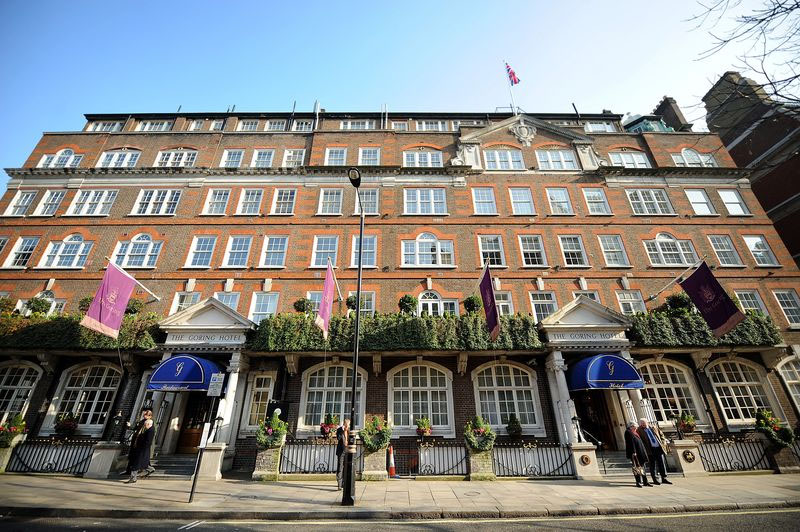 The Goring Hotel, a few blocks from Buckingham Palace, is where Kate Middleton will spend the night before the wedding. Rooms at the posh hotel go for $315-$2,600 (U.S./Canadian) a night. (Ben Stansall/AFP/Getty Images)
More details have emerged about the royal wedding day, right down to the minute.
To start with, it’s revealed that Kate Middleton will be spending her final night of single-dom at the Goring Hotel, nearby Buckingham Palace. (Don’t bother looking … it’s fully booked for April 28). It’s reported that the bride-to-be, her sister Pippa and mom Carole will be staying in a five-room suite, complete with a four-poster bed and a grand piano,
From the moment Kate awakens (if she even gets any sleep), everything is on the clock. Here’s how the day will break down. (These are London times. For Eastern times, subtract five hours: Western times subtract eight hours):
– The Princess Royal and Vice Admiral Timothy Laurence
– The Duke of York
– Princess Eugenie of York
– Princess Beatrice of York
– The Earl and Countess of Wessex
This report taken from the Toronto Star.

Author: Rabbi Dov Fischer
The great tragedy within contemporary Zionism is that Zionist leadership and articulators operate on a continuum of defensiveness, always reacting to the latest attack on Israel’s legitimacy. This “reactive defensive Zionism” is the same whether we look at Jewish organizations, Jewish political figures, or even at college Jewish activists. Zionists always “play defense.”
Defense certainly is an important part of a winning strategy. The best hockey and soccer teams still need to field a goalie. Football teams need a defensive squad, and baseball strategy includes defending against a bunt, pulling an infield-in, and over-shifting towards right field when a left-handed hitter comes to bat. Even so, no team ever wins if it fails to score. And teams well ahead of their opponents see their leads disappear when they excessively shift into a “prevent defense mode” that concedes offense exclusively to the opposition.
We who follow spectator or competitive sports understand this philosophy so clearly – the primacy of offense – yet abandon this simplest of survival principles when Israel’s survival is on the line. Thus, we wait for others to call Israel “racist,” and then we respond that she is not. They speak of an “Apartheid wall” being constructed along Judea and Samaria, and we reply that the wall is not separatist but protective. They accuse Israel of starving out the citizens of Gaza, and we counter with photographs of shopping malls in Gaza and with statistics of food supplies that pass into Gaza through Israel.
They accuse Israel of human rights violations, and we respond that Israel is humane. They say that land belongs to “Palestinians,” and we present compromise: “Let us have a two-state solution.” They propose boycott, divestment, and sanctions (BDS), and we produce reasons not to boycott Israel, not to divest from holdings in Israel, not to sanction Israel.
Seventy years ago, Sid Luckman was the most prominent Jew in American football. A star quarterback for the Chicago Bears, he once brought his immigrant parents to a game to watch him. With Luckman masterfully at the helm, the Bears won handily. After the game, he proudly asked his parents what they thought of his performance. Even though he successfully had scrambled away from defensive front-linemen and had a wonderful passing game that day, his parents responded: “Sidney, you know those men would not try to keep hurting you all day if you would just give them the ball.”
It is time for Zionists to stop giving them the ball.
We need to initiate the discussion, not to react. We need to be creative in our presentation, not predictably defensive. We need to capture the imagination by shifting dynamically, as Sid Luckman did on the field, into a T-formation with men in motion.
It is time to start a nationwide campus movement to boycott, divest, and sanction Arab racist regimes like Saudi Arabia. It is true that they manufacture virtually nothing useful, so we have to find that one thing besides oil, and start a BDS campaign on campuses throughout America. We need petitions on campuses, calling attention to racism – particularly against Black people – in the Arab world, gender discrimination, religious intolerance. We need to promote boycotts of travel to any Arab country that mistreats Christians and that burns churches. We need to promote sanctions against the destruction of churches throughout the Arab world. We need to go on the offensive and let people know how bad that world’s racism, misogyny, religious hatred, and bigotry extends.
We need to start bringing Ethiopian Jews from Israel to American campuses and to African-American communities to tell them their stories. Israel is the only country on the face of the earth – in all of recorded human history – that ever expended national resources including risked lives and material resources for the exclusive purpose of bringing Black people from Africa into their country to join the landed classes in freedom. Others have taken Blacks out of Africa for slavery. No one but Israel ever brought Black Africans into their country to join them in freedom.
We need to expend extra breaths and use eight syllables to say “Judea and Samaria” even though we prefer the two-syllabic “West Bank.” We have to stop saying “West Bank.” We have been taught to say “African American” instead of “Negro,” “Native American” instead of “Indian,” “Mizz” instead of “Missus,” “Gay” instead of “Homosexual,” and “Latino” instead of “Hispanic.” It is time to teach others to say “Judea and Samaria.” As the Left so well demonstrates, language is powerful. If we fear that the listener will not understand us when we say “Judea and Samaria,” then we must expend extra breaths each time we use the term, just as we do when we give an address to a telephone marketer when we order a product and need to repeat the spelling of our street.
On the “refugee question,” similarly, we have to go beyond playing defense. If there are refugees, then there were 800,000 Jewish refugees who lost everything when the Arab world drove them out but held their property in the 1940s. Today they number in the many millions. So, if the 400,000 or 500,000 Arabs who left Israel during that period, mostly voluntarily, now number in the millions of “refugees,” it is time to demand justice for our more-millions of refugees. Demand hearings in Washington on restoration of property and reparations for Jewish refugees. Then, with the issue explained and the public educated, demand freezes on Arab governmental assets in America for transfer to American families among the Edot HaMizrach to compensate and restore refugee property – just as we have been doing for Holocaust victims who today are recovering damages for stolen N azi-era property, for unpaid wages during their enslavement, and for insurance benefits they were owed after having paid their premiums in Europe during the years of the Holocaust.
And demand a complete end to all American funding for the UNRWA, the United Nations agency that promotes anti-Jewish hatred throughout Gaza and in Judea and Samaria by acceding to the myth of “Palestinian refugees in Palestine.” We are so accustomed to playing defense that we never even ask: “How in the world can people who were not alive in the 1940s be called ‘refugees’ from somewhere they never fled? And even if they were ‘refugees,’ how can they still be deemed as ‘refugees’ now that they are living in their supposed homeland?” When people “return home,” the idea is that they no longer are “refugees.” At that point, the UNRWA needed to close down in Gaza, in Jenin, and elsewhere – and America needs to stop funding it. In today’s economic environment, there will be many in Washington who will be delighted to see this aspect of an offensive approach to Zionism once they are educated to this incredible anomaly.
We need to go on the offensive and start pointing at the logos of the Arab groups: the Hamas, the P.L.O., Fatah. Each and every of their logo designs bears depictions of their aspired-to homeland. None of those logos depicts Gaza or Judea and Samaria. Rather, they all depict pre-1967 Israel. Similarly, we need to start pointedly asking: What do the Arabs even mean by “Palestine”? When they founded the Palestine Libration Organization in 1964, to liberate Palestine, what area were they liberating? Not Gaza, then in Egyptian hands. Not Judea and Samaria, then under Jordanian occupation. We need to point to the logo – a picture is worth a thousand words – and to 1964, and we need to start advertising those pictures and explaining what 1964 means.
A movie will be coming out on April 15, 2011 that will introduce many people to a simple libertarian question: “Who is John Galt?” Wait and see. It is time to ask – on T-shirts, at soirees, even at the beginning of every speech at every Young Israel dinner: “What did they want to liberate in 1964?”
In the last half century, perhaps the only issue on which an Israeli Government has stood firm in the Great Debate was last year when the Netanyahu Government finally refused to blink any longer on one issue: refusing abjectly to continue any further construction freeze in Jerusalem for a second round. For once – literally, once – Israel finally said: “We will not freeze construction in Jerusalem not even after Hell, Michigan freezes over.” And, remarkably, the American Administration backed down.
That is what happens when your cause is just, and you do not give them the ball. For those who hate us and find Zionism offensive, maybe it is time that we Zionists finally went on the offensive.
Rabbi Dov Fischer, a member of the Rabbinical Council of California and former national vice president of the Zionist Organization of America, is adjunct professor of Law at Loyola Law School. He is author of “General Sharon’s War Against Time Magazine.” A former chief articles editor of UCLA Law Review, he now is the rabbi at Young Israel of Orange County.
From Kaiser Permanente “partners in health e-newsletter”
Every year, about 790,000 people in the U.S. have a stroke, according to the National Stroke Association. While stroke can affect anyone, African Americans are more impacted by stroke than any other group in the American population.
Strokes can occur suddenly, but if you know the symptoms and how to respond, you can help limit long-term damage. The faster you get medical attention, the better your chances of recovery.
If you suddenly experience these six signs of stroke — or see them in a friend — call 911 right away.
Even if you have one of these symptoms and it goes away, you should see your doctor. It may be a warning that a stroke may happen soon.
You can help decrease your risk of stroke by making a few important lifestyle changes:
The president’s (read the transcript here> debt reduction speech was both good and bad. He told us he would stand up to the Republicans and refuse to sign legislation that would end Medicare. He told us that slightly higher taxes for the very wealthy would not harm them or the country and he was correct. Then he wandered into a wilderness that included “the Vice President will begin regular meetings with leaders in both parties with the aim of reaching a final agreement on a plan to reduce the deficit by the end of June.”
What happened to the National Commission on Fiscal Responsibility and Reform (also called Bowles-Simpson). That was a Presidential Commission created in 2010 by President Barack Obama to identify “…policies to improve the fiscal situation in the medium term and to achieve fiscal sustainability over the long run.” The commission first met on April 27, 2010. A report was released on December 1, 2010, but failed a vote on December 3 with 11 of 18 votes in favor, with a supermajority of 14 votes needed to formally endorse the blueprint.
Do we really need another group to study the issues? At the very least Bowles-Simpson was headed by two highly respected former government leaders. It’s not that Joe Biden is not respected but he is the current Democratic Vice President.
If the Joe Biden committee delivers real reform by reaching compromise with Republicans than the effort will be worthwhile but is that likely? Not in the present environment.
The ultimate hypocrisy!
We all think of General Electric as the all American company. That company has provided Americans with everything electric from vacuum cleaners to radios and television sets. We still have a 13” color television in the kitchen that won’t die. The company was started by Thomas Edison. Remember President Ronald Reagan was a television spokesperson for GE bef ore he entered politics.
That is all changed now. The company has a reported 287,000 employees around the world. It has expanded to manufacturing jet engines for aircraft to building nuclear electrical generating facilities. After the tsunami in Japan it became public that the six reactors in the Fukushima I Nuclear Power Plant had been designed by General Electric.
Big American companies that we all thought were loyal Americans have rapidly shifted their workforces abroad. Calling Time Warner for aid with my Wi-Fi system I learned that the nice lady helping me was located in Manila, Philippines. She had perfect English.
When did offshoring become so prevalent? The trend began in earnest in the late 1970s at large manufacturers such as General Electric. GE’s then CEO, Jack Welch, who was widely respected by other corporate chieftains, argued that public corporations owe their primary allegiance to stockholders not employees. Therefore, Welch said, companies should seek to lower costs and maximize profits by moving operations wherever is cheapest. “Ideally,” Welch said, “you’d have every plant you own on a barge to move with currencies and changes in the economy.” Not only did GE offshore much of its manufacturing, so did its parts suppliers, which were instructed at GE-orchestrated “supplier migration seminars” to “migrate or be out of business.”
President Obama Picks Jeffrey Immelt, GE CEO, To Run New Jobs-Focused Panel . And you thought that Barack Obama was for the American people.
While general words of encouragement are appreciated those comments that are not specific to the subject will not be approved.

