Film legend Elizabeth Taylor dies at age 79


DAVID GERMAIN
From Associated Press

March 23, 2011 11:30 AM EDT

LOS ANGELES (AP) — Elizabeth Taylor, the violet-eyed film goddess whose sultry screen persona, stormy personal life and enduring fame and glamour made her one of the last of the old-fashioned movie stars and a template for the modern celebrity, died Wednesday at age 79.

Read this well written biography here.

America Lacks a Policy to Address Dictators

Kings and other leaders of Arab nations are seeing uprisings. The people in  those countries want to be rid of corruption and obtain a piece of the growing world-wide prosperity.  President  Obama wants Mumar Gadhafi of Libya “to go” but the real issue is the leaders of Syria, Saudi Arabia, Bahrain, Qatar, and Yemen.  Those leaders are firing on their civilian populations.  How does the President square his “no fly zone” and “Gadhafi must go” words with the shootings in other Arab nations?

The problem is there is no policy on dealing with dictators and tyrants where ever they are.  Regardless of their assumed titles these potentates believe they have the right to rule and it appears they are prepared to kill their own citizens to sustain their power.

Even talk show hosts friendly to the president cannot explain America’s policy regarding dictators.  I fear the United States is headed towards some very difficult times.

March 23, 2011

Two well written columns on the Libyan/Middle Eastern  adventures of the United States.

Robert Scheer on the West’s Attack on Libya
“Be Consistent—Invade Saudi Arabia“

William Pfaff on Libya and the West
“The Libyan Question: Now What?“

Less Competition is Great for Business


The stock market shot up early on Monday March 21. Trading up by 1.5%.  The reason?  AT&T is buying T-Mobile.  The consequence of this planned purchase is that there will now be just three national cell phone carriers.  It’s a great benefit for the carriers.  With less competition the cost of services will most assuredly increase.  That means more profit for AT&T Sprint, and Verizon.  The consolidation must be approved by the Department of Justice (DOJ) and Federal Communications Commission (FCC).  Who doubts this won’t be approved?  The losers will be the public.

There is no justification for this proposed buy-out.  Both AT&T and T-Mobile are profitable companies.  The fact that AT&T service is poor is not a societal concern.  What ought to be a concern is the likely impact of reduced competition.

 David Lazarus of the Los Angeles Times wrote about this same issue in the March 21, 2011 edition.

This is not the first time there has been an attack on competition.  Compared to just ten years ago there are fewer banks, department stores, drug stores, and supermarkets now then existed then.  Here in Los Angeles there are just four major banks to serve a population of 10 million people.  They are Bank of America, Wells Fargo, Chase, and Citibank.  Other banking companies in the city are significantly smaller.

There is no Teddy Roosevelt alive today.  This trend will not change if the public remains quiet.

Like Congestion? California is the Place for You

Newsweek published this Daily Beast survey that was no surprise to me.  The list of the top 10 cities with the most congested roads.  I live in Los Angeles so none of this is news.  Actually between U.S. 101 and the I 5 the congestion extends from Tijuana, Mexico to Vancouver, British Columbia. California led the list holding three of the top ten positions.

1.   Los Angeles, California

2.   Honolulu, Hawaii (now this is a surprise)

3.   San Francisco, California

4.   Washington, D.C.

5.   New York, New York

6.   Austin-Round Rock, Texas

7.   Bridgeport, Connecticut

8.   Seattle, Washington

9.   San Jose, California

10. Chicago, Illinois

The American Empire Strikes Back

What is the reason?

It is obvious to me that President Barack Obama learned American history very well.  I suspect he was particularly impressed with the idea of “Manifest Destiny”.  Recall that the words were used in the July/August 1845 issue of the United States Magazine and Democratic Review in an article titled “Annexation.”  The contention was that God intended the United States to occupy all of America from the Atlantic Ocean to the Pacific Ocean.  It was a justification for the Mexican War and the insistence that the northern boundary of the United States be at 54-40.  I remember learning that there were those who said “54-40 or fight”.  In 1844, James K. Polk was elected president using that slogan.

Unfortunately Michael Medved, conservative radio talk show host, in one of his special holiday programs was espousing this same belief that God meant for America to be the world power that it has become.  I wrote about America’s Manifest Destiny and Rick Santorum’s belief that the United States is the hand of God.

I have always said that America only goes to war for one of two reasons.  They are economics and politics.  There is no economic justification for participating in a war in Libya so it must be politics.  The belief in an American mission to promote and defend democracy throughout the world, as expounded by Abraham Lincoln and Woodrow Wilson, continues to have an influence on American political ideology.

No report I have seen at this time explains the justification for interfering in Libya.  Politically, if the Libyan attack ends quickly and the world is better off then Obama will have one more feather in his cap for an easy re-election.  If this adventure fails the Republicans will have one more arrow to shoot. Worse yet, America’s reputation in the world will be seriously tarnished.

Part Time Jobs

These are better than no job.  Whether you need the money or just like the camaraderie, these positions fit the bill.

From AARP,  October 13, 2010

1. Librarian Assistant/Aide

The nitty-gritty: Duties might include fielding questions, shelving books, helping patrons check out, tracking overdue material and sending notices, as well as cataloging and keeping an eye out for lost and damaged items.
The hours: Schedules vary widely. Big libraries, or those on university campuses, tend to keep the doors open 24 hours a day, while small, local libraries might offer limited day and evening hours.
Median pay range: Small libraries can be cash-strapped and rely on volunteers, but at colleges, large city locations and specialty niche libraries, pay can range from $7.69 to $17.82 per hour. Those figures can more than double, depending on experience and where you live.                                                                                                                                                                                                                                                  Qualifications: Experience working in libraries is desirable, as is an undergraduate or master’s degree in library science. Larger libraries favor research skills using library resources, databases and other tools, along with the ability to get along with the various denizens of the library. Some skills that will help: Knowledge of word processing, data entry and online searching, ability to keep accurate records, understanding of library operations and general secretarial skills. Love of books is a given.

2. Bookkeeper

The nitty-gritty: In small businesses, bookkeepers handle a full sweep of financial recordkeeping. You might take care of purchasing office supplies and processing payroll. Other duties can include establishing and maintaining inventory database systems, tracking accounts receivable and accounts payable, maintaining checking and savings accounts, producing financial reports, following up on delinquent accounts, and overseeing audits and reviews.
The hours: Vary by business. Frequently limited to one week mid-month and one at the end of the month for invoicing or bill-paying functions.
Median pay range: $10.23 per hour to $24.25; $50 or more is possible depending on advanced training/degrees and location.
Qualifications: A degree in accounting is desirable. A Certified Public Accountant (CPA) certification is best. Relevant experience or formal training in accounting/auditing services is a plus. Other key skills: data entry, detail-oriented, and adept with financial and related computer software. Handy with a calculator.

3. Personal and Home-Care Aide

The nitty-gritty: You typically help elderly, ill or disabled people with everyday activities ranging from bathing and getting dressed to running errands. Other duties might include light housekeeping, companionship, grocery shopping, meal preparation and medication monitoring.
The hours: If you’re working at someone’s home, three or four hours a day, two or three days a week, might be all they require. These jobs are often booked through a home-care agency. You might opt for a part-time position in an assisted living facility or hospice. A word of caution: Some positions require lifting patients and lots of time on your feet. If you have physical limitations, ask about the requirements of a specific client before signing on.
Median pay range: There tends to be a lot of turnover, so job openings are plentiful, especially helping the elderly in-home as well as at assisted-living and hospice facilities. Expect $7.36 per hour to $12.45; $35-plus depending on experience and certification.
Qualifications: Some employers may require a Certified Nurse Assistant (CNA) certification. CPR training and a driver’s license are helpful too. Good bedside manner is a must.

4. Handyman

The nitty-gritty: If you tackle this as a self-employed fix-it-up service, figure on a smorgasbord of odd jobs that range from tightening loose door handles to repairing running toilets. It can be a toss-up of woodworking, plumbing, electrical and even painting projects. There are more structured opportunities in this arena with building owners who hire part-time workers to perform basic maintenance. This is one job, even on a part-time basis, that requires a certain level of fitness and stamina.
The hours: If it’s your own business, you can call the shots, even working weekends-only. Part-time schedules for building maintenance will depend on the owners’ needs. Some might prefer to have a handyman on call for emergencies, while others might like to have you on-site and available to residents during specific hours.
Pay range: $10 to $20 an hour, and up to $50 for certain custom work.
Qualification: Be competent in various aspects of home improvement, have your own tools, be self-motivated and have good customer-service skills. Be on a first-name basis with the manager of your local hardware store.

5. Medical Assistant

The nitty-gritty: Administrative tasks in doctors’ offices are usually the bulk of the workload. In essence, you’re performing front-office duties, such as checking in patients, verifying insurance information, answering telephones, scheduling appointments and typing. You may also be the one who maintains supplies. Some assistants help physicians with procedures and prepare medical records. If you have the training, you may perform direct patient care such as conducting an EKG, specimen collection, wound care, medication administration and checking vital signs.
The hours: Varies by practitioner, but generally weekdays.
Pay range: $9.98 to $19.21 per hour; $25-plus depending on location and experience.
Qualifications: Some employers permit you to learn on the job, but a certificate of training from a nationally recognized Medical Assistant Program or National Certification as a Certified Medical Assistant is preferred. Related experience can sometimes serve in lieu of formal training and/or certification. Knowledge of medical terminology is useful. The sight of blood shouldn’t make you squeamish.

Is Religion to blame? Abuse of our Children

My opinion: Sexual abuse by Catholic priests appears to be a world-wide practice.  Church leaders have gone to extremes to cover up these atrocities.  Governments should take all available means to prosecute the perpetrators and those who protected them.       

MAUREEN DOWD

An avenging altar boy takes on the Church

PHILADELPHIA – The dis­trict attorney is burning a eucalyptus-spearmint candle on his desk.

“I think the press looks down upon the DA drinking Jack Daniels during the day,” R. Seth Williams says with a broad smile, “so I light my little stress-relief candle.”

It’s understandable if the former altar boy at S10 Carthage in West Philly needs to light a votive. The 44-year-old Catholic, who still attends Mass with his family at the same church, now called S10 Cyprian, is the first U.S. prosecutor to charge a church official for a sickeningly common7 place sin: endangering children whom the Roman Catholic Church was supposed to protect by shuffling pedophile priests to different parishes where they could find fresh prey.

“I grew up treating the hierar­chy of the church kind of like rock stars,” he said in his 18th floor aerie, where he keeps a small iron crucifix and a cross fashioned from Palm Sunday fronds.

“There’s no get-out-of-jail-free card for raping, sodomizing, grop­ing, doing anything wrong to kids.”

Monsignor William 1. Lynn, who served from 1992 to 2004 as the secretary of clergy reviewing sexual abuse cases for then-Cardi­nal Anthony Bevilacqua, appeared in court Monday. He is charged with felonies for allegedly helping the cardinal cover up molesters and transferring them to other parishes.

“It was a conspiracy of silence to ensure the church’s reputation and to avoid scandal,” said Assis­tant District Attorney Evangelia Manos.

Lynn, a round, ruddy man in black priest’s garb, sat silently in court behind his two lawyers ­paid by the archdiocese – as a cheering squad of priests and parishioners watched.

Lynn’s co-defendants sat beside him: a rabbity-looking Rev. James Brennan, 47, charged with raping a 14-year-old boy in 1996 in his apartment; and the unholy alli­ance of a priest, the sepulchral Charles Engelhardt, 64, a defrocked priest, Edward Avery, 68, and a former Catholic school­teacher, Bernard Shero, 48 – all charged with raping or sodomiz­ing the same lO-year-old altar boy 12 years ago.

Lynn’s lawyer, Thomas Berg­strom, told reporters that the charges against his client were “a stretch” and that he was pleading not guilty.

And Richard DeSipio, one of Brennan’s lawyers, went on the attack against his client’s accuser, now 29. “Their witness is in prison in Bucks County for steal­ing his sister’s credit card and using it,” DeSipio told Mensah Dean of The Philadelphia Daily News. “He’s a convicted liar.”

It tells the story of a fifth-grade altar boy at S10 Jerome School given the pseudonym Billy. Engel­hardt plied him with sacramental wine and pulled pornographic magazines out of a bag in the sacristy and told the child it was time “to become a man,” the report says.

A week later, after Billy served an early Mass, the report states that Engelhardt instructed him to take off his clothes and perform oral sex on him. Then the priest told the boy he was “dismissed.”

“After that, Billy was in effect passed around to Engelhardt’s colleagues,” the report says. “Father Edward Avery undressed with the boy, told him that God loved him,” and then had him perform sex. “Next was the turn of Bernard Shero, a teacher in the school. Shero offered Billy a ride home but instead stopped at a park, told Billy they were ‘going to have some fun,’ took off the boy’s clothes, orally and anally raped him and then made him walk the rest of the way home.”

Billy fell apart and turned to heroin.

The report says Brennan knew Mark from the time he was 9. When he was 14, the priest arranged with Mark’s mother for a sleepover. “Bl:ennan showed him pornographic pictures on his computer, bragged about his penis size and insisted that Mark sleep together with him in his bed.” Then the priest raped him as he cried, according to the report.

Mark also fell apart and attempted suicide.

It’s tragically past time to send the message that priests can’t do anything they want and hide their sins behind special privilege.

In Seth Williams’ city, the law sees no collars, except the ones put on criminals.

Maureen Dowd is a columnist for The New York Times.

San Andreas Fault

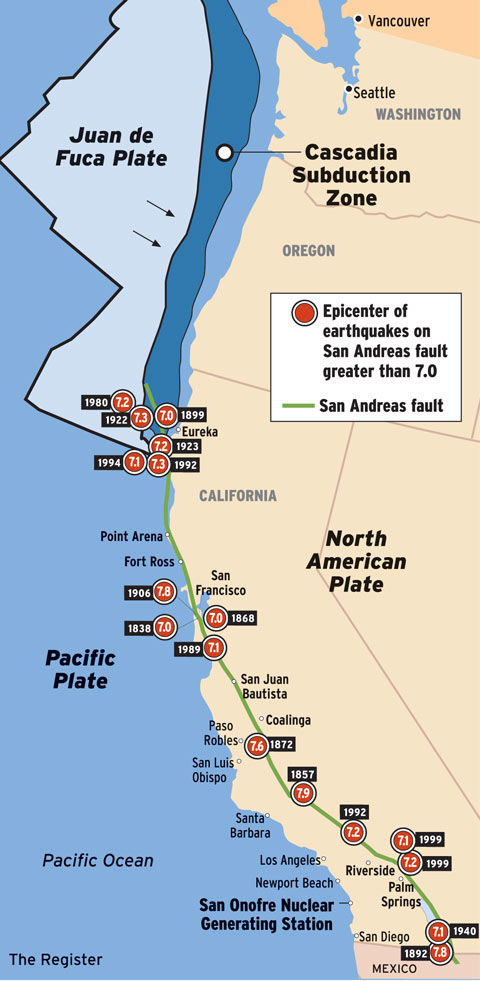
March 14, 2011 from the Orange County Register in California. “The southern San Andreas fault could perhaps produce a quake in the 7.8 magnitude range in the area between the Salton Sea and San Bernardino, said Bob Dollar, a geophysicist with the U.S. Geological Survey. There is also a subduction zone, where one tectonic plate is diving beneath another, running from northern California to British Columbia.”

There was no words on when this might occur.

California Earthquakes

I remember the Tehachapi Earthquake when I was a boy.  We lived in Inglewood, California (near LAX).  It was a magnitude 7.5 (Richter scale) earthquake (USGS, SCEC) on the little known White Wolf Fault.  Cracks in the living room wall were filled with newspaper before my father plastered over the filling and repainted.

Then I got married and there was another earthquake.  As I recall I was shaking in 1969. It was 1971 and my wife and I lived in Hollywood in a second floor apartment.  The deadly Sylmar earthquake was 6.6-magnitude temblor according to the USGS, http://earthquake.usgs.gov/earthquakes/states/events/1971_02_09.php.

The magnitude 6.7 Northridge earthquake started on January 17, 1994 at 5 seconds before 4:31 a.m.  My family was a mere five miles away from this event.  No one was hurt.  Dishes were broken.


The U.S. Geological Survey (USGS) states that the San Francisco Earthquake in 1906 was between 7.7 and 8.3 magnitude.  Equipment was not as sophisticated as today’s technology and that accounts for the range.  Different seismologists have developed different conclusions.

The start of the third game of the World Series between the Oakland A’s and the San Francisco Giants and the city was rocked and rattled by a magnitude 7.1 earthquake. Buildings and bridges collapsed, fires broke out, and 59 people were killed. 

On June 28, 1992, the most powerful quake to hit the U.S. in 40 years struck Landers, California. It measured 7.4 on the Richter scale.

From Wikipedia: The University of California study on “the next big one”

A study completed by Yuri Fialko[9] has demonstrated that the San Andreas fault has been stressed to a level sufficient for the next “big one,” as it is commonly called; that is, an earthquake of magnitude 7.0 or greater. The study also concluded that the risk of a large earthquake may be increasing more rapidly than researchers had previously believed. Fialko also emphasized in his study that, while the San Andreas Fault had experienced massive earthquakes in 1857 at its central section and in 1906 at its northern segment (the 1906 San Francisco earthquake), the southern section of the fault has not seen a similar rupture in at least 300 years.

How big will the “big one” be in California?  No one seems prepared to give an estimate.

Feds Open Anti-Semitism Investigation at UC-Santa Cruz

Dear Friends,

After several years of trying, unsuccessfully, to convince faculty and administrators at my university to address the problem of rampant anti-Israel bias, advocacy, and activism in classrooms and at events sponsored by academic departments and residential colleges, in June 2009 I filed a complaint with the U.S. Department of Education Office of Civil Rights (OCR).  I argued that such political bias, advocacy, and activism had created an intellectually and emotionally hostile environment for Jewish students on my campus.  Last week the OCR informed me that they have decided my complaint merits investigation, which is very good news. I sincerely hope that the OCR’s investigation will motivate UCSC faculty and administrators to address this serious problem forthrightly, and that other universities will follow suit.  (See forwarded press release from the Institute for Jewish & Community Research). 

Tammi Benjamin [mailto:tbenjami@ucsc.edu]

Press Contact:

Kenneth L. Marcus, Institute for Jewish & Community Research

mailto:Press@JewishResearch.org”

JewishResearch.org

(415) 386-2604

Feds Open Anti-Semitism Investigation at UC-Santa Cruz

Complaint Alleges Pervasive Hostile Environment

San Francisco, March 15, 2011 – The Institute for Jewish & Community Research (IJCR) announces that the U.S. Department of Education Office for Civil Rights (OCR) has opened a major investigation into anti-Semitism claims at the University of California Santa Cruz. Lecturer Tammi Rossman-Benjamin filed a June 2009 complaint alleging the university failed to address a hostile environment for Jewish students on that campus. After long deliberation, OCR has determined that the case merits full investigation.

The OCR complaint describes a campus environment in which Jewish students feel harassed and intimidated. University-sponsored events vilify Israel while professors openly express hostility toward the Jewish state and its supporters. Rossman-Benjamin adds that “no other … group on campus has been subjected … to such hostile and demonizing criticism.”

Former OCR chief Kenneth L. Marcus, who now heads The Anti-Semitism Initiative at IJCR, explains: “This case is extremely significant for four reasons. First, it is opened just as International Apartheid Week activities are being held around the world and illustrates the potential ramifications of extremist protest activities. Second, it follows right on the heels of a federal lawsuit alleging similar problems at the University of California Berkeley just a few days before and may illustrate a broad trend. Third, it is only the second major systemic anti-Semitism case that OCR has opened and may have important precedential value. Fourth, it is the first major case to follow OCR’s new campus anti-Semitism policy and may demonstrate whether OCR means what it says about its commitment to addressing hate and bias in federally funded higher education programs.”

The Institute for Jewish & Community Research (IJCR) is an independent, non-partisan think tank that provides innovative research and pragmatic policy analyses on a broad range of issues including racial and religious identity, philanthropy, and anti-Semitism.  www.jewishresearch.org   

###