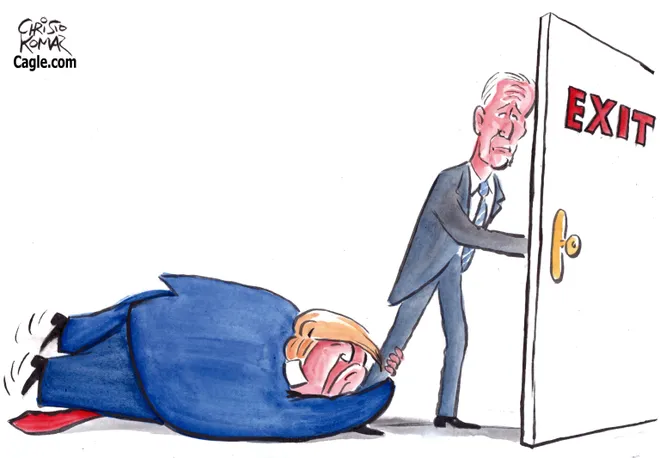
Kamala Harris is now Democratic presidential nominee but was it a mistake?

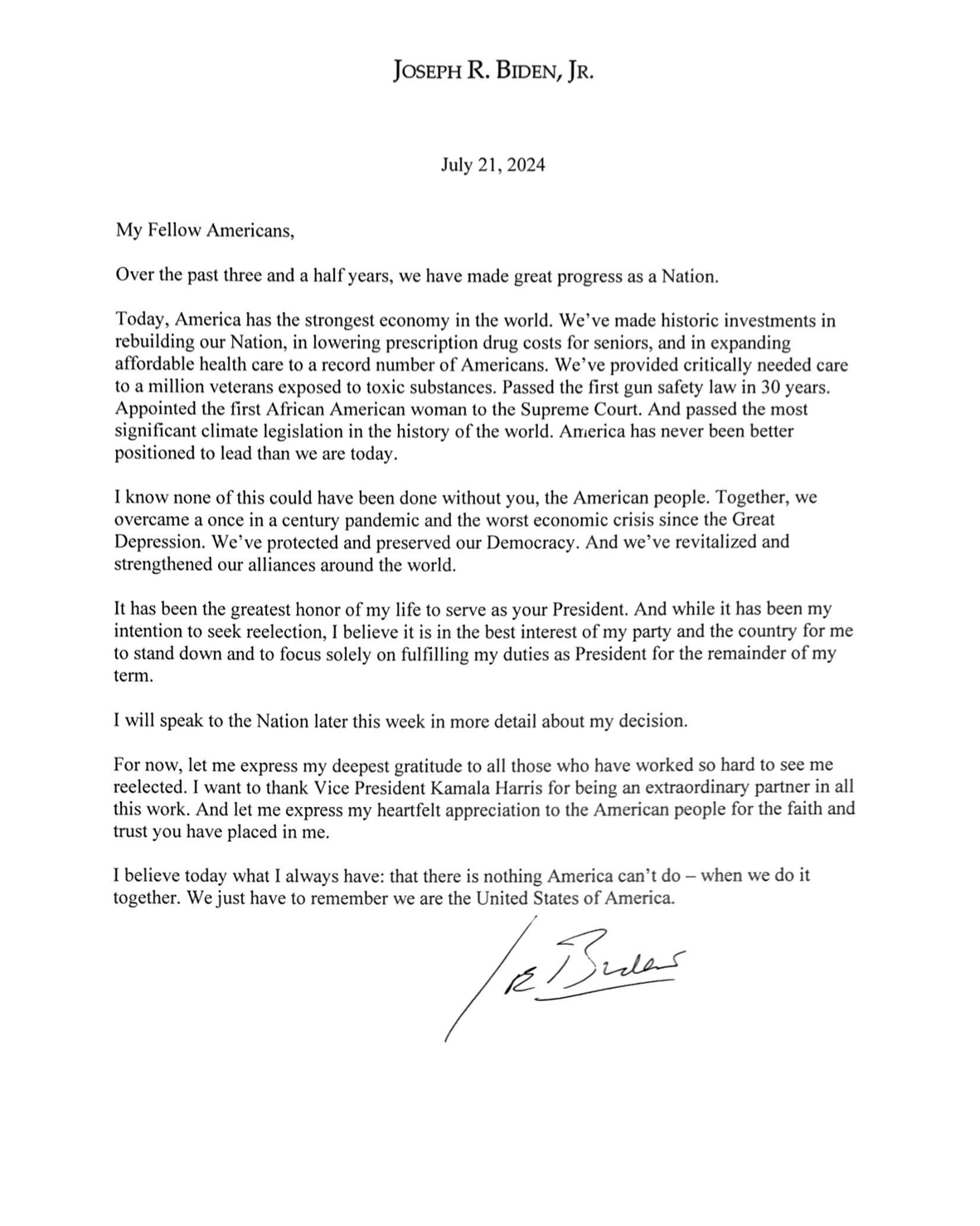
Just as soon as Biden abruptly ended his candidacy, he endorsed Vice Kamala Harris. Her team worked rapidly to secure backing from the 1,976 party delegates needed to clinch the nomination in a formal roll call vote.

When the initial exuberance wears off will Harris be able to lead?

Her first decision was to identify a running mate to be her vice president. The selection offered a list of many extremely qualified candidates. Josh Shapiro, Governor of Pennsylvania, Minnesota Governor Tim Walz, Arizona Sen. Mark Kelly of Arizona, and Secretary of Transportation Pete Buttigieg. All of them more than qualified to be president. None of them with the baggage of the Biden presidency.

No matter what Harris says she will be linked to President Joe Biden and to her past positions. While I agree with most of her positions the Trump campaign will paint her positions as radical and her as a radical left-wing extremist.

None of her potential VP candidates will be burdened with her views.

Democrats rushed to avoid disarray. But crowning Harris was a mistake.

When President Biden courageously ended his reelection bid, he gave Democrats a golden opportunity to win in November. Now, many Democratic leaders and delegates seem intent on squandering that opportunity by rushing to make Vice President Harris the party’s nominee.

Their aim is to coalesce quickly around Ms. Harris as the heir apparent and forestall a nomination fight at the party’s convention next month. But for all her achievements and admirable service, Ms. Harris carries all the baggage of the Biden administration.

She, like Mr. Biden, has been trailing Donald Trump in polling and is unlikely to carry the handful of states — Michigan, Wisconsin, Ohio and Pennsylvania — where this election will be decided. Democrats should take a deep breath and consider their options. If they are guided by data and political instinct, they can choose the candidate most likely to defeat Mr. Trump.

Name calling like saying Trump and Vance and their supporters are “weird” is playground nonsense.

I have yet to hear one thing that a President Harris will do once she is elected.

Joe Biden: My plan to reform the Supreme Court and ensure no president is above the law

By Joe Biden, Published in The Washington Post

July 29, 2024 at 5:00 a.m. EDT

The writer is president of the United States.

This nation was founded on a simple yet profound principle: No one is above the law. Not the president of the United States. Not a justice on the Supreme Court of the United States. No one.

But the Supreme Court’s 6-3 decision on July 1 to grant presidents broad immunity from prosecution for crimes they commit in office means there are virtually no limits on what a president can do. The only limits will be those that are self-imposed by the person occupying the Oval Office.

If a future president incites a violent mob to storm the Capitol and stop the peaceful transfer of power — like we saw on Jan. 6, 2021 — there may be no legal consequences.

And that’s only the beginning.

On top of dangerous and extreme decisions that overturn settled legal precedents — including Roe v. Wade — the court is mired in a crisis of ethics. Scandals involving several justices have caused the public to question the court’s fairness and independence, which are essential to faithfully carrying out its mission of equal justice under the law. For example, undisclosed gifts to justices from individuals with interests in cases before the court, as well as conflicts of interest connected with Jan. 6 insurrectionists, raise legitimate questions about the court’s impartiality.

I served as a U.S. senator for 36 years, including as chairman and ranking member of the Judiciary Committee. I have overseen more Supreme Court nominations as senator, vice president and president than anyone living today. I have great respect for our institutions and the separation of powers.

What is happening now is not normal, and it undermines the public’s confidence in the court’s decisions, including those impacting personal freedoms. We now stand in a breach.

That’s why — in the face of increasing threats to America’s democratic institutions — I am calling for three bold reforms to restore trust and accountability to the court and our democracy.

First, I am calling for a constitutional amendment called the No One Is Above the Law Amendment. It would make clear that there is no immunity for crimes a former president committed while in office. I share our Founders’ belief that the president’s power is limited, not absolute. We are a nation of laws — not of kings or dictators.

Second, we have had term limits for presidents for nearly 75 years. We should have the same for Supreme Court justices. The United States is the only major constitutional democracy that gives lifetime seats to its high court. Term limits would help ensure that the court’s membership changes with some regularity. That would make timing for court nominations more predictable and less arbitrary. It would reduce the chance that any single presidency radically alters the makeup of the court for generations to come. I support a system in which the president would appoint a justice every two years to spend 18 years in active service on the Supreme Court.

Third, I’m calling for a binding code of conduct for the Supreme Court. This is common sense. The court’s current voluntary ethics code is weak and self-enforced. Justices should be required to disclose gifts, refrain from public political activity and recuse themselves from cases in which they or their spouses have financial or other conflicts of interest. Every other federal judge is bound by an enforceable code of conduct, and there is no reason for the Supreme Court to be exempt.

All three of these reforms are supported by a majority of Americans— as well as conservative and liberal constitutional scholars. And I want to thank the bipartisan Presidential Commission on the Supreme Court of the United States for its insightful analysis, which informed some of these proposals.

We can and must prevent the abuse of presidential power. We can and must restore the public’s faith in the Supreme Court. We can and must strengthen the guardrails of democracy.

In America, no one is above the law. In America, the people rule.

Diversity, Equity, and Inclusion

What is DEI and how will it effect the upcoming election? DEI means Diversity, equity, and inclusion. It has become a talking point for businesses and politics.

As the nation prepares for the 2024 election, it is crucial to recognize the role of DEI in shaping political narratives and voter behavior. The ongoing debates and controversies highlight the importance of fostering an inclusive and equitable political landscape where all voices can be heard and respected.

Republicans are warning their colleagues to back off using diversity, equity and inclusion (DEI) politics to attack Vice President Harris as she launches her presidential bid.

The GOP has had to quickly revamp its attacks in the days since President Biden withdrew from the 2024 race and Democrats coalesced around Harris as his replacement — and some members have taken swipes over her race and gender in arguing she is unqualified.

Senator JD Vance (R-OH) and Congressman Michael Cloud (R-TX-27), along with cosponsors Senators Marsha Blackburn (R-TN), Bill Cassidy (R-LA), Kevin Cramer (R-ND), Eric Schmitt (R-MO), Rick Scott (R-FL), and fifteen members of the U.S. House of Representatives, have introduced the Dismantle DEI Act to eliminate all federal DEI programs and funding for federal agencies, contractors which receive federal funding, organizations which receive federal grants, and educational accreditation agencies.

The Washington Post reports that Harris’s campaign will have to contend with DEI, culture war attacks. Despite rising political tensions over DEI programs, a recent Washington Post-Ipsos poll found that about 6 in 10 Americans said diversity programs are a “good thing.”

Real Clear Politics

Perhaps no one can do any better than Joe Biden and it is only July but the trends are obvious

Top Battlegrounds – RCP Average

WisconsinArizonaGeorgiaMichiganPennsylvaniaNorth CarolinaNevada

RCP AVERAGEDATETRUMP (R)BIDEN (D)SPREAD
Top Battlegrounds7/1946.742.4Trump+4.3
ArizonaJuly 19th47.441.4Trump+6.0
NevadaJuly 19th47.742.6Trump+5.1
WisconsinJuly 19th46.643.3Trump+3.3
MichiganJuly 19th44.042.3Trump+1.7
PennsylvaniaJuly 19th47.943.4Trump+4.5
North CarolinaJuly 19th47.241.5Trump+5.7
GeorgiaJuly 19th46.242.2Trump+4.0

We’re ‘bordering on Sixth Sense Bruce Willis

NBC analyst Chuck Todd remarked that like Bruce Willis in “The Sixth Sense,” every Democrat but Biden is aware that his presidential campaign is dead.

Chuck Todd: We’re ‘bordering on Sixth Sense Bruce Willis territory’ with Biden.

Click the link.

https://www.msn.com/en-us/video/watch/chuck-todd-were-bordering-on-sixth-sense-bruce-willis-territory-with-biden/vi-BB1qaU8i?ocid=hpmsn

Time to Retire with Dignity

Joe Biden is a frail old man who means well but is in need of help doing his job and communicating to the public.

This report from the New York Post enforces my opinion.

President Biden was handed a private note during a recent call with Democratic House lawmakers telling him to “stay positive” – and he read it out loud. 

A staffer gave the 81-year-old president a note card with tips as he attempted to persuade members of the Congressional Progressive Caucus on Saturday that he was fit to serve and able to defeat former President Donald Trump on Election Day, the New York Times reported.

“Stay positive, you are sounding defensive,” Biden said on the call, seemingly reading directly from his staffer’s short missive.

One lawmaker told the New York Times that the moment represented how “stage-managed” calls between the president and lawmakers concerned about his re-election chances have seemed. 

Biden has long been known to rely on note cards for press conferences, summits and private fundraisers, instructing him where to sit, what to do and who people are. 

Still, the lawmaker also interpreted the moment as the president “poking fun at his aides” rather than accidentally reading the private memo. 

The president has a history of blurting out instructions meant for his eyes only, including when he read “pause” off a teleprompter during a campaign speech in April.

Rep. Pramila Jayapal (D-Wash.), the chair of the CPC, said the call with Biden was “productive and engaging.” 

“We spoke frankly to the President about our concerns and asked tough questions about the path forward. We appreciate his willingness to thoughtfully answer and address our Members,” she wrote on X. 

Biden’s call with the CPC came on the same day he reportedly held a “tense” Zoom call with moderate Democrats that was “even worse than the debate,” losing credibility with those on the video chat, according to people in the meeting. 

“He was rambling; he’d start an answer then lose his train of thought, then would just say ‘whatever.’ He really couldn’t complete an answer. I lost a ton of respect for him,” one person on the call told Puck.

“The president was rambling, dismissive of concerns, unable or unprepared to present a campaign strategy,” added a second person, who is a member of Congress.

Biden has faced mounting calls from Democrats imploring him to end his re-election campaign in the aftermath of his disastrous June 27 debate against Donald Trump, with several polls showing the incumbent trailing the 78-year-old former president.