“During her reign at Hewlett-Packard, according to public records, her corporation spent $4.7 million to lobby Congress and donated more than $390,000 to political candidates through its political action committee. Fiorina and her husband, Frank, a former AT&T executive, have made more than $100,000 in political donations personally since 2000.
“That suggests not that Fiorina ‘felt disconnected’ from what was going on in Washington, but rather that she understood all too well that in politics, money talks. Why bother to vote when you can get what you need with greenbacks?”
(In other words, she believes in the political system, just not the one that non-millionaires have to use.)
Among her big issues was healthcare reform and the bill just then beginning its journey through Congress. “Wouldn’t you love to know what’s in that 1,990-page healthcare bill that’s being considered right now?” she asked the crowd at her launch event in November 2009. Actually, the measure was closer to 950 pages — but why count pages when there’s a political point to be scored? — and, as I pointed out, it was no secret. The text could be downloaded from a public website and read by anyone, including Fiorina.
More to the point, Fiorina, who was making much out of her own battle with breast cancer (“After chemotherapy, Barbara Boxer just isn’t really that scary anymore,” she quipped), displayed the usual contempt that privileged insurance owners have for the uninsureds. Fiorina received her health coverage through her husband’s AT&T retirement plan, but for everyone else she advocated allowing insurance companies to sell policies across state lines, which would be a boon to the insurers and a disaster for buyers.
As I observed: “If she were an average person who lost that AT&T coverage and had to replace it in an individual market where the insurers could sell it to her on their own terms, subject to the rules of the most lenient and consumer-unfriendly states … as a cancer survivor, she’d be uninsurable.”
The Affordable Care Act, which she opposed in its cradle and now says should be repealed, bars discrimination against applicants based on their medical conditions. What’s her answer to that? We don’t know, because she wasn’t asked at the debate. She has, however, advocated defunding Planned Parenthood, which provides reproductive health services to middle- and low-income women unlike her.
The foundation stone of Fiorina’s political pitch is her business career. It’s impressive on paper, underwhelming in reality. She was CEO of Hewlett-Packard from mid-1999 to early 2005, a period in which the company’s stock sank 49% to 60% (depending on how you count), making it one of the worst-performing high-tech firms.
CEO Fiorina talked a lot about “innovation” while pursuing corporate strategies displaying a striking lack of imagination. She cut HP’s payroll by 10,000 employees in 2000 while surrounding her glamorous self with clouds of image and strategy consultants. She marketed overpriced knockoffs of other companies’ consumer technologies and then, disastrously, doubled down on the PC business by acquiring Compaq in 2002, when the right move would have been to exit that low-margin business altogether.
The Compaq takeover led to a bruising battle with the HP board, which she utterly mismanaged, leading to her bitter ouster in 2005. Her reaction was to blame everyone else, which doesn’t speak well of her capacity for introspection. She left with a severance package estimated at $40 million, which speaks very well of her negotiating skills (or her lawyers’).
The Fiorina running for office today is a package of conventional Republican policy wrapped up in earnestness and poise. She opposes a government mandate for paid maternity leave, which would be very important for middle-class families but not so much for holders of corporate golden parachutes. She blames the California drought on “liberal environmentalists,” which is about as uninformed as one can get about water in the West but fits seamlessly with GOP orthodoxy.
I doubt that Californians who witnessed her tenure at HP or her Senate campaign in 2010 are surprised at the Fiorina of 2015. But the rest of you should know too.
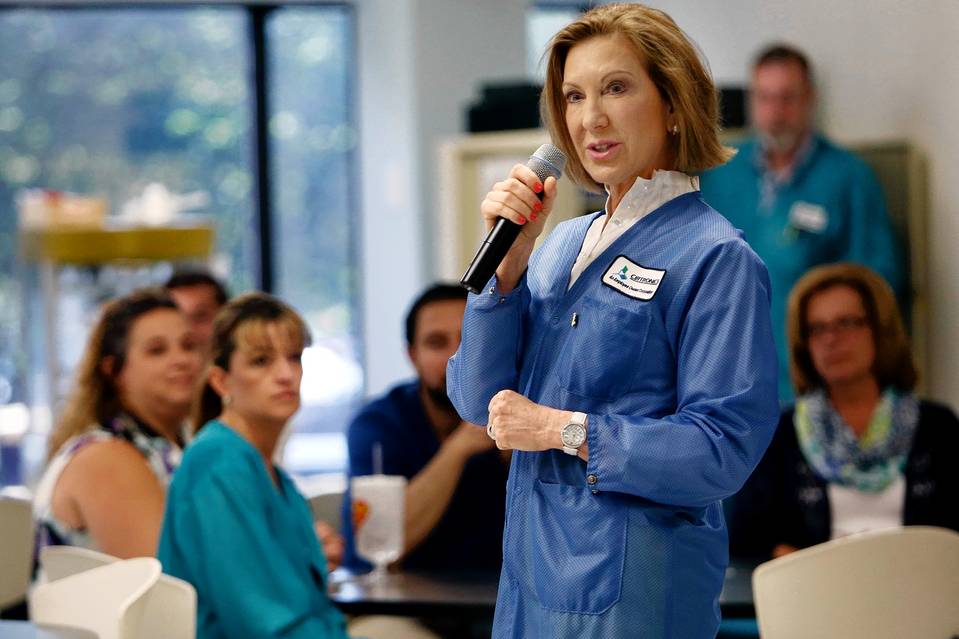 Praise for the former Hewlett-Packard CEO’s performance at the introductory undercard debate spanned the full range of news outlets. The conservative National Review remarked on her “poise and her well-crafted answers,” and CNN paid homage to her “sharp knowledge of the issues.”
 Coast Contact