Is there a march to autonomous cars?

My guess is there will be autonomous trucks and self driving Uber cars but the autos that most of us drive will still require operation by the owner.  There are at least two reasons.

1) There is a question of liability.  Who is responsible when accidents occur?

2) Many of us like to drive our cars.  We like to be in control.  It is the fun of accelerating, speeding, and for many we still like to shift the gears.

I predict the consequence will be cars with an abundance of safety features.  Many of them are on some but not all 2018 vehicles.
Look at the 2018 Toyota Camry and Honda Accord

-Pre-Collision System with Pedestrian Detection

If the system determines that a collision is likely and you do not brake in time to prevent an accident the system will apply the brakes to slow the car.

-Lane Departure Alert and Assist (LDW and LKA)
The system will warn you of a departure by issuing a beeping noise and will make minor correction to keep your car centered in your lane.

-Automatic High Beams

The car will turn on high beams when there the area is dark and there are no oncoming lights

-Adaptive Cruise Control

You have set your cruise control at 65 mph.  The traffic slows to a lower speed. The system slows the car to an appropriate speed and subsequently increases the speed when traffic resumes to a faster speed.

-Blind Spot Detection
Blinking lights on outside rear view mirrors and inside mirrors to aid in knowing there is someone or something that could cause an accident

-Rear cross-traffic alert
A beeping noise and flashing warnings on interior screen

I have an early 2018 Camry that includes most of these features.  The Adaptive Cruise Control that they call Radar Cruise Control is my favorite feature.  All of these safety features should be reason enough to buy a new car rather than spending more money on an old clunker.
The Impact of Technology on Blue Collar Workers

We are about to select a new American president in a world that is rapidly becoming more technically advanced than anyone could have imagined in the year 2000. Remember that as the year many of us were concerned that clocks would stop, power grid systems might fail, and commercial aircraft might fall from the sky. Of course none of that happened. What has happened is the rapid advance of technology and a globally connected society. Thomas Friedman’s “The World is Flat” (Published April 5, 2005) was not only a recognition of a changing world economy but the need for America to look forward and plan for the new economy.

Take just one new technology, autonomous (self driving) cars and trucks, that is predicted to be launched by the year 2020 to 2025 and consider the impact and you will understand that no one – no president of the United States – can stop the impact on the public in either the United States or other countries.

Don’t Tell The Teamsters: But Driverless Trucks Are Already Here.  Driverless trucks are operating in an Australian mine. When those trucks arrive in America the Teamsters will fight with everything they have to stop those autonomous trucks. Feather bedding will be a prominent part of their strategy. There are currently 900,000 active working Teamsters in the United States and Canada. There are approximately 3.5 million professional truck drivers in the United States, according to estimates by the American Trucking Association.

What will all those families that rely on those truck driving jobs do when they are replaced by self driving trucks? As a nation we have not looked forward. We have looked back.  Technology’s impact on the trucking industry is simply one example of the changing work environment.

Donald Trump promises to bring back the jobs that have been lost due to out sourcing. It is not clear what will motivate the return of jobs other than tariffs that could start a trade war.

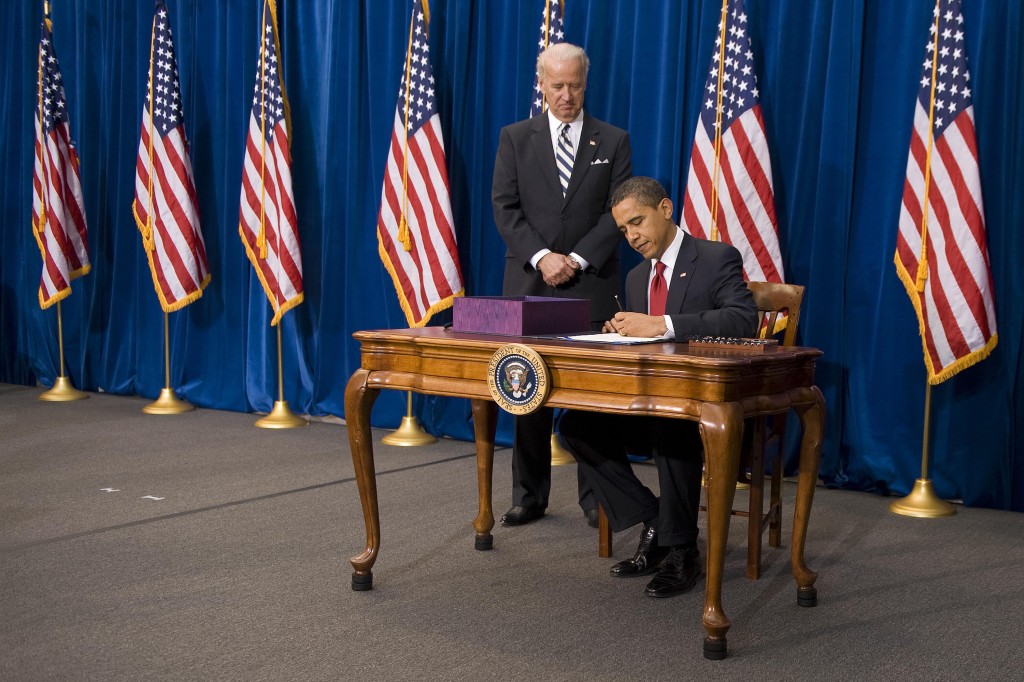
Hillary Clinton says she will propose investing in infrastructure, manufacturing, research and technology, clean energy, and small businesses. The costly $787 billion spending bill that President Barack Obama signed into law soon after taking office had little effect. It was argued that it was insufficient.

obama-signs-the-american-recovery-and-reinvestment-act-of-2009

In all of the Trump and Clinton ideas there is no consideration of the future.