Los Angeles Needs to Grow Up

Major cities throughout the world are noted for their skyscrapers.  Los Angeles lacks that distinctive architectural image.

The tallest building in Los Angeles today is the 73-story U.S. Bank Tower, which rises 1,018 feet (310 m) in Downtown Los Angeles and was completed in 1989.  Among the next nine tallest buildings none are more than 858 feet (262m) tall.  They are 52 to 55 stories high.  Among that group of ten the last one was completed in 1992.  Among the 34 buildings that are at least 400 feet (122 m) tall two were completed in this century and the rest were primarily completed in the 60’s, 70, and 80’s.

LA-tallest-building-in-the-west-to-be-built-in-downtown

Korean Air’s $1-billion hotel skyscraper. Rendering of the 73-story Wilshire Grand hotel and office building to be constructed in downtown Los Angeles. (AC Martin Partners)

Cities either grow or shrink. Los Angeles has filled its land space with low rise structures. If we are to grow it must be up. When you add the new Korean Air 73 story building to new high rise developments in Hollywood and elsewhere you know the city is in growth mode. These new structures will be magnets for more new business. Most of us want to be part of a growing economy.

LA-millennium-hollywood-2 tower project

A proposal for two skyscrapers that would flank the Capitol Records tower in Hollywood gained the approval of the city’s planning department Tuesday despite push-back from dozens of disgruntled residents.

An artist’s rendering of the project near the Capitol Records building in Hollywood. (Handel Architects)

Those who continuously fight against tall buildings, public transportation and other elements of large metropolises are dreaming of another time when land was plentiful and the idea of big city life was something that only those east of the Mississippi could appreciate.  Los Angeles has the second highest population in the nation.  Metropolitan Los Angeles encompasses more than 10 million people.  It’s time we started acting like a very big city.

Impact of Technology on the U.S. Economy

If only businesses would start re-hiring all those people who lost their jobs in the Great Recession everything would be as it was.  It won’t happen like that!  Globalization and technology have changed everything.

The Mobile World Congress is a show of the latest cell phone and tablet technologies.  It will occur February 24 to February 28 in Barcelona, Spain.  The facility used is a new state of the art convention centre called Fira Gran Via consisting of eight halls.  With over 1,500 exhibits, it is a reminiscent of CES and Comdex that have been held at the Las Vegas Convention CenterThis is a wake-up call that the United States is not necessarily the center for new technologies.

  Fira Gran Via, Barcelona Spain

  The Gran Via Convention Centre

 Fira Gran Via mwc_carousel_networking gardens_final                                                                                


No business will hire employees in the western world when the job can be done for far less in developing countries.  Workers in China, Mexico, and elsewhere are willing to work for $1USD an hour.  Workers in the United States, Canada, U.K., Germany and other industrialized nations cannot pay their bills on that rate of pay.

Businesses of all types try to solve their employment needs by looking for automated equipment rather than hiring.  The benefit is lower cost for services rendered where ever labor is needed.

  factory-robots

From cars to bread, robots dominate modern production

On-line Digital Camera Review owner/editor Jeff Keller, “The smartphone became the preferred photo tool for many.”  The web site closed down effective December 31, 2012.

Newsweek’s final print publication mailed out on December 24, 2012.  The final issue is dated December 31, 2012.  The cause was a decline in advertising revenue.  The magazine’s owner will attempt a digital version that will be available only to subscribers.

Borders bookstores have closed.  Barnes and Noble stores are closing too.  E-readers are this year’s sought after device.  Barnes and Noble’s Nook is one of those readers.

Modern manufacturing isn’t based on human labour; it’s based on the robot. Still, most people cannot grasp the breadth of automation in factories. We still picture plants full of human workers toiling to make our cars and furniture, just as we imagine our meat comes from animals in a barn. The truth is much more awe-inspiring, perhaps even frightening. The factories of today have some human workers, but huge portions of assembly lines are 100% mechanized. The US Bureau of Labor Statistics expects automotive jobs to decline 18% by 2018 despite expected increases in production. Robots eliminate the need for more workers.

What is the United States doing to sustain its lead in technology and grow its economy?  Arguing about gun control, immigration, and government debt.

Economic Facts

I have waited to write about this until this weekend hoping that economists and responsible government officials could offer reasonable explanations.  They have not!

The United States economy is in trouble and no one wants to talk about it!

The U.S. economy shrank by .1% in the last quarter of 2012.  That number would not be too bad if it weren’t for the fact that the economy grew by 3.1% in the third quarter of the year.  That is a change in direction of 3.2%.  No one wants to admit the economy is in trouble. Instead all the talking heads and all the government leaders are talking up positive data.  The reasoning appears to be “if we ignore the situation maybe it will go away. Let’s be positive.”

Some worthwhile points:

  • Every wage earner saw his take home pay decrease by 2% thanks to the expired payroll tax holiday.
  • Companies don’t expand and don’t hire when there is no demand for their products.
  • The real unemployment rate is not publicized because it is too frightening for most people (especially those in government) to confront.  It is the “Total unemployed…” from a monthly labor report in Table A-15 called U-6.  The rate was 14.4% for January.  The number has been unchanged for the past three months.  This real unemployment rate peaked at 17.1% in October 2009.  The historical typical rate has been between 7% and 8.5%.
  • The United States must add more than 200,000 jobs a month to reduce the unemployment rate.  150,000 new jobs simply meets the requirements of the growing work force.  This fact has been repeated on newscast after newscast.  Thus 157,000 new jobs in January are not satisfactory.
  • Housing prices may have leveled off but they are far from those that existed in 2007.
  • Corporate profits are for the most part up and that has been great for those who have significant stock ownership.  Most Americans consider themselves well off if they have a $200,000 in retirement savings.  Government statistics indicate most families have $50,000 in savings.  Most people are not major beneficiaries of the past year’s increased S&P 500.
  • The coming sequestration or budget cuts will result in contractor and federal government employee layoffs.  Both political parties seem to have settled on this event starting March 2013.  There will be a cut of $85.4 billion of both defense and non-defense spending.  That is the law that congress passed.

Our Congress needs to start developing solutions rather than arguing.  Politics are destroying this nation.

Credit Cards Can Be Better Than Cash

I bought a new bed using a credit card.  I could have written a check for the full amount but the bed store offered a one year no interest payment plan.  Why not? I thought.  So the bed was to be delivered three days later.

Oh, there is one thing I neglected to tell you.  The old bed had a foam topper that was purchased separately and has been on top for about seven or eight years.  My beautiful wife said it’s not the topper that is sagging it’s the bed.  OK, I agreed without challenging her wisdom.  However, the next day, after I had ordered the new bed, she decides to remove the topper and check the mattress.  “Look at this” she says, “the mattress without the topper seems quite comfortable.”  I lay down on the bed and surprise.  It feels identical to the new bed.  I called and cancelled the bed order!  Did I yell at my wife?  No!  Was I happy the bed was bought using a credit card? Yes!

Thus you have learned one of the benefits of credit card purchases.  If you have a problem with a product you’ve purchased – it’s damaged or defective, or is never delivered ­you have extra legal protection if you bought the item with a credit card. Federal law gives consumers the right to withhold payment on credit card purchases in certain situations.

Try to resolve the dispute directly with the seller. If you call the seller or visit in person and don’t get a resolution, send a letter so that the issue is documented. In the meantime, don’t pay the amount that is in dispute, the California Department of Con­sumer Affairs says.

If the problem remains unresolved, call your credit card company and tell it you want to withhold payment for the disputed transaction. Follow up with a letter to the card company, and send a copy to the seller. This will “demonstrate to the seller that you intend to follow through with your complaint, and that will increase the chance that the seller will resolve the problem voluntarily,” the consumer agency said.

The credit card company will contact the seller and try to resolve the dispute. While the item is under investigation, your card issuer may not report you as “delinquent” for withholding payment, provided that you follow the steps above. But the card company can describe the amount as “disputed.” “Since the dispute probably will end up on your credit record, the right to withhold should never be used frivolously,” the consumer agency said.

Your right to withhold payments does not apply if the transaction was for less than $50, or if it took place more than 100 miles from your home and in a state other than your own. But those restrictions are waived if the credit card was issued by the seller – a department store credit card, for example.

You can withhold payment only if you use your card as a credit card. Using it as a debit card is like paying cash.

Some Investments are Appropriate

Why are you relying in savings account interest?  Some banks are paying .05% APY on certificates of deposit.  I saw an ad this morning trumpeting 0.9% APY.  That is an unacceptable rate of return.

As we start the new year we are all looking at our savings and the earnings those savings provided.  Commentaries on financial networks like CNBC and in the financial sections of newspapers all say that most of us have put our money in low interest earning savings accounts at banks.  The reason is obvious.  We fear losing those hard gained savings.

Businessweek December 24-Janauary 6 edition cover story Titled “Get Rich Slow” points out that at today’s bank interest rates it would take 1,387 years to double your money.  Yes, the Federal Reserve is trying to encourage you to invest elsewhere.  Honestly there are many investments that pay more than FDIC insured savings accounts.  Some are just as safe as a savings account.  My favorite is Ginnie Mae Bonds that are “providing a guaranty backed by the full faith and credit of the United States” These bonds currently pay an interest rate of 2.68%.  They have earned higher interest rates in past years.  According to Morningstar, if you had invested $10,000 in January 2003 and had all interest re-invested in GNMA bonds, the current value would be $16,398.

There are other somewhat more risky investments but those risks are minimal.  Consider Procter and Gamble the world’s largest consumer goods company, whose products like Tide detergent and Gillette razors are in 98 percent of U.S. households.  Other products of theirs are Crest Toothpaste, Pantene Shampoo, Duracell, and Prilosec OTC.  That is not the complete list that encompasses at least 32 items.  The share price has varied over the decade but it has been a reliable dividend payer that now yields 3.19%.  As one lady told me, “I do not care what the share price is as long as I receive my dividends”.  She lives in an expensive independent living facility and draws her income to pay the bill from the dividends.

http://finance.yahoo.com/echarts?s=%5Egspc#symbol=^gspc;range=3m;compare=;indicator=volume;charttype=area;crosshair=on;ohlcvalues=0;logscale=off;source=undefined;

The S&P 500 was at 1257.60 on January 1, 2012.  Today the value is 1502.96.  That is a 19.5% increase in value.  There is no guarantee this growth will continue.  Is this a bubble?  Perhaps! 

Can you afford to be a non-participant?  If the market drops 10% just sell and you just might have more money than you do today.

Cerberus: The Three-headed Dog in Greek Mythology

dogmyth_cerberus

The ancient Greek pantheon is rife with symbolism. One such symbolic creature is Cerberus, the three-headed monstrous canine, the loyal servant and guardian of the Greek God of Death.  In the Greek mythical tradition, Cerberus is the guardian of the gates of the underworld, the realm of Hades. His job is to prevent the living from entering the land of the dead and to prevent the dead from escaping the boundaries of the underworld.
Read more at Buzzle: http://www.buzzle.com/articles/cerberusthree-headed-dog-in-greek-mythology.html

Cerberus Capital Management, L.P. is an American private equity firm. The firm is based in New   York City, and run by financier Steve Feinberg, who co-founded Cerberus in 1992 with William L. Richter, who currently serves as a senior managing director. The firm has affiliate and/or advisory offices in the United States, Europe and Asia. [this information from Wikipedia]

Is this an odd name for an investment firm?  You decide!

According to Bloomberg News, the father of Cerberus chief executive Stephen Feinberg lives in Newtown, Conn. Cerberus said in its statement that it would “immediately” begin the process of selling off the assets of the Freedom Group (the manufacturer of the Bushmaster assualt weapon used in the Newtown massacre).

Cerberus is the company that owned Chrysler Corporation when it decalred banruptcy on April 30, 2009.

The Financial Times reported that after buyout firm Cerberus Capital Management bought a majority stake in GMAC and took that firm private, it later sold most of its exposure to a variety of other investors in order to reduce its own risk. Fair enough. But how did those other investors decide whether they wanted in on the deal?  According to several of them, a group of hedge-fund managers were invited to a private meeting with Cerberus, and most decided–rather quickly–to join in without making any true investigation of their own. “It was a ‘trust me’ kind of trade,” one investor who bought a small piece of GMAC told the Financial Times. “You had no time to do real due diligence. But it was a hot deal and everybody wanted in as part of the gang.” [this item found in a Morningstar.com report]

And now Bloomberg News reports that Cerberus has agreed to acquire Supervalu’s Albertsons, Acme, Jewel-Osco, Shaw’s and Star Market grocery stores in a transaction valued at about $3.3 billion.  Will these grocery chains be in business a year or two from now? The Cerberus track record is not encouraging.  The owners of this private equity fund may earn significant profits but at what cost?  Reduced competition and layoff of employees are the two possible consequences.

  Is this the job for the three headed dog?

Fiscal Cliff – The Soap Opera Continues

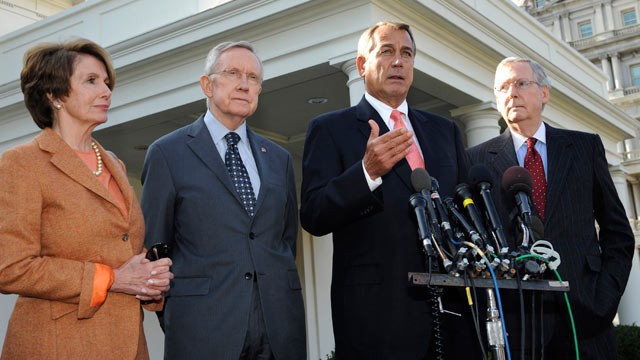
McConnell, Reid point to fiscal stalemate

Tune in to the political programs on television and radio and all you hear is talk about the Fiscal Cliff.  It’s been a continuing story where missing one or two episodes really means nothing.

My question is what fiscal cliff?

The U.S. government spent $3.563 Trillion in 2012.  The total revenue was $2.435 Trillion.  It does not take a mathematical genius to understand that the revenues will have to increase and the spending will have to decrease. Brooking Institute figures are similar to those provided by the Heritage Foundation.

 The automatic spending cuts amount to $1.2 Billion in one year.  That leaves spending at $3.443 Trillion assuming the budget does not increase one cent in 2013.  Why the whining?  That is hardly a cut.

From The Center for Public Integrity

http://www.publicintegrity.org/2012/12/05/11891/fact-check-facing-facts-fiscal-cliff

Some facts to consider:

  • The scheduled tax increases, if allowed to      take effect, would net an additional $536 billion in fiscal year 2013,      according to the nonpartisan Tax Policy Center, raising more than $5      trillion in 10 years. Nearly 90 percent of Americans would pay more in      taxes, TPC says, with the average increase being nearly $3,500.
  • The automatic spending cuts scheduled to      take effect would cut $1.2 Trillion over 10 years, split roughly in half      between domestic and military spending.       That works out to $1.2 Billion a year.
  • A temporary      payroll tax cut enacted for 2011 was extended      through 2012, but is now set to expire at the end of this year.
  • Tax increases contained in the Affordable      Care Act on upper-income taxpayers will go into effect: a 3.8 percent tax      on unearned income, 0.9 percent increase in Medicare payroll taxes and a      higher income threshold for deducting medical expenses.
  • The Alternative Minimum Tax, which was      designed to make sure wealthy Americans pay a minimum tax, was never      indexed to inflation on a permanent basis.

If all that happened, taxes would increase an average of $3,466 per household, according to the TPC. Middle-income households — those earning nearly $40,000 to about $64,500 a year — would see an average increase of $1,984.  Is this going to stop all spending?  NO!

Once again it’s the whining.  It is the result of this thinking.  You can cut anywhere you want just don’t impact me.

Consider these four likely impacts listed by The Week magazine.

– Higher cost of lattes because a dairy subsidy will lapse.  It appears we have had a dairy subsidy for about 30 years.  Starbuck’s will suffer (maybe). Who knew?

 – The Transportation Security Administration (TSA) will be laying off thousands of screeners at the airports.  That will result in less screening.  It is a wasteful program that has never caught a single terrorist.

– If a deal isn’t reached, and the economy creeps back toward recession, demand for fuel will fall (because presumably, Americans won’t have money to go anywhere), slashing gas prices.  That is a good thing!

– According to Money Morning, during the debt-ceiling crisis last year, there was a 30 percent increase in the price of gold — a cost-climb we are likely to see again should the latest negotiations fail.  Another good thing for all of us that bought gold!

Tough choices are part of life.

35 Days to Fiscal Cliff Hell

Some of this posting is based upon an article titled, “Fiscal Cliff Could Cost America 277K Jobs in January” posted on this website.

While addressing the House Financial Services Committee in February of this year, Federal Reserve Chairman Ben Bernanke coined the term “fiscal cliff,” describing, “a massive fiscal cliff of large spending cuts and tax increases” scheduled to occur on January 1, 2013.

Just a few days ago President Barack Obama, House Speaker John Boehner, and Senate Majority Leader Harry Reid and minority leaders were all talking as if an agreement to avoid the fiscal cliff was a realistic possibility.

Today’s news reports are that little progress has been made.

Should Congress fail to act, allowing the tax cuts to expire and budget cuts to take effect, the results could be drastic, increasing the annual federal tax burden on the average family of four by about $2,200, according to the Congressional Budget Office.

The major components of the fiscal cliff are the expiration of the Bush Tax Cuts, federal unemployment benefits, and social security payroll tax cuts, on top of automatically triggered spending cuts associated with the Budget Control Act of 2011.

Cuts associated with the Budget Control Act could result in the loss of 277,000 federal jobs, according to a report from the George Mason  University Center for Regional Analysis. The report assesses the impact the Budget Control Act would have on all agencies subject to cutbacks including Agriculture, Commerce, Education, EPA, Energy, Health and Human Services, Homeland Security, Housing and Urban Development, State, NASA, Transportation and Interior. While the cuts would only reduce federal spending from 22.9% of GDP to 22.4% of GDP, according to the CBO, they would cause significant job losses for federal health inspectors, Federal Aviation Administration workers, and FBI agents.

The president does not appear to be willing to write a piece of proposed legislation to avert going over the fiscal cliff.  This was my complaint about his management style throughout his first term.  It was no Barack Obama who wrote the Affordable Care Act.  It was members of the Democratic Party leadership in the houses of Congress.

If the sequestration occurs both political parties deserve blame.  The president should not be campaigning as he did during much of his first term.  He should be negotiating with congress.  His failure to bring this self inflicted event to a satisfactory conclusion will dog his next four year term.

Medicare for Everyone

Even before the annual enrollment period for Medicare had started (October 15) I was receiving the start of insurance company campaigns for my enrollment.  Since then the volume of mailings has become an avalanche.  This has caused me to ask: Are there significant profits to be made in Medicare enrollments?

The answer appears to be YES.  AARP’s single largest revenue source is royalties from United Health Care Group.  This is no surprise.  I receive solicitations from AARP to join United Health Care every single month of the year.  34% of their revenue comes from United Health Care.  In 2011, the AARP generated $458 million in royalty fees from so-called “Medigap” plans.  Read more about AARP’s special treatment at this forbes.com link.

Other companies solciting my enrollment include: Blue Cross, Blue Shield, SCAN, Aetna, and Humana.

This campaign leads me to the conclusion that Medicare for all would be a real solution to affordable health care for everyone.

The World’s 200 Richest People

Why is this man smiling?  He is the richest person in the world.  Carlos Slim.

Details are on bloomberg.com.  Here is the summary list of the top 30 and few other well-known people and number 200.

1. Carlos Slim

Net worth: $77.5 billion

YTD change: + $15.6 billion / + 25.3%

Source of wealth: America Movil

Industry: Telecommunications

Citizenship: Mexico

Age: 72

2. Bill Gates

Net worth: $64.4 billion

YTD change: + $8.7 billion / + 15.7%

Source of wealth: Microsoft

Industry: Technology

Citizenship: U.S.

Age: 57

3. Amancio Ortega

Net worth: $53.6 billion

YTD change: + $18.4 billion / + 52.1%

Source of wealth: Inditex

Industry: Retail

Citizenship: Spain

Age: 76

4. Warren Buffett

Net worth: $48.4 billion

YTD change: + $5.7 billion / + 13.2%

Source of wealth: Berkshire Hathaway

Industry: Finance

Citizenship: U.S.

Age: 82

5. Ingvar Kamprad

Net worth: $41.8 billion

YTD change: + $5.0 billion / + 13.7%

Source of wealth: IKEA

Industry: Retail

Citizenship: Sweden

Age: 86

6. Charles Koch  

Net worth: $38.6 billion

YTD change: + $4.8 billion / + 14.1%

Source of wealth: Koch Industries

Industry: Diversified

Citizenship: U.S.

Age: 77

7. David Koch

Net worth: $38.6 billion

YTD change: + $4.8 billion / + 14.1%

Source of wealth: Koch Industries

Industry: Diversified

Citizenship: U.S.

Age: 72

8. Larry Ellison

Net worth: $37.2 billion

YTD change: $4.2 billion / + 12.8%

Source of wealth: Oracle

Industry: Technology

Citizenship: U.S.

Age: 68

9. Christy Walton

Net worth: $30.5 billion

YTD change: + $5.4 billion / + 21.4%

Source of wealth: Wal-Mart Stores

Industry: Retail

Citizenship: U.S.

Age: 57

1 0. Jim Walton

Net worth: $29.3 billion

YTD change: + $5.8 billion / + 24.7%

Source of wealth: Wal-Mart Stores

Industry: Retail

Citizenship: U.S.

Age: 64

11. Rob Walton

Net worth: $28.7 billion

YTD change: + $5.7 billion / + 24.7%

Source of wealth: Wal-Mart Stores

Industry: Retail

Citizenship: U.S.

Age: 68

12. Alice Walton

Net worth: $28.2 billion

YTD change: + $5.6 billion / + 25.0%

Source of wealth: Wal-Mart Stores

Industry: Retail

Citizenship: U.S.

Age: 63

13. Li Ka-shing  

Net worth: $27.0 billion

YTD change: + $4.8 billion / + 21.8%

Source of wealth: Cheung Kong Holdings

Industry: Diversified

Citizenship: Hong Kong

Age: 84

14. Mukesh Ambani

Net worth: $26.0 billion

YTD change: + $4.7 billion / + 21.8%

Source of wealth: Reliance Industries

Industry: Energy

Citizenship: India

Age: 55

15. Liliane Bettencourt

Net worth: $24.7 billion

YTD change: + $4.5 billion / + 22.1%

Source of wealth: L’Oreal

Industry: Manufacturing

Citizenship: France

Age: 90

16. Stefan Persson

Net worth: $24.7 billion

YTD change: + $2.9 billion / + 13.1%

Source of wealth: Hennes & Mauritz

Industry: Retail

Citizenship: Sweden

Age: 65

17. Jeff Bezos

Net worth: $24.2 billion

YTD change: + $7.6 / + 45.5%

Source of wealth: Amazon.com

Industry: Technology

Citizenship: U.S.

Age: 48

18. Bernard Arnault

Net worth: $24.1 billion

YTD change: + $3.4 billion / + 16.4%

Source of wealth: LVMH Moet Hennessy Louis Vuitton

Industry: Retail

Citizenship: France

Age: 63

19. Larry Page

Net worth: $23.0 billion

YTD change: + $3.1 billion / + 15.9%

Source of wealth: Google

Industry: Technology

Citizenship: U.S.

Age: 39

20. Alwaleed bin Talal Al Saud

Net worth: $22.9 billion

YTD change: + $5.6 billion / + 32.0%

Source of wealth: Kingdom Holding

Industry: Diversified

Citizenship: Saudi Arabia

Age: 57

21. David Thomson

Net worth: $22.9 billion

YTD change: + $1.3 billion / + 5.8%

Source of wealth: Thomson Reuters

Industry: Media

Citizenship: Canada

Age: 55

22. Sergey Brin

Net worth: $22.8 billion

YTD change: + $3.1 / + 15.7%

Source of wealth: Google

Industry: Technology

Citizenship: U.S.

Age: 39

23. Lee Shau Kee

Net worth: $22.7 billion

YTD change: + $6.1 billion / + 36.7%

Source of wealth: Henderson Land Development

Industry: Real Estate

Citizenship: Hong Kong

Age: 84

24. Karl Albrecht

Net worth: $22.7 billion

YTD change: – $0.20 billion / – 0.9%

Source of wealth: Aldi

Industry: Retail

Citizenship: Germany

Age: 92

25. Michele Ferrero

Net worth: $22.5 billion

YTD change: + $1.4 billion / + 6.4%

Source of wealth: Ferrero

Industry: Food and Beverage

Citizenship: Italy

Age: 87

26. George Soros

Net worth: $21.9 billion

YTD change: + $0.64 billion / + 3.0%

Source of wealth: Soros Fund Management

Industry: Finance

Citizenship: U.S.

Age: 82

27. Sheldon Adelson

Net worth: $21.3 billion

YTD change: + $1.4 billion / + 6.9%

Source of wealth: Las Vegas Sands

Industry: Service

Citizenship: U.S.

Age: 79

28. Eike Batista

Net worth: $20.4 billion

YTD change: – $2.1 billion / – 9.3%

Source of wealth: OGX Petroleo & Gas Participacoes

Industry: Energy

Citizenship: Brazil

Age: 56

29. Iris Fontbona

Net worth: $20.2 billion

YTD change: + $2.7 billion / + 15.8%

Source of wealth: Antofagasta

Industry: Metals and Mining

Citizenship: Chile

Age: n/a

30. Zong Qinghou

Net worth: $20.1 billion

YTD change: + $0.90 billion / + 4.7%

Source of wealth: Hangzhou Wahaha Group

Industry: Food and Beverage

Citizenship: China

Age: 67

46. Carl Icahn

Net worth: $15.8 billion

YTD change: – $0.36 billion / – 2.2%

Source of wealth: Icahn Enterprises

Industry: Finance

Citizenship: U.S.

Age: 76

49. Steve Ballmer

Net worth: $15.0 billion

YTD change: + $1.6 billion / 11.6%

Source of wealth: Microsoft

Industry: Technology

Citizenship: U.S.

Age: 56

52. Paul Allen

Net worth: $14.6 billion

YTD change: + $0.40 billion / + 2.8%

Source of wealth: Microsoft

Industry: Technology

Citizenship: U.S.

Age: 59

70. Michael Dell

Net worth: $12.9 billion

YTD change: – $0.38 billion / – 2.9%

Source of wealth: Dell

Industry: Technology

Citizenship: U.S.

Age: 47

77. John Paulson

Net worth: $11.8 billion

YTD change: – $6.5 billion / – 35.5%

Source of wealth: Paulson & Co.

Industry: Finance

Citizenship: U.S.

Age: 56

88. Mark Zuckerberg

Net worth: $10.7 billion

YTD change: – $6.8 billion / – 39.0%

Source of wealth: Facebook

Industry: Technology

Citizenship: U.S.

Age: 28

92. Rupert Murdoch

Net worth: $10.4 billion

YTD change: + $2.6 billion / + 33.6%

Source of wealth: News Corp.

Industry: Media

Citizenship: U.S.

Age: 81

143. Giorgio Armani

Net worth: $7.8 billion

YTD change: + $1.6 billion / + 26.7%

Source of wealth: Giorgio Armani

Industry: Retail

Citizenship: Italy

Age: 78

176. Eli Broad

Net worth: $6.6 billion

YTD change: + $0.55 billion / + 9.1%

Source of wealth: Kaufman & Broad Home

Industry: Finance

Citizenship: U.S.

Age: 79

200. John Sall

Net worth: $5.8 billion

YTD change: + $1.1 billion / + 24.1%

Source of wealth: SAS Institute

Industry: Technology

Citizenship: U.S.

Age: 64