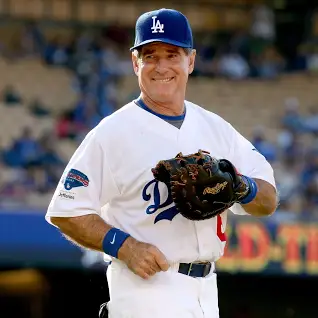
Why is Steve Garvey running for Senate?’

McClatchy News Service is asking the question. The answer is he needs a job. He has name recognition and baseball fans love their favorite players even if they have been long gone from the sport.

Garvey played four seasons for the Dodgers and one more with the San Diego Padres. All that ended in 1987.

What has he done since then? It appears the answer is nothing.

Garvey has made a living as a motivational speaker, local radio show host, celebrity endorser, sports commentator and founder of a marketing firm. At one point, his speaking fee was listed as $25,000.

His February 2024 federal disclosure form, required of all Senate candidates, shows he has income from four sources.

They include GEP Talent of Burbank, Fox News, the Topps Company and IPG DXTRA of Omaha. He lists Topps and IPG DXTRA as paying him for memorabilia signings and “corporate entertainment.”

To political strategists, Garvey had potential as the latest in a line of California celebrities with no need to explain who they were to a constituency smitten with fond memories of their triumphs.

Garvey, the thinking went, could be another George Murphy, the song-and-dance man who won a Senate seat in 1964, or Ronald Reagan, the TV and movie star first elected governor in 1966 and president in 1980. Or more recently, Arnold Schwarzenegger, the Terminator turned governor, the last Republican to win statewide in California.

Recently, Garvey has been actively tweeting, though he offers few concrete solutions to issues he raises.

“Unaffordable gas prices are hurting Californians’ quality of life every day. I see people putting $10 in at the pump instead of 10 gallons. Join my campaign if you believe California deserves better,” he said in a post on X April 5.

“I am driven by a commitment to every Californian’s dream for a better tomorrow. Let’s move onward together,” he said in another X post.

His speeches are filled with baseball references, stretched to show that he’s not tied to ideology. Just the nice guy who Californians cheered and celebrated on the ballfield.

“In a federal position like U.S. Senate you can get those answers. On that stage, on that platform, I’ll get answers,” Garvey said.

He had nothing specific.
California Alone is the Fifth Largest Economy in the World

It is accurate to say that California is a challenging place to live if you are not a millionaire. It is very difficult for median income families.  Median household income for California was $67,739 in 2016. Housing costs are among the highest in the nation. Gasoline is currently averaging $3.63 a gallon for regular. That gasoline price is matched only by Hawaii.

Despite those challenges California’s gross domestic product is only surpassed by the entire United States, China, Japan, and Germany.

The reason for this situation is the multiple economic engines.

-Silicon Valley: the area south of San Francisco is the home of Facebook, Alphabet previously known as Google, Hewlett-Packard, Oracle, Intel, Cisco Systems, Nvidia, Netflix, Tesla, and many less known tech companies.

-Hollywood: Really all of Los Angeles is the television and movie entertainment capital of the world. CBS, NBC Universal, Disney, Paramount, Sony, and Warner Brothers are all in metropolitan Los Angeles.

-Tourism: According to the Los Angeles Tourism & Convention Board, 48.3 million tourists visited L.A. in 2017, an increase of more than 2 percent over 2016 and the seventh consecutive year of record-breaking results. The total number of visitors to San Francisco last year rose 2.3 percent to 16.9 million.

-Import and Distribution: The two largest ports in the United States are Long Beach and Los Angeles. 40% of all goods imported enter through those two ports. They are then moved to distribution warehouses in Los Angeles, Riverside, and San Bernardino.

-Agriculture: California produces a sizable majority of many American fruits, vegetables, and nuts: 99 percent of artichokes, 99 percent of walnuts, 97 percent of kiwis, 97 percent of plums, 95 percent of celery, 95 percent of garlic, 89 percent of cauliflower, 71 percent of spinach, and 69 percent of carrots (and the list goes on. California is the leading US state for cash farm receipts. I have seen California strawberries in Toronto Canada.

-Manufacturing: Manufacturers help to drive California’s economy, with $142.39 billion in manufactured goods exports in 2016.

These are the reasons that nearly 40 million people see the state as the heart of economic opportunity.

‘Godzilla El Nino’ May Be Coming to California – a Big Maybe

There have been a total of eight seasons beginning in years (1952, 1953, 1958, 1969, 1976, 1977, 2004, 2006, 2013) classified as “weak” El Niños, eight years (1951, 1963, 1968, 1986, 1991, 1994, 2002, 2009) as “moderate”, four years (1957, 1965, 1972, 1987) as “strong” and two years (1982, 1997) as “very strong” El Niños.

Of the 10 costliest flood years in California since 1950, only four happened during a season when there was an El Niño. Two others occurred during seasons with La Niña, and the final four were when the temperature of the tropical Pacific was near normal.

I have been collecting rain measurement in my backyard since the beginning of the 1997 El Niño year. That year the rain accumulation was 48.3 inches in my backyard. That was the highest annual total since I started collecting data. However the highest single 24 hour period was March 11, 2011. In that year rainfall amounted to 26.2 inches of rain.  Heavy rain that previous December, 2010 totaled more than 9.6 inches and the news media called the heavy rain a “pineapple express.” That was not declared an El Niño year.

The annual rain fall in southern California is so erratic that averages are worthless. They predict nothing. The year following the 26.2 inches only 13.6 inches fell.

Let’s not hold our breath. We should plan for the worst. In other words plan for drought and hope for more rain.

American Madness – Right Wing Style

Following is PBS listing of the top 10 positions of Senator Ted Cruz who announced his candidacy for president today.

The Budget and debt: Mandate a balanced budget.

Cruz supports a Constitutional amendment mandating that Congress pass a balanced budget. He argues that this is the best way to cut down deficits and the debt.

Corporations: Slash corporate tax rates to 15 percent. End some programs like the Export-Import bank and federal subsidies for renewable fuels.

Common Core: End it.

Immigration: Block any current effort that lets undocumented immigrants legally remain in the U.S.

The Internet: Do not tax access to the Internet and block “net neutrality.”

Obamacare: Repeal it.

Social Issues: States should be allowed to define “marriage” and set strict abortion limits.

Taxes and the IRS: Move toward a flat tax and abolish the IRS.

Iran: Increase and toughen sanctions. End current nuclear talks until Congress approves the outlines of a deal.

Islamic State: Don’t send U.S. ground troops, yet.

Meanwhile there is an initiative proposal being circulated for signature in California that calls for the state to secede from the United States.  it will take just 365,880 signatures for an initiative to be placed on the ballet in 2016.

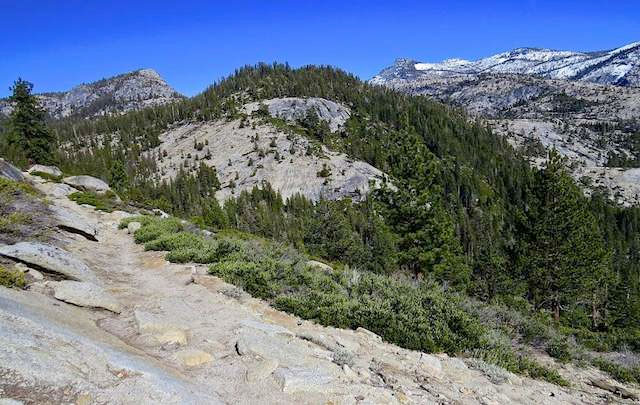
Uh oh: Yosemite. 8,100 feet. February. No snow

The Los Angeles station of the weather service tweeted that the hamlet of Sandberg, in the Tehachapi Mountains of LA County on the old Ridge Route, is sixteen degrees above normal for February. While Los Angeles receives its water from the Eastern Sierra, San Francisco receives its water from the Hetch Hetchy system that has its source in Yosemite National Park.

Yosemite at 8,000 feet

The National Weather Service station up in Hanford, CA posted this photo on February 19.

The Los Angles DWP has not put the city on water rationing but perhaps they should start that now.

Snow Pack

Spend Today – Let Tomorrow be Someone Else’s Problem

I am exhausted by government mismanagement.  It’s not about Obamacare.  It’s about foolish spending at the state and local levels.

Here in California the EDD (Employment Development Department),  that is the department that pays unemployment insurance, they decided to implement a new computerized check paying system.  California paid Deloitte Consulting $62 million to develop EDD’s new computer system.  An estimated 148,000 people have experienced delays of up to four weeks in receiving their payments due to computer glitches.

The Los Angeles DWP implemented a new billing system in October of this year.  Thousands of people received bills that were double their normal charges.  Some received bills one half their normal charges.  When those receiving incorrect overcharges refused to pay they were threatened with shutoff notices.

A retired DWP construction worker volunteered his retirement benefit to me, $6,000 per month.  Stunned, I said nothing.  The DWP has a powerful union.

Meanwhile Chicago officials, as they often do, turned to borrowing to relieve the financial pressure. This time they used taxable bonds with high interest rates, making the ultimate price tag even bigger.  A $12 million bill related to disabled parking will be paid off in 2039 for at least $30 million.  The Chicago Tribune found that the mayor’s boasting of tough choices amounts to selling taxable bonds to cover day-to-day expenses.  Long after he is gone the bill for retirement benefits will come due.  With a declining population (in the 1950s it was 3.5 million people, today the population is 2.5 million) this city may be the next Detroit.