10 states most at risk for major disasters

Oklahoma tornado

Surprisingly Oklahoma is not the number one state for disasters according to the Federal Emergency Management Agency (FEMA).  Oklahoma came in at number 3.

10. Missouri

The Show-Me State has been shown disastrous weather in every month of the year: severe snow and ice storms in winter, tornadoes during the spring, summer and fall, and flooding at virtually any time.

Major disaster declarations since 1953: 53

9. Arkansas

Arkansas has been walloped by heavy rain, snow, ice, tornadoes and flooding over the years and has even taken poundings from tropical storm systems, though it’s not a coastal state. In 2008, storms and tornadoes associated with Hurricane Gustav littered streets with debris, damaged buildings, roads and bridges, and knocked out electric cooperatives.

Major disaster declarations since 1953: 54

8. Kentucky

The disaster roster in Kentucky has included landslides, mudslides and rockslides, along with flooding and tornadoes. The state was ripped up in 2008 by the remnants of Hurricane Ike. Another major disaster declaration involved a record snowfall in late 2004, and yet another stemmed from a 1981 series of chemical explosions in the Louisville sewers.

Major disaster declarations since 1953: 56

7. Alabama

This Gulf Coast state has been battered by hurricanes, including Isaac in 2012, Gustav in 2008, Katrina and Dennis in 2005, and Ivan in 2004. But tornadoes in April 2011 rivaled the hurricanes for destructive power, lashing the state with winds that exceeded 210 mph and leaving about 250 people dead and an estimated $1.5 billion in damage.

Major disaster declarations since 1953: 57

6. Louisiana

It has taken Louisiana years to recover from Hurricane Katrina, the now-legendary 2005 storm that government officials say killed nearly 1,000 residents and caused tens of billions of dollars in damage. The Gulf state has been visited by numerous hurricanes including 1969’s Camille, a Category 5 storm that came ashore with 190 mph winds. By comparison, Katrina was “only” a Category 3 on the wind scale.

Major disaster declarations since 1953: 60

5. Florida

The Sunshine State has been pummeled by dozens of tropical storm systems since the 1950s — none worse than Hurricane Andrew in 1992. The Category 5 hurricane with gusts of more than 200 mph held the title as the most expensive natural disaster in U.S. history until Hurricane Katrina in 2005. Severe freezes have been disastrous for Florida farming on multiple occasions.

Major disaster declarations since 1953: 65

4. New York

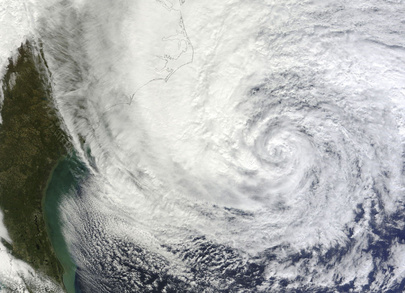
Across its empire that stretches from the Great Lakes to the Atlantic coast, New York has been lashed by everything from blizzards to tropical storms. In 2012, Superstorm Sandy killed nearly 50 in the state and caused more than $40 billion in damage. New York also received disaster declarations for the Sept. 11, 2001, terrorist attacks that destroyed the World Trade Center and an earlier bombing in the complex’s garage.

Major disaster declarations since 1953: 67

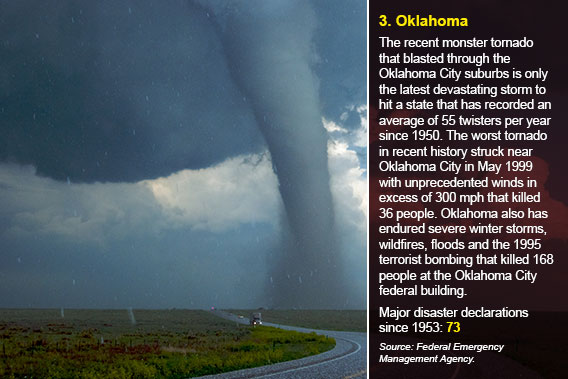
3. Oklahoma

The recent monster tornado that blasted through the Oklahoma City suburbs is only the latest devastating storm to hit a state that recorded an average of 55 twisters per year since 1950. The worst tornado in recent history struck near Oklahoma City in May 1999 with unprecedented winds in excess of 300 mph that killed 36 people. Oklahoma also has endured severe winter storms, wildfires, floods and the 1995 terrorist bombing that killed 168 people at the Oklahoma City federal building.

Major disaster declarations since 1953: 73

2. California
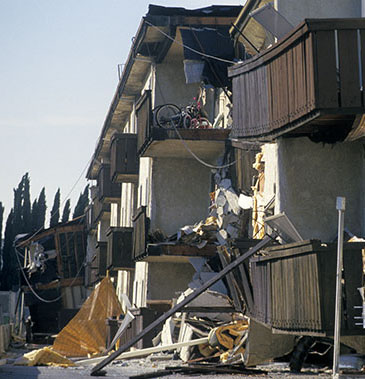
Northridge Earthquake Apartment Building

Apartment house damage from 1994 Northridge Earthquake

The nation’s most populous state also is one of the most disaster-prone thanks to wildfires, landslides, flooding, winter storms, severe freeze and even tsunami waves. But earthquakes are the disaster perhaps most closely associated with California. The worst in recent years have included a magnitude-6.9 quake near San Francisco in 1989 that killed 63 and a magnitude-6.7 quake in Southern California in 1994 that killed 61.

Major disaster declarations since 1953: 78

1. Texas

Within Texas’ nearly 267,000 square miles (second only to Alaska in size), at least one major disaster is declared nearly every calendar year. The Lone Star State has dealt with tornadoes, floods, wildfires and fairly frequent coastal hurricanes. One of the deadliest and costliest in recent decades was Hurricane Celia, which tore up Corpus Christi in 1970. The storm left 13 dead and destroyed millions of dollars’ worth of property.

Major disaster declarations since 1953: 86
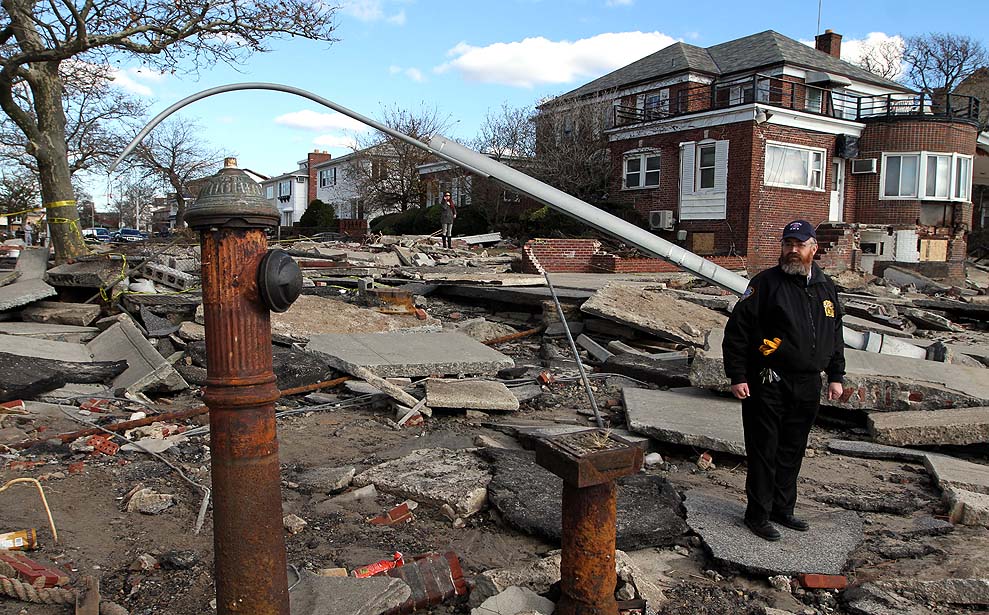
One More Reason There is a Federal Government

Those in the path of Hurricane Sandy should be grateful that Mitt Romney was not elected president.  Last year Mr. Romney pledged that if elected he would shrink the deficit by axing FEMA and handing the responsibility of disasters over to the states and local governments.

During a CNN debate at the height of the GOP primary, Mitt Romney was asked, in the context of the Joplin disaster and FEMA’s cash crunch, whether the agency should be shuttered so that states can individually take over responsibility for disaster response.

“Absolutely,” he said. “Every time you have an occasion to take something from the federal government and send it back to the states, that’s the right direction. And if you can go even further, and send it back to the private sector, that’s even better. Instead of thinking, in the federal budget, what we should cut, we should ask the opposite question, what should we keep?”

“Including disaster relief, though?” debate moderator John King asked Romney.

“We cannot — we cannot afford to do those things without jeopardizing the future for our kids,” Romney replied. “It is simply immoral, in my view, for us to continue to rack up larger and larger debts and pass them on to our kids, knowing full well that we’ll all be dead and gone before it’s paid off. It makes no sense at all.”

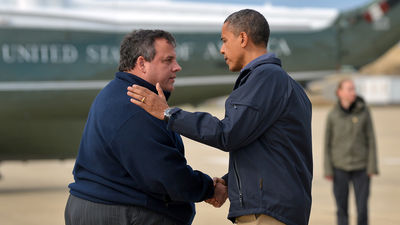
The Los Angeles Times is reporting today that New Jersey Governor Chris Christie is planning to ask the federal government to pay 90% of the associated costs.  Those costs are estimated to be in the billions of dollars.  They are already at $20 billion.  New York officials have indicated they will seek more than $30 billion in federal aid.

It is unlikely that any state could handle the costs of devastating climatic or geological occurrence.  Think Hurricane Sandy, Hurricane Katrina, and the Northridge Earthquake.

If we are the United States we come together to help those in need.  This is just one of the many reasons Americans re-elected Barack Obama.

Japan’s Technology is Impacting the World

Bloomberg Businessweek sells advertising that looks like its columns.  Companies and countries use this methodology to promote their business friendly atmosphere.  The sections are clearly marked as “advertising section.”  In one edition the United Arab Emirates bought pages that promoted the business opportunities in those nations.  The information was presented in a format that leads readers to believe the articles were being presented by the magazine.  The font sizes and the presentations give the appearance that they are indeed being presented by the magazine publisher.

In the October 22, 2012 edition there was a 13 page presentation that was sponsored by Japanese companies.  It is impressive and informative.  It makes me realize how far other counties have developed compared to the United   States.  The article is long but is worth your time.  I was especially impressed by the fact that a Japanese company is updating the British railway system.  Another has developed quick set up homes for people who have been displaced by natural disasters (think the homes damaged by Hurricane Sandy).

Following is very abridged version of the article with significant statements in bold text.

A new market for Japanese rail technology is the U.K., the original home of railways. Hitachi Ltd. has formed a consortium with a British company to supply a total of nearly 600 high-speed rail carriages, and the supporting maintenance infrastructure, starting delivery in 2017. The Hitachi Super Express trains will be manu­factured in a newly built factory in the north of England. The total value of the project. including the maintenance and repair centers to be constructed throughout the U.K., is estimated at between ¥400-¥500 billion ($5.1-$6.3 billion).

These new trains will replace the U.K.’s aging Intercity fleet on the East Coast Main Lines and the Great Western Main Lines. The lightweight construction of the trains (between 15 and 40 percent weight reduction per seat) lowers energy consumption of the bi­mode units, and this light weight also helps reduce the travel time for the growing number of passengers on the routes where these trains will be operated.

High-speed shelters

Following the Great East Japan Earthquake, over 340,000 people were displaced, with most taking refuge in emergency shelters, such as school gymnasiums, until more permanent housing could be arrangec for them. The lack of privacy for extended periods (blankets or tempo­rary cardboard partitions were often the only divisions between family groups) caused severe additional emotional stress to many survivors.

Photo was scanned from Businessweek

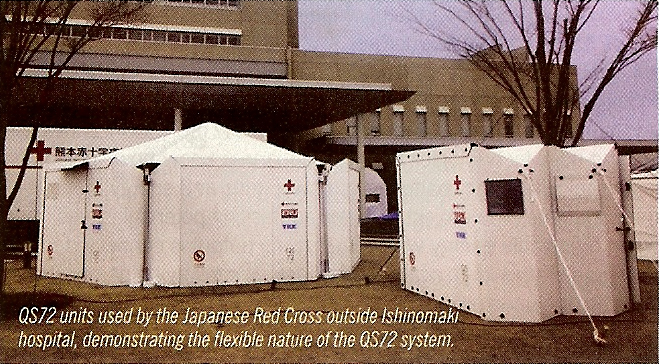
Accordingly, a need was perceived for lightweight flexible structures that can be quickly transported and erected to provide such spaces. Enter the QS72 from Daiichikensetsu Ltd., with “QS” standing for “Quick Space” and “72” representing the number of hours within which such components can be deployed to provide floors, walls and roofs for meeting rooms, emergency clinics, toilets and other areas, in the time when disaster survivors are at their most vulnerable psychologically.

Constructed of polypropylene, the system requires only a few people and no tools to assemble. Using a lightweight construction method providing thermal insulation, the units can be linked together in a variety of ways to serve various needs of a displaced community. The basic construction recalls the principles of origami in the way the different parts fold and unfold to create the spaces. A single unit can temporarily accommodate a small family until more permanent accommodations can be arranged and constructed. Following this, the unit can be combined with others and reused as a community space, for example, or a store or medical center. Indeed, following the March 2011 quake, 100 units were donated to the Japanese Red Cross, and used as general purpose structures in lshinomaki, supplementing the existing hospital facilities.

Keeping in touch during disasters

A key issue following a disaster is the effective dissemination of information. Making use of one of the best IT infrastructures in the world, the Japanese government has developed Disaster Guide­lines and Action Plan for IT, with a twopronged emphasis on the preservation of life and the well-being of the survivors.

First, the safety of inhabitants of the affected area, and the status of emergency services, is confirmed. Following this immediate response, the system changes to provide information to survivors about vital infrastructure elements (utilities, communications and transportation). The rapid growth of smartphone use in Japan al­lows for rapid and easy sharing of information. Already, earthquake early-warning systems are incorporated into the cellular network, and internet sites designed for smartphones are planned that will allow parents to check on the safety of their children at school, as well as to use the newly developed J-anpi system to check on others’ safety and reassure friends and family of their own.

Lessons learned from the March 11 disaster that have been incorporated into the plan include the use of alternative channels (websites, email and social network services) beyond the usual emergency number. These channels can also disseminate information, using cloud services to ensure continuity of service, and supplement radio and TV broad­casts. The Prime Minister’s Office also operates a Twitter account, allowing the government to “push” up-to-the-minute information to millions of smartphone users.

In the event of future disasters, Japan hopes to save lives, and to improve the lives of survivors through such implementations of technology, and to share these techniques and technologies with other nations. – H.A.

Americans Can Come Together

Can Americans come together when there is a major tragedy?  The answer is yes!  Whether it was the Oklahoma Federal Building bombing or the 9-11 terrorist attack we did come together.

On January 17, 1994 Los Angeles was hit with a 6.7 magnitude earthquake.  Unfortunately there are no warnings to help prepare for the event.  The National Weather Service did an excellent job of warning the East Coast of the Sandy Hurricane and ensuing storm.

In both instances the Federal government came to the aid of the people who were impacted.  Houston did open its doors to those who lost their homes in Louisiana after the devastating floods caused by Hurricane Katrina. These events prove that Americans can come together to support those in need.

My problem with Americans is that they want to put politics ahead of logic and reason in so many instances.  So we have these two political parties that behave like mad dogs.  One party suggests a solution to a problem and the other will reject it even if it is worthwhile.  Proof? Richard Nixon proposed a health care plan similar to Obamacare but the Democrats rejected the idea.  Forty years later the GOP staunchly opposes that very same plan.

We need new behavior from our politicians.  My forecast; Unfortunately it’s not coming any time soon.