There is a value to mergers. They make companies larger and more powerful. The likely outcome is more revenue and higher net income. It is a share holders dream.
Historically the United States has taken the position that large mega companies that control an industry are not in the best interest of America. The Sherman Antitrust Act was passed into law July 2, 1890. The purpose was to prohibit monopolies. The most infamous of the trusts was the Standard Oil Trust, which was formed in January, 1882. At that time, Standard Oil and its affiliates controlled more than 90 percent of the oil refining capacity and most of the oil marketing facilities in the U.S. The trusts came to dominate a number of major industries, and were, in effect, monopolies.
This ground breaking piece of legislation was the result of intense public opposition to the concentration of economic power in large corporations and in combinations of business concerns (i.e., trusts) that had been taking place in the U.S. in the decades following the Civil War. Opposition to the trusts was particularly strong among farmers, who protested the high charges for transporting their products to the cities by railroad.
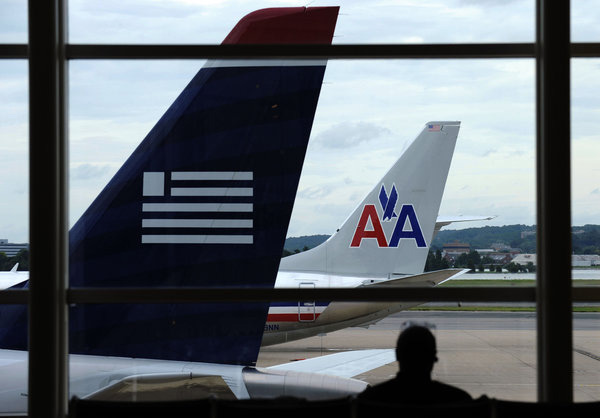
So what do you suppose would happen if most of the airlines were consolidated into one carrier? There would be no reason to control the charges that the airline could impose. Even now the number of airlines has declined in the United States. There were nine major national airlines as recently as 2005, but only five remain today. American Airlines has acquired four other air carriers since 1971. The largest was TWA in 2001.
Continental Airlines merged with United Airlines 2010 to 2012. They retained the United Airlines name.
Between 2008 and 2010 Delta Airlines absorbed Northwest Airlines.
See a more complete list here.
What has happened to the cost of flying? The airlines have added numerous fees to hide the increased cost of air travel. Now there is a fee to check a bag. A fee for food (even chips or soft drink). Want to watch a movie? There is a fee. Some airlines are even charging extra for aisle seats.
So what do you expect the fares to be once this merger is completed? The average cost of a roundtrip domestic ticket — including baggage and reservation change fees — grew to $378.62 last year, up from $351.48 in 2008, when adjusted for inflation according to a report from the Associated Press.
Just imagine the cost of other items if there was little or no competition. Bank fees have increased simply because there is less competition. AT&T and Verizon dominate the telecommunications industry just as Time Warner and Comcast dominate the television service industry.
The justice department is finally stepping forward to protect consumers. Let’s hope this is the first of many more actions to protect consumer interests.
 Coast Contact