
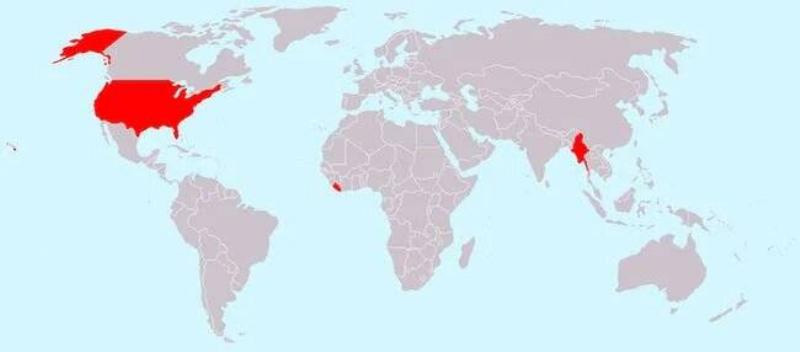
There are only three countries in the world that use the English system of weights and measures. It was called the British Imperial System.
Most common are the weight in the pound divided into 16 ounces (oz) and the ounce into 16 drams.
The basic unit of length is the yard (yd); fractions of the yard are the inch (1/36 yd) and the foot (1/3 yd), and commonly used multiples are the rod (5 1⁄2 yd), the furlong (220 yd), and the mile (1,760 yd). The acre, equal to 4,840 square yards or 160 square rods, is used for measuring land area. For liquid measure, or liquid capacity, the basic unit is the gallon, which is divided into 4 quarts, 8 pints, or 32 gills.
The three countries still on the English system – the U.S., Liberia and Myanmar – still (mostly or officially) stick to the imperial system.
The rest of the world has adopted the metric system and there is a reason. It functions like the decimal system much like the United States dollar. Ten pennies equal a dime. Ten dimes equals a dollar.
We just bought a new trash can that came in a box marked “10 L.” Further examination I determined it has a 10 liter capacity. We also buy 2 liter bottles of soda (pop).
The biggest reasons the U.S. hasn’t adopted the metric system are simply time and money. That is the excuse that is provided by Encyclopedia Britannica and repeated on other internet sites.
None of these countries did not offers excuses. They simply made the switch including Great Britain (United Kingdom) at the end of 1994 under a directive of the European Union.
There is a US Metric Association but it was founded in 1916. As the United States has become ever more reliant on goods from other countries. That new trash can says the USA will join the world on weights and measures.
(In the US) Why is soda sold in liters while milk and other drinks sold in gallons? By coincidence, the large plastic soda bottle was invented right around the time that the US was seriously flirting with a conversion to metric. So it was introduced in a 2 liter size instead of a half gallon size. My 16.9 FL. OZ. bottle of water is 500 ml.
Metric is coming to America. It’s not a plot and it’s not part of an invasion.
 Coast Contact